Seasonal Sightings: October 2025

October has a bit of everything. Sought-after songbird migrants are still trickling through until at least mid-month, while waterfowl, raptor, and sparrow numbers are building. It is usually a little less dynamic than September, but it is undeniably a great time to be in the field, and the weather is usually pleasant as the fall progresses. Turning to unexpected finds, a Surf Scoter was seen at the Woodland Wastewater Treatment Plant (WWTP) on 10/27, and, while hardly unexpected at this point, the female Costa's Hummingbird first found at a private yard in Wilton in August of 2024 has continued for more than a year. A Common Poorwill was seen on 10/19 during the Tall Forest survey at Cosumnes River Preserve, while another was found at Folsom Point, Folsom Lake, on 10/24. A Black Swift was a nice surprise on 10/3 along the American River Parkway (ARP), near the Mayhew Drain.

Exceptional shorebird reports may well be the theme of 2025, and things didn't slow down this month. Two Pacific Golden-Plovers were seen at the WWTP early in the month, with one continuing for most of the month. At Beale Air Force Base, there were seven Mountain Plovers on 10/20 and a single on 10/21 (eBird Checklist S280703219); and there were up to 11 along Flannery Rd, south of Dixon, beginning on 10/25. An Upland Sandpiper photographed on 9/22 from Knight's Landing was missed during last month's compiling of records. This is an extremely rare wanderer to California. Up to three Hudsonian Whimbrels (as they are now known since the species was split from the Eurasian populations), which are quite rare in the region outside of spring migration, were found at the WWTP during the first half of the month. A first Sacramento County record of Hudsonian Godwit was photographed (eBird Checklist S277704909) on Tyler Island, a Delta island south of Walnut Grove, on 10/6. The Ruff found at the WWTP on 9/28 continued to the end of October. Another was reported at the Yolo Bypass Wildlife Area on 10/25-10/31. Pectoral Sandpipers were widely seen in the region, with up to 18 on a single visit reported at the WWTP. A Parasitic Jaeger was an excellent find at Beals Point, Folsom Lake, on 10/17. Additional WWTP notables included a Sabine's Gull on 10/6 (eBird Checklist S277741481), the continuing Lesser Black-backed Gull, and a Common Tern from 10/6 through 10/15.

A Yellow-bellied Sapsucker was an excellent find at Slide Hill Park in Davis on 10/28 (eBird Checklist S281950018), continuing into November. A Tropical Kingbird was found at the EchoWater Facility (formerly the Sacramento Regional WTP) on 10/23 (eBird Checklist S280981827 and eBird Checklist S281005202), accounting for the fifth Sacramento County record and the second for the property. A Sage Thrasher was found on 10/13 along Meiss Rd, and a Grasshopper Sparrow was found on 10/22, very late in the season for this species, at the South Fork Putah Creek Preserve to the south of Davis. A Sagebrush Sparrow photographed (eBird Checklist S279775939) along on Meiss Rd on 10/16 was quite a surprise and one of very few records for the region. A Vesper Sparrow was photographed near the intersection of Yolo County Rds 38 and 106 on 10/10, with another along Meiss Rd on 10/25. There were no rare warblers found this month, but a Rose-breasted Grosbeak was a nice discovery along ARP near the Mayhew Drain on 10/3.

The Sacramento Area as covered here lies between Hwy 20 to the north, Hwy 12 to the south, and the 1000-foot contour to the east and west, plus all of Sacramento and Yolo counties. Many reports first appeared on the Central Valley Bird Club listserv (groups.io/g/centralvalleybirds) and in eBird (ebird.org). It is impossible to list everyone, but we thank the following for their reports: Lyann Comrack, Chris Dong, Konshau Duman, Lynette Williams Duman, Andy Engilis, Gil Ewing, Stephen Fettig, Joshua Greenfield, Cliff Hawley, Marcel Holyoak, Emmett Iverson, Julian Johnson, Jeri Langham, James Laughlin, Andrew Lee, Mark Martucci, Collin McKahin, Gary Mele, Roger Muskat, Michael Perrone, Zane Pickus, Linda Pittman, Ron Pozzi, Mark Sawyer, Samuel Schmidt, Steve Scott, Sean Smith, Gavin Stacey, Drake Stallworth, Kevin Thomas, and John Trochet. Thanks to everyone for their reports--without them, this column would not be possible.

- Chris Conard

More Seasonal Sightings

Support American River Trees

Please see this important message from American River Trees:

Come support American River Trees (ART) at the court hearing!

On Friday, November 7th, attorneys for American River Trees (ART), Save the American River Association (SARA) and the Center for Biological Diversity (CBD) will be presenting our case to secure a court ordered injunction to prevent the defendants, the U.S. Army Corp of Engineers, Central Valley Flood Control Board, and or any of their assigns from removing vegetation or trees on the American River Parkway for Contracts 3B and 4B, until the complaint is settled.

This is not a public hearing, only attorneys will be speaking. However, a full courtroom will demonstrate the public's opposition to the proposed design plans and show support for designs and construction techniques that are less destructive to the habitat. The courtroom gallery seats approximately 40 people.

Please dress professionally and be courteous (no signs, shouting, or chanting). We expect that some US Army Corps staff will attend in military attire.

WHEN:
Friday, November 7, 2025 at 1:30 pm
Plan to arrive by 1 pm so you can clear security. We expect that the hearing will last 1-3 hours but is up to the court’s discretion. There is a small café on the 2nd floor where you can purchase drinks and snacks.

WHERE:
Robert T. Matsui Federal Courthouse*
501 I Street, Sacramento, CA 95814
Courtroom 10, 13th Floor
Judge Dena Coggins

*Be prepared for security screening similar to airports. You will need to show identification.

Parking options:
Metered street parking
Sac County Garage, 725 7th St, 95814
City Hall Garage, 1000 I St, 95814
AMTRAK Station Parking, 401 I Street, 95814

What’s the lawsuit all about?

Read (or skim) the request for a Preliminary Injunction filed by ART on October 3rd to legally prohibit the Army Corps of Engineers, the Central Valley Flood Protection Board and the National Park Service, and their contractors and assigns from “undertaking any ground or vegetation disturbing activities—including site preparation, vegetation removal and tree felling—within the Project area” as part of the unnecessarily destructive American River Contract 3B Erosion Control project.

Read (or skim) the legally filed Complaint to see all the components of the Contract 3B Erosion project that ART is challenging. These include violations of the National Environmental Policy Act, the California Environmental Quality Act, the federal Wild and Scenic Rivers Act and the California Wild and Scenic Rivers Act.

You can also visit AmericanRiverTrees.org for additional project information.

Please continue to help us keep an eye out for any signs of tree removal or construction activity on the Parkway, especially on the north side of the river, east of Howe Ave and on the south side of the river, east of the Watt Ave bridge. Look out for signs such as tree marking, ground marking, fence installation, equipment presence, contractors, etc.

If you spot any potential activity, please an email to americanrivertreesupdates@gmail.com. Include a description of the location, what you observed, and pictures, if possible.

 Thank you to all who have donated to help get the lawsuit started! Additional funds are still needed to support our ongoing legal efforts.

If you haven’t donated yet, or would like to donate again, please donate here. Donations are made to the Save the American River Association (SARA) for the ART Fund. SARA is a 501(c)3 non-profit organization, and your donation is tax-deductible.

Field Trip Findings for September 11 - October 5, 2025

SAS Field Trip: Mississippi Bar on Lake Natoma, 9/11/25

Leader Nicole Barden reported: On this overcast morning a group of 17 birders, including 6 young birders between the ages of 4 and 12, met at the Shadow Glen Riding Stables for a walk at Mississippi Bar along the Shady Trail. From the parking lot we had a flock of White-throated Swifts and a single male Phainopepla fly over our group. The trail we took passed by the horse stables, along the edges of grasslands, and eventually a gravel road that led to Lake Natoma, where we then took the Shady Trail back. The vegetation seen was mostly dried grasses and Oaks, with Cottonwoods, Elderberries, and Poison Oak mixed in, among other species. Throughout our trip we had good looks at common birds including Acorn Woodpeckers, Mourning Doves, California Towhees, European Starlings, Lesser Goldfinch, Oak Titmouse, and White-breasted Nuthatch. At one point along the walk, we had quick looks at a kestrel above the canopy, that we were sadly unable to re-find. Everyone in our group had really good looks at Rufous-crowned Sparrows—we saw at least 3 individuals. The highlight for me was finding a beautiful Townsend’s Warbler bouncing around in an oak tree near the end of our adventure. In total, we had 27 species and our eBird list from the day can be seen here: https://ebird.org/checklist/S273448806

SAS Field Trip: Putah Creek Riparian Preserve, 09/13/25

Leader Sonja Sorbo reported: Migration is in full swing, and Putah Creek is a great place to view birds on their way to points south as well as year-round residents. Our group of 10 people enjoyed a gorgeous summer morning, tallying 44 bird species. Standing in the parking area, we logged a half a dozen species including Yellow-billed Magpie, Mourning Dove, Northern Mockingbird, Red-winged Blackbird, Bushtit, California Scrub-Jay, Barn Swallow, American Crow, Common Raven, White-breasted Nuthatch, and a flyover of about 70 White-faced Ibis. After dropping down from the parking area to the trail, we had barely walked 20 yards when we began hearing warbler “chips” all around us. Nearby oak trees were a hub of activity, harboring Yellow and Wilson’s Warblers and House Finches. Not to be ignored, a Western Tanager called loudly. A few American Robin swooped around.

A bit farther west on the trail, a Belted Kingfisher zipped downstream, looking for a morning snack. It passed under two Red-shouldered Hawk who entertained us with some aerial acrobatics before landing on branches in beautiful light, much to the delight of our two camera-toting birders. The photographers also got great shots of a Black-headed Grosbeak, a Warbling Vireo, and a Western Flycatcher, clinching the birds’ identities.  Woodpeckers seemed to be everywhere; we achieved a “grand slam” of Acorn, Nuttall’s, Downy, Northern Flicker and…… Lewis’s!!! The Lewis’s was first spotted perched across the creek in Solano County but it breached Yolo County airspace as it flew northwest, so we could add it to the Yolo list. Shortly thereafter, we were privileged to see a Great Horned Owl perched across the water in Solano County, seemingly unfazed by 10 two-legged admirers. (It got its own Solano County eBird list!). When we could tear our eyes away from views of Yellow Warblers, we looked upward and were able to find a pair of Red-tailed Hawk circling, the ubiquitous Turkey Vulture, a Cooper’s Hawk, Cedar Waxwings, and a Great Egret flyover. A Western Wood-Pewee sat silently on a snag, watching seven or eight Western Bluebird fight over who got to sit on top of a metal post. Several species were heard but skulked around unseen, including California Towhee, Blue-gray Gnatcatcher, Bewick’s Wren, and House Wren.

SAS Field Trip: Nimbus Fish Hatchery, 09/13/25

Leader Molly Shea reported: The recent bird walk at the Nimbus Fish Hatchery went swimmingly! Things are becoming more active along the American River with sightings of Belted Kingfishers, Spotted Sandpipers, Common Mergansers, and more! We weren't restricted to just birds either -- within 30 minutes of starting the walk, we saw a family of river otters playing in the water. A delight! Our group collectively identified a juvenile Yellow Warbler after much discussion and admired the tenacity of the Black-crowned Night Herons that had snuck into the hatchery raceways hoping for a tasty snack. While looping back to the hatchery on the bike path, many cyclists were curious to know what we were looking at and we happily shared, "BIRDS!" We rounded out the trip with a sighting of a juvenile Bald Eagle soaring overhead. 

SAS Field Trip: Seasonal Transitions at the Bufferlands, 9/14/25

Leader Chris Conard reported: We had a nice morning with a group of 20, focused early on riparian habitat and switching to shorebirds for the last hour. We saw a distant Osprey, an active group of three juvenile Cooper's Hawk chasing around, and two lingering Swainson's Hawks. Two Lincoln's Sparrows were the first detected on the property for the season. We saw an Orange-crowned Warbler, a dozen Common Yellowthroats, a few Yellow Warblers, a couple Wilson's Warblers, and a few Western Tanagers--many of the migrants were heard and viewed fleetingly. Two apparent family groups of lingering Blue Grosbeaks were a nice surprise along with a couple of Lazuli Buntings. Switching to shorebirds, we had a possible family group of four Spotted Sandpipers. We then found a continuing Solitary Sandpiper as well as a continuing Baird's Sandpiper among the more expected species.

SAS Field Trip: Napa-Sonoma Marshes WA—Huichica Creek Unit, 9/16/25

Leaders Amy McDonald and Nancy Gronert reported: Six enthusiastic birders showed up at Napa-Sonoma Marshes Wildlife Area at the Huichica Creek Unit for a beautiful, sunny, mostly windless day. Birders observed the usuals: Loggerhead Shrike, House Finches, Black Phoebes, Savannah and Song Sparrows, a heard only Virginia Rail, Double-crested Cormorant, many White Pelicans, Snowy and Great Egrets, White-tailed Kites, Northern Harriers, a Red-shouldered Hawk, Marsh Wrens, Western Bluebirds and Red-winged Blackbirds. Birders had close looks at a Great Horned Owl perched over the path. Thousands of peeps, hundreds of Least Sandpipers huddled on downed trees very close at high tide, and many other shorebirds quite a distance across mudflats: American Avocets, several Semipalmated Plovers, Black-necked Stilts, a Marbled Godwit, Greater Yellowlegs, Red-necked Phalarope, Dunlin, and a dowitcher. Incoming winter birds included a Say's Phoebe, Yellow-rumped Warblers, Northern Shovelers and some gulls. 

SAS Field Trip: William Pond Park, 09/20/25

Leader Mark Martucci reported: 16 birders detected 49 species of birds on an early morning walk along the American River Parkway. Migration was very slow with only 3 species, 1 Western Tanager (heard only), 2 Yellow Warblers, and 1 Black-throated Gray Warbler. Early returning wintering birds were Cedar Waxwings, Yellow-rumped Warbler, White-crowned Sparrow and Ruby-crowned Kinglet. Other notable birds included Lark Sparrow, Common Yellowthroat, Spotted Sandpiper and Yellow-billed Magpie.

SAS Field Trip: Teal Bend, 09/21/25

Leader Mark Martucci substituting for Leader Richard Barbieri reported: A small group of five detected 53 species of birds on a calm morning along Teal Bend Golf course. Migration was in full swing with over a dozen Yellow Warblers, three to four each of Wilson's, Orange-crowned and Black-throated Gray Warblers. Other migrants included Western Wood-Pewee, Western Flycatcher, and six Western Tanagers. Early winter arrivals were Cedar Waxwings, Lincoln Sparrow, and White-crowned Sparrows. A nice surprise was a flyover Long-billed Curlew.

SAS Field Trip: Point Reyes for Vagrants, 09/27/25

Leader Dan Williams reported: Wind dominated the storyline for our day at Point Reyes, but 7 of us persevered and managed to make a lovely day of it despite the unrelenting tempest. The difficulty opening our car doors upon our arrival at the Lighthouse immediately indicated that hopes of finding any of the rare warblers reported at the Point that week were likely scuttled. Nevertheless, we made the climb up the road from the Lighthouse parking lot through the bush lupines and cypresses and managed to find a few returning winter sparrows: "Gambel's" White-crowned, Golden-crowned, and Fox, in addition to the resident "Nuttall's" White-crowned and Song Sparrows. A Rock Wren was piercing the wind with its call close to the Lighthouse visitor center and a couple of Northern House Wrens called from the bush lupines. No warblers to be found.

Down the road at the Fish Docks, the wind was equally persistent. A few birders that were at this location earlier in the morning reported they had managed glimpses of the continuing Blackpoll and Black-throated Blue Warblers there, but those rarities did not make appearances for our group. We managed fleeting glimpses of one Black-throated Gray Warbler and otherwise settled for enjoying scope views of a snoozing Great Horned Owl, and the activity on Drakes Bay below which included several Common and Pacific Loons, and hundreds of Heermann's Gulls, Brown Pelicans, Brandt's Cormorants, and Elegant Terns. The loafing elephant seals also put on a nice show as did a trio of river otters along the rocky bay shore.

We continued on to Drake's Beach, with a brief stop at Mendoza Ranch Pond which yielded a newly returned Horned Grebe, and another quick detour at a pond near Historic D Ranch where a pair of Pectoral Sandpipers had landed after flying (or more accurately being blown) right across our windshield. In a flooded area just west of the Drake's Beach parking lot, a pair of Blue-winged Teal remained right where they had been reported all week, as well as a few Least and Western Sandpipers and a Snowy Egret. However, if the super rare Mourning Warbler was still present that had been there just the previous day, there was no way it was making an appearance with the ongoing gale.

Finally, we decided to give up on the Outer Point and head inland to bird the Inverness area and the Earthquake Trail at Bear Valley before heading home. The Inverness Tennis Club was very quiet with the exception of a few Chestnut-backed Chickadees, Acorn Woodpeckers, a Yellow Warbler, and a Pacific Wren. The Earthquake Trail proved to be our most productive passerine birding of the day, with more Chestnut-backs and Pacific Wrens, Band-tailed Pigeons, Pygmy Nuthatches, two Warbling Vireos, a Wilson's Warbler, a Townsend's Warbler, a Western Wood-Pewee, and a Swainson's Thrush. Somehow, despite our misfortune with the wind, we managed to see north of 80 species and as always had a great time in great company in one of the most beautiful places in California.

SAS Field Trip: Beginning Birder Walk, William Pond Park, 09/28/25

Leader Larry Hickey reported: On an overcast September morning at the William Pond section of the American River Parkway, 12 of us enjoyed a morning of birding. Yellow-billed Magpies were loud and perching together at the top of a bare tree, giving us excellent views. We also had excellent views of several Red-shouldered Hawks, including one directly above us that one of the beginning birders spotted. It was a relatively quiet morning, but we were delighted to see and hear several species that just recently returned for the winter including White-crowned Sparrows, Ruby-crowned Kinglet and Cedar Waxwings. We had good views of Great Blue Herons and an interesting-looking juvenile Belted Kingfisher. Highlights were Western Tanagers first heard then seen, and a large adult male deer with a full rack of antlers running at full speed along a trail right in front of us. 

SAS Young Birders Club Field Trip: Cache Creek Preserve, 09/28/25

Leader Mackenzie Hollender reported: Two young birders and one parent met my father and I on this cloudy morning at the Cache Creek Preserve. Immediately in a young valley oak, we saw a Black-throated Gray Warbler foraging. In the big pond below the preserve center, we noticed many Wood Ducks, Pied-billed Grebes, a Belted Kingfisher, many flyover California Scrub-Jays, and a flyover Yellow-billed Magpie. All around the preserve we noted our club’s first of the fall season birds! Our first White and Golden-crowned Sparrows chirped from the chaparral bushes lining the pond, our first Ruby-crowned Kinglets flitting in the young oaks, and our first Northern Flickers flapped across the mature forest behind the pond. In the mature forest and along the creek, we noticed a small group of Killdeer making a continuous fuss about a juvenile Cooper’s Hawk that was hunting nearby. A medium-sized flock of Long-billed Dowitchers flew speedily down to the creek shore. The woods were quite silent, except for a few American Robins, and a Western Wood-Pewee perched at the top of a tall cottonwood. Once the woods opened up, and more berry-providing Elderberry bushes lined the path, we were surrounded by Western Tanagers, and an Orange-crowned Warbler. A Downy Woodpecker called from the top of a bare tree. In some young oaks, two Warbling Vireos foraged. Other notable sightings from the trip included Red-shouldered Hawk, American Kestrel, Common Raven, and Lesser and American Goldfinches. Overall, it was a very interesting day, a transition between two seasons, where the last of the fall migrants were passing through and the winter residents were beginning to arrive, mixing at this site. 

SAS Young Birders Club Field Trip: Folsom Lake SRA-Folsom Point, 10/4/25

Leader Mackenzie Hollender reported: Six young birders and three parents met my father and I on this sunny morning at Folsom Point. We met at the lower parking lot, where in the big oaks, House Finches, White-breasted Nuthatches, Acorn Woodpeckers, and many Western Bluebirds contributed to a symphony of sounds and sights. We walked down the hill towards the lake, pausing to scan a huge flock of Western Grebes resting, diving for food, or preening, noting their bright yellow bills, black forehead covering the bright red eyes. We picked out a Pied-billed Grebe among the flock in the complete open water of the lake, a strange place for a Pied-billed to be. We continued down the hill and along the lakeshore, flushing a Western Meadowlark from the ground, and scoping out California Gulls and Double-crested Cormorants on the lake. We continued along the lakeshore towards the giant rocky levee, noting multiple Savannah Sparrows in small willows, American Pipits flying overhead, and an abundance of White-crowned Sparrows in the hills above the lake. Along the lakeshore, a few Killdeer foraged with a large group of Least Sandpiper in a muddy patch. At the levee we paused and scanned extensively for Rock Wren, finding FOS Dark-eyed Juncos and a California Towhee, but no wrens. We headed back through the oak woods, finding a Bewick’s Wren, Spotted Towhee, and pausing to admire a Red-shouldered Hawk perched in an oak. We checked the lake again; the activity hadn’t changed. We then looped back through the woods and headed towards the rocky levee again, on the way spotting a Pocket Gopher digging a small hole. In a young Gray Pine, we were very surprised to find two Black-throated Gray Warblers, late migrants! After some quick scanning at the rocky levee, the second time proved to be the charm, and two Rock Wrens flew into the low rocks close to us. We watched them forage and give bubbly call notes to each other, noting their upright posture, long down curving bill, and sandy rufous lower flanks-- the highlight of the trip! 

SAS Field Trip: Garcia Bend Park, 10/5/25

Leader Ben Graber reported: We had a lovely and very enthusiastic group of people and nice weather. We saw a total of 41 species. An early-migrating flock of Sandhill Cranes surprised us by flying overhead. Other highlights included a Cassin's Vireo, Wood Ducks, Eurasian Collared-Doves, White-throated Swifts, and a large flock of Cedar Waxwings. 

Seasonal Sightings: September 2025

September is the most anticipated month on the avian calendar. While perhaps a step down in shorebird diversity and abundance from August, it is still quite good, and nothing beats September for songbird rarities. While songbird migration has been generally slow in 2025, spring and fall, there was more than enough to make many days in the field a lot of fun. Amazingly, the female Costa's Hummingbird first found at a private yard in Wilton in August of 2024 has continued for more than a year; an immature male was also found at Jan Park in Carmichael on 9/8. Single Band-tailed Pigeons were reported at Elkhorn Regional Park on 9/6 and at Reichmuth Park on 9/16, with 20 at Bobcat Ranch, west of Winters, on 9/13. A Common Poorwill was a nice find at Elk Slough on 9/6. A Black Swift was reported over Sacramento on 9/9, with three the same day over the Mace Blvd Bridge, southeast of Davis, and there were also three reported over Mt Vaca on 9/13.

Rare and uncommon shorebirds were well-represented this month. Solitary Sandpiper reports were more numerous than expected, and a Ruff was an excellent find (eBird Checklist S276400625) at the Woodland WTP on 9/28, where it continued into October. A Stilt Sandpiper found at the Yolo Bypass Wildlife Area on 8/30 continued for a few days into September; another was briefly seen at the Woodland WTP on 9/11, and another was found (eBird Checklist S275897776) along Desmond Rd at Cosumnes River Preserve (CRP) on 9/27. A Sanderling was seen at the Woodland WTP from 9/18 to 9/24, while Baird's Sandpipers and Pectoral Sandpipers were relatively well-represented throughout. A Franklin's Gull was seen briefly (eBird Checklist S274991858) at the Woodland WTP on 9/22, and a Lesser Black-backed Gull was found (eBird Checklist S273485729) at the same location on 9/1, continuing for most of the month--another was at Beals Point, Folsom Lake, from 9/7-9/14. The Neotropic Cormorant first found at Lagoon Valley Park on 7/28 continued into September.

Even with numbers of common migrants somewhat depressed, the list of rarities is impressive. An Eastern Kingbird was found on 9/7 along Putah Creek, downstream of Pedrick Rd, and a Red-eyed Vireo was found (eBird Checklist S271357101) along Elk Slough in the Clarksburg area of Yolo County on 9/3. A Gray Catbird was seen at the California Raptor Center near the UC Davis campus on 9/10. A Clay-colored Sparrow was a nice find (eBird Checklist S275442476) at Folsom Point, Folsom Lake, on 9/25, and several Brewer's Sparrows were reported from the region, including singles at Folsom Point on 9/16, the William B Pond access to the American River Parkway (ARP) on 9/23, and from Michigan Bar on 9/27. A Sagebrush Sparrow was quite a surprise on 9/1 at Putah Creek and Mace Blvd (Putah Creek South Fork Preserve). At least nine separate Green-tailed Towhees found in the region this month is an impressive total. A Northern Waterthrush was an excellent find at Bushy Lake (ARP) on 9/6, and another was found from 9/9-9/11 at Knight's Landing. A Tennessee Warbler was at Knight's Landing on 9/14. Other interesting warblers included an American Redstart at CRP on 9/19, a Northern Parula at Elk Slough on 9/3, and single Chestnut-sided Warblers on 9/7 near the Mayhew Drain along the ARP, from Colusa NWR on 9/10, on 9/25 at the Lower Sunrise access to ARP, and, finally, at Elkhorn Regional Park on 9/26. A Rose-breasted Grosbeak was seen by many in Woodland on 9/26, and an Indigo Bunting was found along Putah Creek, downstream of Pedrick Rd, on 9/28.

The Sacramento Area as covered here lies between Hwy 20 to the north, Hwy 12 to the south, and the 1000-foot contour to the east and west, plus all of Sacramento and Yolo counties. Many reports first appeared on the Central Valley Bird Club listserv (groups.io/g/centralvalleybirds) and in eBird (ebird.org). It is impossible to list everyone, but we thank the following for their reports: Steve Abbott, Peyton Bounds, Lyann Comrack, Chris Dong, Konshau Duman, Lynette Williams Duman, Andy Engilis, Gil Ewing, Stephen Fettig, Joshua Greenfield, Kevin Guse, Cliff Hawley, Mackenzie Hollender, Marcel Holyoak, Emmett Iverson, Eric Johnson, Julian Johnson, Adam Kucharek, Jeri Langham, Andrew Lee, Phil Lutz, Mark Martucci, Michael Perrone, Zane Pickus, Linda Pittman, Ron Pozzi, Mark Sawyer, Samuel Schmidt, Steve Scott, Gregg Schwab, Sean Smith, Kevin Thomas, Jerry Ting, John Trochet, Tom Uslan, and Amy Williamson. Thanks to everyone for their reports--without them, this column would not be possible.

- Chris Conard

More Seasonal Sightings

CVBS Seeking Items for Silent Auction

From the Central Valley Bird Club:

The Central Valley Birding Symposium is just around the corner, and we encourage you to support our silent auction by donating an item or two.

The silent auction is an important fundraiser for the Central Valley Bird Club, and we need your help. A silent auction donation will benefit you, as well, since your contribution is a tax-deductible donation to our 501(c)(3) organization. You will receive an official letter from the CVBC for your tax records.

CVBC is looking for quality items, big and small!
In addition to birding-related items, event tickets, vacation rentals, and quality collectibles are big sellers!


We will collect items on the first day of the event, but would prefer to accept items in advance at one of the dates and locations listed below. (The times listed are 30 minutes prior to the actual meeting time.)

If you have items to donate at these meetings, please contact Tom Uslan prior to these meetings at: thomasuslan@gmail.com.

Thank you!
Central Valley Birding Symposium Committee

Silent Auction Item Drop Off Events

Yolo Bird Alliance Meeting
October 15 @ 6:30 pm
646 A Street, Davis, CA

Sacramento Audubon Meeting
October 16 @ 6:30 pm
Effie Yeaw Nature Center, Carmichael, CA

San Joaquin Audubon Meeting
October 27 @ 6:30 pm
Central Methodist Church, Stockton, CA

Make a Silent Auction Donation

Check Out the New Registration System

Easily add field trips & meals, and complete payment in under 5 minutes!

Find all the essential info, including:

  • Field Trips

  • Guest Speakers

  • Hotel Discounts

  • 2025 Merchandise Orders

Learn more

2025 Symposium Merch on Sale Now

Get shirts, hoodies, tote bags, and more delivered directly to your doorstep before you leave for the event.

  • Delivery in 4-8 Business Days

  • Less Waste

  • More Choices

  • Rotating Discount Offers

Learn more

UPDATE - Coyote Creek Solar Project

The Coyote Creek Solar Project will be before the Sacramento County Planning Commission on October 6th. The commission will decide whether or not they should recommend the project to the Sacramento County Board of Supervisors.

Solar is an important part of our energy future, however this project is being proposed in the wrong location. This approximately 1,200 acre industrial solar facility will be located in the eastern part of Sacramento County.  This is an unacceptable location to site such a facility because:

  • They are proposing to cut down as many as 4,787 native oak trees, many of which are older mature oak trees that take decades to grow that large;

  • It will destroy habitat for numerous local and protected wildlife species;

  • It will disrupt an important wildlife corridor in an area where there is very little Oak Woodland Grassland habitat remaining;

  • There are many far more appropriate sites in the county;

  • SMUD does not need this project to be able to close local fossil fuel plants or meet its 2030 net zero carbon goals;

  • It disrupts the ability of the South Sacramento Habitat Conservation plan to achieve its conservation goals;

  • It runs counter to Sacramento County general plan directives for the use of this area;

  • It will destroy sacred ground and the associated cultural resources for local tribes;

  • It will be a visual blight in a very scenic part of the county;

  • It will negatively impact operations and events in the Prairie Creek state vehicular recreation area, immediately adjacent to the proposed facility. These events generate 57 million dollars for the local economy and that revenue would be at risk with the degradation of a massive industrial solar facility being installed immediately adjacent to their facility.

It is important the planning commissioners know the level of opposition to this project.

Please join us at the upcoming October 6th, 2025, Sacramento County Planning Commission meeting to tell them that you oppose destroying thousands of oak trees, native wetlands, native grasslands, and numerous local and rare wildlife species.

The meeting will be held at 700 H street, Suite 1450, Sacramento, CA at 5:30 pm.

Public comment is not necessary if that makes you uncomfortable. We need to fill that chamber!

If you cannot attend in person, please email the Commission. You can contact Sacramento County Planning Commission members by emailing comments to BoardClerk@saccounty.gov or reach out to your District Commissioner directly, contact information can be found at https://sccob.saccounty.gov/Pages/CCPCPublicMeetings.aspx

Thank you for your commitment to conserving our natural resources! I hope you are finding time to get out and enjoy the fall bird migration, northern pintail, white-fronted geese, and sandhill cranes are all arriving, and the weather is cooling down, such a great time of year!

- Cliff Feldheim, Sacramento Audubon Conservation Chair, sacaudubonconservation@gmail.com

Field Trip Findings: August 11 - September 10, 2025

Field Trip: Del Campo Park, 08/13/25

Participant Jane Van Kessel reported: It was an unusually chilly August morning and there were not a lot of birds. Ed Harper (trip leader) recommended we revisit the park in September. Five birders ventured out to explore this vast neighborhood park. We encountered Yellow-billed Magpies, Western Bluebirds, and House Finches. A Cooper’s Hawk perched in a tree and offered us superb looks. We all had a wonderful morning.


Field Trip: Sierra Dragonflies and Damselflies, 08/16/25

Trip Cancelled


Young Birders Club Field Trip: Lake Solano County Park, 08/17/25

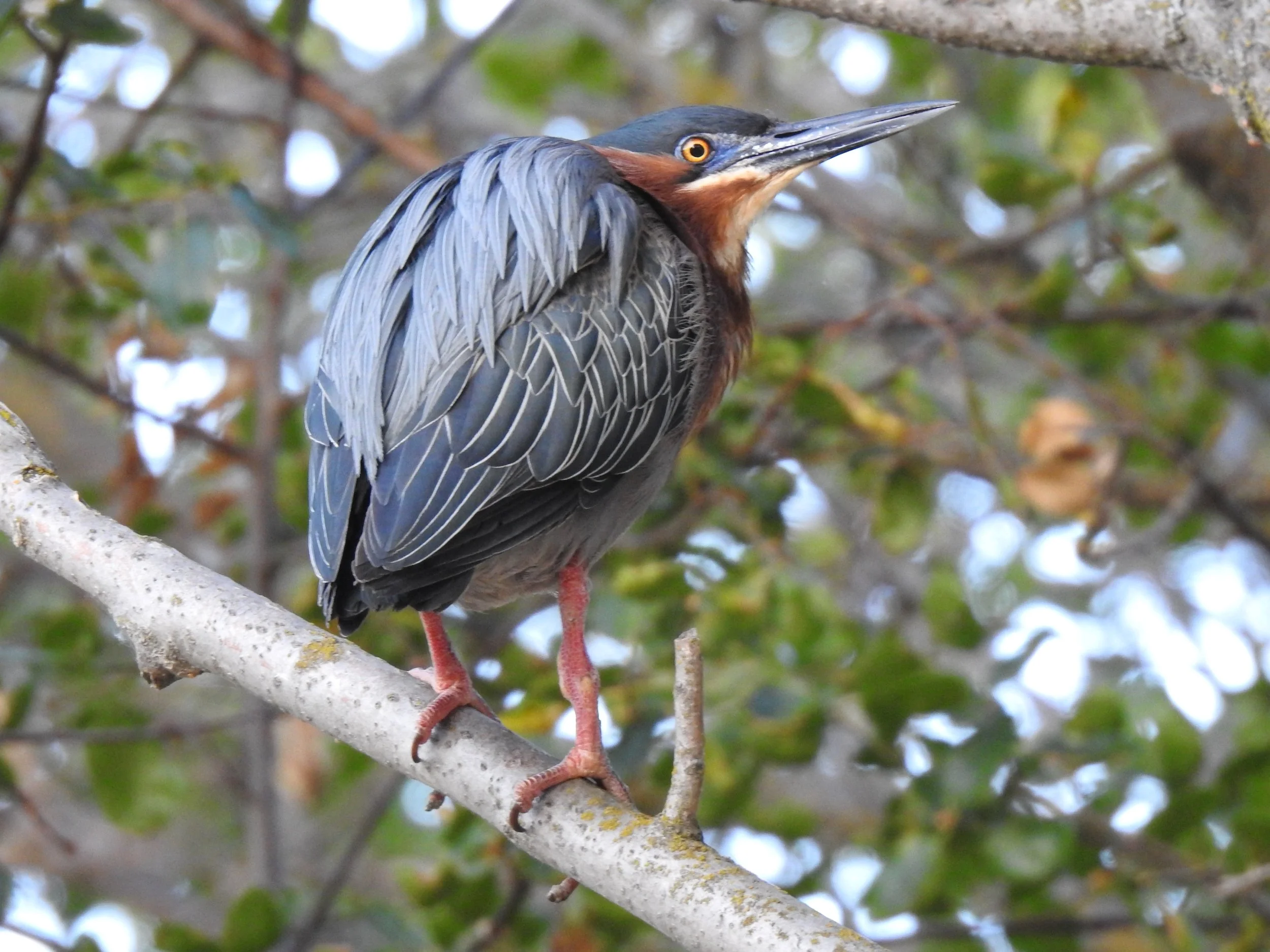
Leader Mackenzie Hollender reported: Five young birders and three parents met my father and me at the Lake Solano County Park day use area on this sunny morning. Acorn Woodpeckers, Eurasian Collared-Dove, Oak Titmouse, a sunning Turkey Vulture, and a perched Red-shouldered Hawk welcomed us to the park. As we made our way down the shoreline trail, we got amazing looks at Western Bluebirds foraging in the grass in direct sunlight, lighting up their blue wings to the highest of vibrancy. An adult male Phainopepla landed at the top of a small tree perfectly in view, and we admired the wispy black mohawk, deep red eye, and “shiny black cloak”, of this unique north American Silky-Flycatcher, one of our target birds. We noted Wood Ducks and Common Mergansers on the water, and an Osprey overhead coursed swiftly downstream. A Great Egret preened on a log in the center of the lake, and multiple Great Blue Herons were seen as well. A few Barn Swallows, many more Northern Rough-wing and Violet-green Swallows were seen zipping just above the water, directly overhead, or perched in a dead tree overlooking the river. Two Bewick’s Wrens foraged along a low branch covered in bramble. Belted Kingfisher, Green Heron, California Towhee, and White-breasted Nuthatch were also present.

We watched attentively in the oak canopies and willow thickets for little movements and subtle call notes of migrating warblers and spotted our first Wilson’s Warbler high in a valley oak around 9. Throughout the course of the trip, we heard and saw many Wilson’s Warblers in all levels of the forest. The cries of summering Northern Flickers accompanied us as we headed away from the picnic tables and towards the deeper woods, and we saw a flicker foraging on the ground. Double-crested Cormorants croaked from an oak covered in whitewash. Two Red-tailed Hawks circled overhead.

In the deeper woods, the number of Wilson’s Warblers increased, along with a Yellow Warbler that still wore some of its russet streaks. Two Warbling Vireos that gleaned the mid to upper levels of a willow for small insects, providing excellent looks, was a highlight. Out of respect to an Orb-weaver’s masterful web built across the narrowing trail, we had to turn around, and we did so just in time to watch a Willow Flycatcher fly into the upper levels of an oak, a first for the season for Lake Solano County Park! We noted its pale underside and bold white wing bars had a sharp contrast with its brown back, crown, wings and tail, as the flycatcher foraged for insects in the canopies of the oaks and willows, a lifer for many of the attendees. On the way back, Downy and Nuttall’s Woodpecker, Ash-throated Flycatcher, a perched juvenile American Kestrel, and another Phainopepla were enjoyed. We heard but did not see California Quail and a Western Tanager.

The last highlight of the day occurred when we heard subtle notes coming from the top levels of an oak and spotted a Black-throated Gray Warbler. We watched the warbler move in and out from behind oak leaves for a few minutes until it departed from the tree. Then we ourselves departed for home, bidding farewell to a very well-rounded day of birding, and a lasting impression of early fall migration in a healthy riparian ecosystem. 


SAS Field Trip: Sailor Bar, 08/23/25

Leaders Mary Forrestal and Jane Van Kessel reported: Neither the threat of extreme heat nor the early start time scared off the 14 birders who chose to join us. Wild Turkey, numerous White-throated Swift, Black-crowned Night Heron, Double-crested Cormorant, and first-of-season California Gulls were some of the early excitement. Anna’s Hummingbirds, Cedar Waxwings, and Lesser Goldfinch were observed in abundance. We had four Spotted Sandpiper and at least 2 different Belted Kingfisher, noting the red band on one and its absence on the other.  An Empidonax flycatcher was never specifically identified, and we had a possible Yellow Warbler and possible Black-throated Gray Warbler. Both were only seen briefly by one of the group and never spotted again. The most exciting find of the day was 3 Lazuli Bunting, moving quickly through the trees along the river. Only 39 species were seen overall but we managed to wrap things up before the heat became overwhelming and that felt like a success. https://ebird.org/checklist/S269036674  


SAS Field Trip: Ancil Hoffman Park, 08/24/25

Leader Rich Howard reported: We had a large group of 20 folks for this return to Ancil Hoffman Park after a summer closure for repaving. They were a great mix of new, but already skilled, birders and many helpful veterans, including four current and former Beginning Birding instructors. The picnic area next to the parking lot gave us great views of the endemic Yellow-billed Magpie and the iconic Acorn Woodpecker. The rattling call of the near-endemic Nuttall’s Woodpecker was a constant presence on our walk along the trail between the golf course and the American River, and we finally picked up a Downy Woodpecker at the south end.

The trail also gave us many good views of the common oak woodland species. A group of almost 30 California Quail allowed comparison of male, female, and immature plumage and several different vocalizations. Our visit to the gravel bar near the old water intake tower gave us our lone Barn Swallow and Great Egret, our only flock of Rock Pigeons, and single pairs of Common Mergansers and Killdeer. All the Cliff Swallow nesting activity on the tower was finished. Climbing back to the trail, we found our first pair of Yellow Warblers and then a beautiful male Black-throated Gray Warbler, all of which allowed clear looks and photos. Two Warbling Vireos showed themselves in a Valley Oak a little farther south, and two pair of Wilson’s Warblers confirmed our feeling that Fall migration is fully underway! Cedar Waxwings headlined the returning winter visitors. Pausing at a thistle patch gave us good looks at Lesser and American Goldfinches and Anna’s and Black-chinned Hummingbirds. Watching a very high flock of White-throated Swifts allowed us to see an even higher Cooper’s Hawk. 


SAS Mindful Field Trip: Sierra Discovery Trail, Emigrant Gap, 08/30/25

Trip Cancelled


SAS Field Trip: Coastal Shorebirds, 08/31/25

Leader Dan Williams reported: Eight of us had a day we won't soon forget at Point Reyes National Seashore! We spent the morning making the 3-mile trek to Abbott's Lagoon and back. The open brush en route to the lagoon provided lots of the coastal resident "Nuttall's" White-crowned Sparrows (including several still begging juveniles), a family group of California Quail, nice views of a few Northern Harriers and White-tailed Kites, and an unusually obliging Wrentit that perched on a barbwire fence for quite a while for us, issuing its purring contact call. Some playful river otters near the lagoon footbridge would NOT be the last we'd see that day (*foreshadowing*).

Tide was quite high at the lagoon and shorebirds were few and distant, but nevertheless there proved to be some gems there waiting for us. A juvenile WESTERN CATTLE EGRET strolling near the shore of the lagoon was quite a surprise. A flock of terns in the northwestern corner of the lagoon was made up mostly of Caspians, but also contained a few Elegant, one Common, and one ARCTIC TERN. Before we could enjoy the Arctic Tern in the scope, it stood and stretched, took off, circled the lagoon dipping at the water a couple of times, then headed out to sea. Shorebird highlights included a few Snowy Plovers still on their nesting dunes, some very close views of Least Sandpipers resting on the beach, and a few Semipalmated Plovers and Marbled Godwits at the far edge of the lagoon.

After a parking lot picnic lunch at Abbott's, we headed to Chimney Rock Trailhead to scan Drake's Bay from the Elephant Seal Overlook. A scene typical of late summer at this location greeted us with Brown Pelicans churning the water with their dives and Heermann's Gulls all over them for each haul. We were able to spot a few Pacific Loons and more than a few Brandt's Cormorants from the overlook...then...*it* happened. We noticed a struggle in the water rather close by that turned out to be a RIVER OTTER attempting to DROWN a BRANDT'S CORMORANT! The cormorant fought the good fight for a few minutes, but eventually the otter was able to haul its victim to shore where two other otters emerged from the rocks and the trio made a meal of the bird right below us, much to our amazement! 

What we thought was to be a shorebird-focused trip ended up having highlights that were much more diverse than we imagined and ended with a stark reminder of the beautiful brutality of nature.


SAS Field Trip: Biodiversity Day at Bushy Lake, 09/06/25

Northern Waterthrush © Kevin Thomas

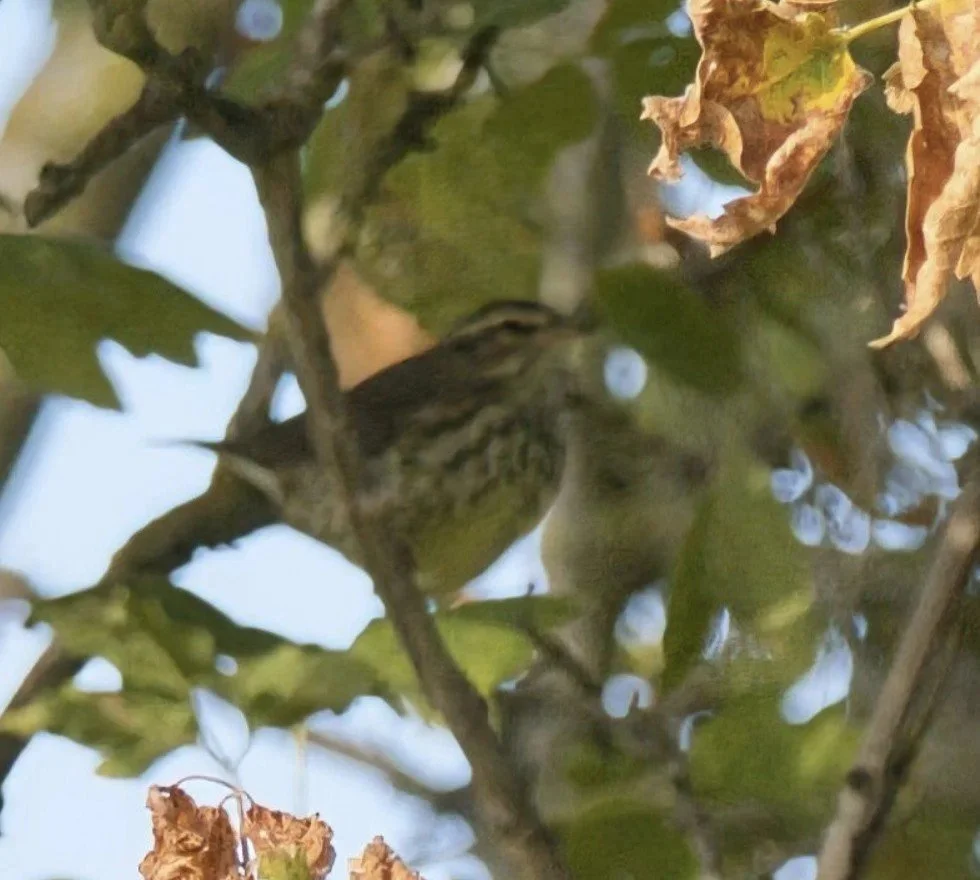
Our biggest surprise of the day came in one of these mixed flocks when we got looks at a streaked bellied, white supercilium, warbler bobbing its tail in an oak tree, a rare Northern Waterthrush was spectacular to see.

Leader Kevin Thomas reported: Our group of 9 was met by a slight chill in the air and overcast skies as we set out for this Sacramento Audubon sponsored Biodiversity Day event. It felt more like fall than summer, as we headed out to the riparian habitat along the American River before working our way back along Bushy Lake. Within the first few minutes we were treated to a pair of American Kestrel, a Cooper's Hawk, and a Peregrine Falcon carrying a small songbird in its talons. The fun continued as we ran into several mixed flocks of Yellow, Orange-crowned, and Wilson's Warblers along with some Western Tanagers. Our biggest surprise of the day came in one of these mixed flocks when we got looks at a streaked bellied, white supercilium, warbler bobbing its tail in an oak tree, a rare Northern Waterthrush was spectacular to see. From there we added on Blue-gray Gnatcatcher, a few White-tailed Kites, and a few Vaux's Swifts. We also saw a Desert Cottontail and documented many plant species during the walk. It was a great morning to be outside.  


SAS Field Trip: Lake Solano and Putah Creek, 09/07/25

Eastern Kingbird © MaryAnn Clark

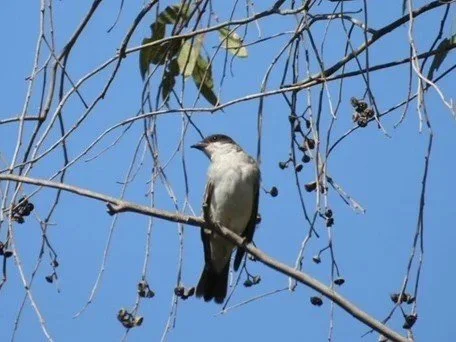
The biggest prize of the day was an Eastern Kingbird at Putah Creek preserve.

Leader Ben Graber reported: We had an outstanding day of birding today! We had excellent weather and a very nice group of people. The biggest prize of the day was an Eastern Kingbird at Putah Creek preserve. The bird was found earlier in the day by Mark Martucci and later re-found, well-seen and photographed by our group and several others. We also had lots of Yellow Warblers, a Wilson's Warbler, a Nashville Warbler, a Warbling Vireo, a Hooded Oriole, and several Western Tanagers. 

About half of the group continued to Lake Solano after lunch. There, the highlights were two Lewis's Woodpeckers and a Phainopepla. There were many swallows at the lake, with Violet-green Swallows being particularly well-represented. 


SAS Young Birders Club Field Trip: Putah Creek Riparian Reserve, 09/07/25

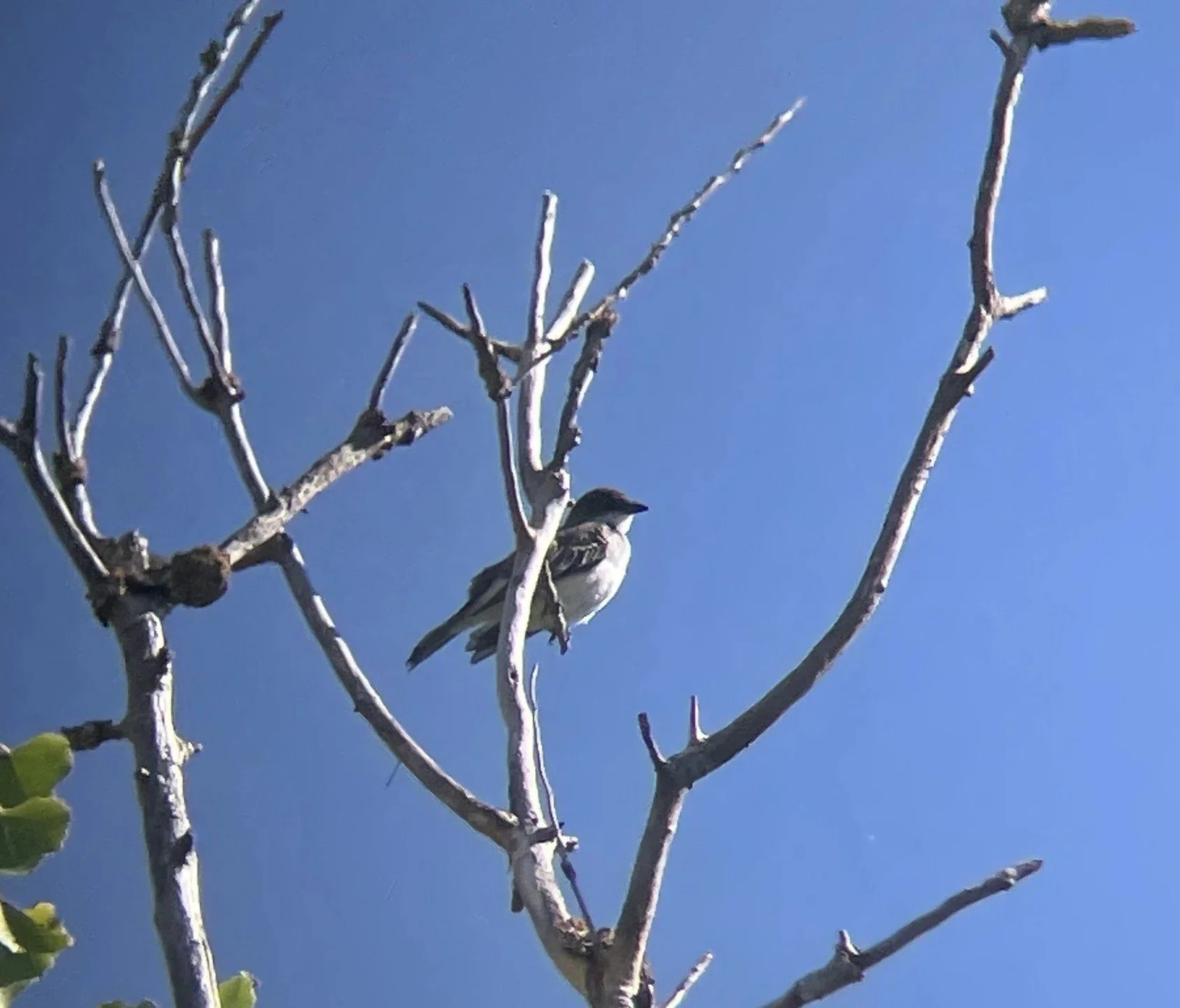
Leader Mackenzie Hollender reported: Seven young birders and five parents met my father and I at the Putah Creek Riparian Reserve this morning. Flyover Great Egrets welcomed us to this rare riparian corridor in Yolo County. As we made our way down the trail, we watched the tall eucalyptus trees, eager to catch glimpses and good looks at the many Yellow Warblers and Western Tanagers. Continuing down the trail, Northern House Wrens singing in the undergrowth, Western Flycatchers hunting in the oaks, and fly by Wood Ducks were all good finds. An adult birder we passed on the trail, Mark Martucci, let us know that he thought he had an Eastern Kingbird at the bird bath spot that had flown off, but he was still unsure. We kept this possible sighting at the back of our minds as we made our way to the bird bath, picking up Nuttall's and Downy Woodpecker, plenty of Black Phoebes, and Bewick's Wren. At the bird bath, more Yellow Warblers flitting in the low vegetation put on a show for us. Cliff and Barn Swallows foraged overhead, and through dense vegetation we glimpsed a female Hooded Oriole. A Green Heron very close to the path stood poised on a half-submerged log, so incredibly stoic and focused on its hunt that it barely noticed us creeping up to it to obtain incredible photos and long looks. We watched the heron lean off the end of the log until it was almost vertical. By then, we heard from another birder that Mark Martucci developed a photo of the possible Eastern Kingbird, and the sighting was confirmed.

Eastern Kingbird © Mackenzie Hollender

Arriving at the swing spot, we watched a small group of Wilson's Warblers, then headed back, and lingered a while at the bird bath spot. A Willow Flycatcher landed in perfect view on some exposed branches, and a Western Wood-Pewee flycatched from a tall sycamore. Just then, three other birders emerged out of the underbrush, running. When we asked what was going on, they simply replied "Eastern Kingbird!" We all followed them, running as fast as we could, down the trail to a small clearing where a towering sycamore was in view a few yards ahead. And there, sitting on a high branch that arched to the creek's edge, was the EASTERN KINGBIRD!! Most of us got there in time to see the large, black and white flycatcher before it flew off. We stuck around the clearing in hopes the bird would return to the perch, as kingbirds do. I decided to veer from the rest of the group to check the original sight it was seen, the bird bath, just in case. I arrived at the site and spotted a backlit large flycatcher preening in a leafless treetop, ruffling its feathers like it had just reemerged from a bath. I moved around the tree to view the bird from a non-backlit angle and could clearly see it was the Eastern Kingbird! I yelled down the trail and texted the young birders club group chat that I had the bird at the original bird bath spot. Despite the stampede of birders coming its way, the kingbird stuck around at the top of the tree, and those of us who did not arrive in time to see it at the original spot got incredible looks and photos of the remarkable bird. We noted its size, the striking pale white underside and throat, and dark back, tail, and wings, too dark to be a Western Kingbird. We heard from other birders, then saw for ourselves that the bird had no white terminal band, as Eastern Kingbirds usually do, meaning the bird was more than one year old. For the remainder of the trip, we watched the wayward kingbird—the first Eastern Kingbird to be seen in Yolo since 2018—preen amidst the flashing cameras, and eager comments from the many awestruck birders around. Overall, this trip was one for the books, an unforgettable experience with an incredible bird. 

October Monthly Speaker Presentation

Join us on October 16, 2025 at 7pm for Status and Conservation of the Purple Martin in California in 2025 presented by Dan Airola. The meeting will be held in-person at Effie Yeaw Nature Center and online via Zoom (hybrid meeting). Registration is no longer required to attend via Zoom.

About the Presentation 

The well-documented and drastic decline in the Purple Martin nesting population in Sacramento has contributed to concerns about the species’ status throughout California. The species has been recognized as a state Species of Special Concern for nearly 50 years. Dan Airola is co-leading a comprehensive statewide Purple Martin status assessment 2025. Dan will discuss the unique life history of this largest North American swallow, differences between the eastern and western subspecies, and current threats they face. He’ll present an overview of the status and conservation issues facing the species in California. He will also provide preliminary results of the 2025 statewide Purple Martin breeding population survey

More About Our Speaker

Dan Airola is a Sacramento Wildlife Biologist and Ornithologist who has worked for over 45 years in research and conservation of at-risk species birds in Northern California. Dan has conducted research and a conservation program for the Sacramento Purple Martin population for over 30 years. He also has conducted several status assessments of the species in California and is co-leading the 2025 statewide status. Dan also has led studies in Northern California for the Tricolored Blackbird, Yellow-billed Magpie, Osprey, Bald Eagle, Swainson's Hawk, Turkey Vulture, fire-adapted forest species, migrant songbirds, and diving ducks. Dan also serves the Central Valley Bird Club as a Director, Conservation Chair, and editor of the journal Central Valley Birds and is a Conservation Committee member for Sacramento Audubon.'

Attend the Meeting and Presentation

This meeting will be a hybrid session. Participants can join the meeting on-site at Effie Yeaw Nature Center or from the comfort of their home via Zoom.

Attend the Meeting in Person
Dan will give his presentation live at Effie Yeaw. Registration is not necessary to attend the meeting at Effie Yeaw.

 Effie Yeaw Nature Center
2850 San Lorenzo Way
Carmichael, CA 95608

Attend the Meeting Online via Zoom
The presentation will be streamed in real time on ZOOM from Effie Yeaw. To attend the meeting via Zoom use this link below then enter the passcode.

Zoom Link for October Meeting: https://us06web.zoom.us/j/86204518851?pwd=cL8a3fFk2LKcreKyemKSQILGxzaxSS.1
Passcode for October Meeting: 242171

You do not need a ZOOM account to join the meeting. The Zoom portion of our meeting is limited to 100 participants. Participants will be admitted on a first come, first serve basis.

Seasonal Sightings: August 2025

As is often the case in August, Yolo County shorebirds stole the show. Songbird migration was generally slow, but a few unexpected finds made things more interesting. Unusual summering ducks continued at the Woodland WTP. These included up to eight Canvasbacks, up to 18 Redheads, and up to two Buffleheads--with one Bufflehead also at Sailor Bar along the American River Parkway. Amazingly, the female Costa's Hummingbird first found at a private yard in Wilton on 8/14 (and likely before) has continued for more than a year. There were just two reports of Calliope Hummingbirds: one from Fair Oaks on 8/12 and one from Natomas on 8/31.

Among the shorebird highlights was a Snowy Plover found at Folsom Lake, Beals Pt, on 8/2, and Marbled Godwits were reported throughout the month from the Yolo Bypass Wildlife Area (YBWA), Davis Wetlands, and the Woodland WTP--the high count was 13 at the Davis Wetlands. There were multiple Solitary Sandpiper reports in Yolo County, and one during the last week of the month at the EchoWater Facility (Sacramento Regional WTP). A Stilt Sandpiper (eBird Checklist S270761556) was reported at YBWA from 8/30 into September. Baird's and Pectoral Sandpipers were reported from multiple Yolo County shorebird spots, with one each at the Anatolia Vernal Pool Preserve in Sacramento County during the last week of the month. The bird of the month was the region's second-ever Little Stint. It was found, carefully studied, and photographed from 8/22-8/27 (eBird Checklist S269015910 and eBird Checklist S269115892). Small numbers of Semipalmated Sandpipers were found among the many Least and Western Sandpipers in Yolo County throughout the month, with singles at the Lincoln WTP and the EchoWater Facility. It is interesting to look back and consider that this was thought to be a quite rare species in our region as recently as 30 years ago. Improved optics and digital photography, along with knowing what to look for has made a huge difference. Single juvenile Franklin's Gulls were found at Beals Pt, Folsom Lake, from 8/13-8/14 (eBird Checklist S267097301), and at YBWA from 8/19-8/30. The Neotropic Cormorant found at Lagoon Valley Park on 7/28 continued through mid-month.

There was an early movement of Lewis's Woodpeckers, with singles reported in Folsom, Latrobe Rd, and Babel Slough--all on 8/31. A Gray Flycatcher was a nice find at Gibson Ranch County Park on 8/17. There were scattered reports of Yellow-breasted Chats from local hotspots and a Tennessee Warbler was an excellent find (eBird Checklist S270487874) at Audubon Bobcat Ranch from 8/28-8/29. A Summer Tanager was found on 8/17 in Folsom along Willow Creek, and a female-type grosbeak visiting a feeder on 8/31 in Fair Oaks was photographed (eBird Checklist S271510272) and appears to be a Rose-breasted Grosbeak.

The Sacramento Area as covered here lies between Hwy 20 to the north, Hwy 12 to the south, and the 1000-foot contour to the east and west, plus all of Sacramento and Yolo counties. Many reports first appeared on the Central Valley Bird Club listserv (groups.io/g/centralvalleybirds) and in eBird (ebird.org). It is impossible to list everyone, but we thank the following for their reports: Steve Abbott, Peyton Bounds, Lyann Comrack, Chris Dong, Konshau Duman, Lynette Williams Duman, Gil Ewing, Joshua Greenfield, Kevin Guse, Cliff Hawley, Mackenzie Hollender, Marcel Holyoak, Emmett Iverson, Eric Johnson, Julian Johnson, Adam Kucharek, Jeri Langham, Andrew Lee, Mark Martucci, Michael Perrone, Zane Pickus, Linda Pittman, Ron Pozzi, Mark Sawyer, Samuel Schmidt, Steve Scott, Sean Smith, Elliott Steinfels, Kevin Thomas, and John Trochet. Thanks to everyone for their reports--without them, this column would not be possible.

- Chris Conard

More Seasonal Sightings

Birds and Benches in North Natomas Regional Park

Funded through the City of Sacramento’s 2% for public art ordinance, the Sacramento Office of Arts and Culture (OAC) Art in Public Places (APP) program has been tasked with management of a new Artist Designed Benches Project in North Natomas Regional Park (NNRP) named Birds and Benches. 

The project will have two phases to support robust community engagement:

  • Phase 1 - Five (5) Artist Ambassadors to engage with five careholder organizations.

  • Phase 2 – up to eight (8) artists for the design and fabrication of up to 8 artist made benches.

The ideal envisioned bench design will enhance the community atmosphere of the site while celebrating the bird life of the Natomas Basin, focusing on areas in the park where visitors can enjoy resting and viewing avian species as well as other areas determined through conversations with project careholder organizations and community participants.

The Sacramento Audubon Society is one of the cardholders. As the project moves along we will provide updates and solicit involvement. The link below provides additional information and the overall  project timeline.'

For more information visit: www.cityofsacramento.gov/ccs/oac/public-art/public-art-projects/Birds_and_Benches

Seasonal Sightings: July 2025

As expected for July, shorebirds accounted for most of the reports, but by month's end, the beginning of the post-breeding migration of songbirds was underway. Ducks that are unusual in the summer for the Central Valley continued at the Woodland WTP. These included up to four Canvasbacks, up to 32 Redheads, including young, a single Greater Scaup, and up to two Buffleheads--with up to two Buffleheads also at Sailor Bar along the American River Parkway. The female Costa's Hummingbird first found at a private yard in Wilton on 8/14 (and possibly as early as a year ago) continued.

Among the shorebird highlights was a nicely photographed Snowy Plover found (eBird Checklist S261712749) at Folsom Lake, Beals Pt, from 7/21 to 7/23. Solitary Sandpiper reports included one on 7/21 at the Wheatland Water Treatment Plant, another on 7/26 at Yolo Bypass Wildlife Area (YBWA), and one on 7/30 along Hwy 45 north of Knights Landing. The only Sanderling reported was at YBWA on 7/27. A Semipalmated Sandpiper was found at the Woodland WTP on 7/3, with up to two Semipalmated Sandpipers at YBWA (eBird Checklist S261712905) from 7/19 to the end of the month, and singles at the Lincoln WTP and the EchoWater Facility (Sacramento Reg. WTP) during the last few days of the month. A Common Tern was found at the Woodland WTP on 7/31, identified by a recording of its call. Neotropic Cormorants are turning up more frequently in the area, and one was found and well photographed at Lagoon Valley Park (eBird Checklist S263879790) from 7/28 into August.

A few common songbird migrants, including Warbling Vireos and Wilson's Warblers, began moving through local woodlands by the end of the month. A pair of Red-breasted Nuthatches continued in Davis, and there was a single at Reichmuth Park on 7/3. At least four Yellow Warblers continued in the vicinity of the Tall Forest at CRP, and the male Summer Tanager found on 6/15 near the Tall Forest continued through at least 7/9. The most notable and widely shared songbird find of the month was a beautiful adult male Rose-breasted Grosbeak (eBird Checklist S260389651) along Putah Creek near Old Davis Rd, south of UC Davis, from 7/16 to 7/19.

The Sacramento Area as covered here lies between Hwy 20 to the north, Hwy 12 to the south, and the 1000-foot contour to the east and west, plus all of Sacramento and Yolo counties. Many reports first appeared on the Central Valley Bird Club listserv (groups.io/g/centralvalleybirds) and in eBird (ebird.org). It is impossible to list everyone, but we thank the following for their reports: Steve Abbott, Dan Airola, Peyton Bounds, Lyann Comrack, Chris Dong, Konshau Duman, Lynette Williams Duman, Andy Engilis, Gil Ewing, Joshua Greenfield, Cliff Hawley, Marcel Holyoak, Emmett Iverson, Eric Johnson, Julian Johnson, Jeri Langham, Andrew Lee, Mark Martucci, Asher Perla, Michael Perrone, Zane Pickus, Linda Pittman, Ron Pozzi, Samuel Schmidt, Elliot Schoenig, Steve Scott, Sean Smith, Kevin Thomas, and John Trochet. Thanks to everyone for their reports--without them, this column would not be possible.

- Chris Conard

More Seasonal Sightings

Field Trip Findings July 13 - August 10, 2025

SAS Field Trip: Hayward Regional Shoreline, 07/13/25

Leader Kevin Thomas reported: Mid July can be an extremely hot time in the Central Valley of CA so we ventured over to the Bay Area for a break from the warm weather. When the four of us arrived at Hayward Regional Shoreline the marine layer was in place and temperatures were in the low 60s, a nice way to start the morning. The sun started to break through about halfway through our walk and we finished in full sun at around 70 degrees. There were lots of signs of breeding in the area with numerous young Song Sparrows, House Finches, and Wild Turkey around. It was low tide in the bay and the exposed mudflats were covered in shorebirds, many too far away to identify but we did get great looks at Willet, Whimbrel, Marbled Godwit, Semipalmated Sandpiper, and Least Sandpiper. The Least Sandpiper were particularly close and dazzling in their alternate plumage. A highlight was watching a Whimbrel capture what appeared to be a small mollusk and carry it over to clean it off in a small puddle before gulping it down. Watching it delicately handle the prey in its bill and reposition to clean and consume it was very interesting. We were fortunate enough to hear a lone Ridgway's Rail although it never popped out of the vegetation to provide a look. The ponds on the east side of the area were covered in Black-necked Stilt and American Avocet; hundreds were out feeding, preening, and strutting around the shallow water. It was a wonderful morning in the Bay Area with good people and birds along with pleasant temperatures.

SAS Young Birders Club Field Trip: Woodland Water Treatment Plant, 07/13/25

Leader Mackenzie Hollender reported: Three young birders and two parents met my father and me at the Woodland Water Treatment Plant on this sunny morning. Right away, we noticed an abundance of Cliff and Tree Swallows flying across both ponds, and Great-tailed Grackles walked on the gravel road. Ruddy Ducks floated in groups and dove under water at the back ends of the ponds, along with female Northern Shovelers and Gadwall. At the start of the northern right pond, we watched an outstandingly large group of Snowy Egrets foraging with American White Pelicans. We scanned a sandbank with a flock of resting Canada Geese and were able to pick out one Greater White-fronted Goose among the flock. We enjoyed a dusty immature Yellow-headed Blackbird that perched in perfect view in the short grass behind the shore. We admired a beautiful adult Peregrine Falcon overlooking the pond from the top of a dead snag. We noted multiple Canvasback swimming in the water, and a plethora of American Coots as well. We watched a group of nine female and immature male Redhead dive under and resurface from under the water, noting their round heads and thin white ring around their eyes.

Pied-billed Grebes were also abundant, and we saw a chick trailing its parent, and noticed its intricate black, white and orange-red face patterning. From there we headed for a loop around the field adjacent to the ponds to look for burrowing owls, but we had no luck in this pursuit. We did get incredible looks at a Coyote resting on the gravel path. From the field path, looking out across the back of the north pond, we saw Western Grebes carrying fluffy silver chicks on their backs, got amazing looks at two adult male Redhead preening on the sandbank, watched a couple of fly-by Long-billed Dowitchers and Greater Yellowlegs, and observed Black-necked Stilts flying very close to us while calling rapidly. We enjoyed a flock of ten Least Sandpiper that briefly landed on the short shoreline below the field before taking off again. On the field path, we saw Western Kingbirds, heard a Marsh Wren and a Western Meadowlark singing, and saw a massive flock of Cliff Swallows perched vertically on the side of a building. Ever-present White-faced Ibis that flew overhead was a continuing highlight throughout the duration of the trip. Overall, we had a nice, well-rounded day with a lot of species diversity and enthusiasm. 

SAS Field Trip: Wrights Lake Area, 07/19/25

Leader Rachael Cowan reported: Four of us met up for a gorgeous day of birding at Wrights Lake. We spent a long time looking for the Lazuli Bunting we heard at our first location at Lyons Creek Trailhead, but we never caught a sight. We did find many great pairs: Red-breasted Sapsucker, Hairy Woodpecker, Green-tailed Towhee, and Western Tanager. And we also had a great view of a MacGillivray’s Warbler. We hit Wrights Lake later than expected and enjoyed great sightings, but it was generally quiet due to high recreation. We caught lots of activity between fledglings and parents, most notably among Red-breasted Sapsuckers, and Northern Flickers. We saw Western Wood-Pewee, Olive-sided Flycatcher through the walk along the lake and enjoyed sightings of two different Bufflehead females with fuzzy young in tow, as well as some Common Mergansers with their young. Further into the wetlands we were treated to the song of the Hermit Thrush, and we also spotted a Chipping Sparrow. At our farthest point out, we saw a pair of Black-backed Woodpeckers. Once back at the lake, we saw an Osprey flying and hovering over the lake and perhaps a favorite observation as we approached the end was a pair of Pine Grosbeaks. We were not sure if they were a pair of juveniles chasing after a parent. We had a total of 15 species at Lyons Creek Trailhead and 28 species at Wrights Lake.

SAS Field Trip: A Focus on Shorebirds at the Bufferlands and Echo Water Facility, 07/20/25

Leader Chris Conard reported: CANCELLED

SAS Mindful Field Trip: Sierra Discovery Trail, Emigrant Gap, 07/27/25

Leader Paul Miller reported: The weather was absolutely beautiful for a fun day of birding. A total of eight people attended the trip, including two teenagers from Seattle with their grandparents. The trail winds through a dense conifer forest with tall mature trees. Most of the birding is by ear (or Merlin) as many of the birds were hanging out way up in the trees. Species observed were: Red-breasted Nuthatch, Golden-crowned Kinglet, Steller’s Jay, Northern Flicker, Spotted Towhee, Hairy Woodpecker, Dark-eyed Junco, and Common Raven.

SAS Field Trip: Yolo Wildlife Area-Migration Hotspot, 08/02/25

Leader Kevin Thomas reported: Our group of 9 arrived at the gate for Yolo Wildlife Area at 6:05 am for our early morning start to go looking for shorebirds in the recently flooded fields east of parking lot C. We were delayed for a bit as we waited for someone to show up and unlock the gate for entry. We managed to pick up a Swainson Hawk and several groups of flyover White-faced Ibis while we were waiting. After getting through the gate we headed to parking lot C where we were greeted by singing Marsh Wren and Song Sparrows. We started the trek along the fields east of parking lot C to the flooded fields a half mile or so out from the parking lot. We positioned ourselves to use the sun to our advantage looking back in good light at the thousands of shorebirds feeding in the flooded fields. We had lots of Long-billed Dowitcher and Least Sandpiper throughout the morning. Our unexpected bird was a lone Wilson's Snipe that flew by us at the very start of the walk and landed in a dry dirt field in the grass edge. We picked up some Western Sandpiper and Lesser Yellowlegs among the flocks of the more common species. As we circumnavigated the ponds, we encountered a few Wilson’s Phalarope and one Red-necked Phalarope exhibiting their spinning behavior while feeding. With four scopes and ample experienced birders, we were able to comb through the flocks and look for anything rare. Although nothing rare showed up we had a lot of time to discuss various aspects of shorebird identification and life history. It was a great morning to practice identification skills and share in the joy of shorebirding.

SAS Field Trip: Cosumnes River Preserve, 08/07/25

Leader Rich Howard reported: Five people from as far away as Lake Tahoe and Turlock braved the potential heat and road closures to explore the River Walk at Cosumnes River Preserve. Before the walk started, some folks in the parking lot spotted an American Barn Owl flyover and a Downy Woodpecker working the trees across the road. Spotted Towhees were a constant presence, giving both their mewing call and trilling song. Nuttall’s Woodpeckers and White-breasted Nuthatches were also widespread. Our first peek into Middle Slough yielded a nearby adult Black-crowned Night Heron. The riparian vegetation between the path and slough hosted a Western Flycatcher, and a Contopus flycatcher high in the dead branches of a cottonwood. After a long discussion and many scope views front and back, we settled on Olive-sided Flycatcher (see eBird list for details). Young birds were a fun challenge, and we had a very scruffy Song Sparrow, Oak Titmice with no crest, and odd vocalizations from several birds. Three wren species were fun to sort out: Bewick’s, Northern House, and Marsh. With only a gentle breeze, it took the Turkey Vultures a while to get airborne, and the Swainson’s and Red-shouldered Hawks were distant specks until we got back to the parking lot for a closer sighting. Every trip needs a mystery bird, and for us it was a high and distant column of swallows that we only spotted when looking at the hawks. We eliminated Barn Swallow based on tail shape, but that’s as close as we could get. The lack of water in the ponds meant flyover flocks of Canada Geese were our only waterfowl; the stunning flocks of geese and ducks are still a few weeks away. The cool Delta breeze and plenty of shade permitted us to walk all around the once and future ponds, and we were back at the Visitor Center before 11 to see Anna’s and Black-chinned Hummingbirds feeding in the native flowering shrubs.
A checklist for the walk can be found here: https://ebird.org/checklist/S265671290

SAS Field Trip: Napa and Sonoma County Marshes, 08/09/25

Leader Dan Williams reported: Twelve of us had a phenomenal day birding the Napa-Sonoma Marshes.  We started at Wetlands Edge Park in American Canyon where we were greeted right away by a pair of White-tailed Kites hover-foraging over the shrubby fields adjacent to the tidal flats. At one point, one of them caught a small mammal and transferred it to the other. The tide was receding all morning and the mudflats were teeming with shorebirds: Willets, Godwits, Curlews, both Dowitchers, Black-bellied and Semipalmated Plovers, and Least and Western Sandpipers, all in the many dozens to hundreds. While passing the freshwater lagoon on our way to the Napa River Mouth, the first of our surprise rarities, a BLACK TERN, flew by low over the lagoon giving us brief but definitive views. A Virginia Rail spoke up from the reeds and then gave us a brief peek as it ventured out then dashed back to cover. As we scanned through the throng of Red-winged Blackbirds, we came upon a male TRICOLORED BLACKBIRD with its darker red wing patch and milky white border; another rarity for this park. Other highlights there included an Osprey, Black-crowned Night Herons, Green Herons, and Snowy Egrets, some chattering Chestnut-backed Chickadees, and an early Glaucous-winged Gull.

After a lovely picnic lunch, we ventured up HWY 29 through the winery traffic to the Huichica Unit of Napa-Sonoma Marshes. There, the tidal mudflats continued to be good to us, with hundreds more Least and Western Sandpipers and a single SEMIPALMATED SANDPIPER, dozens more Semipalmated Plovers, Greater and Lesser Yellowlegs, and a squadron of American White Pelicans.  As we made our way down the trail, we heard a peculiar squawking that turned out to be a fledgling Great Horned Owl in a eucalyptus tree loudly begging to its nearby parents. The pond at the southern end of the trail held dozens of Wilson's and Red-necked Phalaropes, and one Caspian and one Forster's Tern patrolled up and down the adjacent canal. While looking through the darting Barn and Cliff Swallows low overhead, a BANK SWALLOW suddenly appeared, capping off a day that was full of wonderful variety, multitudes of shorebirds, and more than a few surprises along the way.

SAS Young Birders Club Field Trip: Migratory Shorebird Day, 08/09/25

Leader Mackenzie Hollender reported: Six young birders and three parents met my father and me at the Yolo Bypass Parking Lot C for a morning of shorebirding. In the parking lot, many flyover White-faced Ibis and Red-winged Blackbirds and a singing Song Sparrow welcomed us to the preserve. We drove over to the August shorebird fields and noted Great Blue Herons, and Double-crested Cormorants on the way. Immediately after getting out of the car, we noticed giant flocks of ducks skimming the distant flooded fields, and we were able to pick out Mallard and Green-winged Teal. An adorable River Otter swam in the canal, peeking its head up from the water to look at us. Our first shorebird of the day, Greater Yellowlegs, sat perched in the far end of the first field. We later saw many flying over and noted their brilliant golden legs, white tail feathers and breeding plumage barring on the sides. Long-billed Dowitchers also flew overhead; we noted the white wedge up their backs. We caught a few quick glances at a flyover flock of Semipalmated Plovers, noting their black-tipped orange bill and dark bands around the eyes, forehead, and breast. Throughout the trip, we received many extraordinary views of Least and Western Sandpipers foraging in big groups just beyond the road, both lifers for some of the attendees. We noted the differences between the two, the Western’s greater size, greater amount of white on the underparts and breast, and the Least’s pale legs, darker back and “snipe stripes”. Far out at the back of a field, we scoped a distant Red-necked Phalarope, noting its stunning white plumage in comparison to other small shorebirds. A departing flock of Greater Yellowlegs revealed a smaller lookalike with a shorter bill, which some of us heard giving a one noted call as opposed to the 3-4 notes of a Greater Yellowlegs- a very strong candidate for the less common Lesser Yellowlegs. Suddenly we heard a strange, one noted call that sounded like a yellowlegs with a lower pitch, coming from a flying bird. As the bird flew in a wide circle around the fields, it revealed its black axillaries, and pale face with a dark smudge around the back of the eye-- a Black-bellied Plover, a lifer for many. A drifting Northern Harrier, sharp-winged Peregrine Falcon, shrieking Caspian Terns, and circling American White Pelicans added to the scene. Brown-headed Cowbirds in a willow tree bid us farewell from the preserve. 

SAS Field Trip: William Pond Park, 08/10/25

Leader Mark Martucci reported: Fifteen people braved the heat and detected 44 species of birds along the American River Parkway. Highlights included White-throated Swift, Belted Kingfisher, Yellow-billed Magpie, Western Tanager, Black-headed Grosbeak, and Lazuli Bunting.

At Camp Adobe

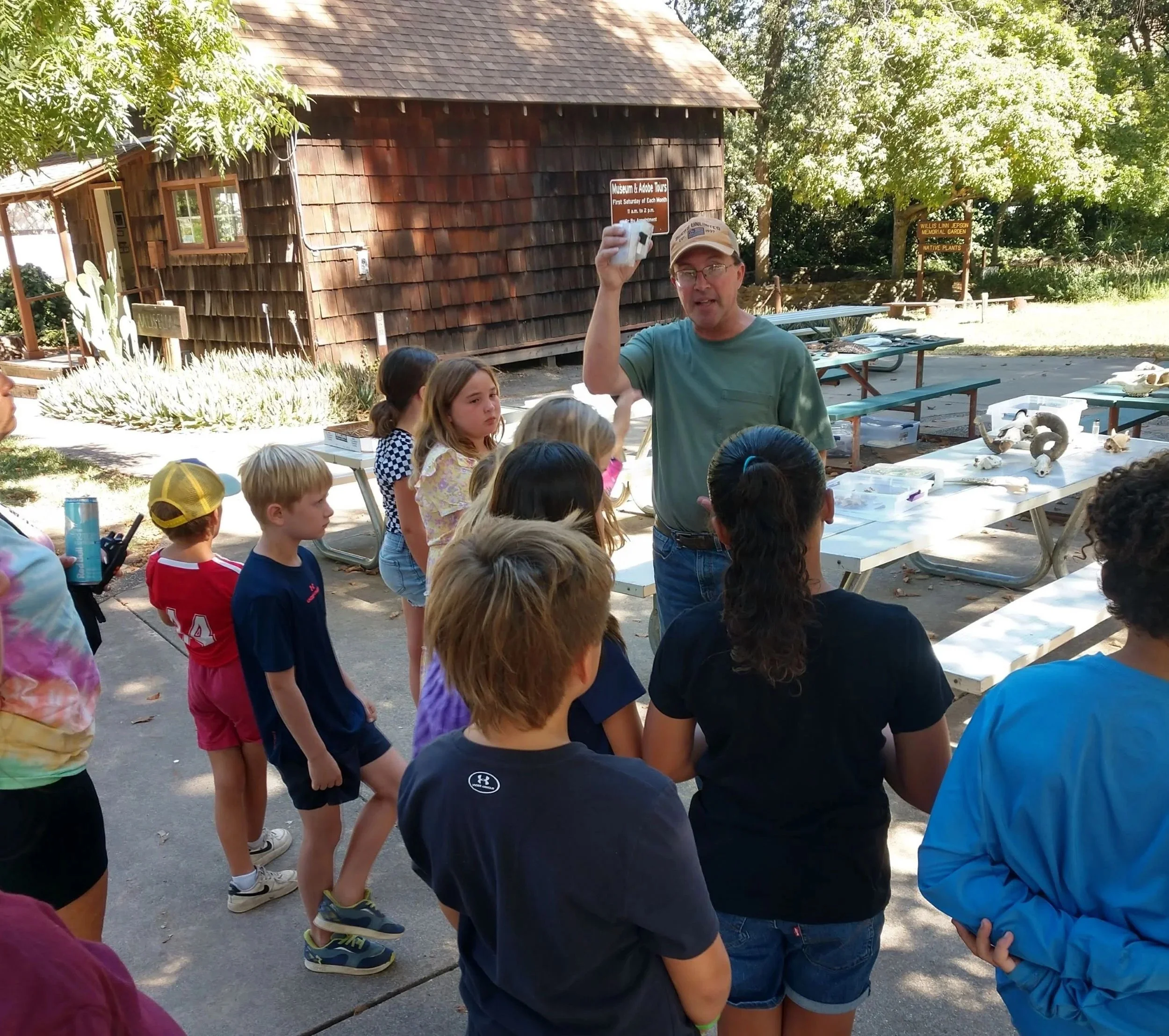
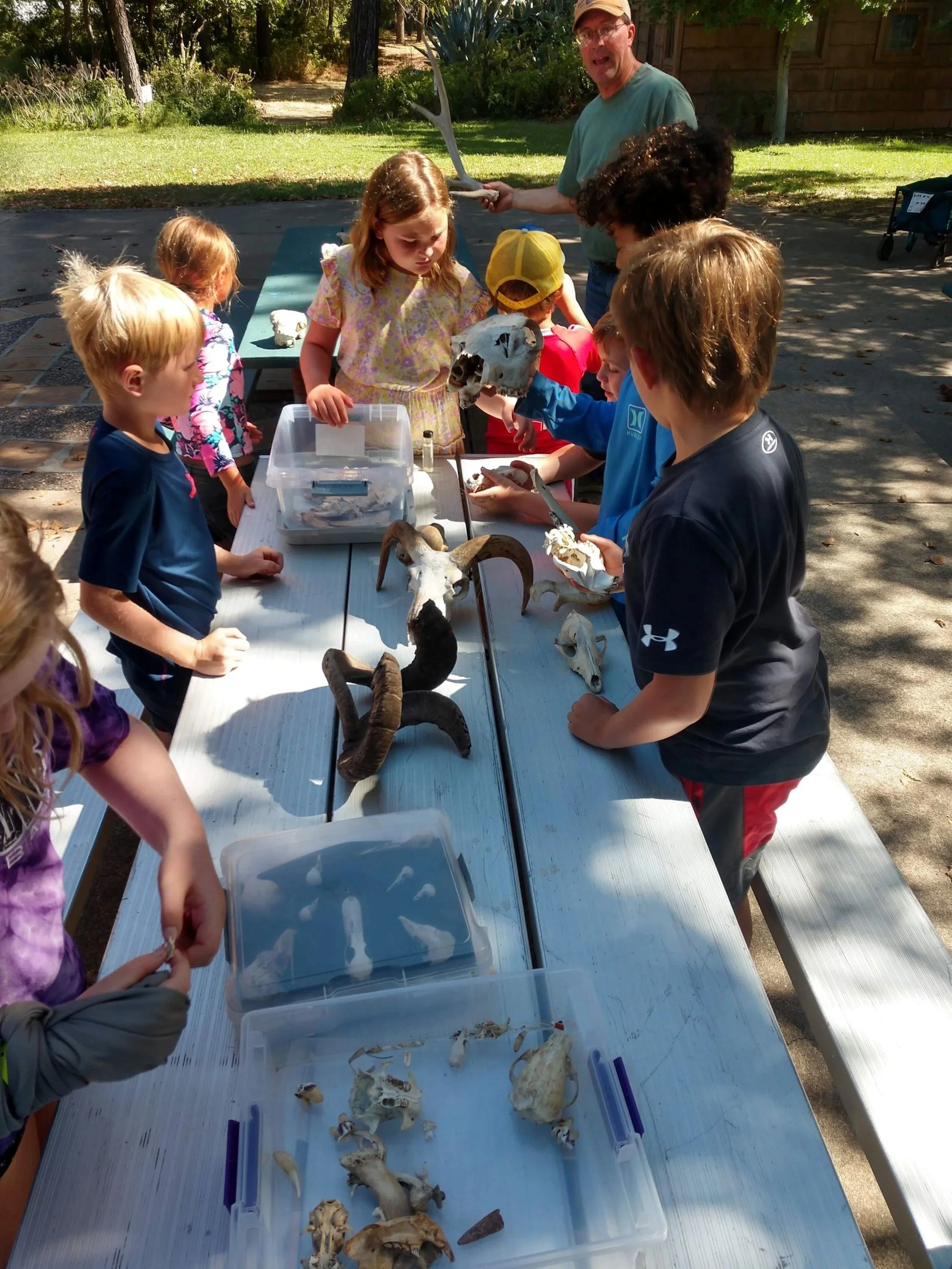
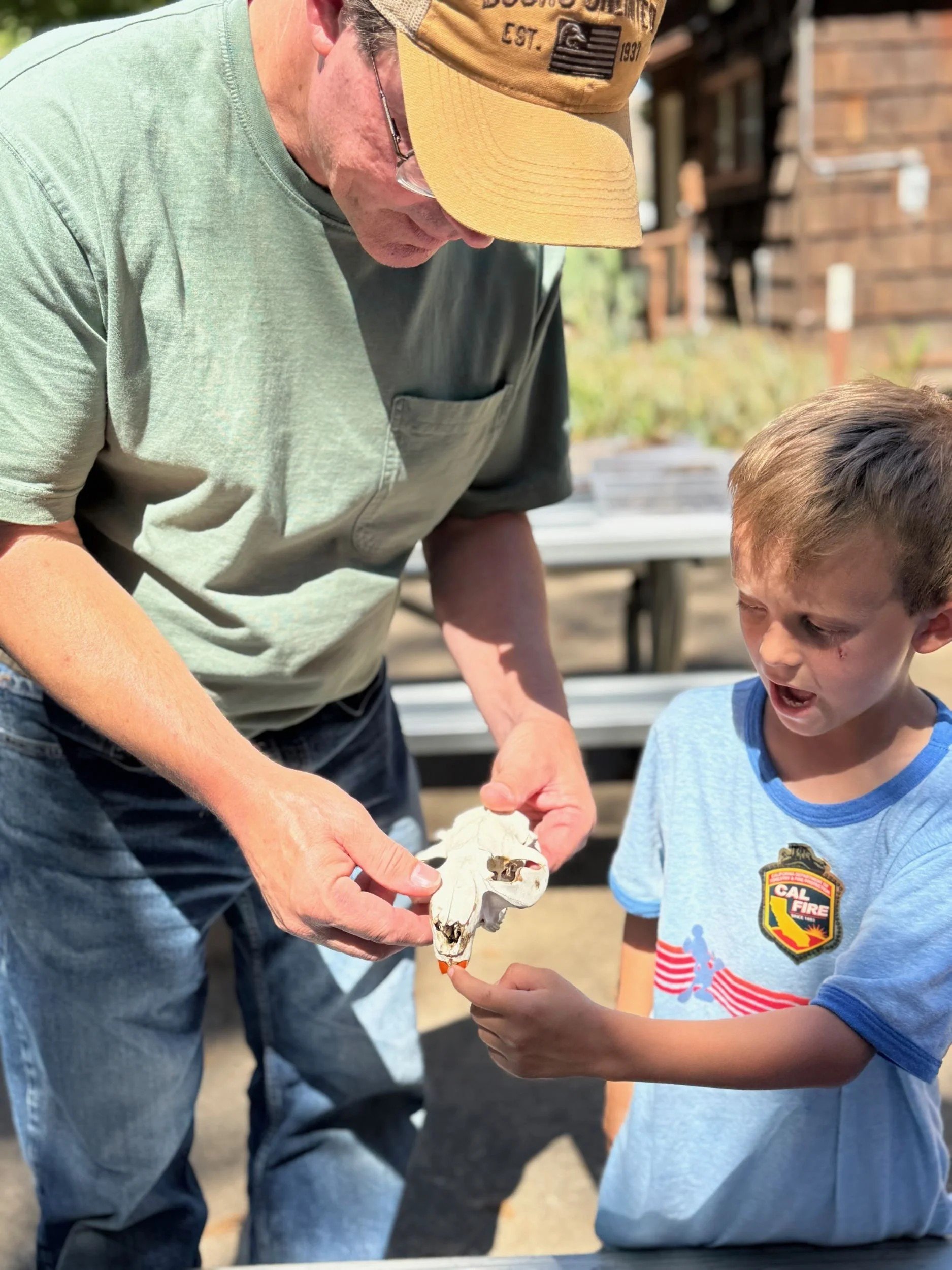
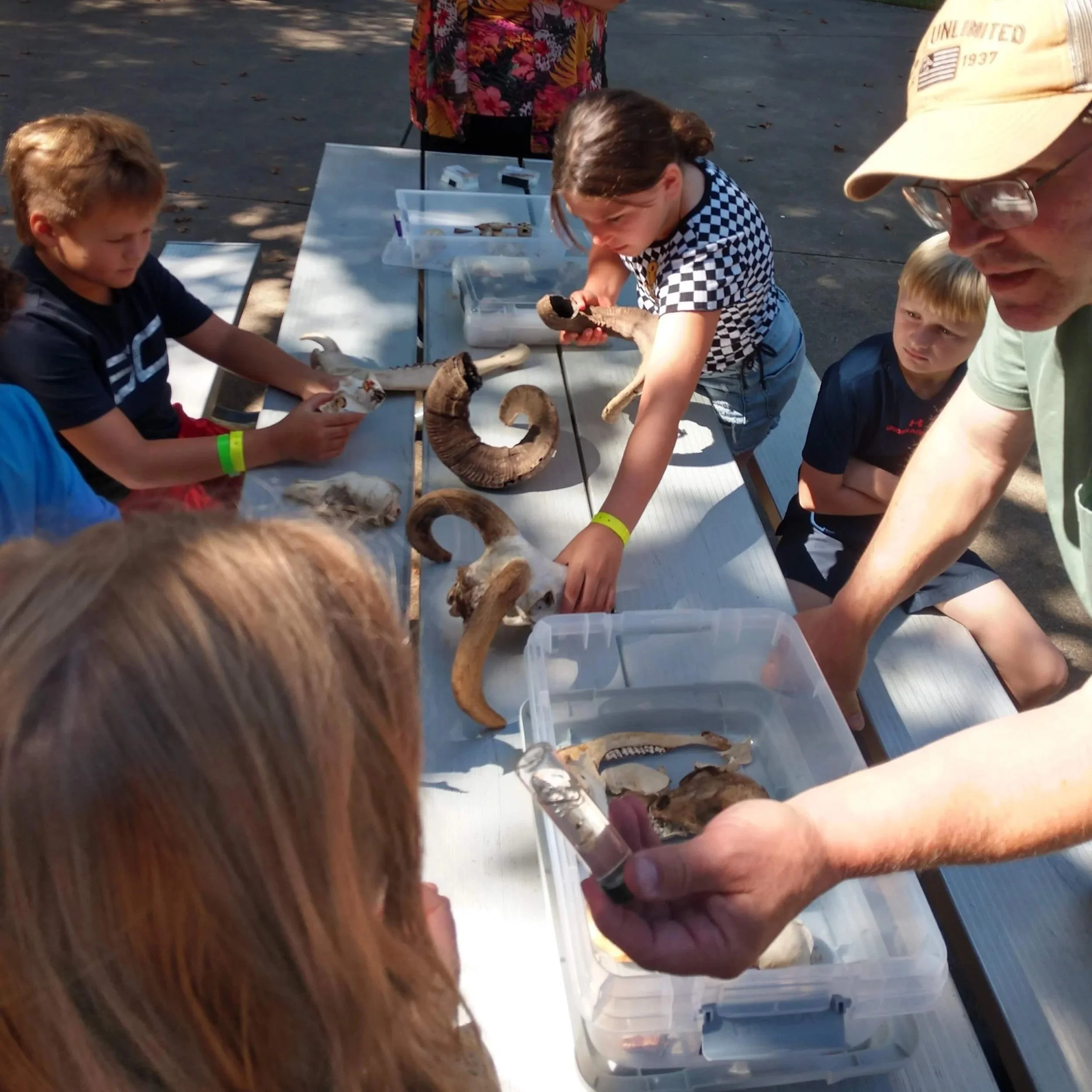
Education Committee Volunteer, Cliff Feldheim helped close-out this summer’s adventures at Camp Adobe. One of several interactive areas, Cliff shared with the kids animal skulls, feathers, scat and more. Cliff spent the day answering questions and increasing awareness, deepening the connection between the kids and the environment around them.

“We can't thank you enough for helping us to make our last week for Camp Adobe a big hit! All 43 of the kiddies enjoyed the hands-on experience with all the skulls, antlers and eggs you brought to share. We look forward to working with you again in the future!”

- Cricket Kanouff, President Peña Adobe Historical Society

September Monthly Speaker Presentation

Join us on September 18, 2025 at 7pm for Three Decades at the Bufferlands presented by Chris Conard. The meeting will be held in-person at Effie Yeaw Nature Center and online via Zoom (hybrid meeting). Registration is no longer required to attend via Zoom. The link to join the meeting is posted below.

About the Presentation

Chris has had the rare privilege of spending over 6,000 days in the field managing habitat for, monitoring, enjoying and sharing the birds at the 2,000+-acre Bufferlands surrounding the EchoWater Facility (wastewater treatment plant) between Sacramento and Elk Grove. He will share interesting finds, trends, habitat relationships, and photos of many of the nearly 250 species he has seen at the Bufferlands. He will also share a bit of the winding path that led him to the Bufferlands and the pleasure of getting to know a place so well that it is (almost) never boring.

Attend the Meeting and Presentation

This meeting will be a hybrid session. Participants can join the meeting on-site at Effie Yeaw Nature Center or from the comfort of their home via Zoom.

Attend the Meeting in Person
Chris will give his presentation live at Effie Yeaw. Registration is not necessary to attend the meeting at Effie Yeaw.

 Effie Yeaw Nature Center
2850 San Lorenzo Way
Carmichael, CA 95608

Attend the Meeting Online via Zoom
The presentation will be streamed in real time on ZOOM from Effie Yeaw. To attend the meeting via Zoom use this link below then enter the passcode.
Zoom Link for September Meeting: https://us06web.zoom.us/j/87567223170?pwd=j3AypYB5h6bpvhX8zbELT2XGGmWpow.1

Passcode for September Meeting: 658652

You do not need a ZOOM account to join the meeting. The Zoom portion of our meeting is limited to 100 participants. Participants will be admitted on a first come, first serve basis.

Help Stop the Proposed Airport South Industrial Project

The proposed Airport South Industrial Project, 6 million square feet of warehouses, is a monster that will affect the entire Natomas area by bringing in more huge trucks. Lawsuits that have been filed may slow down the project, but the ONLY way to stop it is for four members of the City Council to vote NO. That critical vote is set for August 12.

We need your City Council Member (CCM), regardless of their district, to vote NO on this project. Normally, there are nine votes on Council, but CCM Kaplan has recused herself from the vote due to the location of her residence near the project. Four “no” votes will block the project.

Everyone in the City of Sacramento can help build opposition to this project by writing to their CCM. Your CCM’s vote could be decisive. 

TAKE ACTION!

  • Attend the August 12 meeting at City Hall, 915 “I” St, Sacramento. Put the date on your calendar. Confirm the date, time and see both the Agenda and the staff report on about August 8 when it should be published on the City website.

  • Donate to oppose Airport South Industrial. Lawsuits are expensive.  

  • Email the mayor and the City Council today. Email addresses are here.

  • Please sign our petitions against this project and Upper Westside.

Send your email or make your phone call no later than August 10, 2025.

For Social Media

Social media really spreads the message – please use it! Share the two video links and the flyer.

  • Video 1 - Former Mayor Heather Fargo, shares her thoughts on the Airport South Industrial Project.

  • Video 2 - Natomas high school student and birder, MacKenzie Hollender, talks about the birds she has seen that use the excellent habitat that would be paved for Airport South Industrial.

  • Flyer - Share this flyer to let others know about the August 12 meeting. 

In the News

  •  Here is a July 16 Opinion Piece by the Sacramento Bee’s Editor, Tom Philp

Reach out to your City Council Member Today. Write Today.  They need to understand the depth and breadth of opposition.

Sacramento Audubon and ECOS are very concerned about this proposal’s plan to approve paving over farmland for megawarehouses next to residences and a school in the City. The project has impacts on air pollution that can harm children in the adjacent school yard and homes next door. Truck traffic to the warehouses will also have an impact on traffic congestion on I-5 next to the Airport. Paving over farmland for more warehouses isn’t a smart move. Farmland and habitat are disappearing while there is plenty of land already zoned for warehouses. The City needs to focus on quality of life in our neighborhoods, not building next to the airport. 

Please take a moment to contact your City Council Member and Mayor, and tell them to vote to protect our quality of life and wildlife habitat!

Thank you for your time and consideration,

Cliff Feldheim
Conservation Chair, Sacramento Audubon Society

2025-26 Duck Stamp Now Available

More than 98% of the money raised from the sale of Duck Stamps goes directly to help acquire wetlands and conservation easements for the National Wildlife Refuge System. These wetlands and easements benefit a countless number of species and are important for people too. Wetlands acquired with Duck Stamp dollars help purify water, aid in flood control, reduce soil erosion, and provide outdoor recreational opportunities. The National Wildlife Refuge System has at least one refuge in every state and territory, providing many opportunities for people to enjoy these outdoor spaces.

Physical Federal Duck Stamps are available at:

  • Most U.S. Post Offices

  • Participating sporting goods and outdoor retailers

  • Select national wildlife refuges

  • Online at DuckStamp.com, operated by the U.S. Fish & Wildlife Service’s licensed distributor, Amplex Corporation

Seasonal Sightings: June 2025

June is usually one of the slowest months for birding around Sacramento. Wintering species have left and migrants have mostly passed through. Occasionally, a late-moving rarity will appear or an unusual breeder will set up shop. While it can be slow for birders, it is one of the most important months for our local nesting birds, with a lot of breeding activity to see and document. Lingering diving ducks at the Woodland WTP included up to 25 Redheads, with breeding confirmed (eBird Checklist S249631711), and a single Greater Scaup. A Black Swift was a nice surprise on 6/5 at Audubon's Bobcat Ranch (eBird Checklist S247123732) to the west of Winters. The female Costa's Hummingbird first found at a private yard in Wilton on 8/14 (and possibly as early as July) continued. In May she fledged two young that were likely fathered by an Anna's Hummingbird. 

Migration does arrive by the end of the month in the form of shorebirds that breed outside of our area. There were building numbers of regular migrants such as Least Sandpipers, Western Sandpipers, and Greater Yellowlegs at local shorebird spots during the last few days of the month. A Snowy Plover was a nice find (eBird Checklist S249377034) at Woodland WTP on 6/11, a Least Tern was at the same location on 6/24, as was a Least Bittern reported from 6/4-6/11. A little north of the area usually covered here, but warranting a mention, was a Roseate Spoonbill photographed on Rd. 57 in Glenn County, southeast of Willows, on 6/9, and flying near Willows on 6/12. This is one of the northernmost records in Western North America, a species not yet recorded in the Sacramento Area as defined by this column, though there were multiple records of an individual just to the south of our area last year. A juvenile Brown Pelican was a nice find at the Stockton WTP on 6/21.

Notable songbird records for the month were few and far between. On 6/27, an Orange-crowned Warbler was seen carrying insect prey in its bill (indicating it was feeding young) at the Orr Forest portion of Cosumnes River Preserve (CRP). This is a rare and sporadic breeder on the flats of the Valley. For at least six years, Yellow Warblers have continued breeding in the vicinity of the Tall Forest at CRP, with at least three pairs near the Accidental Forest, and up to seven singing males west of the Tall Forest this June. At least one nest was documented fledging Yellow Warblers instead of Brown-headed Cowbirds this season. Yellow Warblers were once common nesters in the Central Valley, but were mostly gone by the middle of the last century, likely from a combination of habitat loss and cowbird brood parasitism. Perhaps they are rallying. A male Summer Tanager was reported in the publically accessible portion of CRP on 6/8 and then it or another bird was found on 6/15 near the Tall Forest. It was heard singing and seen sporadically into July.

The Sacramento Area as covered here lies between Hwy 20 to the north, Hwy 12 to the south, and the 1000-foot contour to the east and west, plus all of Sacramento and Yolo counties. Many reports first appeared on the Central Valley Bird Club listserv (groups.io/g/centralvalleybirds) and in eBird (ebird.org). It is impossible to list everyone, but we thank the following for their reports: Steve Abbott, Dan Airola, Lyann Comrack, Konshau Duman, Lynette Williams Duman, Andy Engilis, Gil Ewing, Marc Fenner, Susan Goodrich, Joshua Greenfield, Cliff Hawley, Chris Henry, Emmett Iverson, Eric Johnson, Julian Johnson, Jeri Langham, Andrew Lee, Rondine Mangrum, Mark Martucci, Michael Perrone, Zane Pickus, Linda Pittman, Steve Scott, Sean Smith, Kevin Thomas, and John Trochet. Thanks to everyone for their reports--without them, this column would not be possible.  

- Chris Conard

More Seasonal Sightings

Field Trip Findings June 14 to July 12, 2025

SAS Field Trip: Sailor Bar, 06/14/2025

Leaders Mary Forrestal and Jane Van Kessel reported: What a beautiful morning for a walk. Thirteen of us enjoyed the cooler temperatures and Sailor Bar proved once again that birding in the summer is worth the effort. The regulars dominated the morning with Oak Titmice, Bushtits, Bewick’s Wrens, and Spotted Towhees singing us along. The group enjoyed discussing the different ways to distinguish between swallows and swifts, the different types or swallows (Cliff, Tree, and Northern Rough-winged were all seen), and Black-chinned vs. Anna’s Hummingbirds. It was a great morning for raptors. Swainson’s Hawk, Red-shouldered Hawk, Red-tailed Hawk, Turkey Vulture, White-tailed Kite, and Bald Eagle were all seen. The Bald Eagle even put in a second appearance, seen at both the beginning and towards the end of the trip. There was only one Great Blue Heron juvenile still in the rookery but plenty of others were flying about, along with Green Herons and Great Egrets. If you’d like to see the complete list of birds recorded on the walk, it is here: https://ebird.org/checklist/S250280565.

SAS Field Trip: June Singers at the Bufferlands, 06/15/2025

Leader Chris Conard reported: Seventeen of us enjoyed a cool morning that warmed up as the day progressed. Almost immediately, we heard a Blue Grosbeak singing, but it took a little while to zero in on the bird. We saw at least three of them, plus abundant Song Sparrows, and Common Yellowthroats. Other highlights included flocks of American White Pelicans, Double-crested Cormorant nests with young, Cooper's, Swainson's and Red-tailed Hawks, a Pied-billed Grebe with two young, good numbers of herons and egrets, a fairly cooperative Belted Kingfisher, Ash-throated Flycatchers, and singing Black-headed Grosbeaks. View the checklist at https://ebird.org/checklist/S250748173

SAS Field Trip: William Pond Park, 06/21/2025

Leader Rachael Cowan reported: I gathered with 8 birders at William B. Pond on an early mid-June morning and we all shared gratitude for a beautiful day that could have been significantly warmer. Our group was a mix of familiar and new faces, including three younger women who shared it was their first time out birding “officially.” The group welcomed their excitement in shifting from backyard birds to something new. A male California Quail kindly posed atop a brush pile on the other side of the bike trail, offering a perfect subject for binocular focus tips for our new birders. We discussed the sentineling behavior and how it is a crucial survival tactic for quail, helping them to avoid predation. As we passed through the blackberries lining the path we paused to take in the morning chorus and observations of Spotted and California Towhees, as well as some Bushtits working the leaves deep within a dense live oak. Lesser Goldfinches were checking the fennel for seeds and as a House Finch was singing at the top of a nearby tree. Mourning Doves were switching from ground to trees, and we wondered if there were some recently fledged doves waiting for food deliveries on the ground. We were trying to make out a couple of sparrow-sized birds that switched from a treetop to the power lines and realized they were juvenile Brown-headed Cowbirds when we saw and heard them vocalize. I wondered if we were watching juveniles who recently found their true flock by responding to the adult’s chatter. We began to lament at the frequent observance of the cowbirds while remarking on the extraordinary conservation practices by the species.

I thought I heard a flicker in the distance, but then we set our sights on a Northern Mockingbird pair, and I doubted my ear on the flicker. Just then we turned to face the sound of a Common Raven and saw five fly over in a group. The population has been growing on the Lower American River, and I wondered if this is a family of the season. We headed down toward the river and stopped to take in a call. It was a Common Yellowthroat! We never set eyes on the bird, but we all clearly heard the repeating whitchity-whitchity-witch. At the beach, we observed a wonderful assortment of species working their usual areas. A group of older Mallard ducklings greeted us at the edge of the water with their mother and a male further out. A Great Egret was hunting in the water near an island of nesting Canada Geese, and it startled a Spotted Sandpiper who flew away to another shore spot with a Green Heron and a Killdeer, and a Black Phoebe was fly-catching from a perch in the irises. A Double-crested Cormorant landed on a log, and I encouraged the new birders to look at their eyes through the spotting scope. And then one of the young women pointed out a white bird and we all were delighted to tell her she found a White-tailed Kite, and I once again encouraged her to look at the eyes. We observed Tree Swallows, Cliff Swallows, and a White-throated Swift move through the scenery. We spotted both Downy and Nuttall’s Woodpeckers as we headed to check on the rookery, which still had Great Blue Heron nestlings. It was a really fulfilling visit at the river! On our way back, we heard that flicker sound again and one of the birders saw a pair of Northern Flickers in a distant treetop. It was a great way to wrap up the trip. We had a total of 43 species on our checklist.

SAS Field Trip: Loney Meadow, 06/22/2025

Leader Sonja Sorbo reported: A beautiful summer day provided a lovely backdrop for our group of four birders. We made a brief stop at the Discovery Trail off Bowman Lake Road and were lucky enough to spot a MacGillivray’s Warbler and a Lazuli Bunting —the latter was singing in full sunlight at the top of a nearby pine tree. A couple of miles farther down the road, we stopped the vehicle to watch a pair of Townsend’s Solitaire chase each other; they landed on a log just across the road. After arriving at the Loney Meadow trailhead parking lot, we stood near the vehicles and sighted and heard over half a dozen bird species within just a few minutes. Red-breasted Nuthatch, Mountain Chickadee, Western Tanager, Yellow-rumped Warbler, Steller’s Jay, Cassin’s Finch, Warbling Vireo, and American Robin all welcomed the morning with song.  The theme of the day seemed to be “warblers and woodpeckers” — we had nice views of Red-breasted Sapsucker, Hairy and White-headed Woodpecker, and Northern Flicker while ambling down the trail through conifers. Once we reached a creek area with alders, we spotted Nashville, Wilson’s, Orange-crowned and Yellow Warblers. However, the command performance was given by a group of at least six MacGillivray’s Warblers who were bouncing around in a large swath of mountain whitethorn. We all had never seen so many of this species in such close proximity, so it was a memorable experience.

As we passed by the meadow area, we noted Red-winged and Brewer’s Blackbirds and heard a Song Sparrow. The real treat here was a Wilson’s Snipe who flew right at us before diverting at the last second, circling back to the meadow. On a slope on the other side of the trail, numerous Dark-eyed Junco hopped about, ignoring the Green-tailed Towhee that passed next to them. High in the conifers, a Western Wood-Pewee called while his cousin, the Olive-sided Flycatcher, asked for “quick three beers” leaving no doubt as to its identity! At our lunch stop we were entertained by several Fox Sparrow (including a Thick-billed) and a Black-headed Grosbeak, bringing our bird tally for the day to 30 species.

Young Birders Club Field Trip: Capay Open Space, 06/28/2025

Leader Mackenzie Hollender reported: Four other young birders and three parents met my father and I on this very hot afternoon at the Capay Open Space Park. Later in the evening, another young birder and another parent joined us. We noted the Tree Swallows flitting overhead, and a fly-by Swainson's Hawk while standing in the parking lot. As we headed down to the riverbed, we noticed many fly-by Mourning Doves, a calling Killdeer, and silhouetted hummingbirds zipping around the cottonwoods. We traveled along the riverbed until we were facing a small cliff wall with many holes near the top—a Bank Swallow colony. We spent a good amount of time watching these uncommon birds hunt high above the water and occasionally fly into burrows. We noted the bird's brown band across the chest and white face, differentiating it from the similar Northern Rough-winged Swallows that were also in the area. Also, at the site of the colony, multiple American Kestrels provided great looks as they perched in the bare trees above the cliff. From there we headed back along the riverbed and birded the perimeter of the entrance of the park. We got great looks at a California Towhee calling from some scrub. Nuttall's Woodpeckers trilled in the distance, and California Scrub Jays perched while holding their bills open to provide themselves with relief against the heat. Lark Sparrows landed at the top of a bare tree, a few California Quail scurried into cover, and a Western Kingbird foraged in an elderberry bush in the back of the parking lot.

At 7:25 we headed towards the far end of the park to look out along the riverbed to see nighthawks, along the way spotting a family of four Ash-throated Flycatchers in a pine. At 7:32 pm our first Lesser Nighthawk flitted on bouncy, butterfly-like wingbeats above the riverbed. A few more solo nighthawks rose from the riverbed and traveled along it throughout the 7 pm hour. Once we arrived at the barbed-wire fence, we saw a head peeking out of a hole in a large square nest box, the unmistakable face of an American Barn Owl. We admired the bird from a respectable distance. From there, we walked to a nice spot that overlooked the riverbed and waited for more nighthawk activity to begin. Around 8:15, a group of three nighthawks began flying low over the open ground, back and forth. We watched one of the birds pursue close behind a second bird with its white throat puffed out. Further into the evening, two more nighthawks flapped higher in the sky and traveled in very close proximity to our spot, providing stellar looks at the glowing white wing bars and intricate patterns of dusty brown, buffy, and darker brown. We were also able to admire a perched nighthawk on a piece of dead wood, and could hear its faint, eerie toad-like trill. While we were nighthawk watching, a Northern Mockingbird with a spot-on Western Kingbird impression melodied us. More and more nighthawks came into view from all directions as the evening advanced until our count stood at about 20. Overall, it was an incredible experience to get to know these unique birds in one of their northernmost breeding areas.


SAS Field Trip: Yuba Pass and Sierra Valley, 06/28/2025

Leader Chris Conard reported: Twelve of us had a very enjoyable, if a little warmer than ideal, day in the mountains around Yuba Pass and Sierra Valley. Highlights early included Band-tailed Pigeons, White-headed Woodpecker and Red-breasted Sapsucker nests, Swainson's and Hermit Thrushes singing, Evening Grosbeaks, Cassin's Finches, Red Crossbills, Wilson's, Hermit, and Yellow-rumped Warblers, and Lazuli Buntings. We happened upon an open house at the SFSU Sierra Nevada Field Campus and got to learn a little about the site's operation and courses and see a video of an aplodontia (aka mountain beaver). In Sierra Valley, we enjoyed expansive views and a mix of wetlands and sage/grassland species. Highlights there included Sandhill Cranes, White-faced Ibis, Osprey, Bald Eagle, Horned Larks carrying food for young, hundreds of swarming Cliff Swallows, Sage Thrashers, Vesper and Brewer's Sparrows, and hundreds of Yellow-headed Blackbirds. A Wood Duck at the last pond was unexpected, and a small herd of pronghorns in Sierra Valley was a welcome surprise.


SAS Field Trip: Donner Summit, 07/05/2025

Leader Peter Perrine reported: One intrepid Birder made the trip from Sacramento to join my wife and me for an easy wander through the conifer and riparian habitats of Donner Summit. We found the usual Sierran birds and were continually serenaded by many Dark-eyed Juncos and Fox Sparrows. We all had great views of singing Green-tailed Towhees and Townsend’s Solitaires, with nice views of MacGillivray’s and Wilson’s Warblers. We were surprised and pleased to see a beautiful male Williamson’s Sapsucker and a flyover Common Nighthawk. All in all, 30 bird species, beautiful weather, lots of wildflowers and views, and good company made for a most enjoyable morning.

SAS Field Trip: Van Vleck Meadows/Tells Creek, 07/06/2025

Leader Craig Swolgaard reported: Seven of us drove to Van Vleck Meadow, stopping at the Cheese Camp Road Pond on the way. We totaled 32 species between the two locations. Van Vleck Meadow was alive with birds as we circled it in a 4-hour walk. The meadow was wet and full of wildflowers. The meadow itself offered 29 species, including White-crowned, Lincoln’s, Song, and Thick-billed Fox Sparrows, Green-tailed Towhee, Red-breasted Sapsucker, four warbler species, and a surprise Pygmy Nuthatch. The pond, with 10 species & one taxa, had breeding Ring-necked ducks, Pied-billed Grebes, Red-shouldered Hawk, and a group of six Common Nighthawks that were soaring over the water.

SAS Field Trip: Carpenter Valley, 07/09/2025

Leader Dana Miller-Blair reported: We gathered at the trailhead to Lower Carpenter Valley Trailhead and spent about 30 minutes listening to and seeing a multitude of species in the parking area before we set off on our hike. The weather was about 78 degrees and sunny with a light breeze. The meadows along the creek were filled with wildflowers and there were still a few patches of snow in the surrounding mountains. Two of our group saw Mountain Quail on the dirt road driving in and one other of our party heard them. In the parking lot we saw a Black-backed Woodpecker and 2 Red-breasted Sapsuckers, as well as a Townsend's Solitaire and a Black-headed Grosbeak. Song Sparrows were singing. As we set off on the trail, we heard Golden-crowned Kinglets and saw 2 Brown Creepers. As we walked along, we puzzled over flycatchers, seeing many Western Wood-Pewees (including a nest with 2 nestlings), an Olive-sided Flycatcher and at least one Hammond's Flycatcher which was high in the conifers. Most of the flycatchers were quiet, which made identification a bit challenging. The well-maintained trail follows Prosser Creek with some areas of boardwalk over marshy areas. We saw and heard many Warbling Vireos and heard one Cassin's Vireo. We saw and heard several  Mountain Chickadees, and we heard at least 2 Red-breasted Nuthatches.

Overhead, there were 2 Common Ravens, and we enjoyed watching 2 Kestrels being chased by a Brewer's Blackbird. We heard, but did not see, Northern Flickers. There were several female Western Tanagers and one male Western Tanager. We enjoyed listening to White-crowned Sparrows in the willows along the creek and watched one Fox Sparrow in the woods along the creek. There were numerous Dark-eyed Juncos. We would have liked to see more warbler species, but did see several Yellow Warblers and a couple of beautiful male Yellow-rumped Warblers. There were a few American Robins and at least one Red-winged Blackbird. These are usually more numerous near the private property along the route, but, unusually, there was noisy construction activity there, which probably caused these birds to hide. Nearing the bridge, we heard White-headed Woodpeckers and also the distinctive song of the Swainson's Thrush. We looked hard for these birds but did not see them. After 2 miles on the trail, we had lunch at the bridge over Prosser Creek and then came back via the dirt road, hoping to see more woodpeckers in the forest. We did see 2 more Red-breasted Sapsuckers. One of our group stopped behind the rest of the group to rest in the shade and was lucky enough to see a silent Pileated Woodpecker. The rest of us went back but could not re-find it. The highlight of the trip was watching Sooty Grouse—a mother and 3 babies. The mother stared at us curiously for some time, before hopping up on the boardwalk to cross to the other side, with her 3 chicks following her.

SAS Field Trip: Wrights Lake, 07/12/2025

Leader Rich Howard reported: Ten folks joined this trip to escape the valley heat (20 degrees cooler up there!) and see some mountain birds. Wildflowers were abundant and the water in the lake and creek looked refreshing. Bird highlights of the day were many fledglings - begging Mountain Chickadee puffballs, striped young Dark-eyed Juncos, adorable tiny Spotted Sandpipers bobbing their tails just like their parents, long lines of Bufflehead and Common Mergansers following mom. We were able to observe the contrast between the “dirty vest” of numerous Western Wood-Pewees and the “clean vest” of the larger Olive-sided Flycatcher. Woodpeckers showed in fine form - three Red-breasted Sapsuckers at close range, a young male Black-backed Woodpecker pounding away at a large dead tree at the lunch stop, and a male Williamson’s Sapsucker low in trees on the return trip. We had 30 species in all (including a hummingbird too quick to ID to species); a trip report can be found here: https://ebird.org/tripreport/393969

Sacramento NWR Closed to Public

From U.S. Fish & Wildlife Service

Starting Monday July 14, there will be an estimated three-week full closure of the Sacramento NWR to the public (no access to the auto tour, visitor center, bathrooms and trails) while construction crews replace a culvert under the entrance road. This is a temporary closure. Please visit other parts of the Refuge Complex during this time, and check www.fws.gov/refuge/sacramento or on social media to know when the Sacramento NWR is back open to the public.

You can read more about the project in this Press Release from Project Leader Sharon Vaughn.

UC Davis Grad Students at Bobelaine

Another Education Committee adventure on July 1, 2025 - SAS Volunteer, Rich Howard, met with a group of University of California, Davis students and educators to consider local freshwater ecosystems at Bobelaine Audubon Sanctuary. The goal was to learn about regional bird communities and their connections to riparian and wetland habitats.

The group, part of the NSF IRES ASI: Freshwater Ecosystems program were participating in a field-based educational experience for graduate students focused on freshwater ecology and environmental systems across California and the Italian Alps.

Speaking with UCANR Rice farming expert.

Rich, 
Thank you so so so much for joining us yesterday! Your knowledge and insight is incredible, I personally loved the way you told the history of the area and put the bird migratory patterns in the context of the river systems. We are so grateful for the time and energy you put into hanging out with us.
- Kira

Walking and discussing the ecosystem at Bobelaine with Rich Howard.