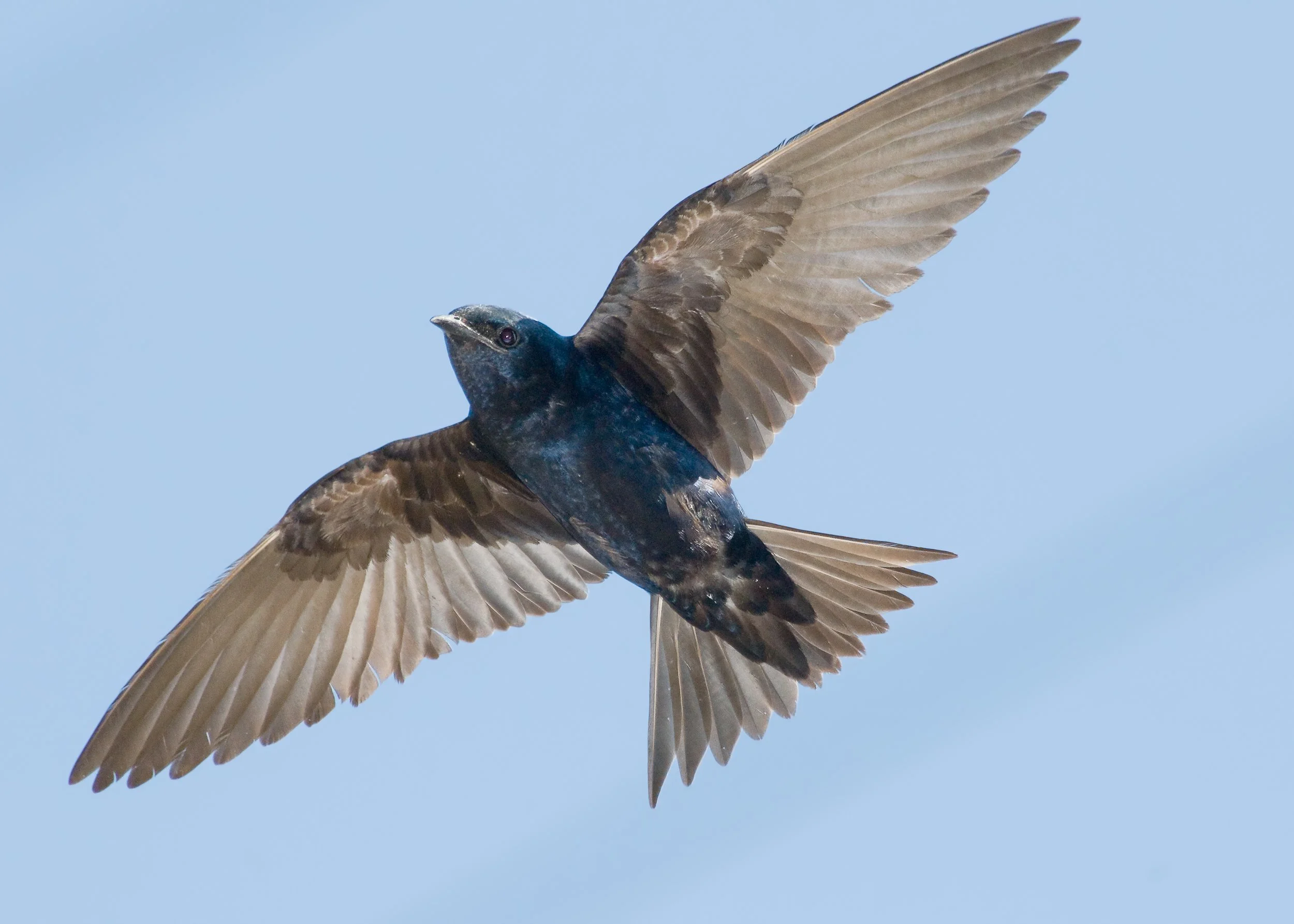
Sacramento Bird of Note: Purple Martin

Sacramento Birds of Note are birds who as a species or subspecies are of special concern or interest in the Sacramento region.

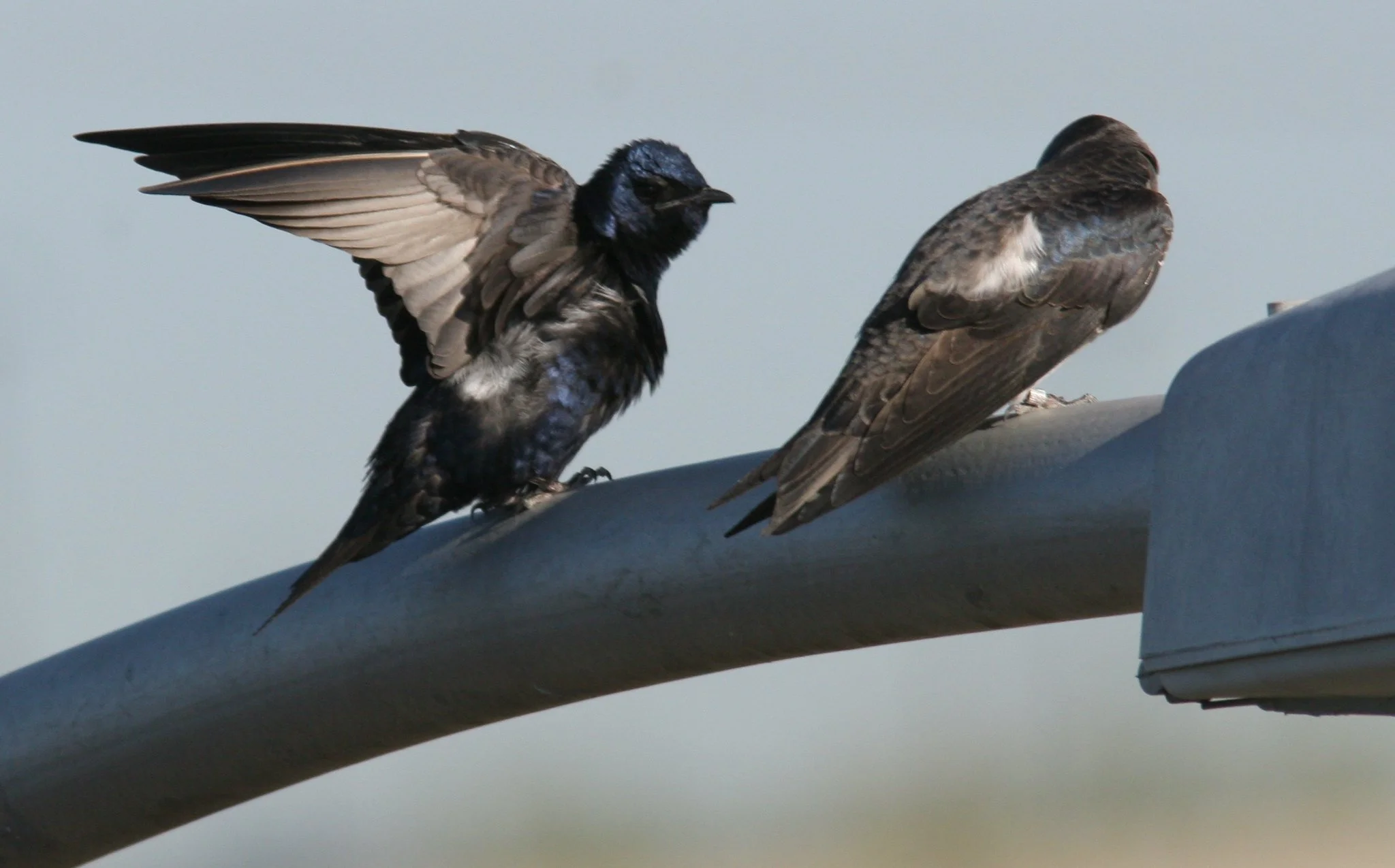
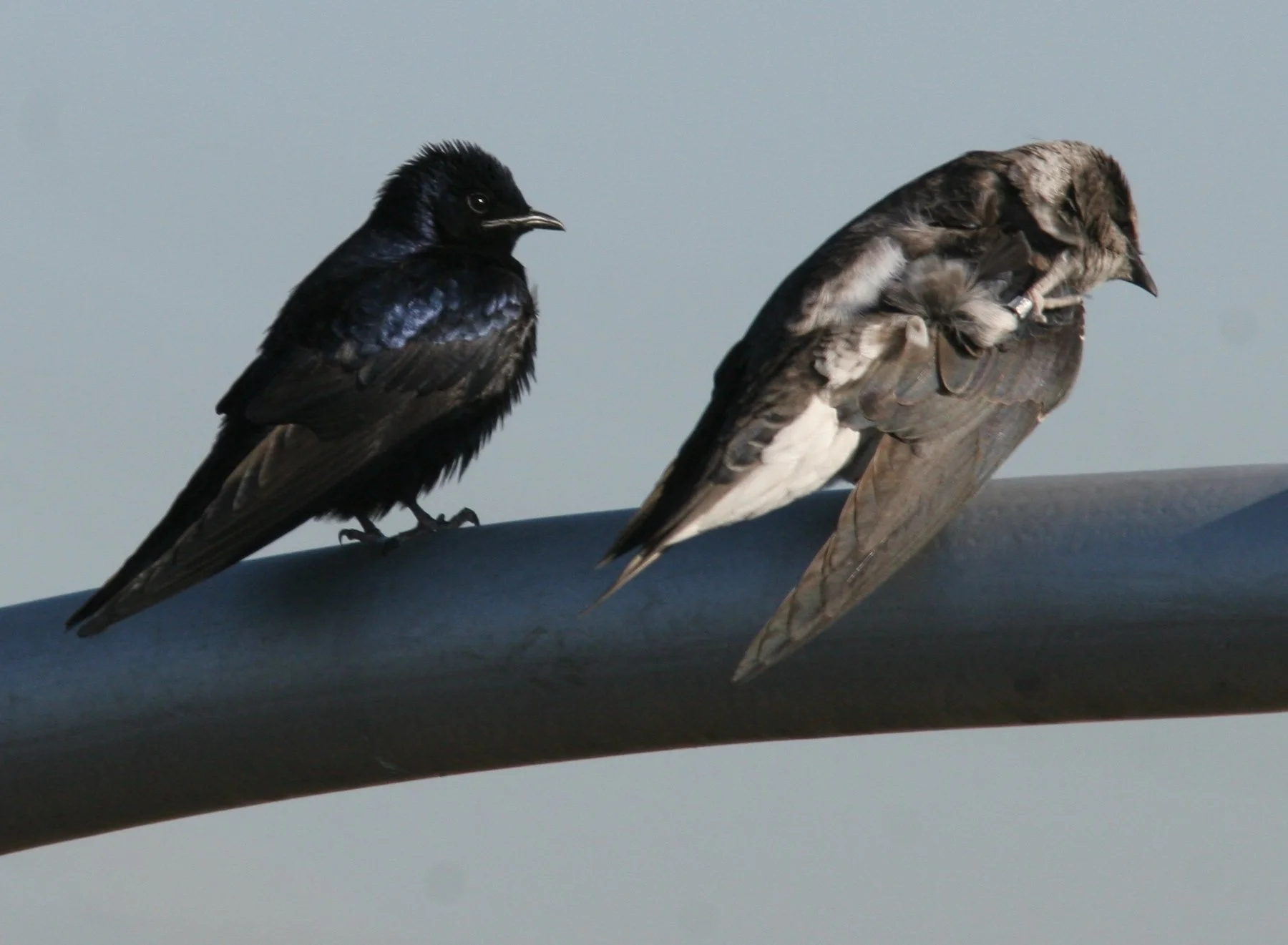
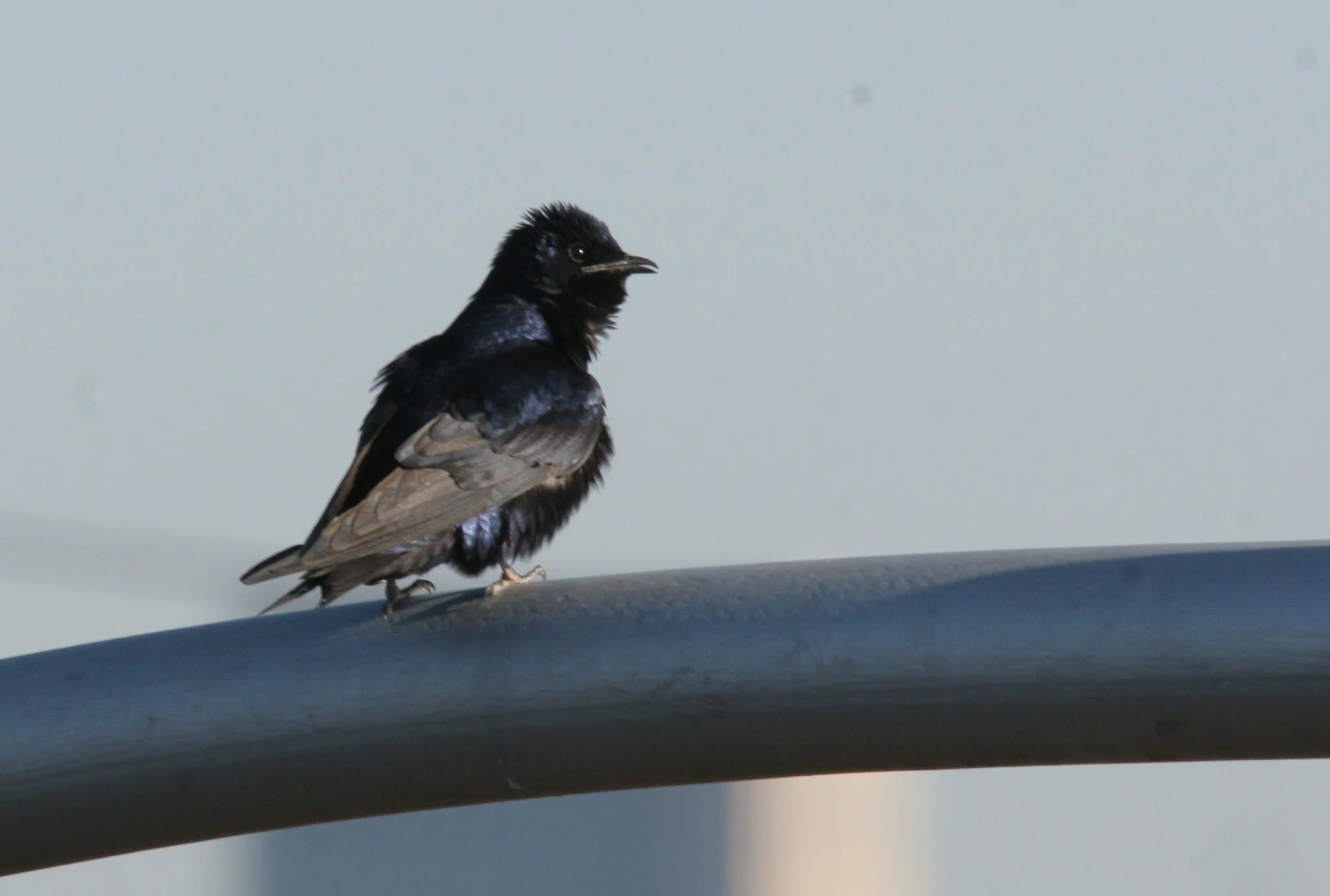
Purple Martins are summer residents that live and breed in colonies in the Sacramento Region. Unfortunately, the number of breeding colonies in our region has been in drastic decline. According to research by Dan Airola, “the Sacramento population declined by 88% between 2004 and 2019, to only 21 nesting pairs.”
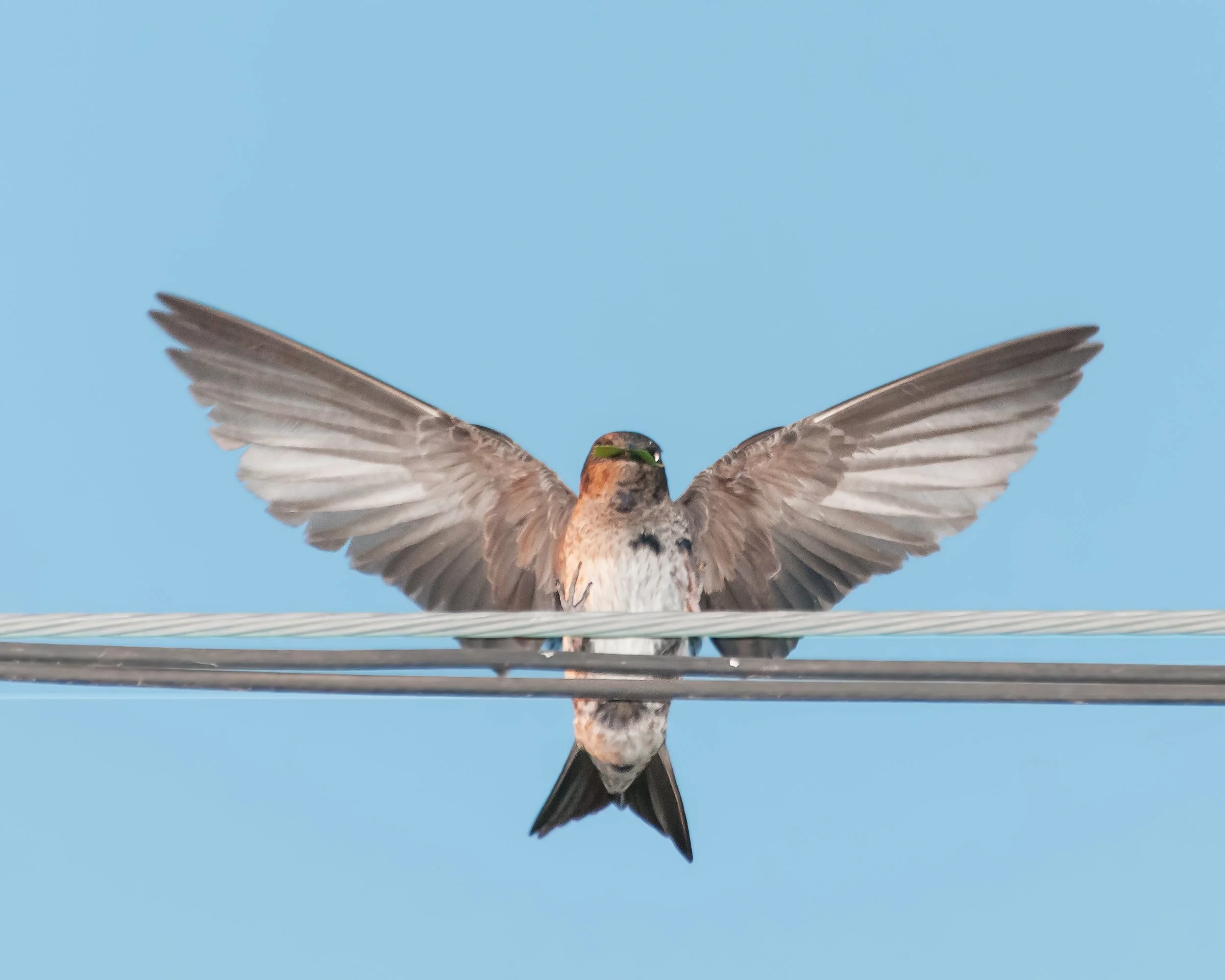
Life Under the Fast Lane, a comprehensive report on long-term studies of the Sacramento population of Purple Martins is available for purchase through the Central Valley Bird Club and was published with support from the Sacramento Bird Alliance.

In October 2025, Dan Ariola presented Status and Conservation of the Purple Martin in California in 2025 at the Sacramento Bird Alliance Monthly meeting. You can watch a video of the presentation here.
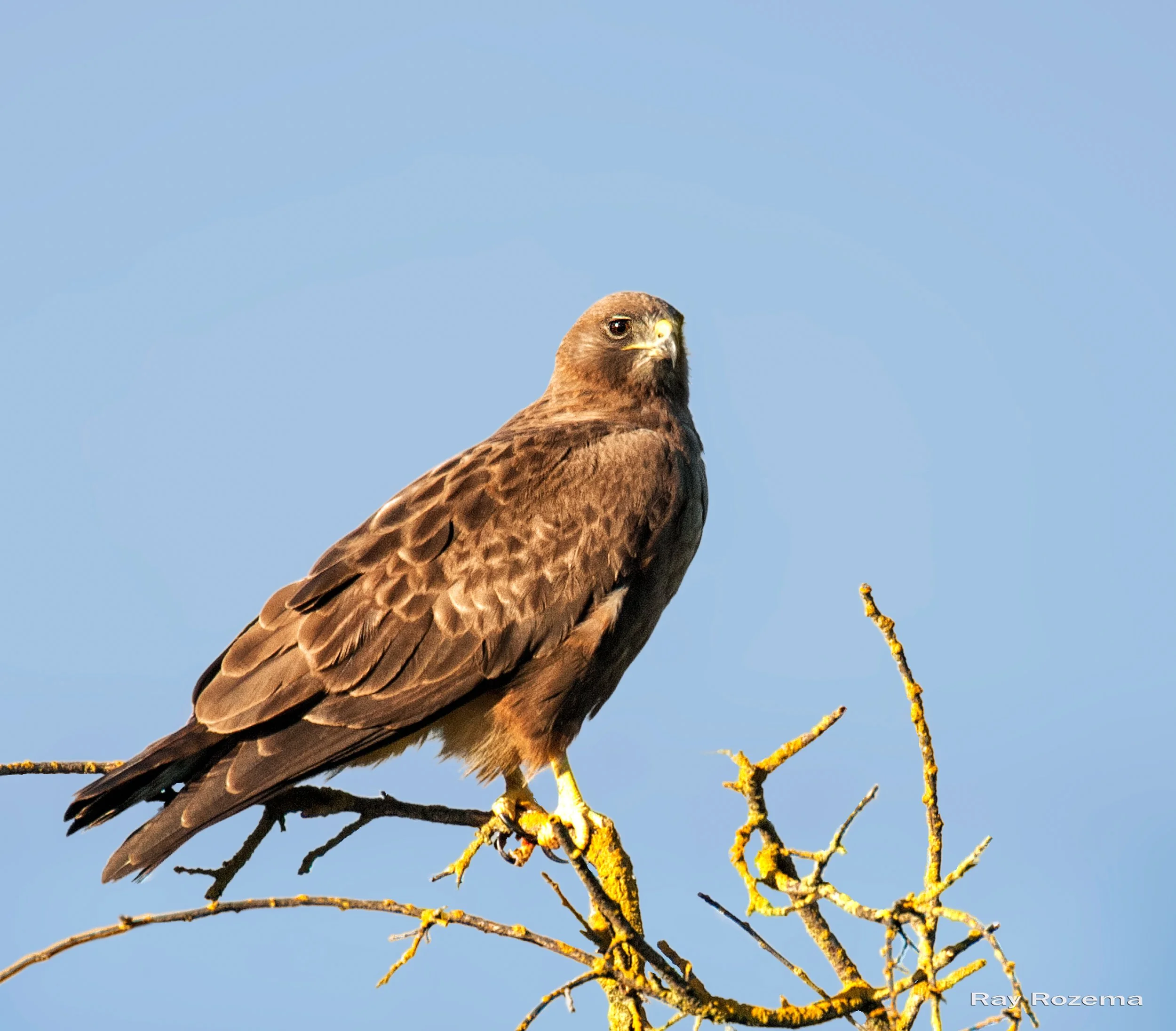
Sacramento Bird of Note: Swainson's Hawk

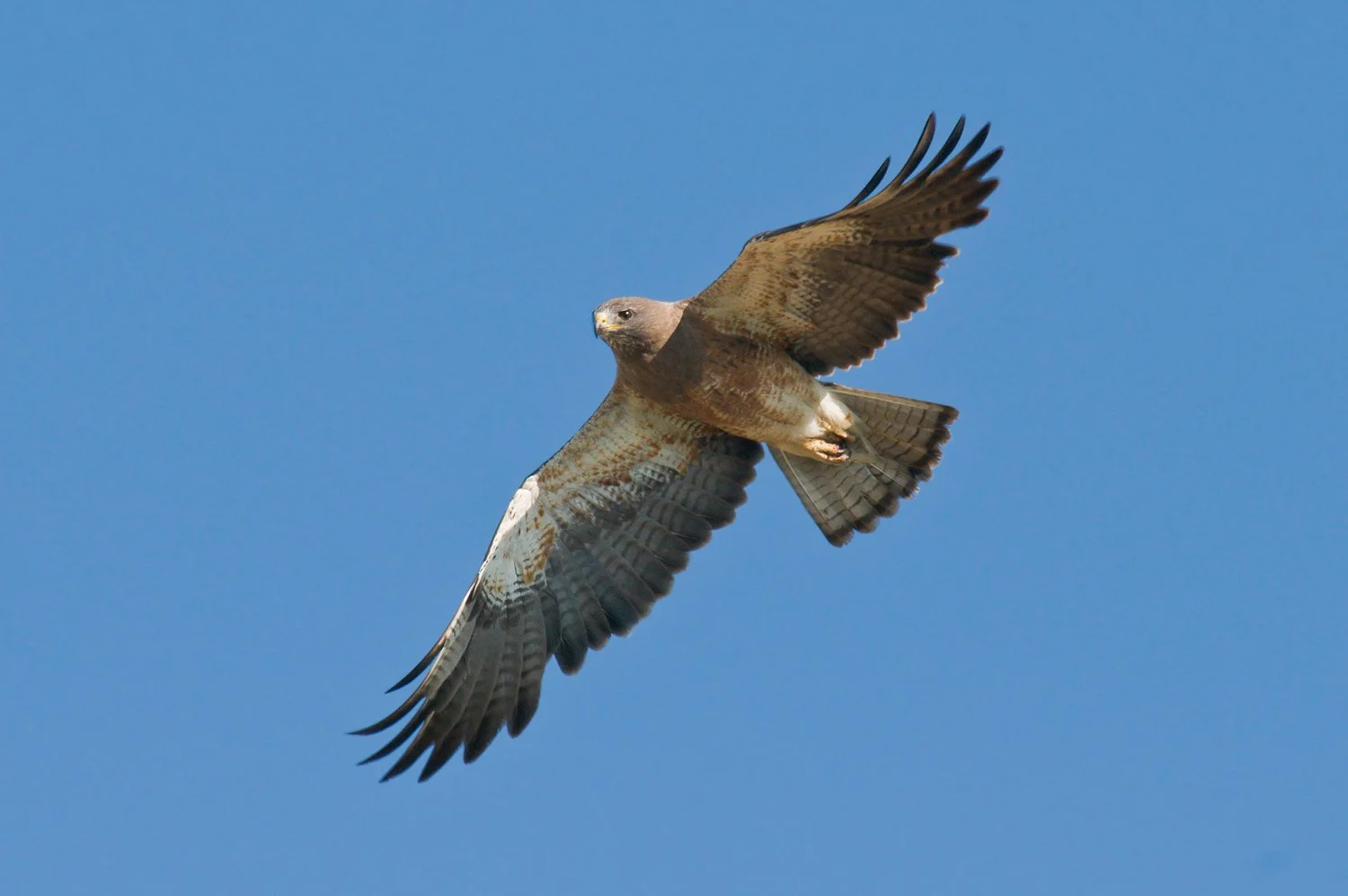
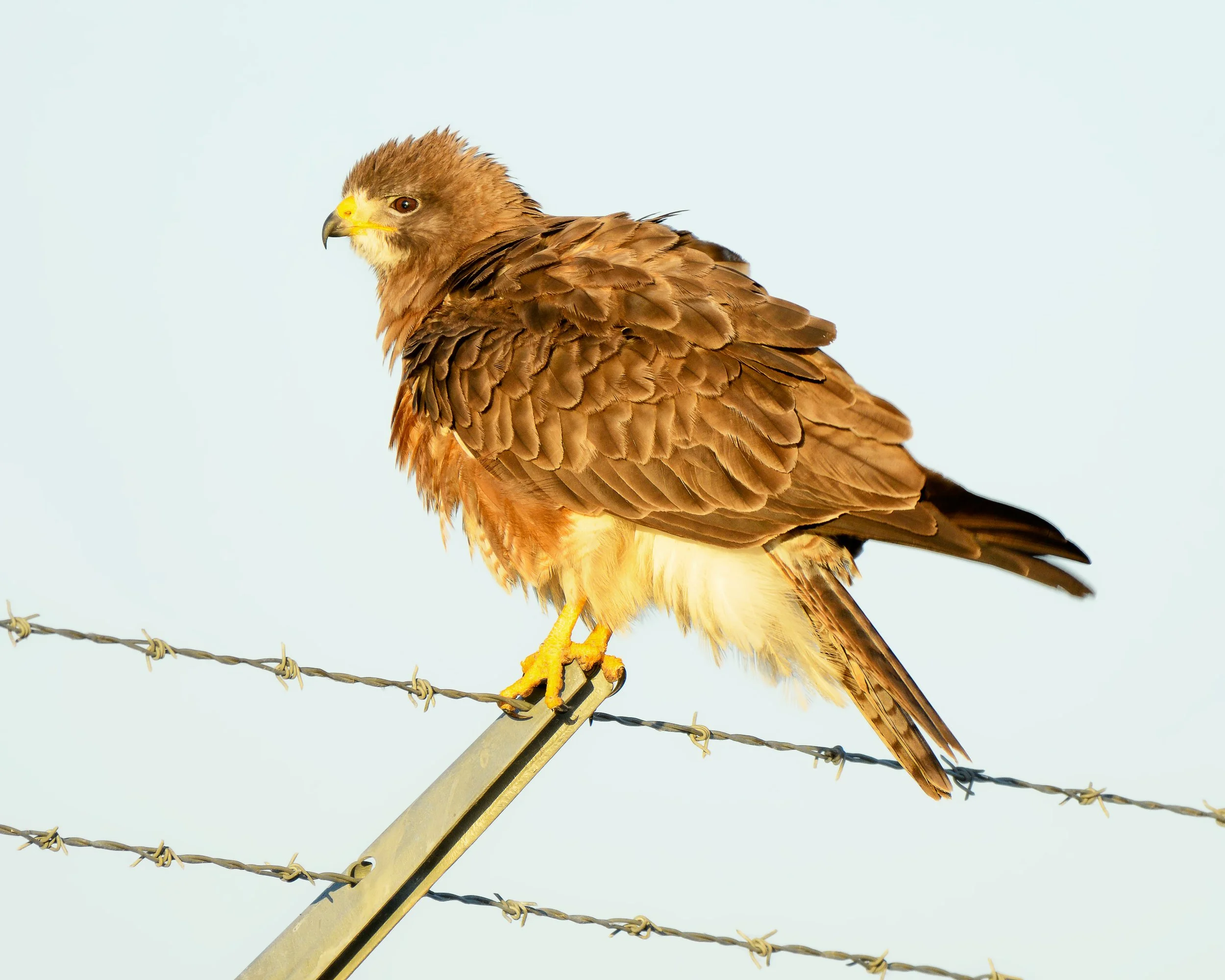
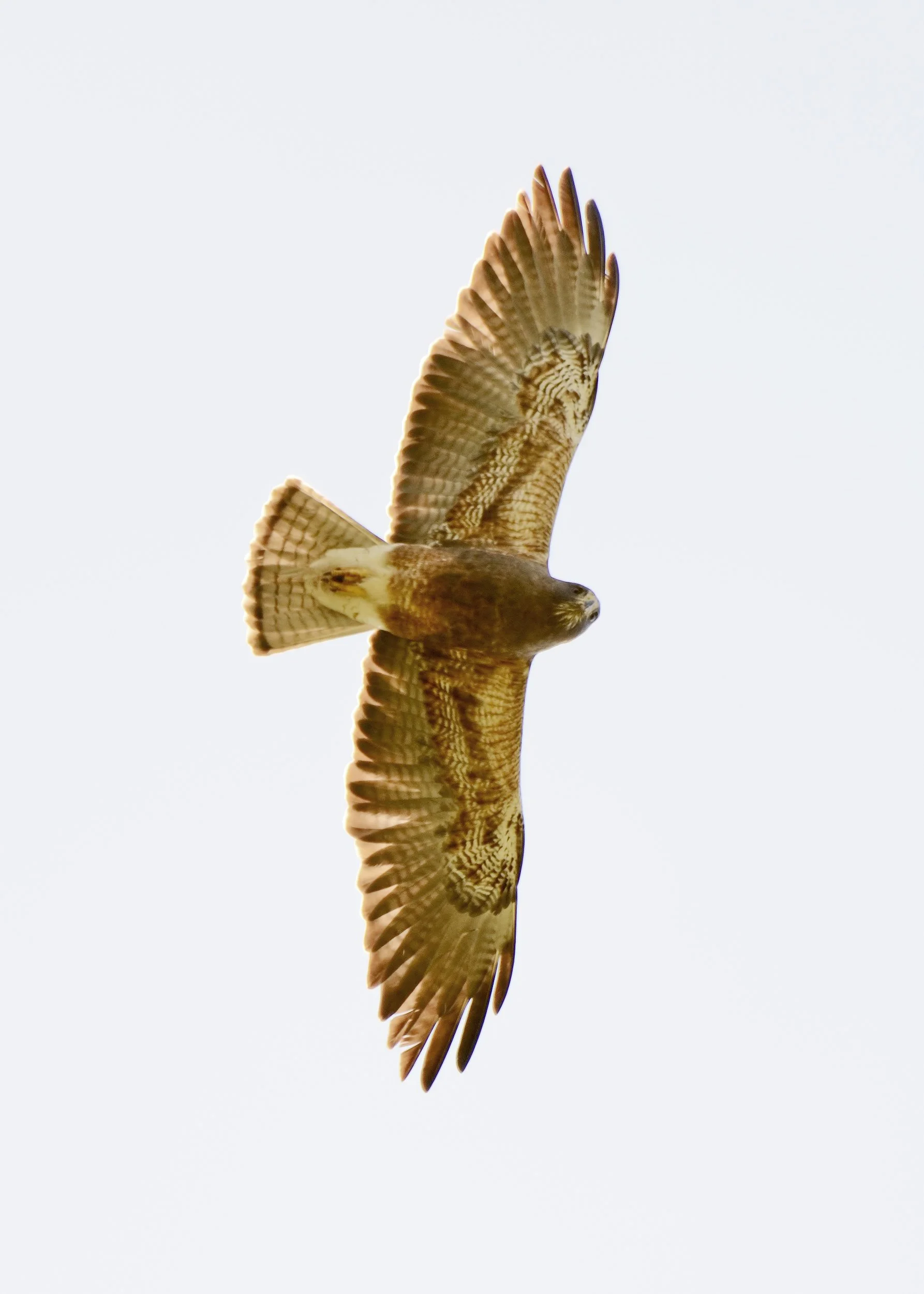
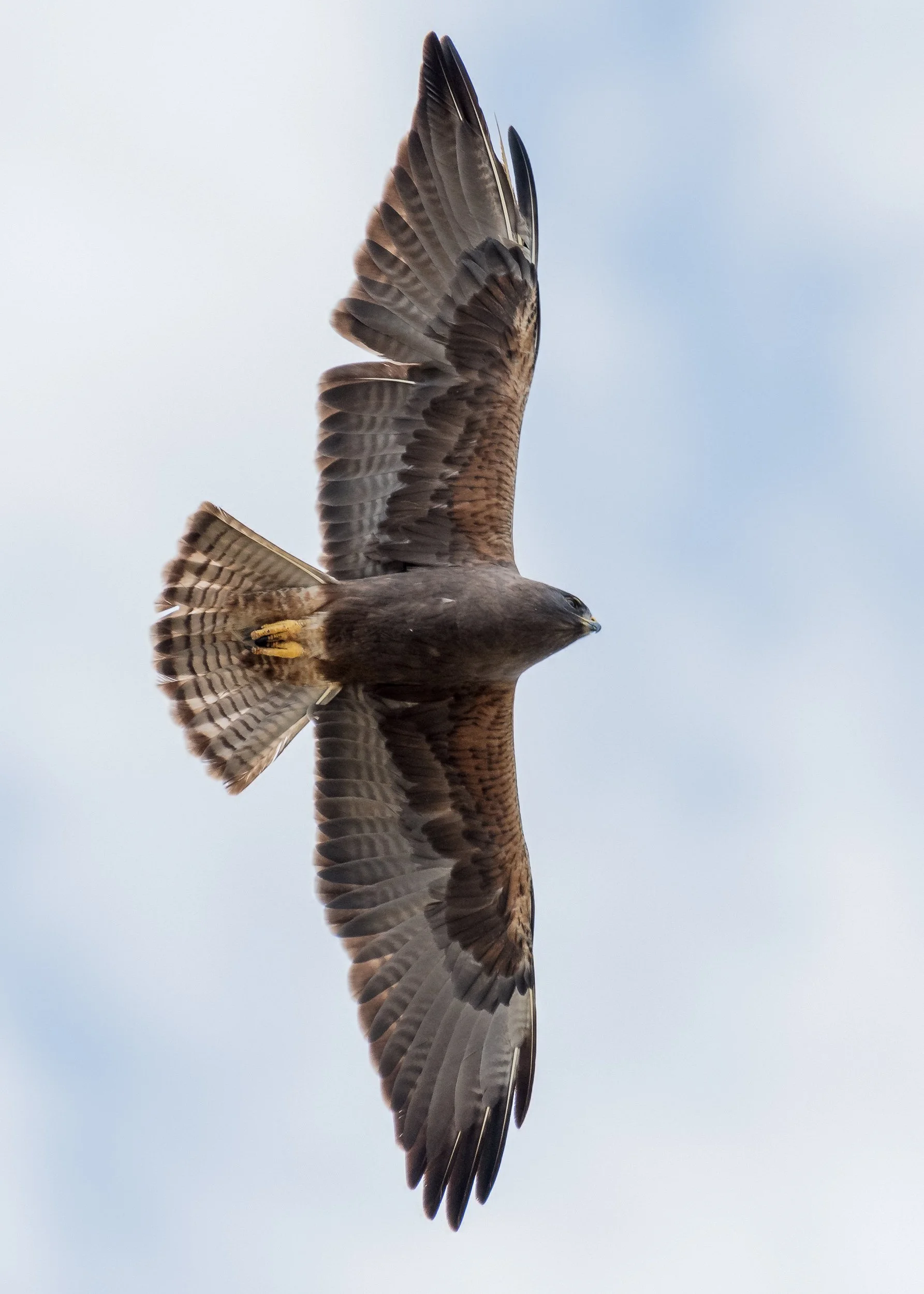
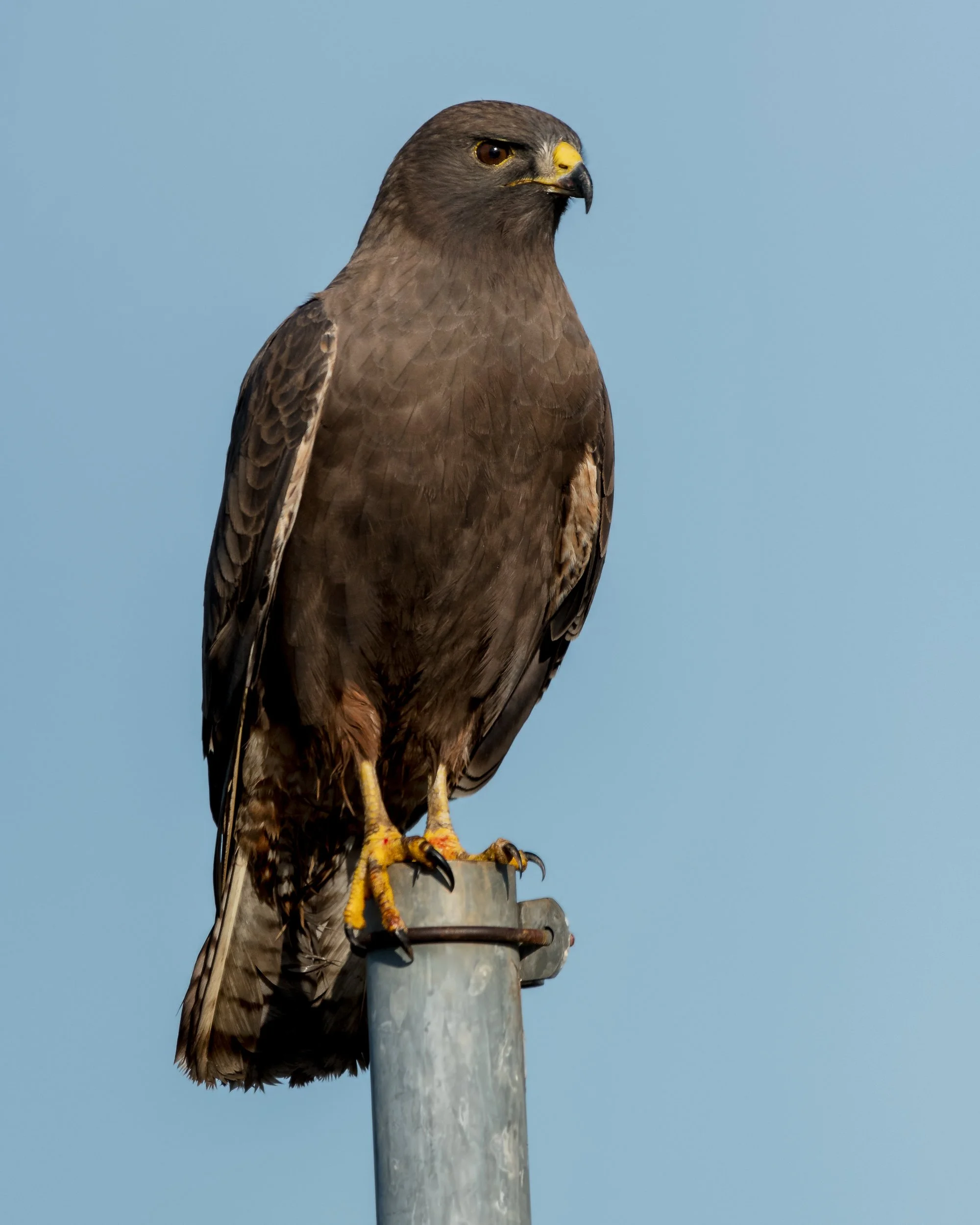
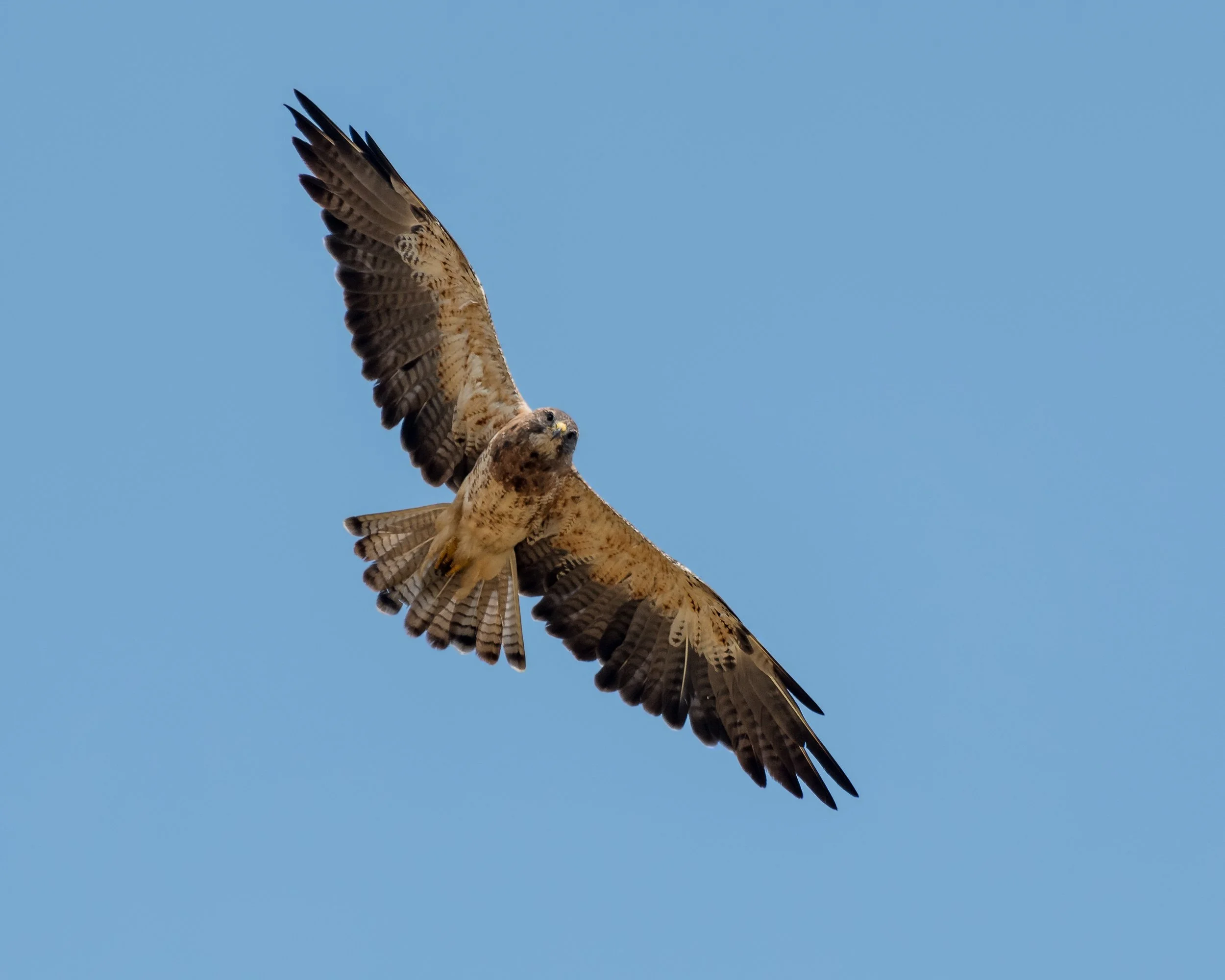
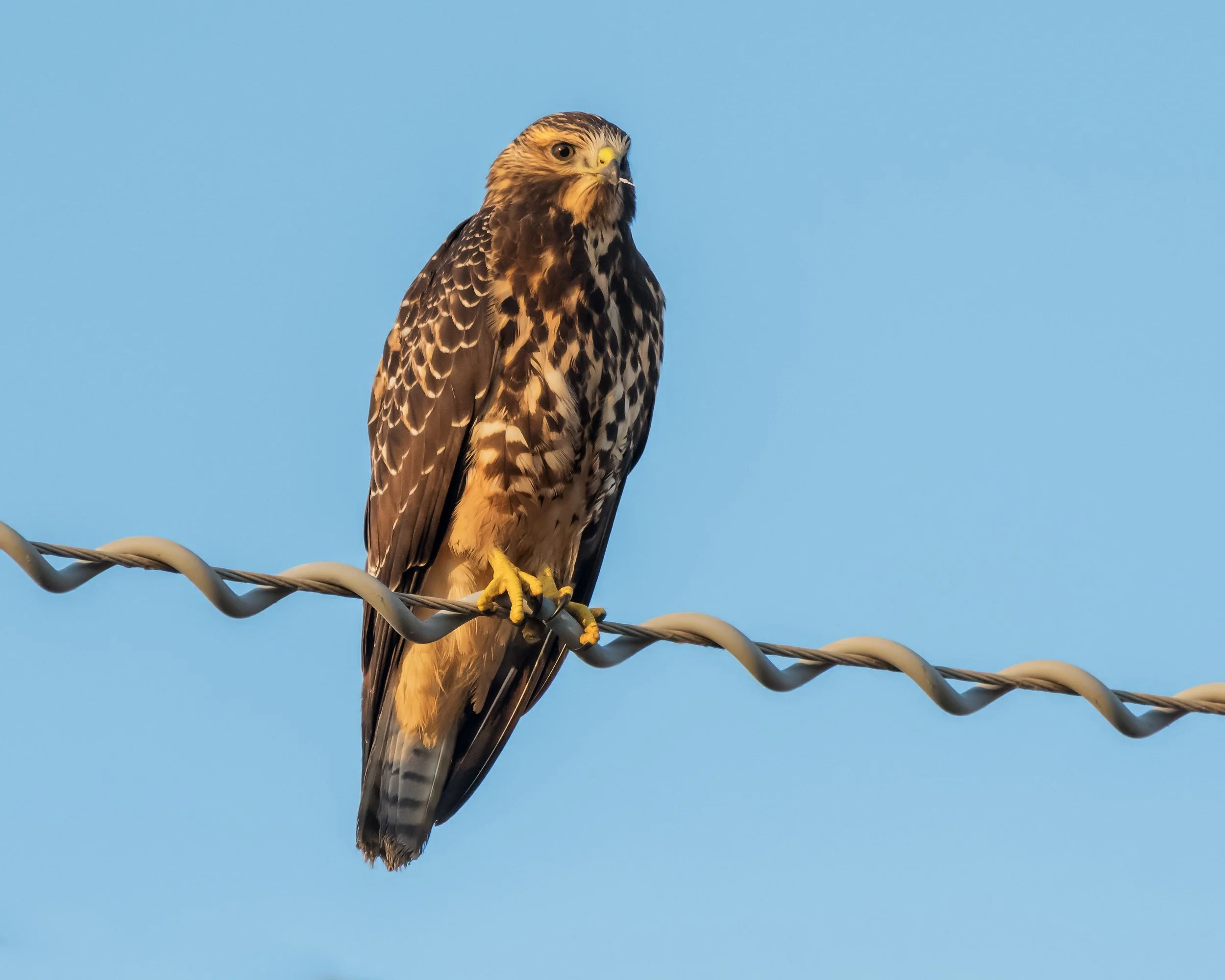
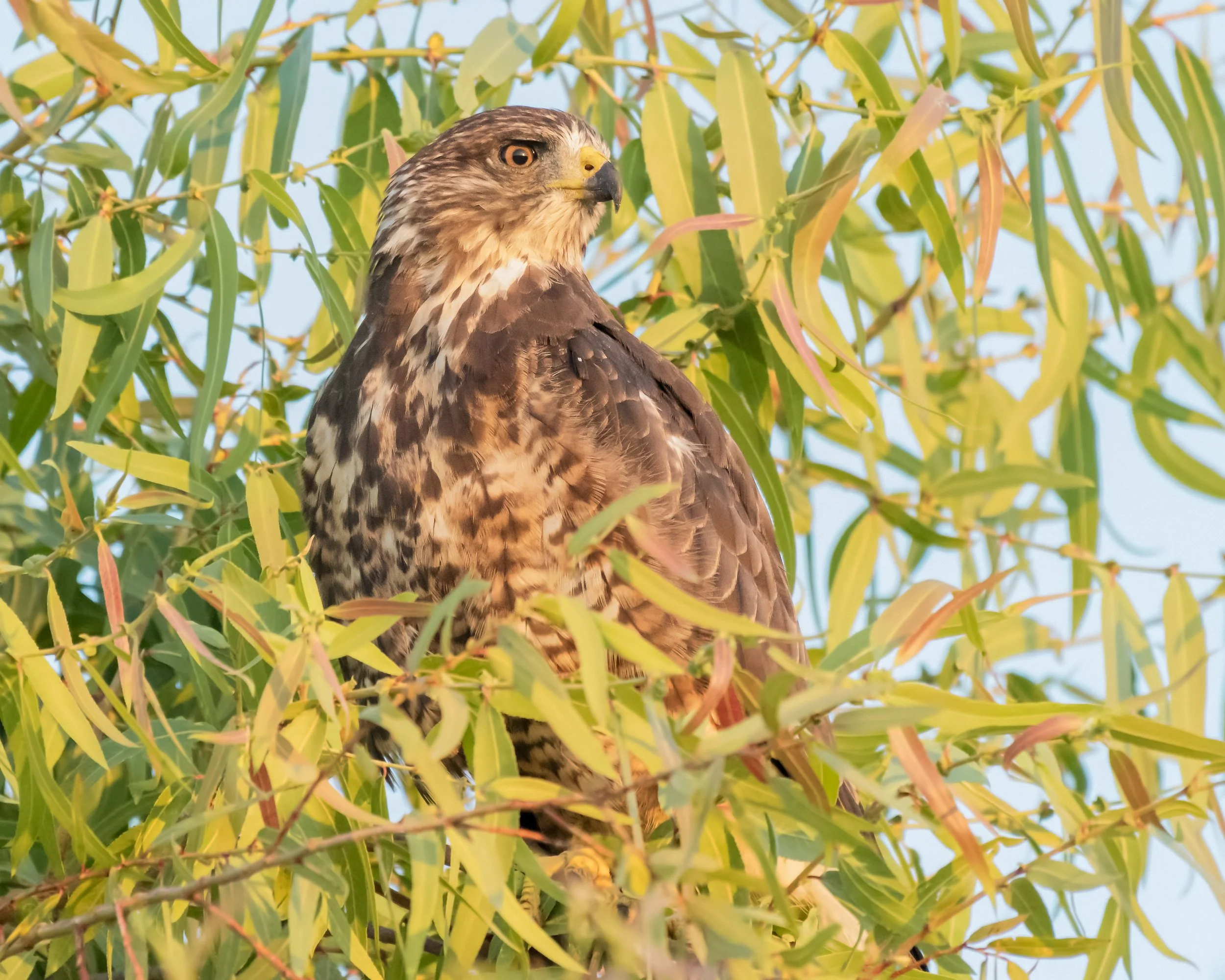
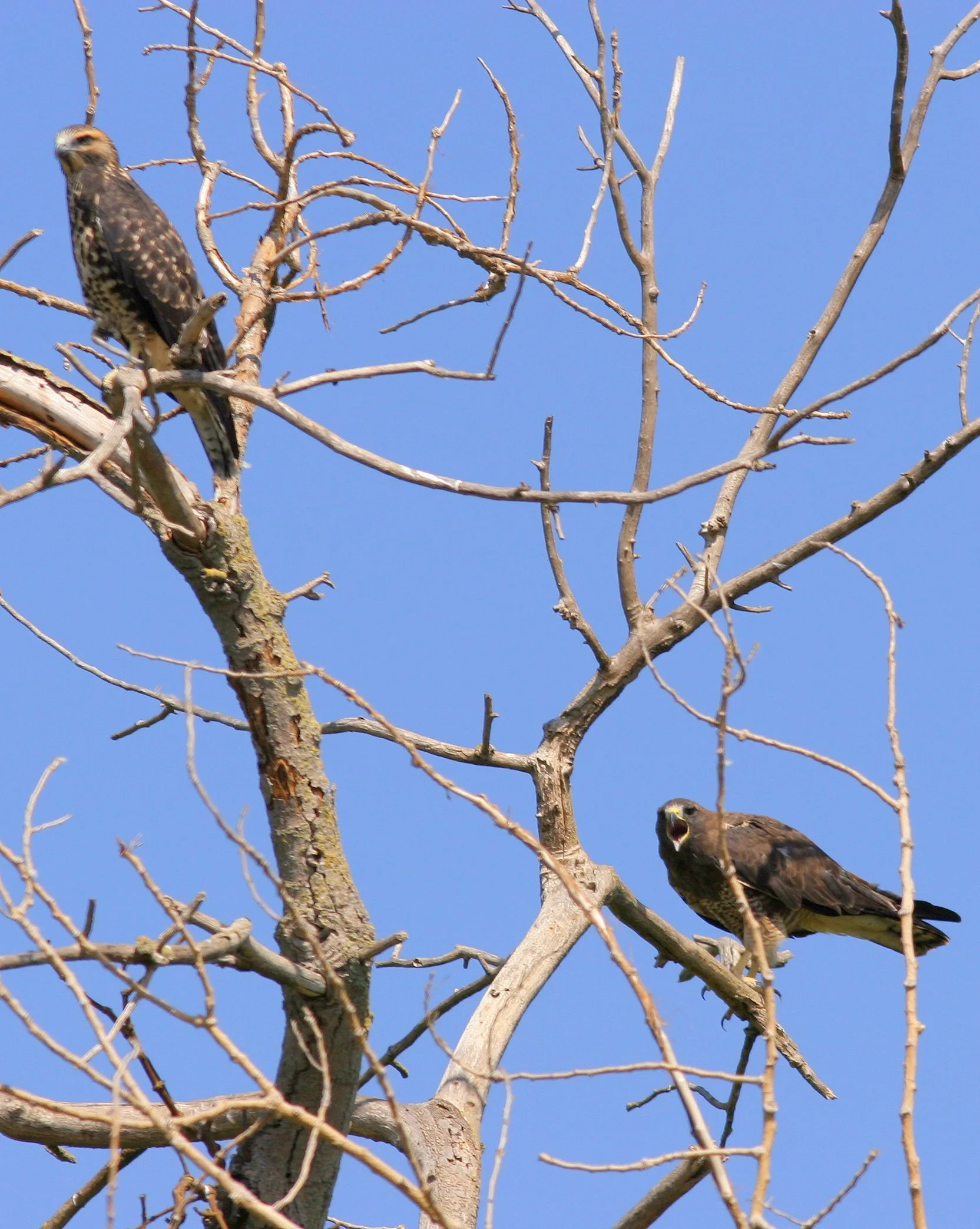
Found primarily from March through September in the Central Valley, California’s Swainson’s Hawks are a distinct population from those found elsewhere on the continent. During their time in our area, they nest in cottonwood riparian woodlands and large lone trees adjacent to open areas, and can often be seen foraging in the agricultural fields surrounding Sacramento.

For more information on the local Swainson’s Hawk population visit Friends of the Swainson’s Hawk.

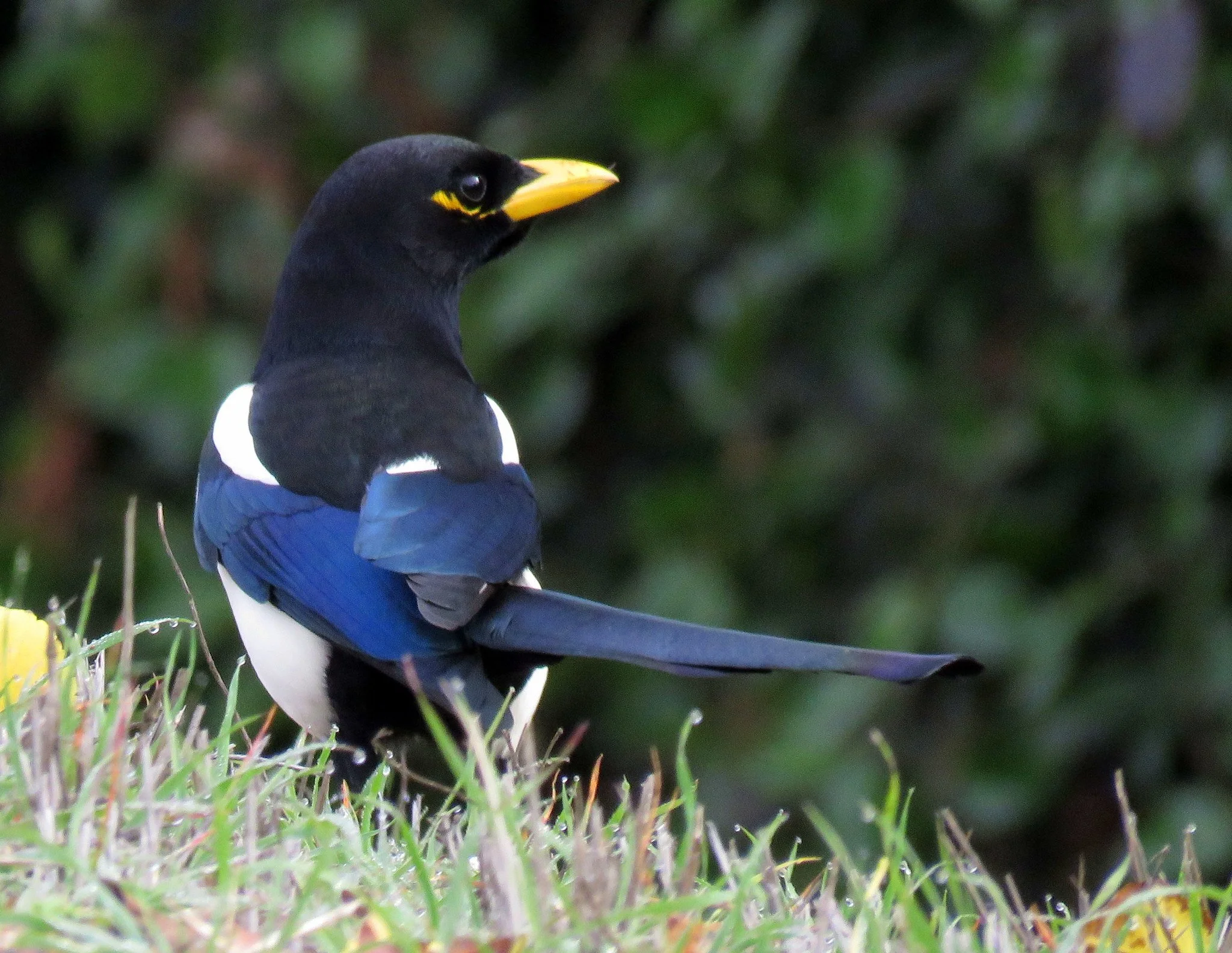
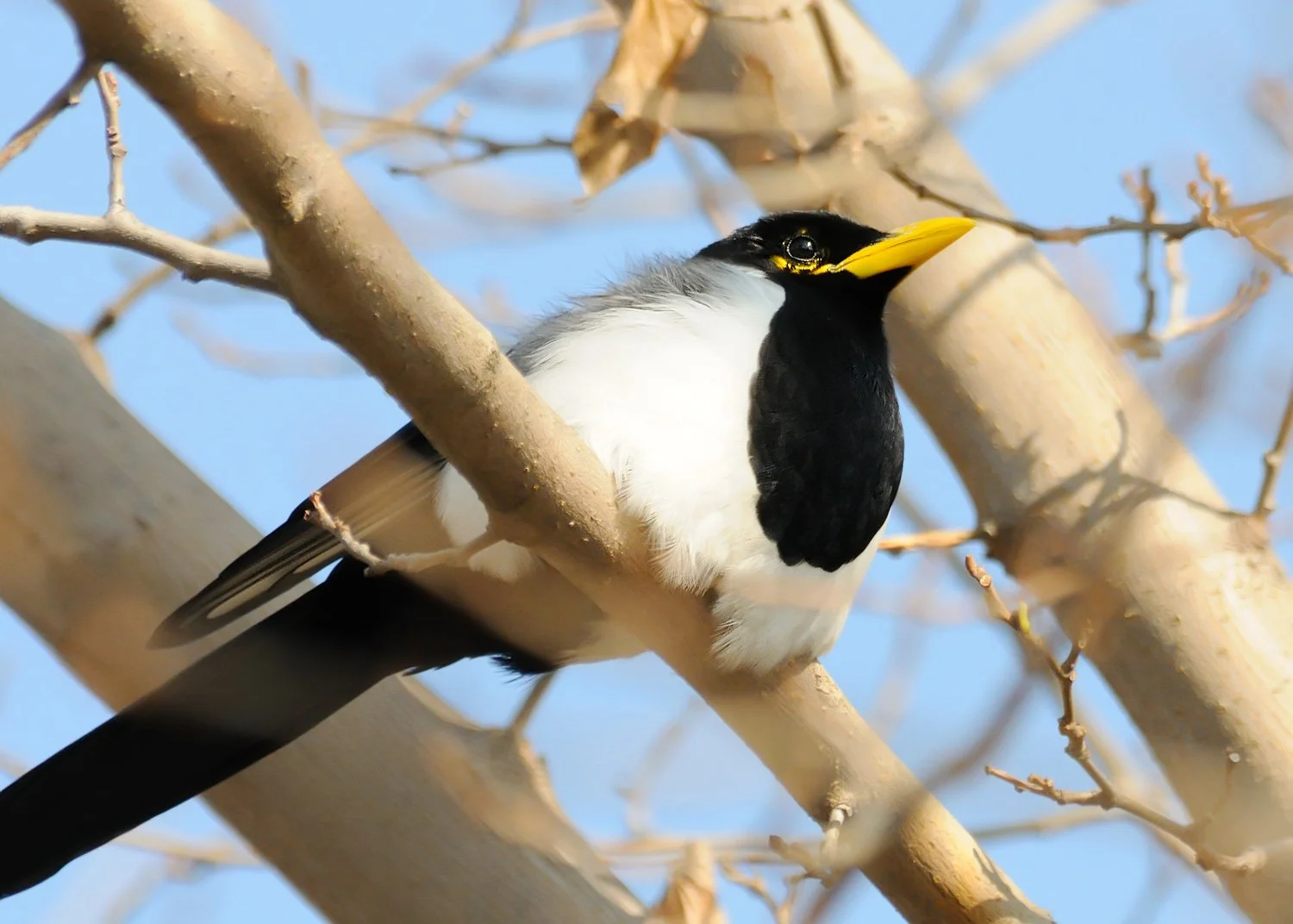
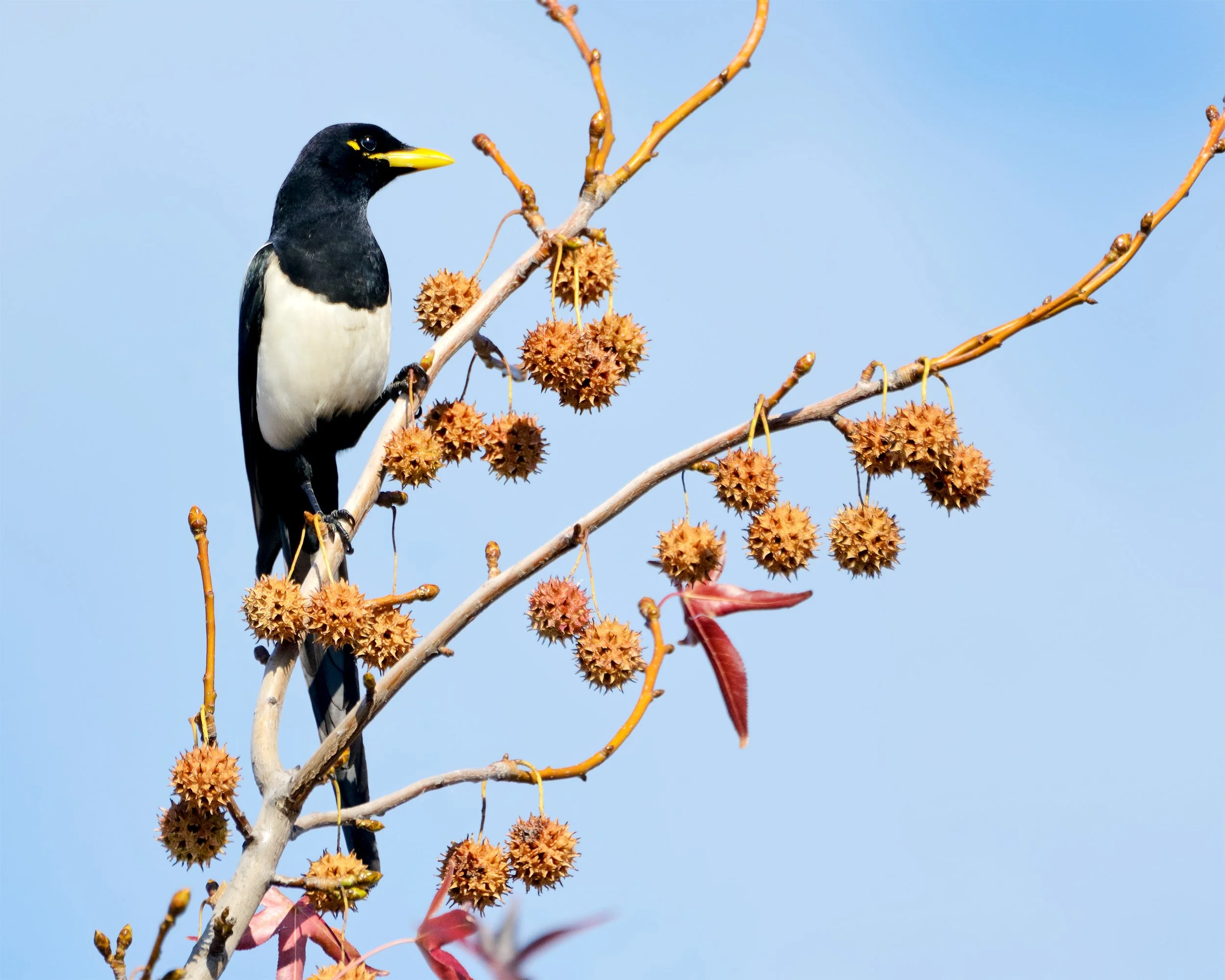
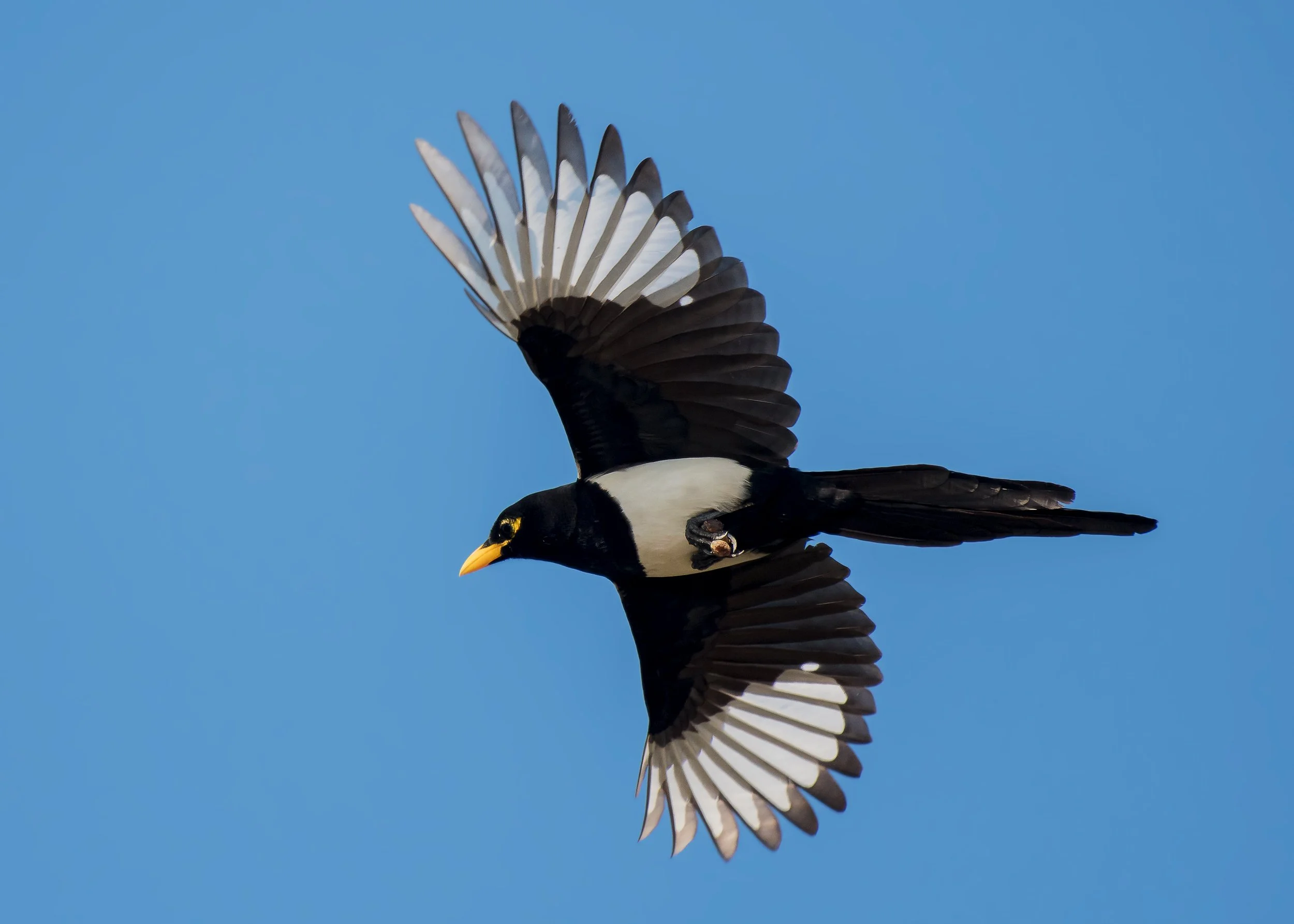
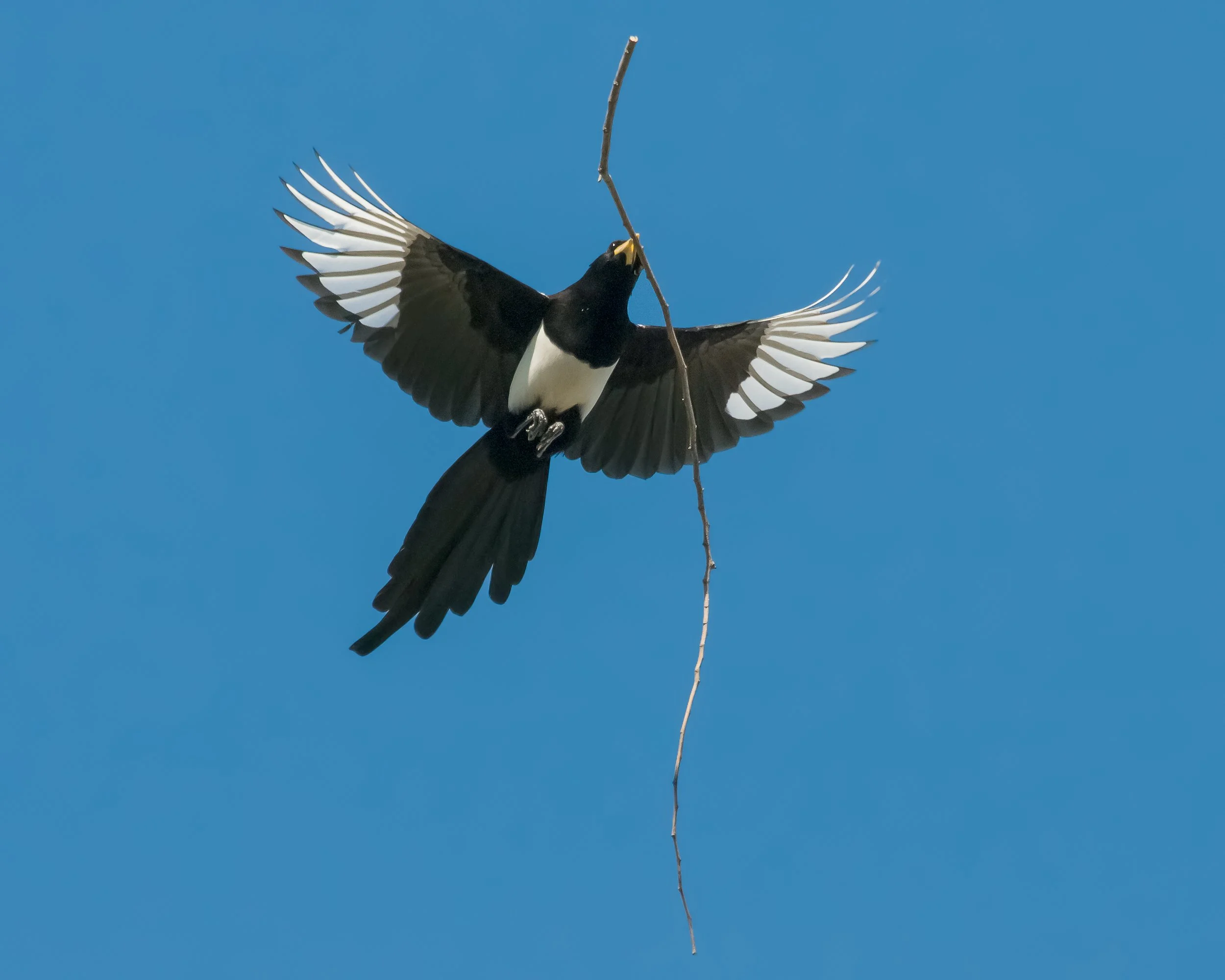
Sacramento Bird of Note: Yellow-billed Magpie

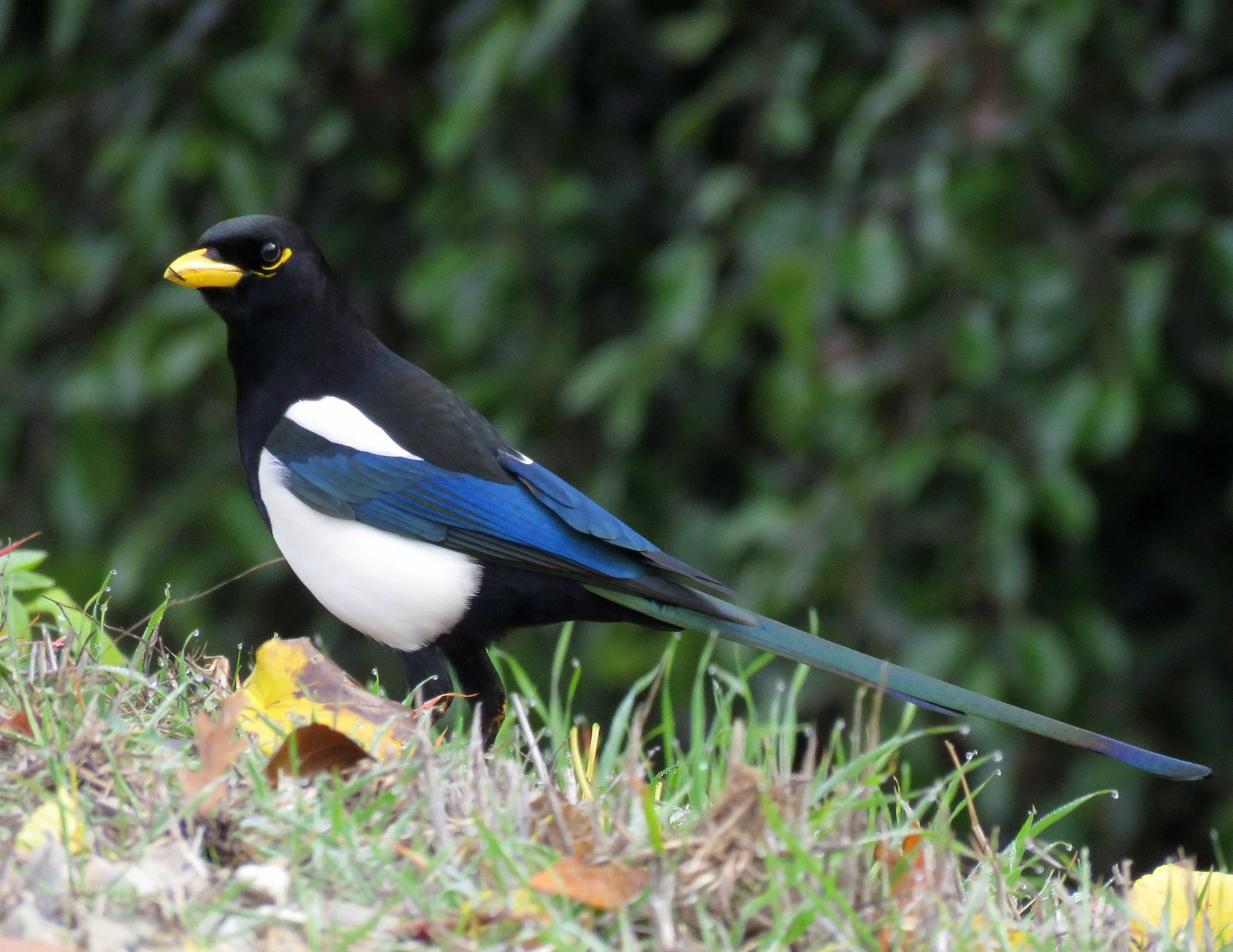
Birders from all over the world travel to California’s Central Valley to observe the Yellow-billed Magpie. A species endemic to the open oak savannah of California, it’s bold coloring and gregarious nature make it easy to spot at local birding hotspots such as Ancil Hoffman Park or William B. Pond Recreation Area.

In May 2021, Dan Airola presented Population and Habitat of the Yellow-billed Magpie in Sacramento at the Sacramento Bird Alliance Monthly Meeting. You can watch a video of the presentation here.
Meet the Great Horned Owl

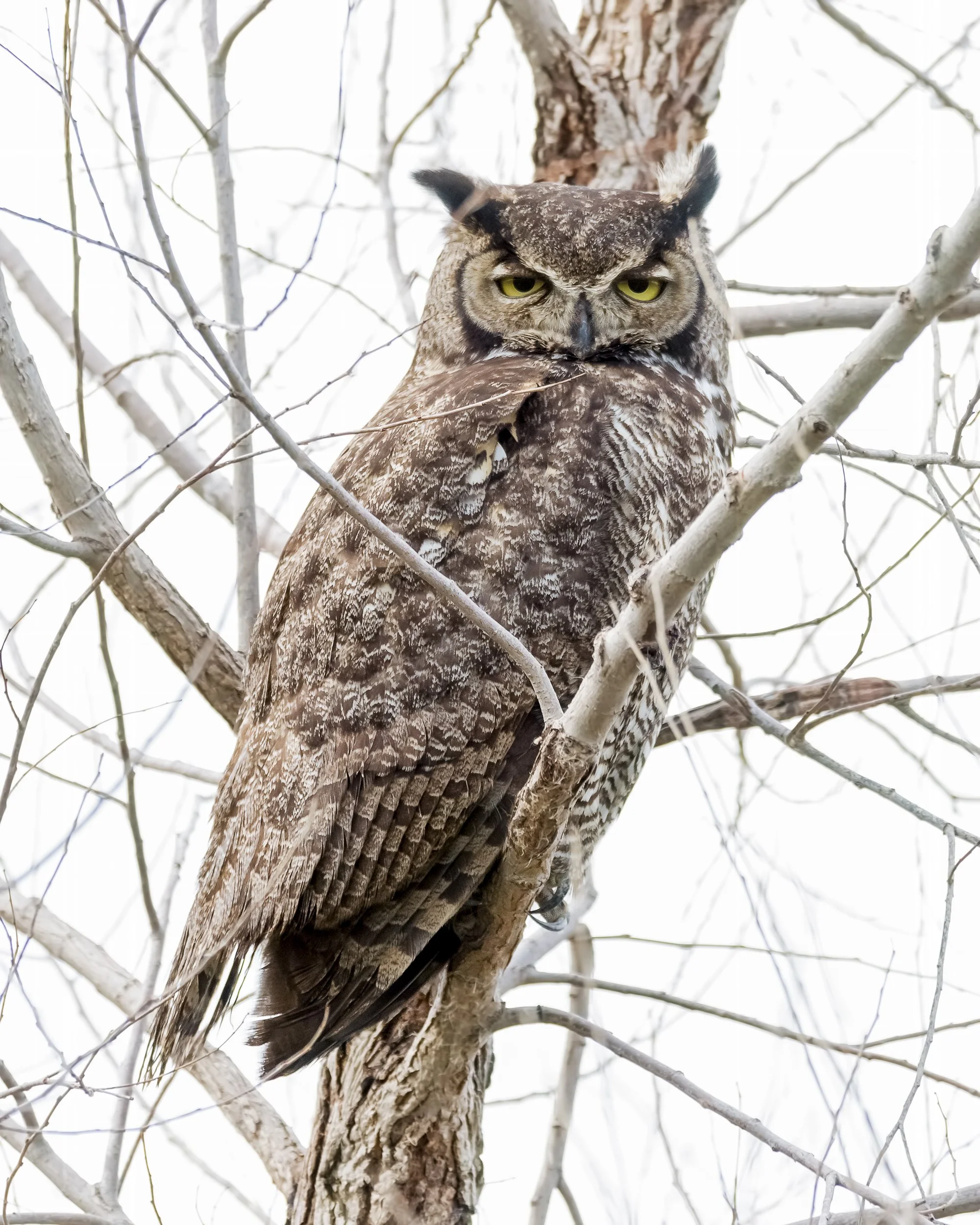
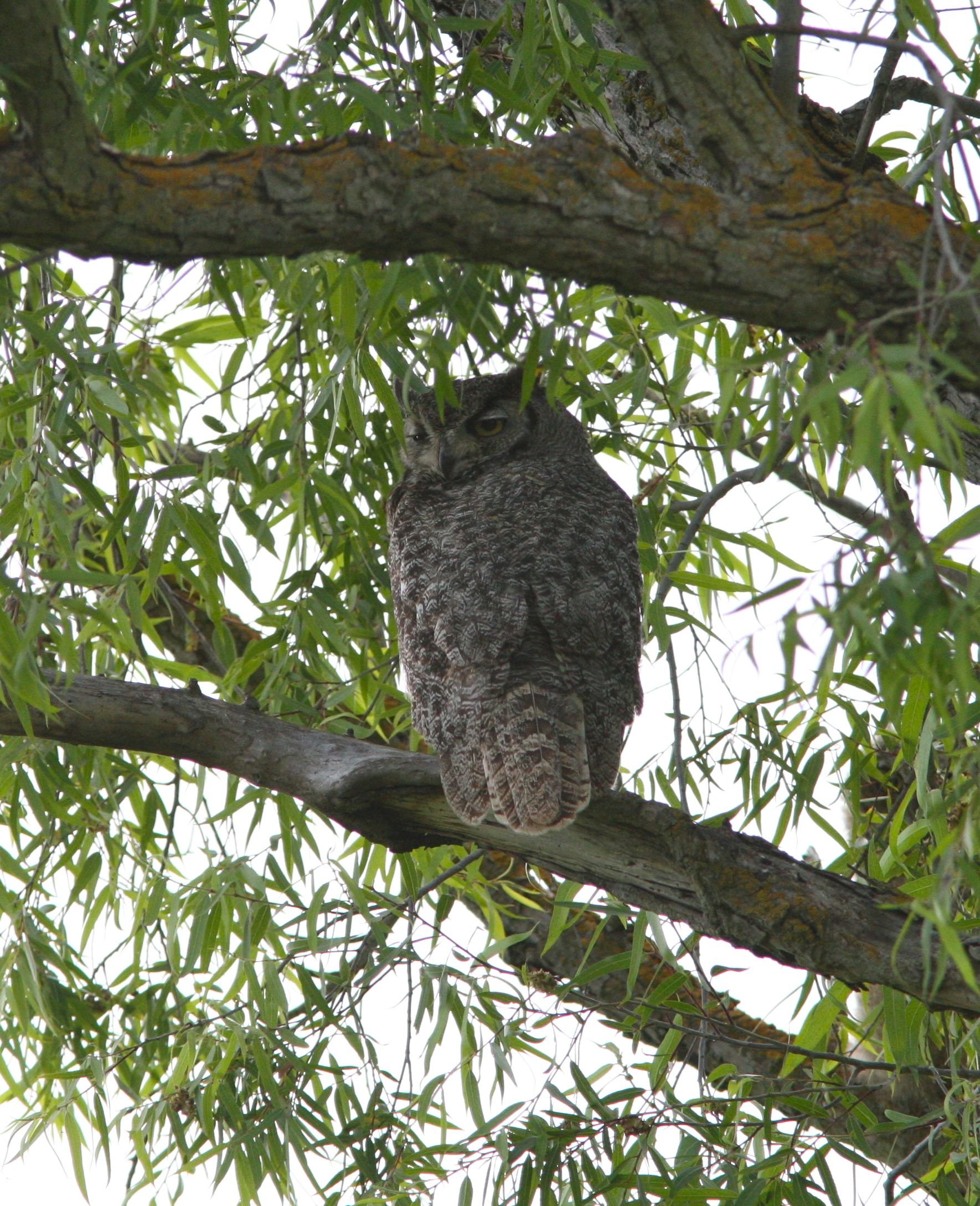
Great Horned Owl, adult © Daniel Lee Brown

This month let’s talk about the Great Horned Owl. Its name alone makes it clear that this is quite a special species! It has a huge range and is found all over North America and in some parts of South America as well. It’s even found in far northern regions if there are trees present. The Great Horned Owl is nocturnal (active at night); but is sometimes active in the late afternoon or early morning, especially when food supplies are low. Even though they are fairly large birds, their soft feathers and special wing structure makes them able to fly silently! Also, they can fly up to 40 mph! They have excellent night vision; but because their eyes don’t move in their sockets, Great Horned Owls must move their heads in order to look around. This is pretty easy for them because their necks can rotate 270 degrees!

What do Great Horned Owls look like?

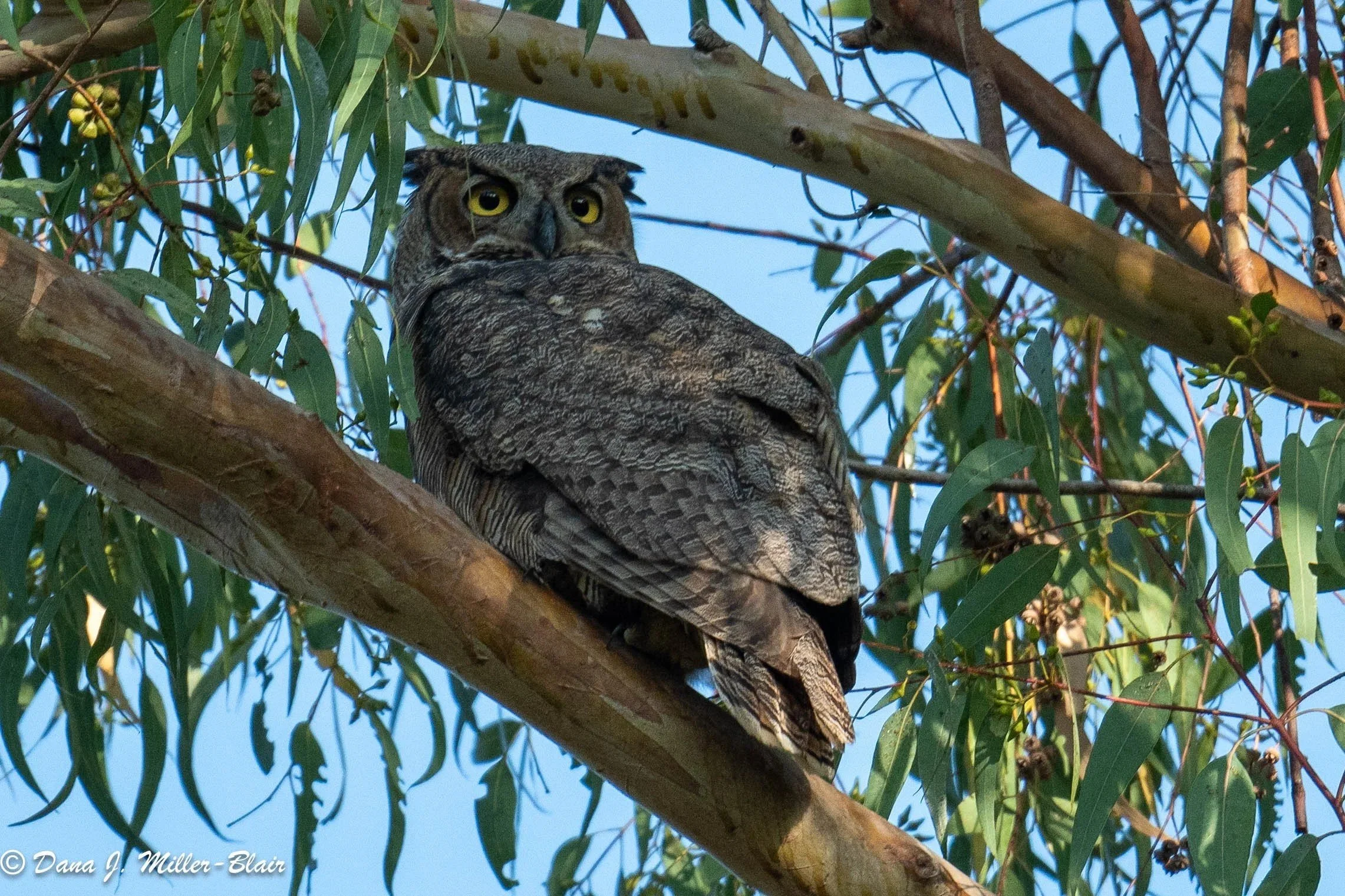
Great Horned Owls have a barrel-shaped body, large yellow eyes, a large head, a fairly short tail, and short yet very wide wings. Depending on the region they live in, these owls have a few different color tones. Some are more whitish, some very dark, and some are a pale gray. This is thought to be because Great Horned Owls are non-migratory birds (remain in their area year-round). Their feathers can be orangish-brown, white, black, or gray. They have two high or peaked feather groupings on the top of their heads, which look like ears; but they are not! Their ear openings are further down on the sides of their heads. Like many owls, one ear is lower than the other. This ‘unusual’ ear placement actually improves their hearing and makes locating food extremely easy! A Great Horned Owl’s hearing is about ten times better than a human; and they can hear sounds up to ten miles away! Their talons (or claws at the end of their toes) are very powerful.

Great Horned Owl © Dana J. Miller-Blair

Where do Great Horned Owls live?

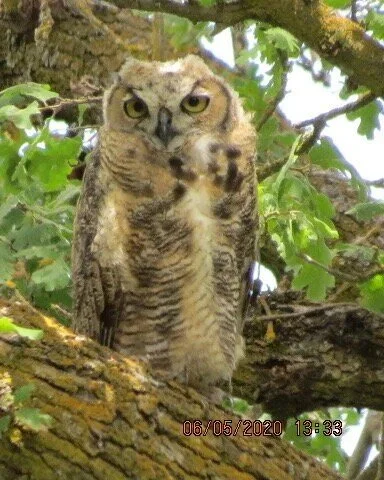
Great Horned Owl, juvenile © Jane Van Kessel

They can be found in forests, river valleys, lake shores, agricultural areas, and sometimes in wooded suburban and urban areas, mostly around golf courses or parks. Great Horned Owls are very early nesters compared to most birds and start their nests in early winter. It has been said that these owls are a bit lazy when it comes to building their own nests. Usually, they simply reuse an old nest of a hawk or other large bird. They also nest in tree hollows (holes or cavities inside trees), caves, tree stumps, or abandoned structures. While the male does the hunting for food while the female sits on the eggs, both parents will feed the babies after they hatch. Baby Great Horned Owls are cared for and fed by their parents for several months. The parents stay fairly close to the area after the nesting season; but the young owls leave the area. The young owls fly far away in the Fall and find new areas to live in. A pair of nesting Great Horned Owls won't allow others to nest in their area.

What do Great Horned Owls eat?

Great Horned Owls don't seem to be very picky about what they eat. They will eat many species; but their diet is mostly that of mammals. Great Horned Owls are one of the only predators of skunks! They have a terrible sense of smell; so they aren't bothered at all if a skunk should spray them. They also eat birds, amphibians, and reptiles.

Great Horned Owl, adult © Craig Swolgaard

When perched in trees, Great Horned Owls are usually well camouflaged (the ability to not be seen easily) and usually fly down to the ground to catch prey. They also may glide along the ground to look for food. Their short, wide wings also make it easy to fly in dense forests or in heavily planted landscapes; but hunting success increases when owls hunt in more open spaces.

What do Great Horned Owls sound like?

Some people label the familiar hooting sound of the Great Horned Owl as a call. Most researchers now label the hooting sound as a song. Many people also confuse the daytime song of the Mourning Dove with that of the Great Horned Owl, which is heard at night. The song of the Mourning Dove is added below; so you can compare the two.

You can listen to the songs and calls of the Great Horned Owl at xeno-canto. xeno-canto.org/species/Bubo-virginianus

Sacramento Bird of Note: Sandhill Crane

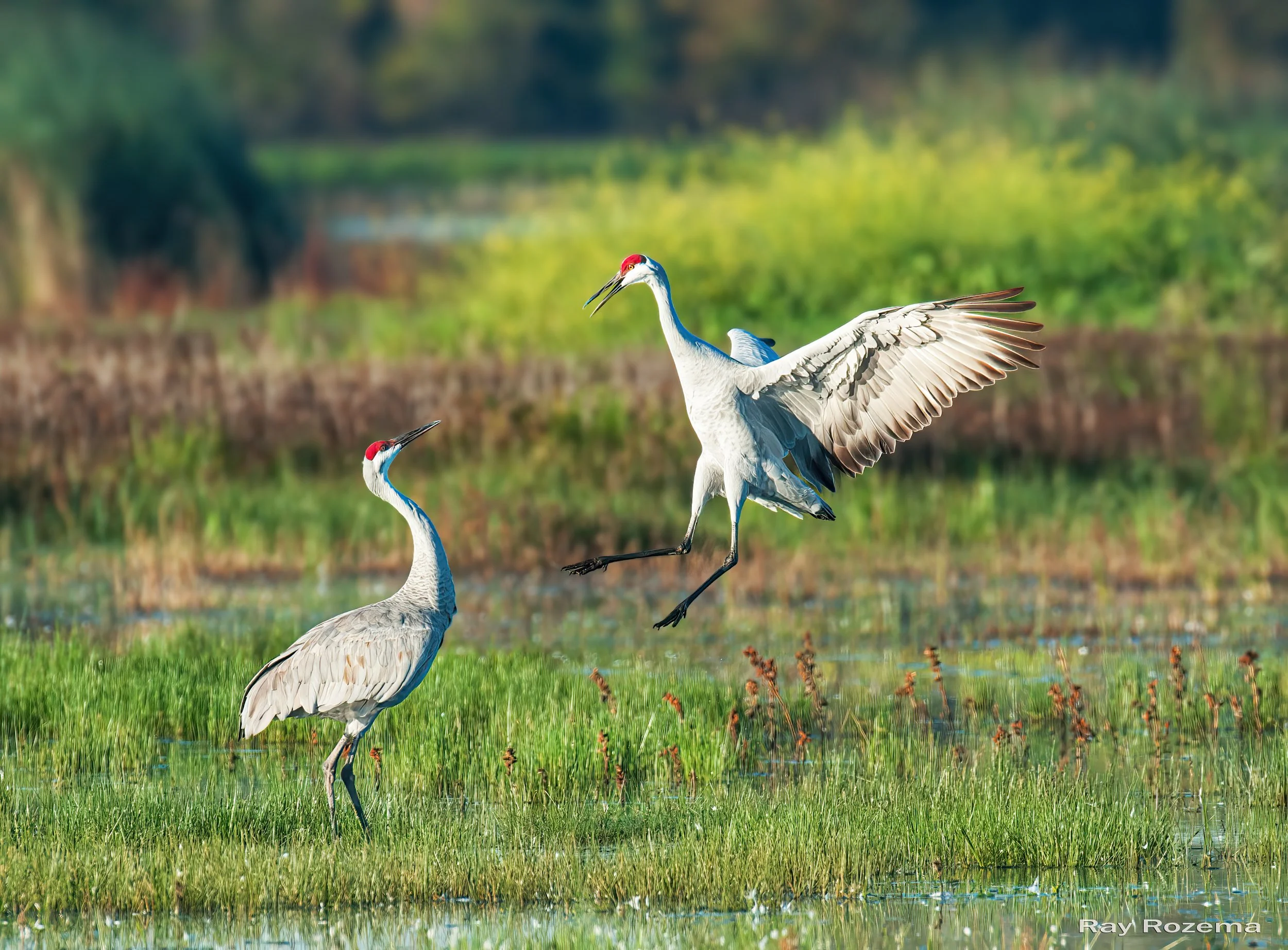
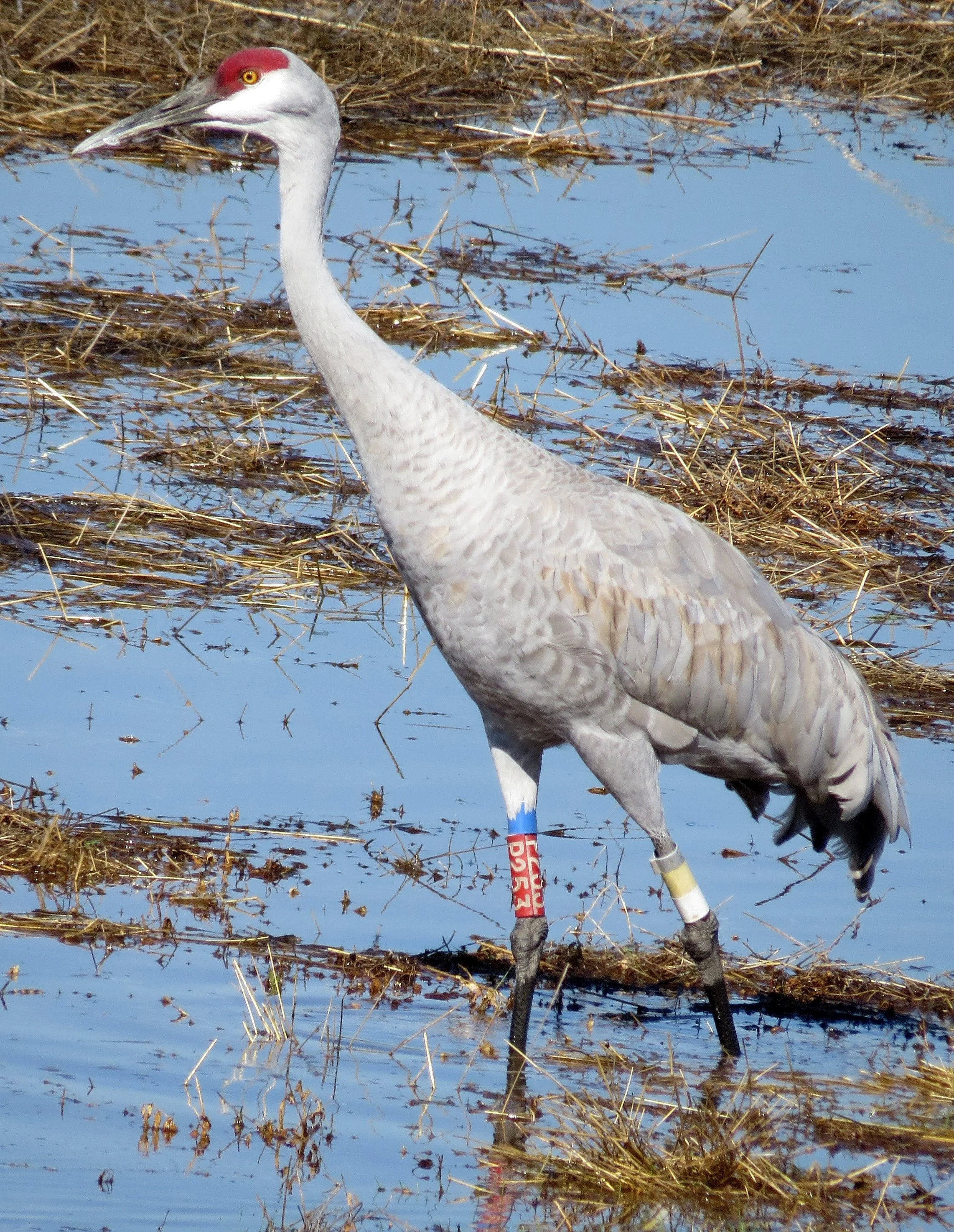
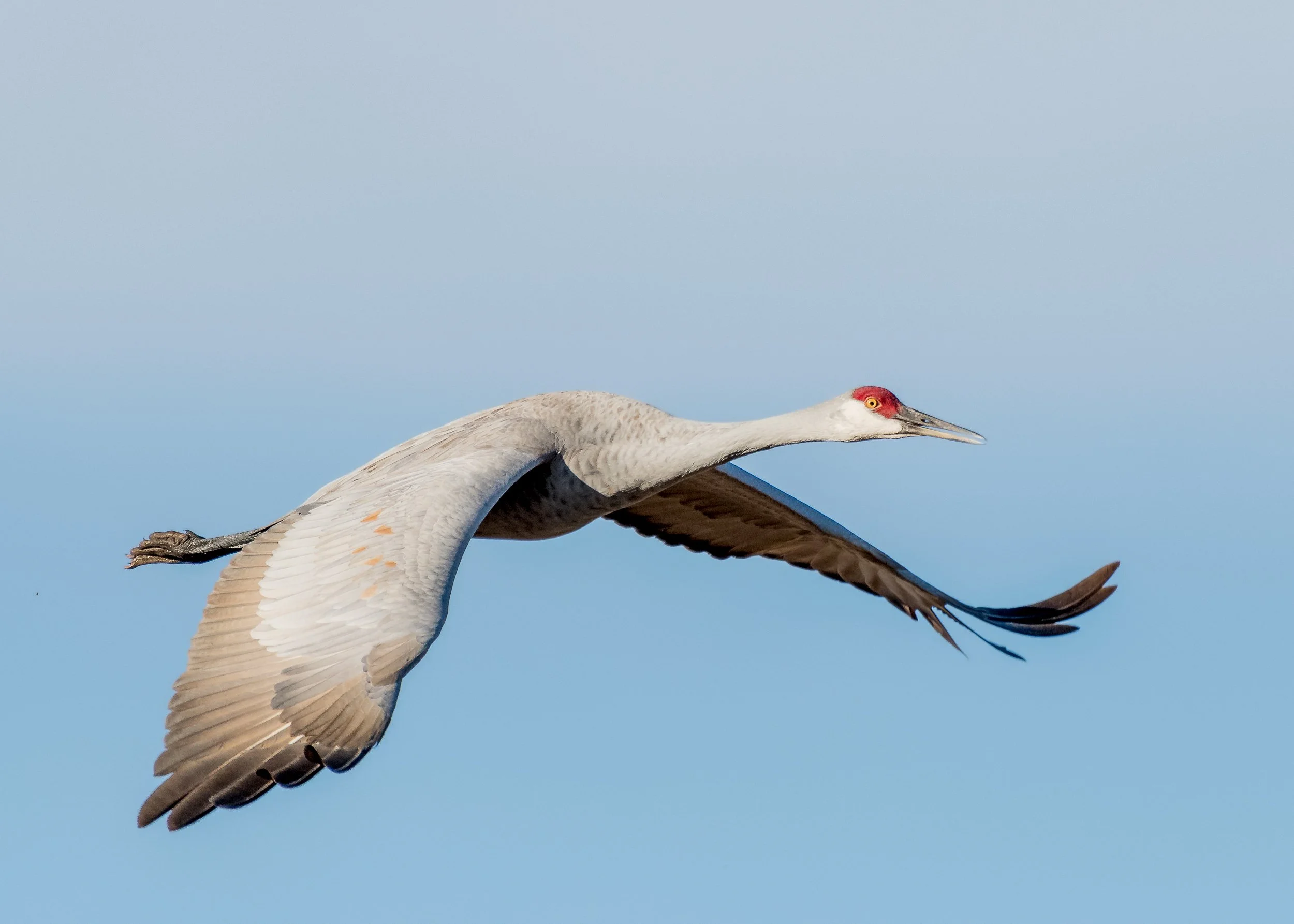
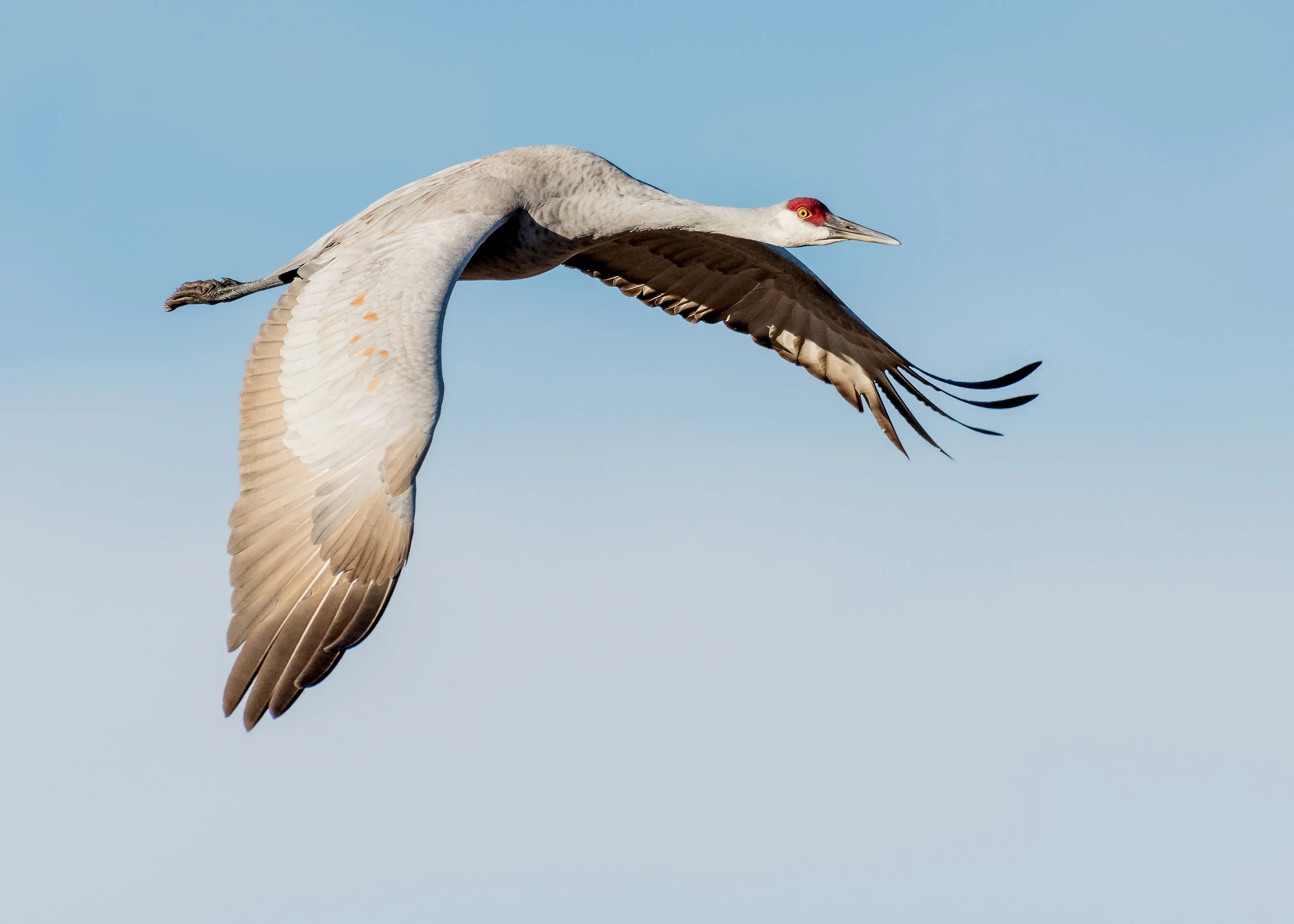
A spectacular winter visitor to the Central Valley is the Sandhill Crane. Their triumphant bugling call can be heard throughout the region as migrating flocks return to the valley in fall and depart again in spring.

Throughout the winter, Sandhill Cranes can be found in large numbers at Delta hotspots such as Stone Lakes and Cosumnes River Preserve. They have even inspired their own festival in Lodi in November, brought to you by the Lodi Sandhill Crane Association.

Meet the Black Phoebe

Black Phoebe, adult © Mary Forrestal

This month, let’s talk about the Black Phoebe. This bird is a member of the flycatcher family. If you live in the Sacramento Valley, you probably have seen them in your yard or in a neighborhood park. Black Phoebes seem to do well living among humans and are not as ‘shy’ as other species of flycatchers seem. 

What do Black Phoebes look like?

Black Phoebe, juvenile © Mary Forrestal

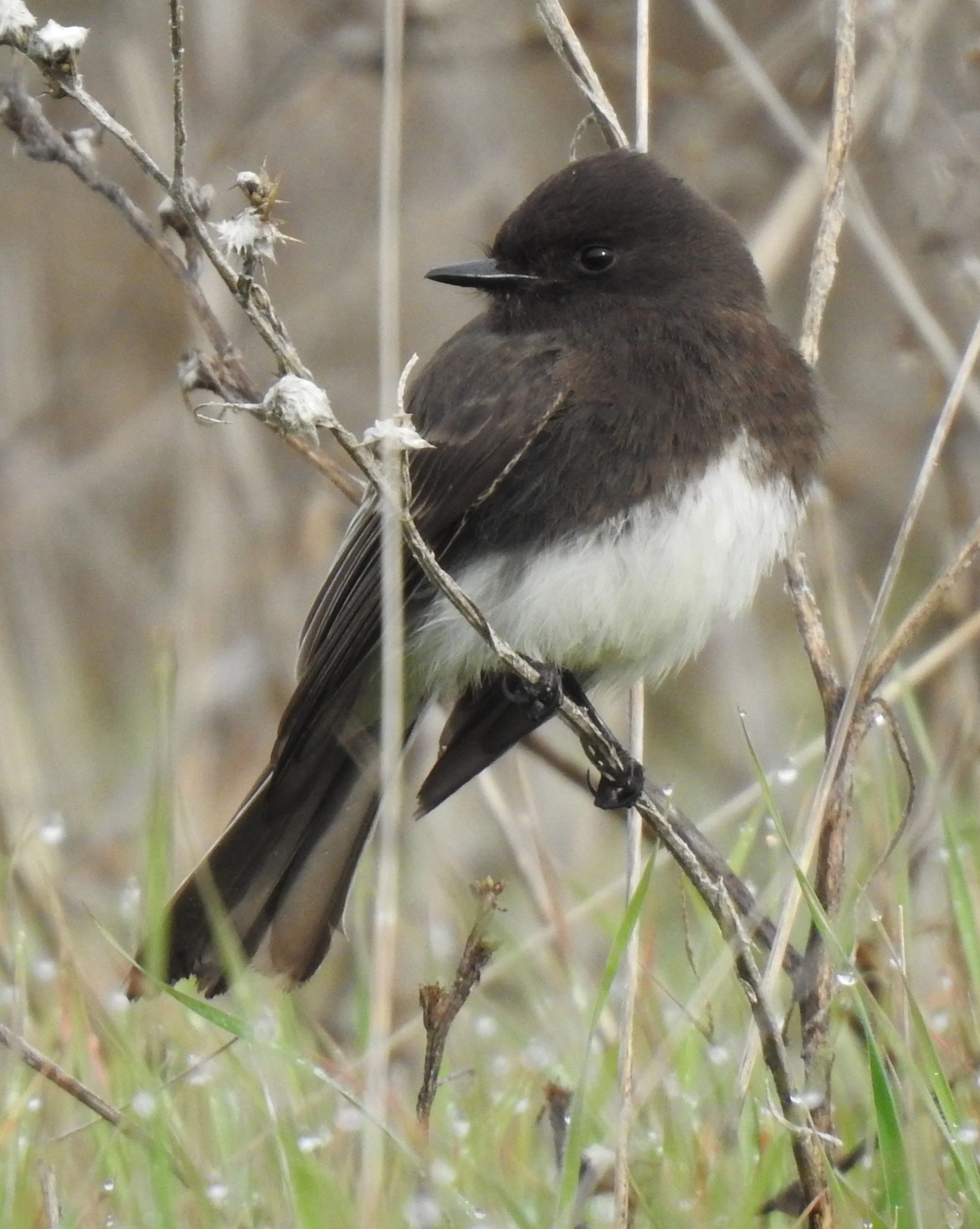
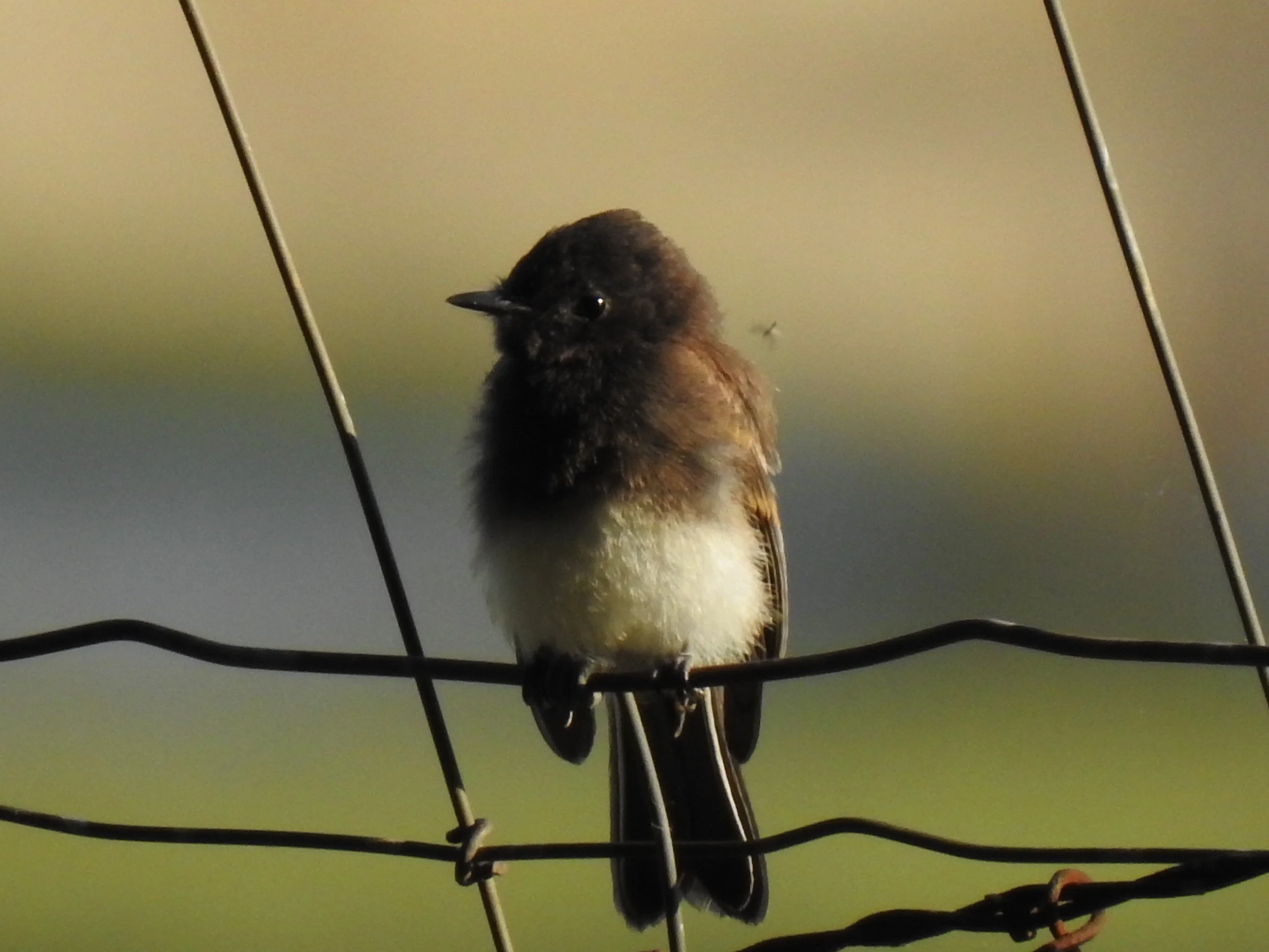
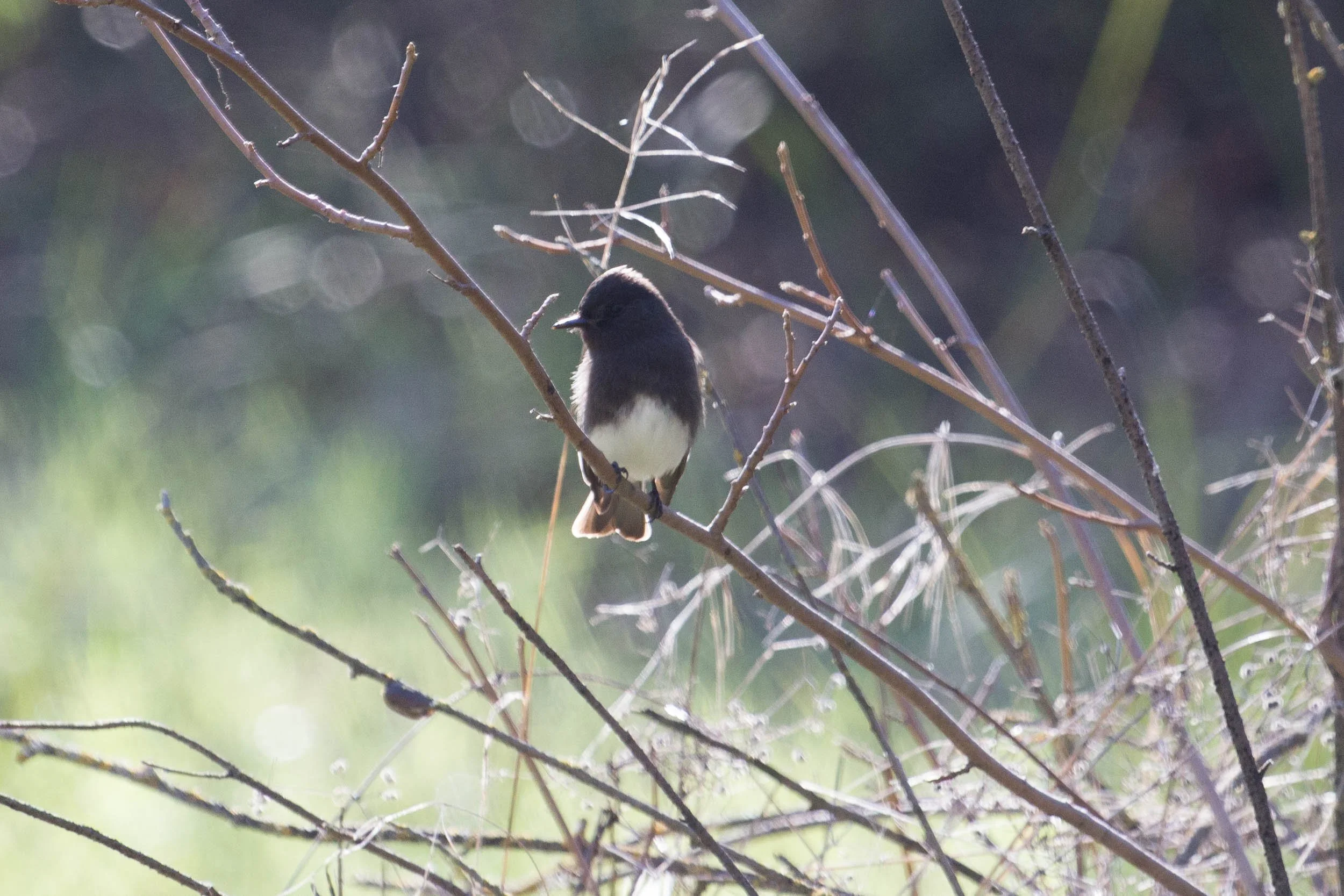
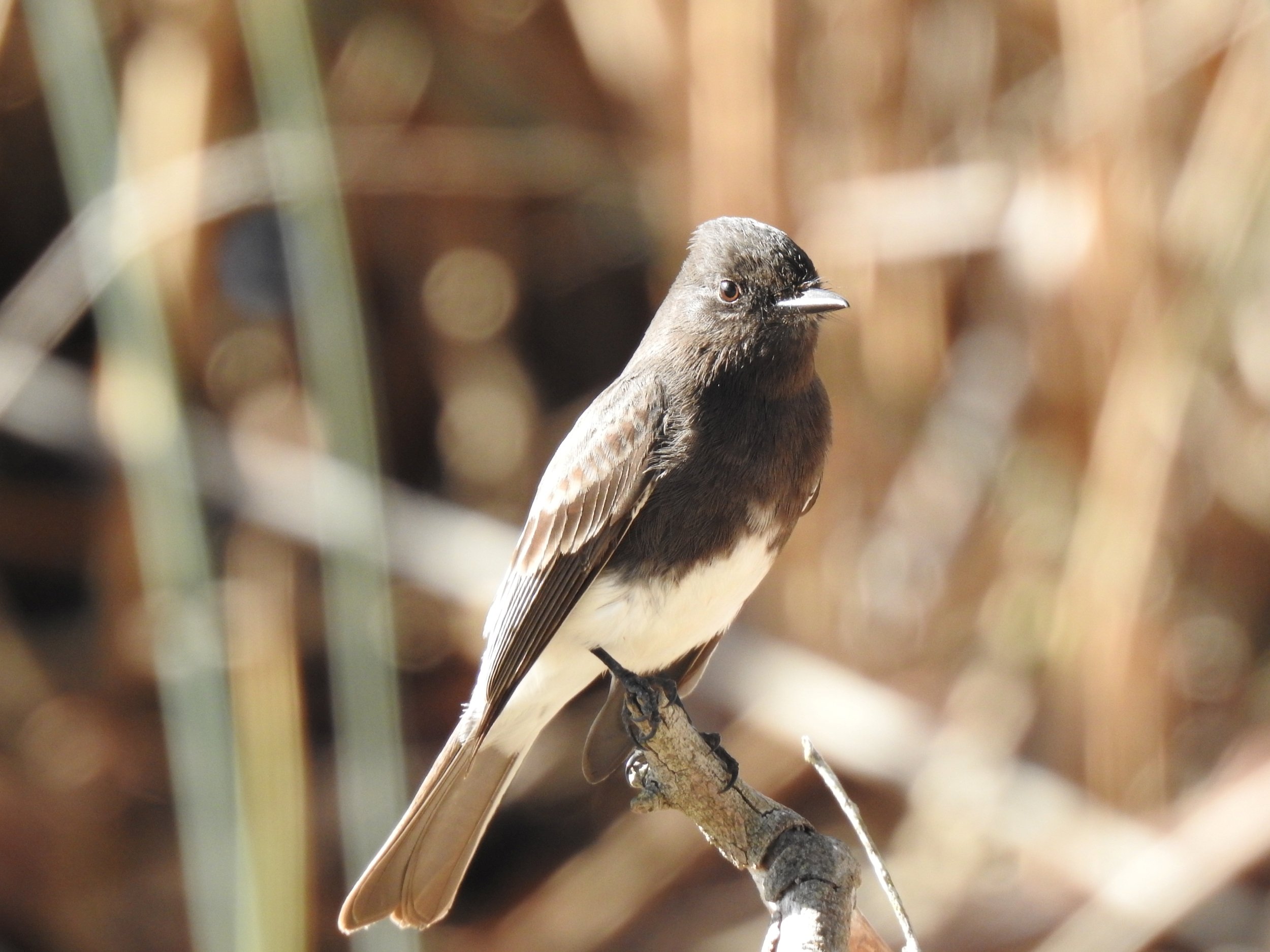
Black Phoebes are black on their heads, wings, and upper breast. They have a white contrasting belly. Their bill, legs, and feet are black. Males and females look the same. Young (or juvenile) birds have brown feathers (or plumage) and have two light brown wing bars. The feathers of young birds will darken as they age.

Where do Black Phoebes live?

Black Phoebe © Larry Hickey

The range of the Black Phoebe is from the southern Oregon coast, into California, and down through Central and South America. There are also populations living in parts of the southwestern United States. While there are a few populations that migrate to warmer climates for winter, most Black Phoebes remain in the same area year-round.

Black Phoebes almost always live near a water source. This is because they use mud to build their nests and because water attracts the insects that they eat. They live near streams, creeks, ponds, rivers, and along coastal areas. However, they also are often found living near people’s homes or in neighborhood parks. Just as long as water (or mud) is available, Black Phoebes seem satisfied. 

Black Phoebes often build their nests on vertical surfaces and favor sites with overhead protection. In natural habitats, Black Phoebes nest in rock faces, coastal cliffs, boulders, or tree hollows. In urban or suburban areas, they have adapted well to nesting in man-made structures, such as eaves of buildings, abandoned wells, and irrigation canals (or culverts). By using mud, they can plaster their nests onto walls under the eaves of buildings, creating a perfect nest site. Black Phoebes frequently come back to the same nest or nesting spot year after year! Their nests are built well and last because they are strong. Black Phoebes are also quite territorial; so you usually won’t find another pair nesting close by.

It’s the Black Phoebe female that constructs a cup-shaped nest. She is also the one who sits on the eggs to keep them warm (this is called incubation). The Black Phoebe’s nest has an outer shell made of a mixture of mud and grass and is lined inside with soft plant fibers and/or animal fur or hair. When the young hatch, both parents are active in feeding their babies.

What do Black Phoebes eat?

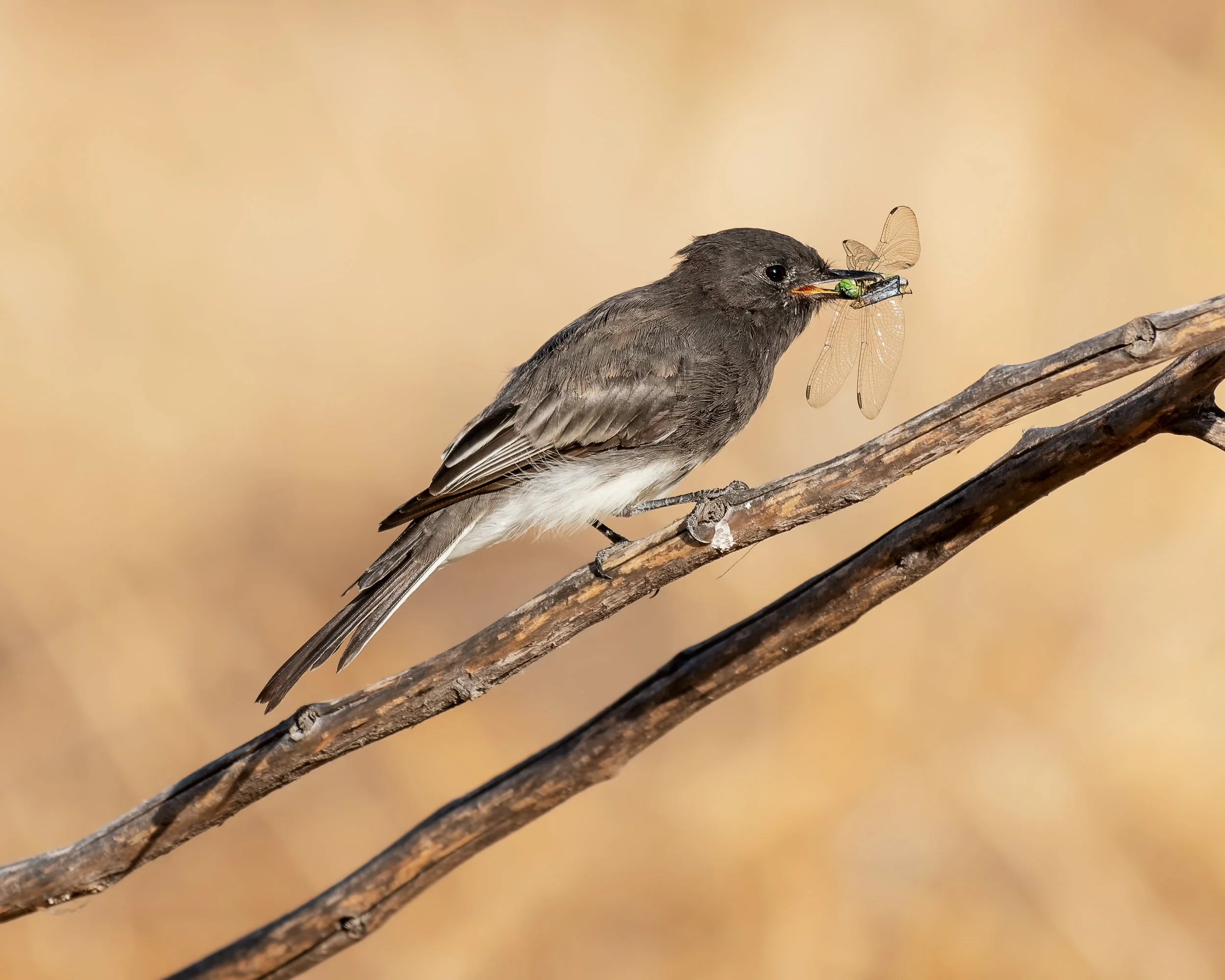
Black Phoebe © Daniel Lee Brown

The main diet of the Black Phoebe is insects, mainly flying insects. They will eat bees, wasps, flies, beetles, bugs, grasshoppers, crickets, dragonflies, termites, and spiders. If you see one out in the open, calling frequently, perched low, and dipping and fanning its tail, it is probably busy scanning for insects to eat. When Black Phoebes spot an insect, they quickly take flight, chase the insect, and often catch it in mid-air! Occasionally, Black Phoebes will look for insects while they are on the ground; but, most of the time, they look for food when perched on low branches or on other low perches. Black Phoebes will also catch insects when they are flying over bodies of water. They will sometimes hover in the air and grab spiders on plants or trees. Black Phoebes have even been seen catching and eating small minnows just below the water’s surface!

What do Black Phoebes sound like?

Black Phoebes are quite vocal and have a familiar song and calls. They also use a contact call that is heard sometimes when two birds are flying close to each other. Kaufman describes the call note as a “sharp ringing peep” sound and the song as “thin, shrill whistles.”

You can listen to the songs and calls of the Black Phoebe at xeno-canto. xeno-canto.org/species/Sayornis-nigricans

Black Phoebe © Mary Forrestal

Meet the Red-tailed Hawk


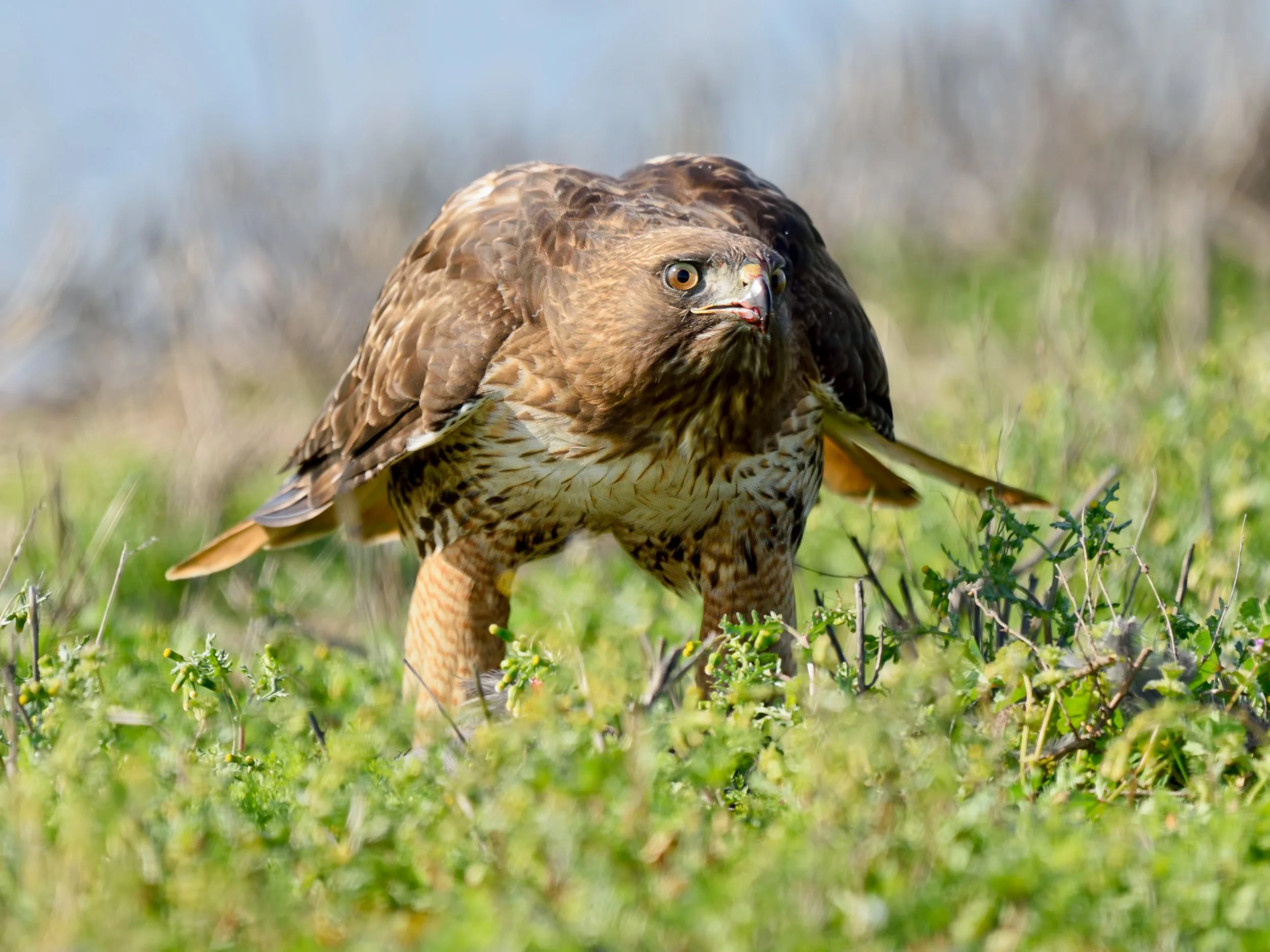
Red-tailed Hawk © Daniel Lee Brown

This month, let’s learn about the Red-tailed Hawk! You can often see this hawk along a roadside either soaring in the air or perched on telephone poles and fence posts as it hunts for food. The Red-tailed Hawk has a vast range in North America, which includes all across the United States. Most Red-tailed Hawks live in their areas year round. Only those that are in the far northern regions migrate south to warmer habitats for the winter.

What does a Red-tailed Hawk look like?

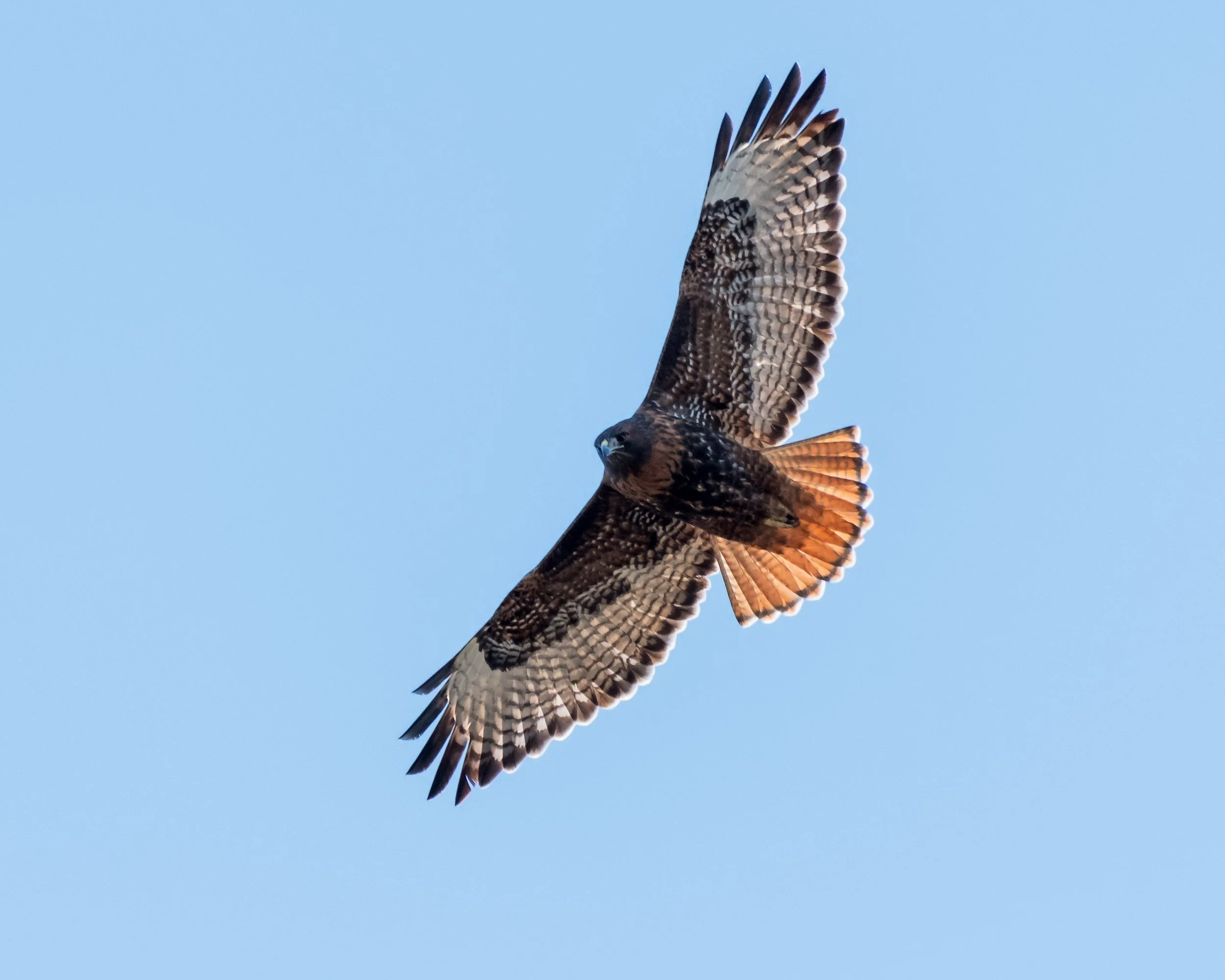
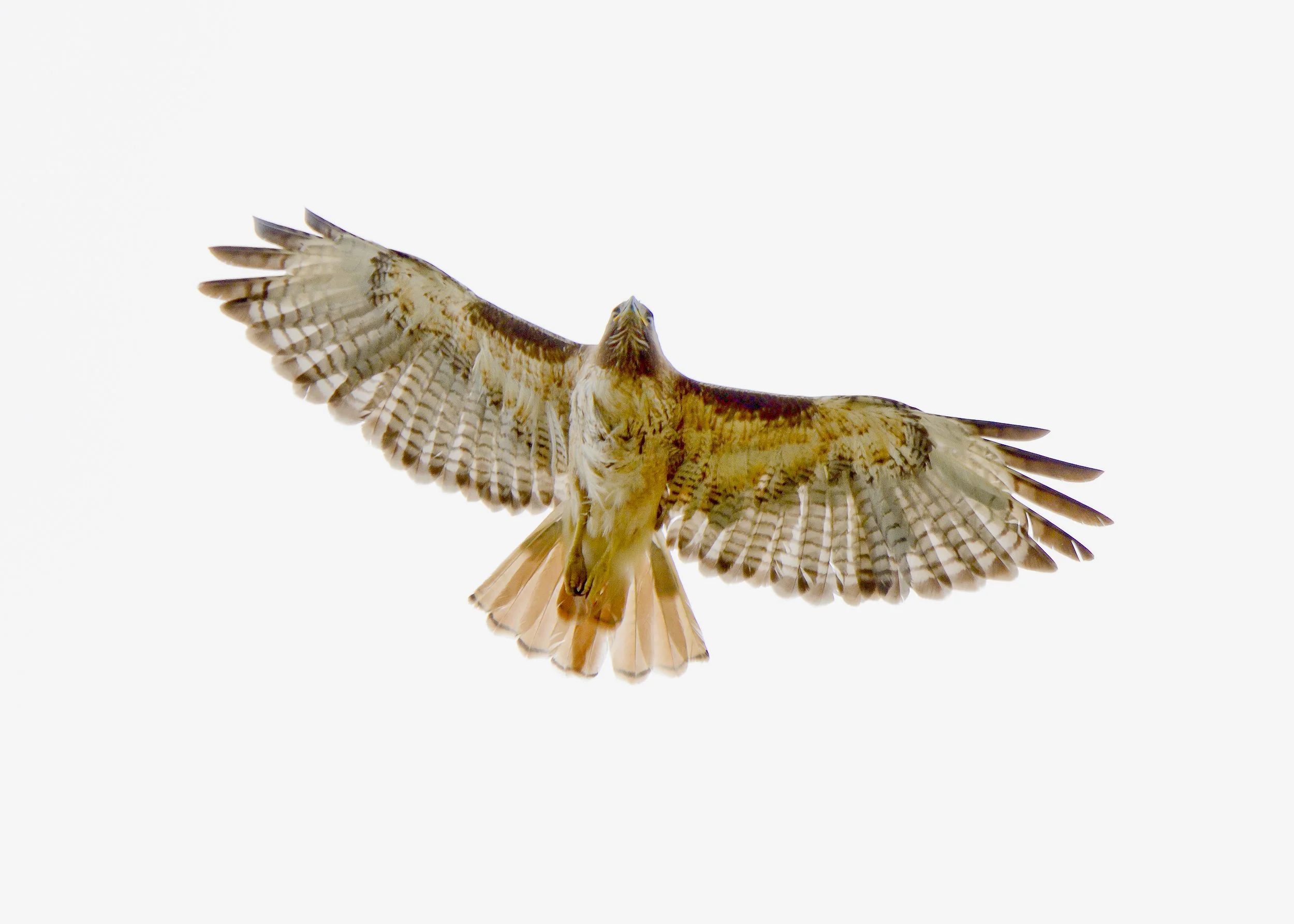
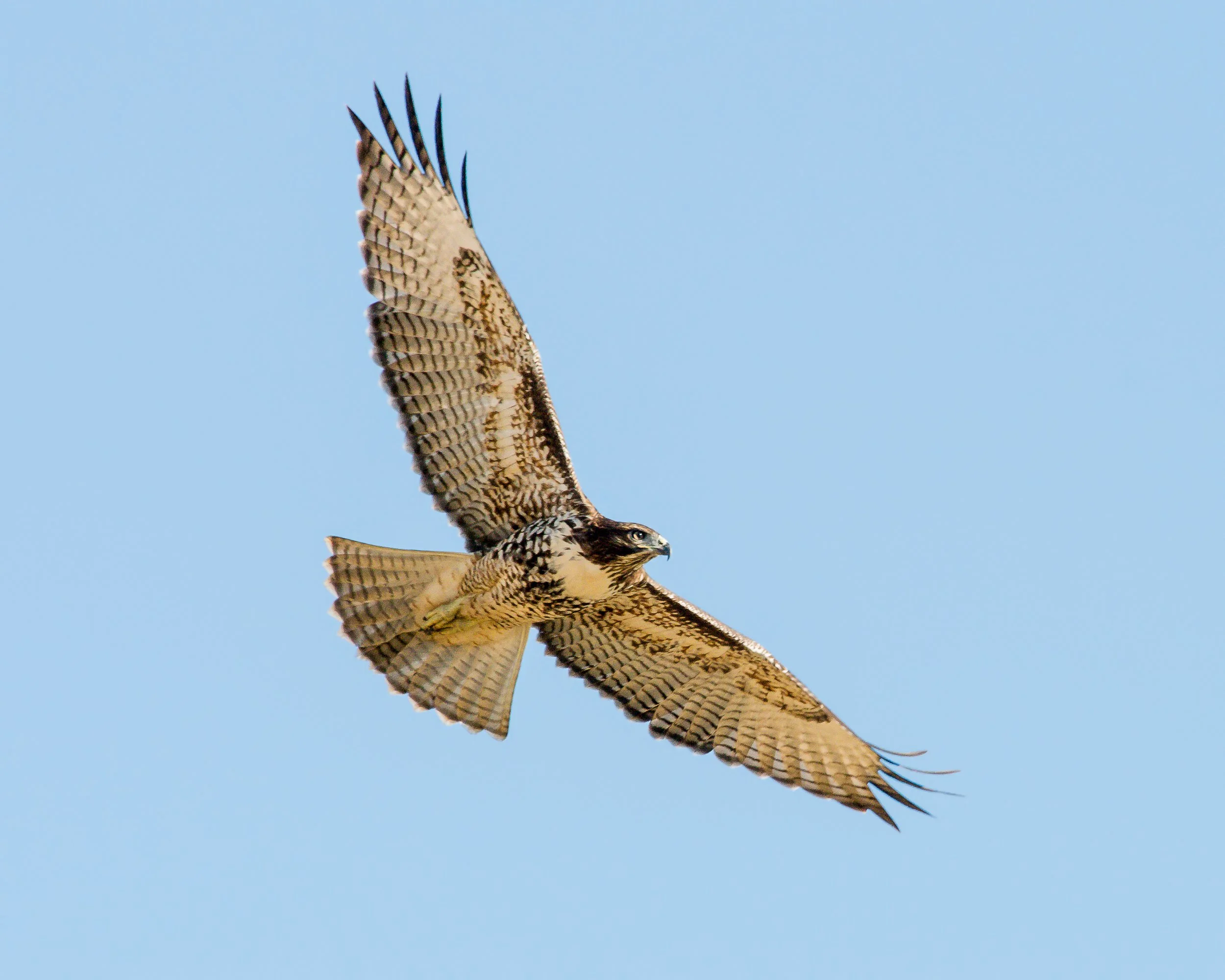
Red-tailed Hawks have long, broad wings and short, wide tails. A Red-tailed Hawk can be positively identified when flying overhead by the dark line on the top edge of the inner part of its underwing. These darkened lines on the upper wing edges are called patagial markings. No other raptor in our region has this characteristic. Another way to identify a Red-tailed Hawk is when you see its red tail! That makes sense. Actually, the tails of adult Red-tailed Hawks are red on top and whitish below; but the red color shows through the white when they are soaring up in the sky. It’s good to keep in mind that young birds won’t have red tails until they are around two years old! Most Red-tailed Hawks have light-colored abdomens with a streaky darker band that runs across the belly and continues under their wings. Birderwatchers call this the belly band. Red-tailed Hawks usually have dark heads. Their backs, shoulders, and upper wings are a rich brown color and often there are mottled white patches or markings on the back shoulder area. The descriptions of individual Red-tailed Hawks can be quite unique and they vary in color from region to region as well.

Red-tailed Hawk © Daniel Lee Brown

Red-tailed Hawk, juvenile © Daniel Lee Brown

Where do Red-tailed Hawks live?

Red-tailed Hawks live in many different habitats. They are frequently seen in open country, agricultural areas, and are seen sailing over homes or developed areas too. Red-tailed Hawks usually require some amount of open space with trees nearby. They build their nests in tall trees, often the tallest tree in a cluster, or on cliff ledges, towers, nest platforms, and occasionally buildings. Both the male and female help with nest building and incubation (keeping eggs warm by sitting on them). After the young hatch, the male usually brings food to the nest and the mother then feeds the brood.

What do Red-tailed Hawks eat?

The Red-tailed Hawk diet is mainly small mammals, like voles, rats, rabbits, and ground squirrels; but they also eat birds and reptiles. Occasionally, they will eat bats, frogs, and toads. The Red-tailed Hawk does most of its hunting from a perch. However, they also may hunt while flying. 

Red-tailed Hawk © Daniel Lee Brown

What do Red-tailed Hawks sound like?

The call of the Red-tailed Hawk is a loud, high-pitched, hoarse scream. It will immediately get your attention! Since the call of the Red-tailed Hawk is much more dramatic than that of other raptors, their call is often used in movies and television shows or commercials. Bald Eagles, for example, have much weaker or softer calls.

You can listen to the calls of the Red-tailed Hawk at xeno-canto. xeno-canto.org/species/Buteo-jamaicensis.

Meet the Nuttall's Woodpecker

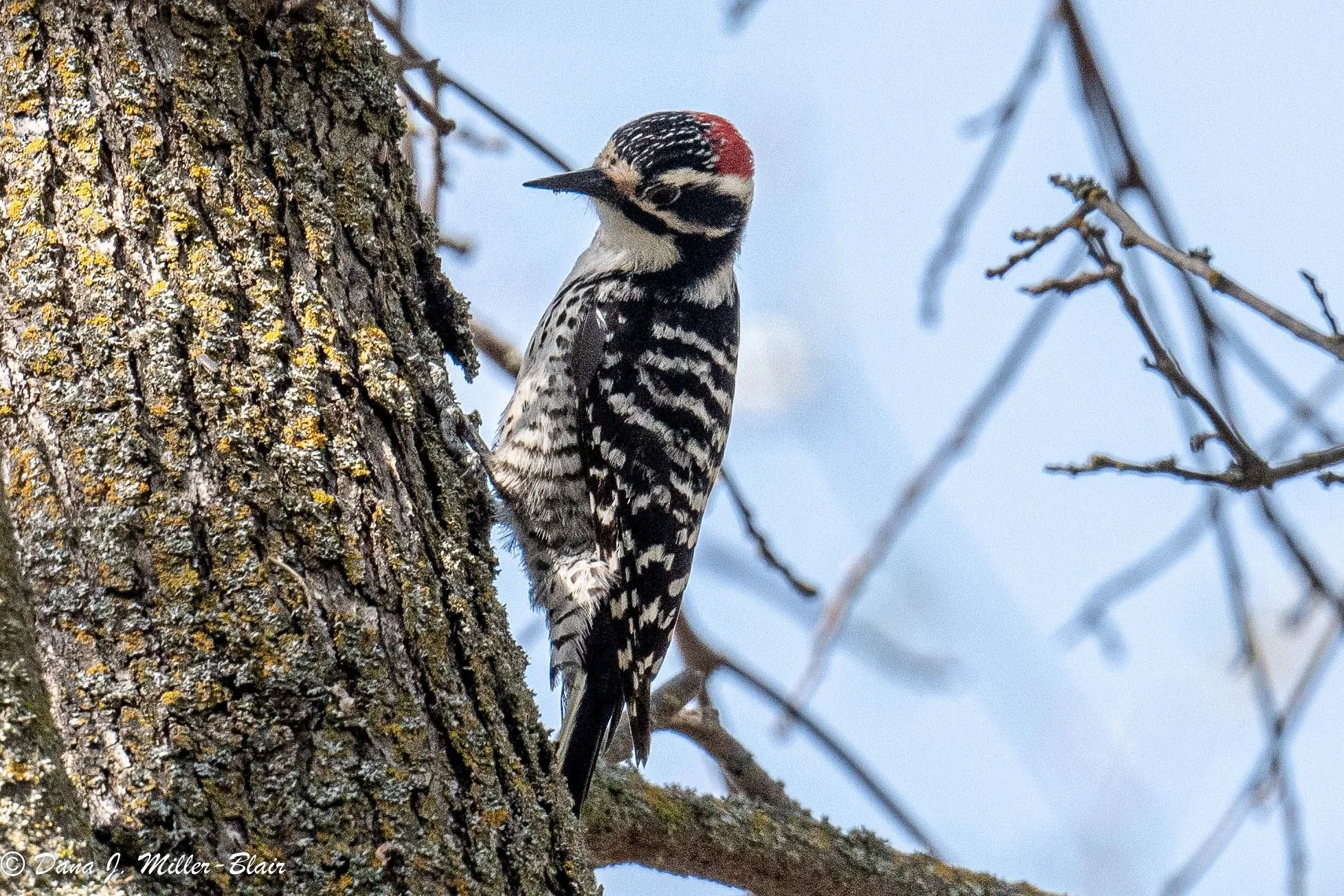
Nuttall’s Woodpecker, male © Dana J. Miller-Blair

This month let’s talk about a bird you may frequently hear and see in your yards, the Nuttall’s Woodpecker. The Nuttall’s is one of several woodpecker species that can be seen in our region. It was named after an English naturalist named Thomas Nuttall in 1843. Nuttall’s Woodpeckers are found primarily in California (and sometimes in northern Mexico) to the west of both the Sierra Nevada Mountains and the Cascades.

What does a Nuttall’s Woodpecker look like?

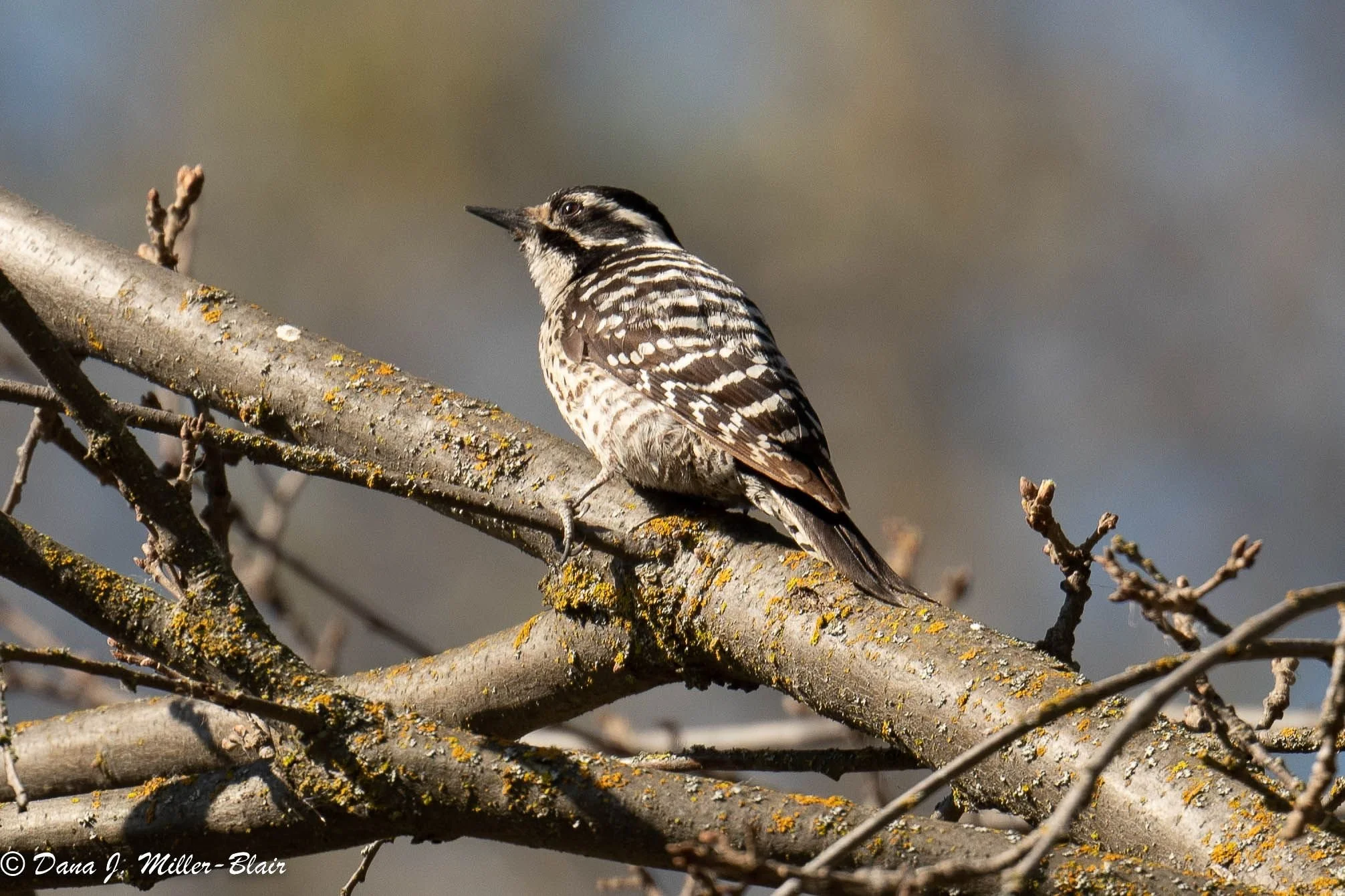
Nuttall’s Woodpecker, female / juvenile © Dana J. Miller-Blair

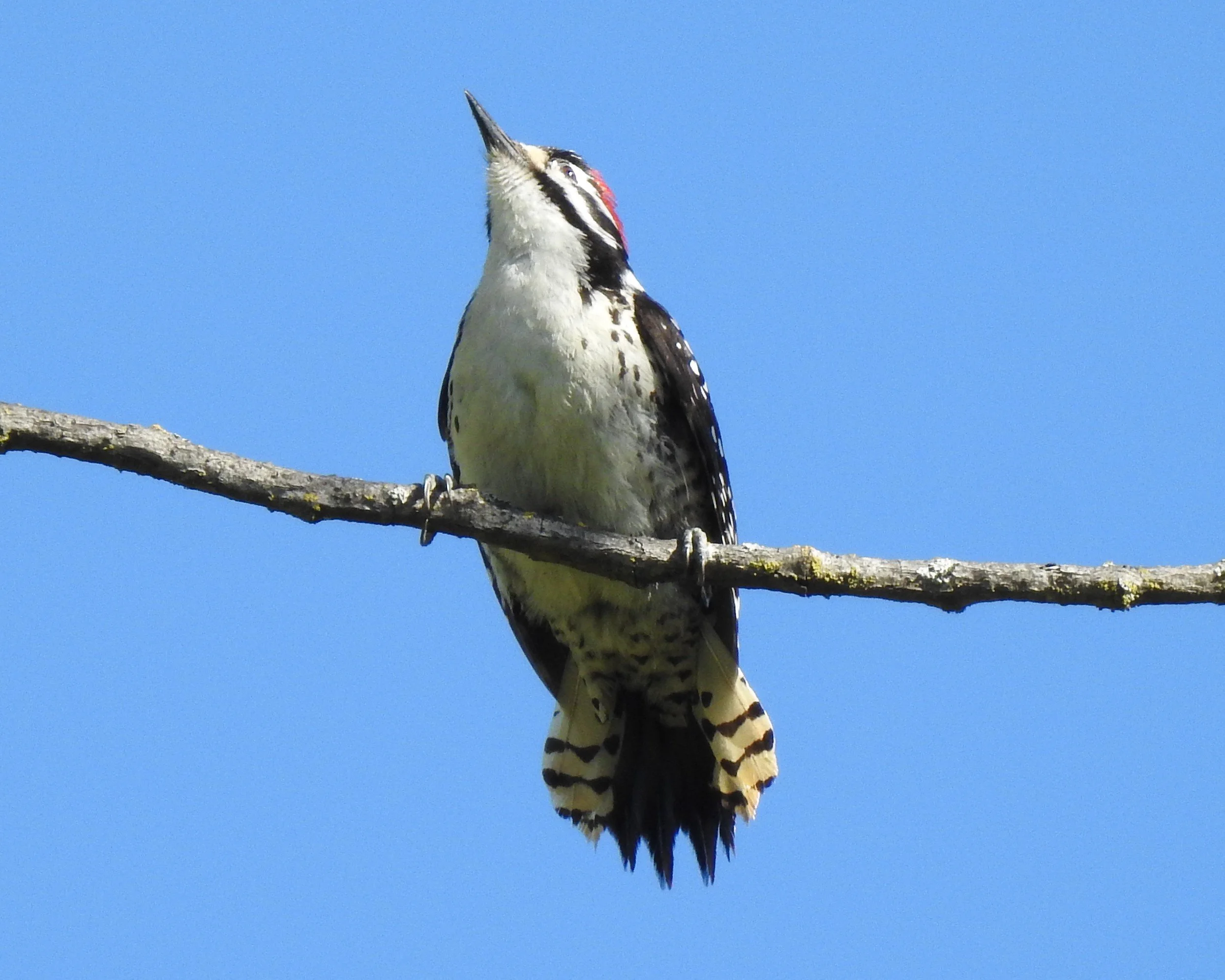
Nuttall’s Woodpecker from below © Mary Forrestal

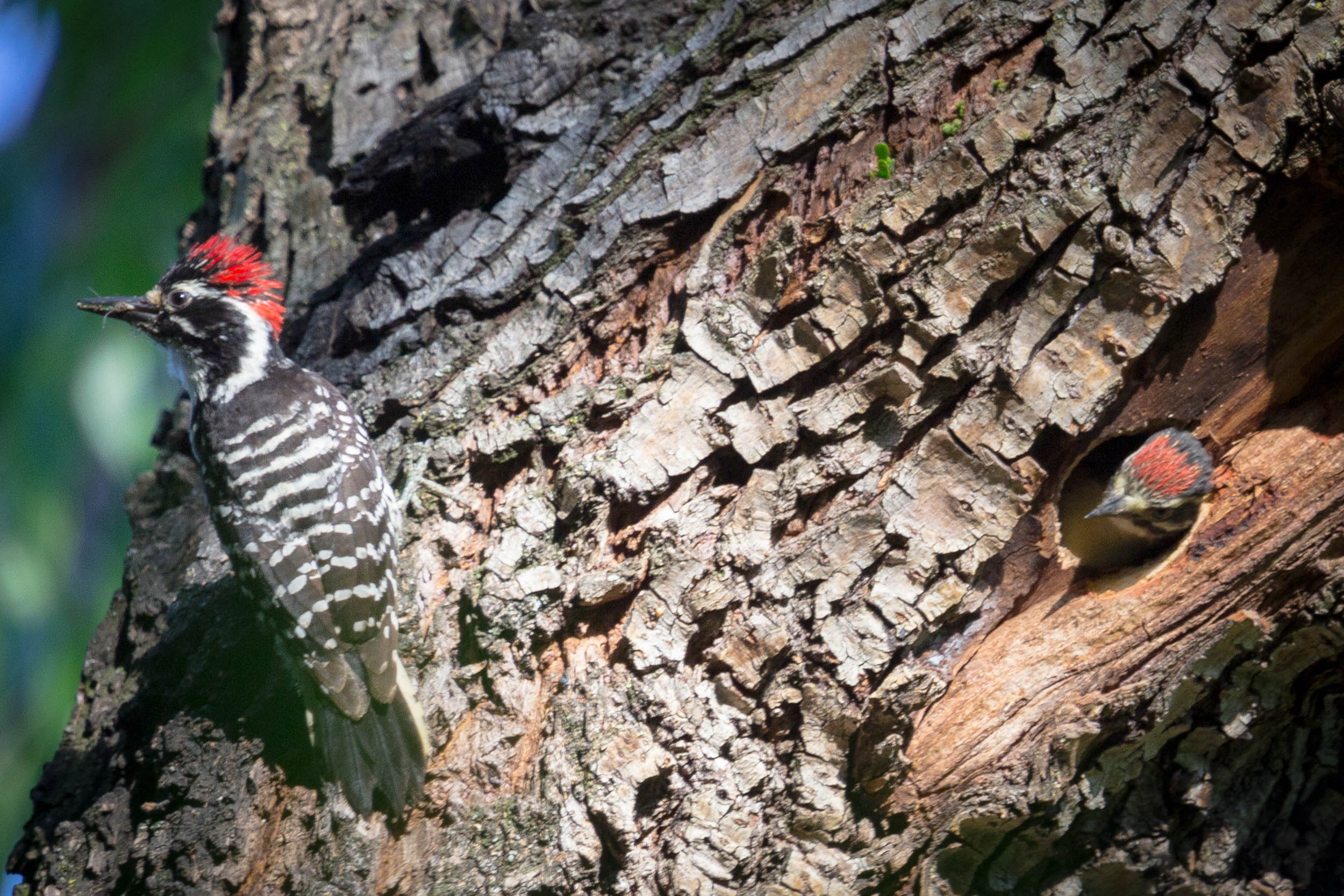
Nuttall’s Woodpeckers are about seven inches long and are mostly black with white barring (or spots) on its back, wings, and outer tail. They have a black face with white stripes and have a short black bill. Nuttall’s Woodpeckers have a white belly with black spots running along the sides of their bellies. The male has a red “crown” patch on the back of its head. Juvenile birds look a lot like the adults; except they have some white color on their heads.

Where do Nuttall’s Woodpeckers live?

Nuttall’s Woodpeckers are “cavity nesters” which means they use holes inside live or dead trees to lay their eggs and protect their young. A new cavity is created every year; and this is usually the job of the Nuttall’s male. The entrance hole is about two inches wide. Nuttall’s Woodpeckers usually nest in cottonwood, willow, sycamore, or oak trees. They even line the bottom of their nest cavities with wood chips to help cushion their eggs! Both parents help with incubation (sitting on the eggs) and raising their young. Young birds leave the nest at about one month after hatching. After Nuttall’s have finished raising their young, their old nests are frequently used by other birds that are incapable of making cavities. While Nuttall’s Woodpeckers prefer oak woodlands and riparian areas (land near rivers or streams); they will go anywhere there are trees and often are seen in populated areas.

Nuttall’s Woodpecker, males © Larry Hickey

What do Nuttall’s Woodpeckers eat?

Although you find Nuttall’s Woodpeckers frequently among oak trees, they are not really fond of acorns. They like to eat insects and really enjoy eating both adult beetles and beetle larva. They also eat caterpillars, ants, bugs, termites, and millipedes, in addition to, berries and other fruits, poison oak seeds, and sap. They flutter their wings to help themselves balance when searching for food on small twigs. Nuttall’s don’t use their bills to drill when they look for insects under the bark of trees. Instead, they use their bills to pry and flake away pieces of bark; and then to probe to find insects. One can actually watch them turn their heads from side-to-side when they peer into bark crevices seeking insects!

What do Nuttall’s Woodpeckers sound like?

Like many birds, you frequently can hear a Nuttall’s Woodpecker before you spot one. They have a rattle-like call that is quite loud and it quickly becomes a familiar sound to many birdwatchers. Nuttall’s Woodpeckers also drill or “drum” at the bark of trees. (heard in second recording below). Woodpeckers of all species do this for three reasons: either to communicate with other birds or claim a territory, to drill a hole for a nest, or to sometimes look for insects or sap.

You can listen to the sounds of the Nuttall’s Woodpecker at xeno-canto. xeno-canto.org/species/Dryobates-nuttallii

Meet the Western Bluebird

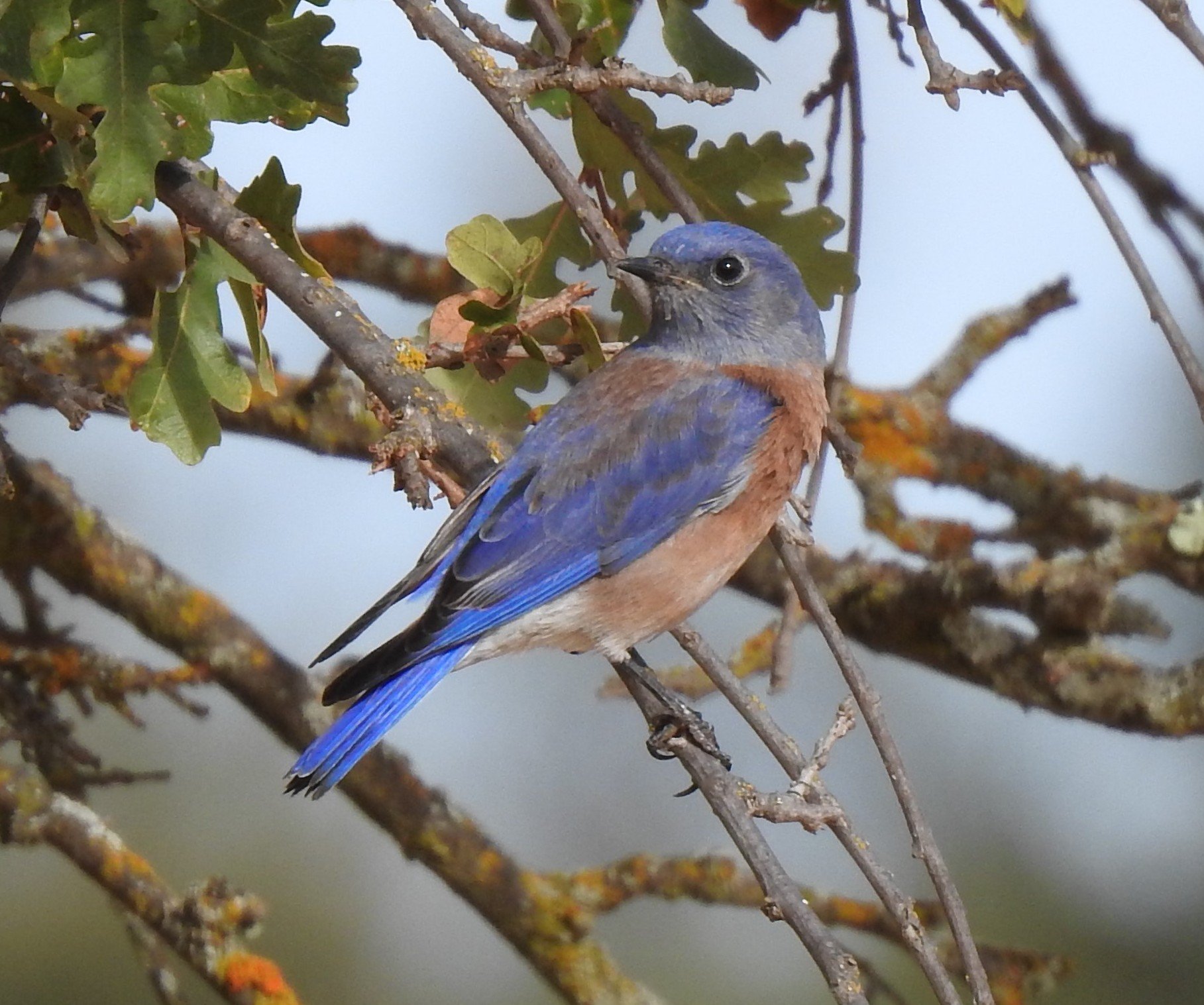
Western Bluebird, male © Mary Forrestal

No matter how many times you’ve seen one before, there isn’t a more beautiful site than to see a Western Bluebird perched on a park fence. They seem at home in the suburban park setting.

Western Bluebirds, along with American Robins and Hermit Thrushes, are members of the Thrush family. Like many thrushes, they are social birds. Except when nesting, flocks of Western Bluebirds are often seen feeding together. Their year-round range is from California, into the southern Rocky Mountains, Arizona, and New Mexico in the Untied States and most of Mexico. Their breeding range extends up to the Pacific Northwest, British Columbia, and Montana. Depending on how far north they were nesting, some Western Bluebirds do migrate to warmer areas in the winter. It is interesting that, unlike most songbirds which migrate during the night, Western Bluebirds migrate mainly in the daytime!

What does the Western Bluebird look like?

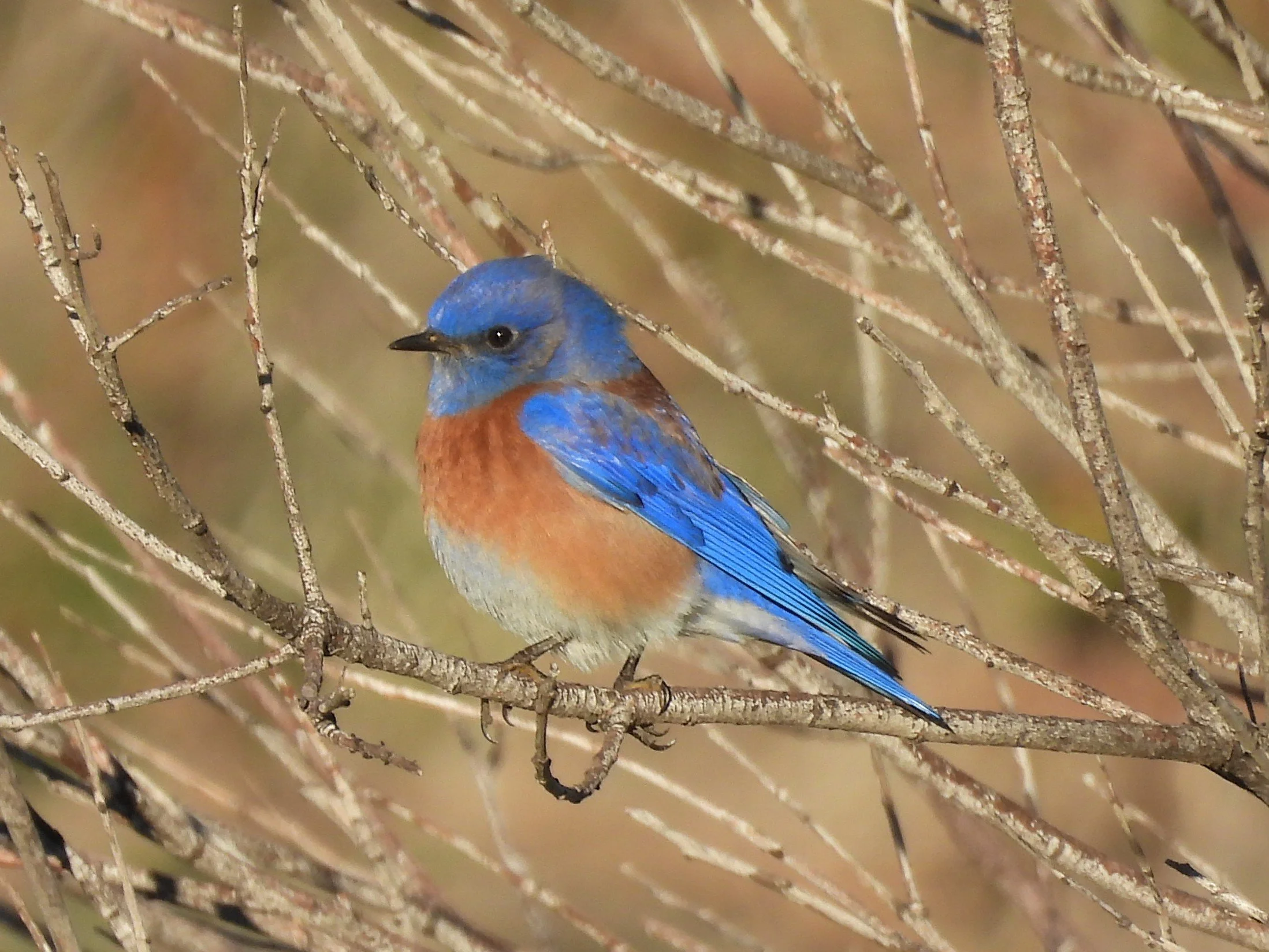
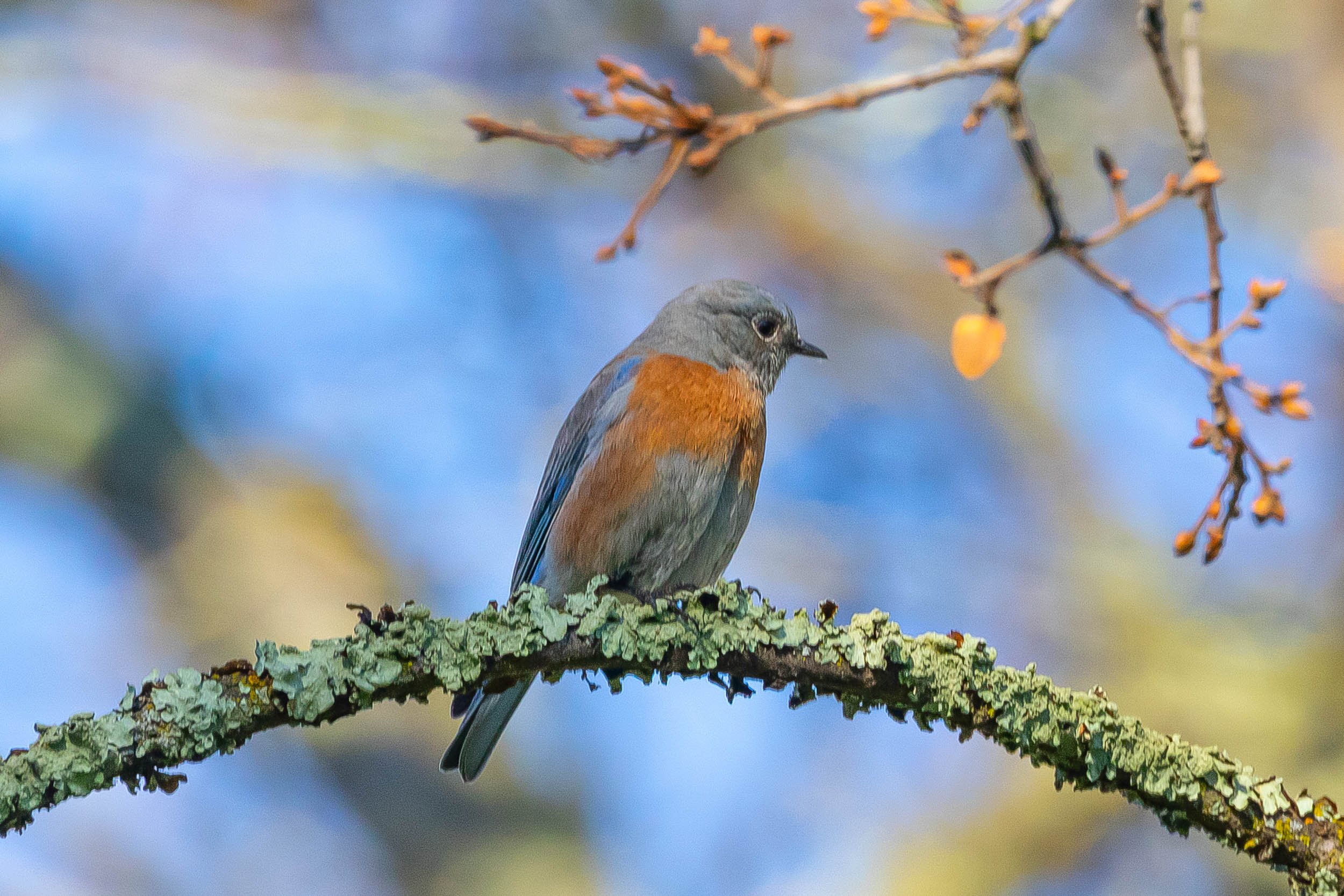
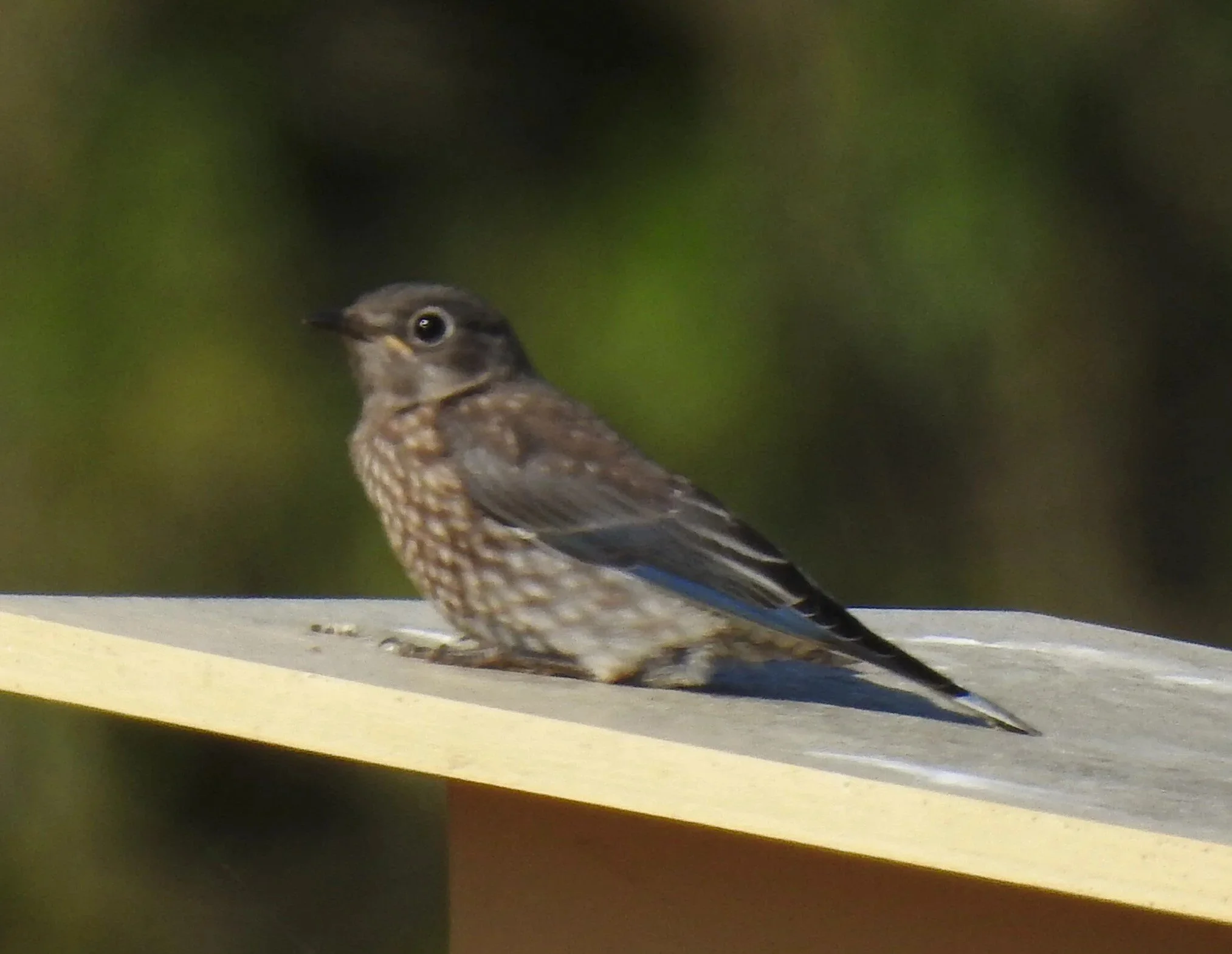
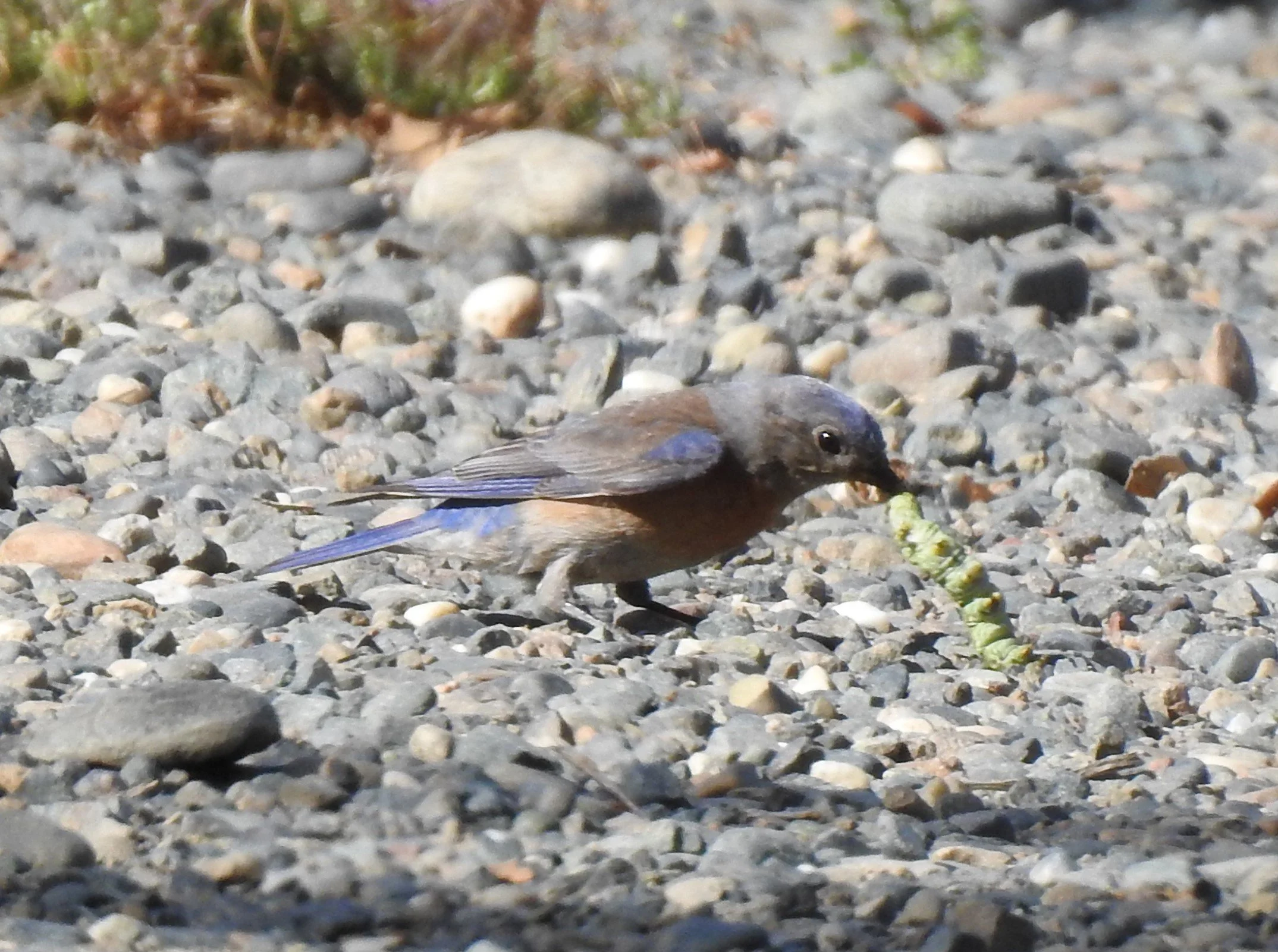
The Western Bluebird male and female look a little different from each other. Like many birds, the male has more pronounced or bolder feather color. Male birds have bright blue colored wings, heads, throats, as well as part of their backs. Males also have a deep rust-orange color on their chest and shoulder areas along with a gray belly. Female Western Bluebirds are also blue and orange; but their color is duller overall. Females lack the bright blue feathers on their heads and throats that males have. Western Bluebirds have short tails and have thin, straight bills. Young or juvenile birds look quite different from their parents. They are brown and gray, with blue only on their tails and part of their wings. Juveniles also have light colored spots on both their chests and backs.

View fullsize

Western Bluebird, male © Mary Forrestal

Western Bluebird, female / immature © Larry Hickey

Western Bluebird, juvenile © Mary Forrestal

Where do Western Bluebirds live?

Western Bluebirds nest in “cavities” or holes. Unfortunately, their bills aren’t able to dig the holes that they need for nesting. So, frequently Western Bluebirds will use cavities made by woodpeckers in the past. They seek holes in both live and dead trees. Western Bluebirds also nest in man-made boxes or other man-made holes. Once a pair has chose a nesting site, the females do most of the work to construct the nest inside.

What do Western Bluebirds eat?

Western Bluebirds like to eat both insects primarily in summer and rely more on fruits and berries in the winter. They like the berries of mistletoe, juniper, and elderberry. Western Bluebirds will perch on low tree limbs or fences and then jump down when they spot an insect to eat. They are also seen catching insects in mid-air and looking for insects inside tree canopies.

Western Bluebird, female / immature, eating a catepillar © Mary Forrestal

What do Western Bluebirds sound like?

The call of the Western Bluebird is a strong, low-toned whistle sound. Their song is not heard as often and is actually just a series of their call notes!

You can listen to the songs and calls of the Western Bluebird at xeno-canto. xeno-canto.org/species/Sialia-mexicana

Meet the Belted Kingfisher

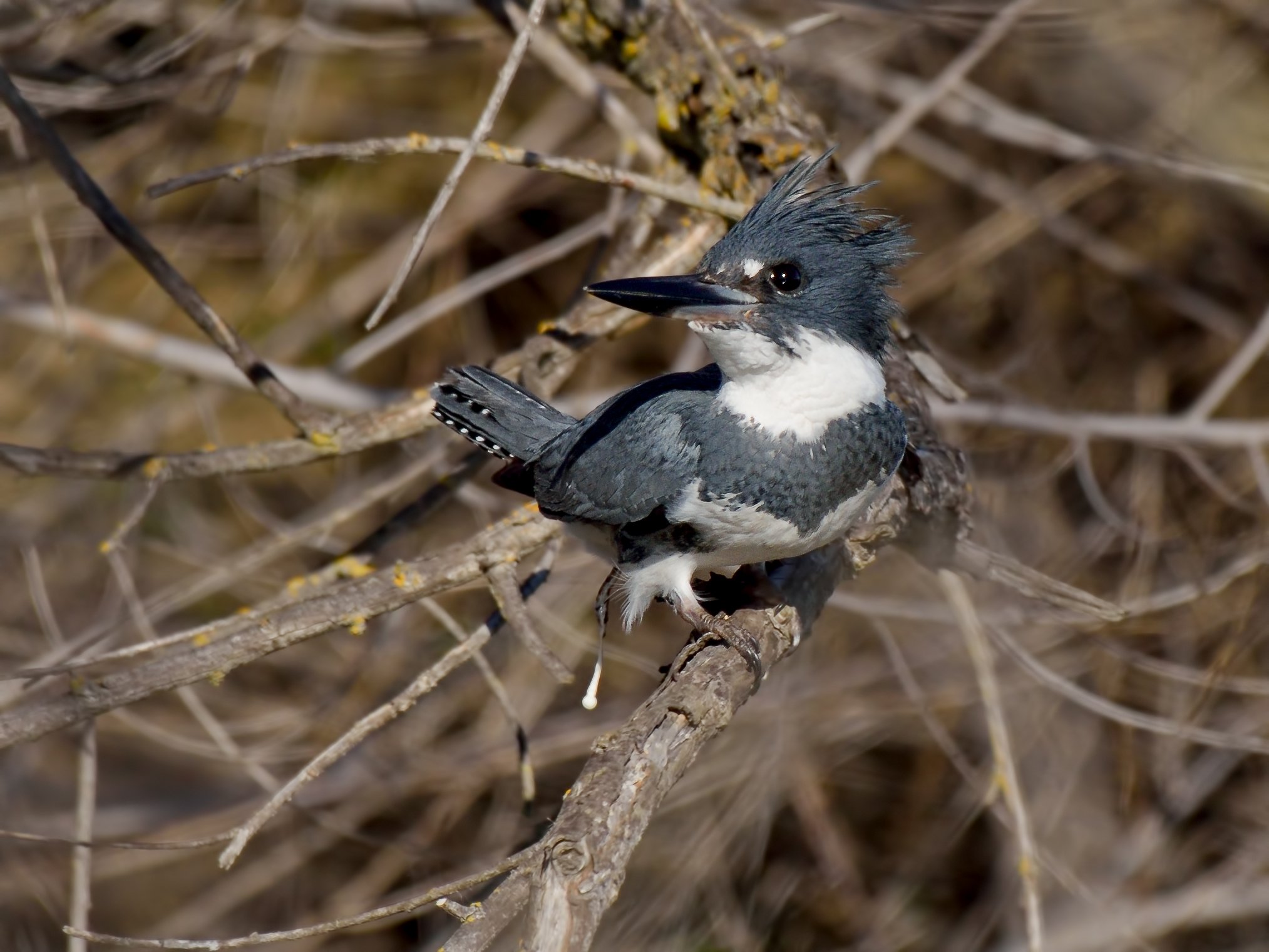
Belted Kingfisher, male © Daniel Lee Brown

There are many species of kingfishers in the world, but only one, the Belted Kingfisher, inhabits North America. Their range extends from the northern parts of Canada, Alaska, throughout the United States, and down as far south as Panama in Central America.

Belted Kingfishers are very independent and solitary birds. You will often see them perched alone, over a body of water looking for food. Some Belted Kingfishers must migrate south in the winter to find water that isn’t frozen. However, in the Sacramento area, Belted Kingfishers stay year-round.

What does the Belted Kingfisher look like?

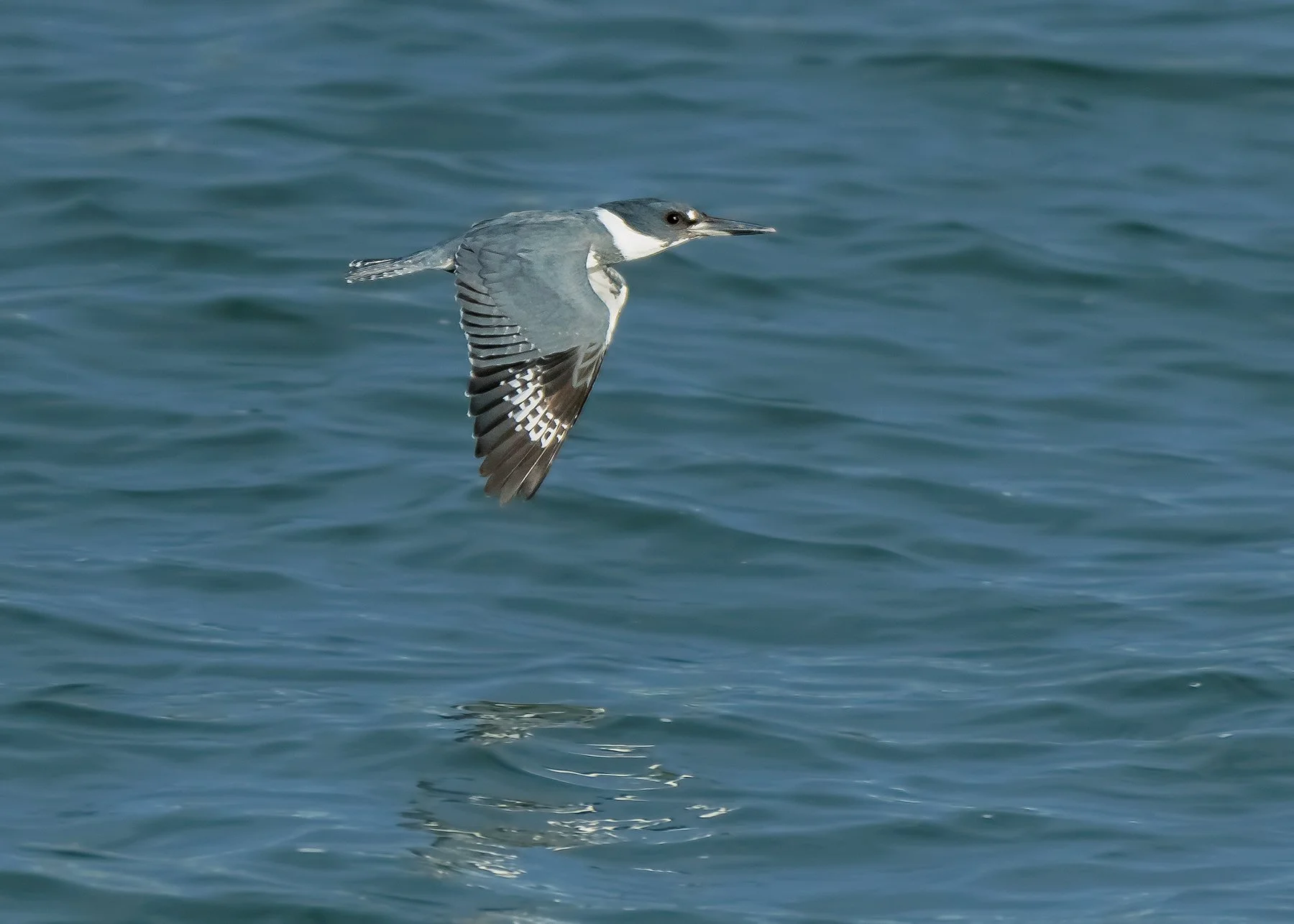
Belted Kingfishers are quite handsome birds with their stunning slate-blue feathers and bright white collar and belly. A tall crest of blue feathers is present on top of their heads and they have a striking slate-blue chest band.

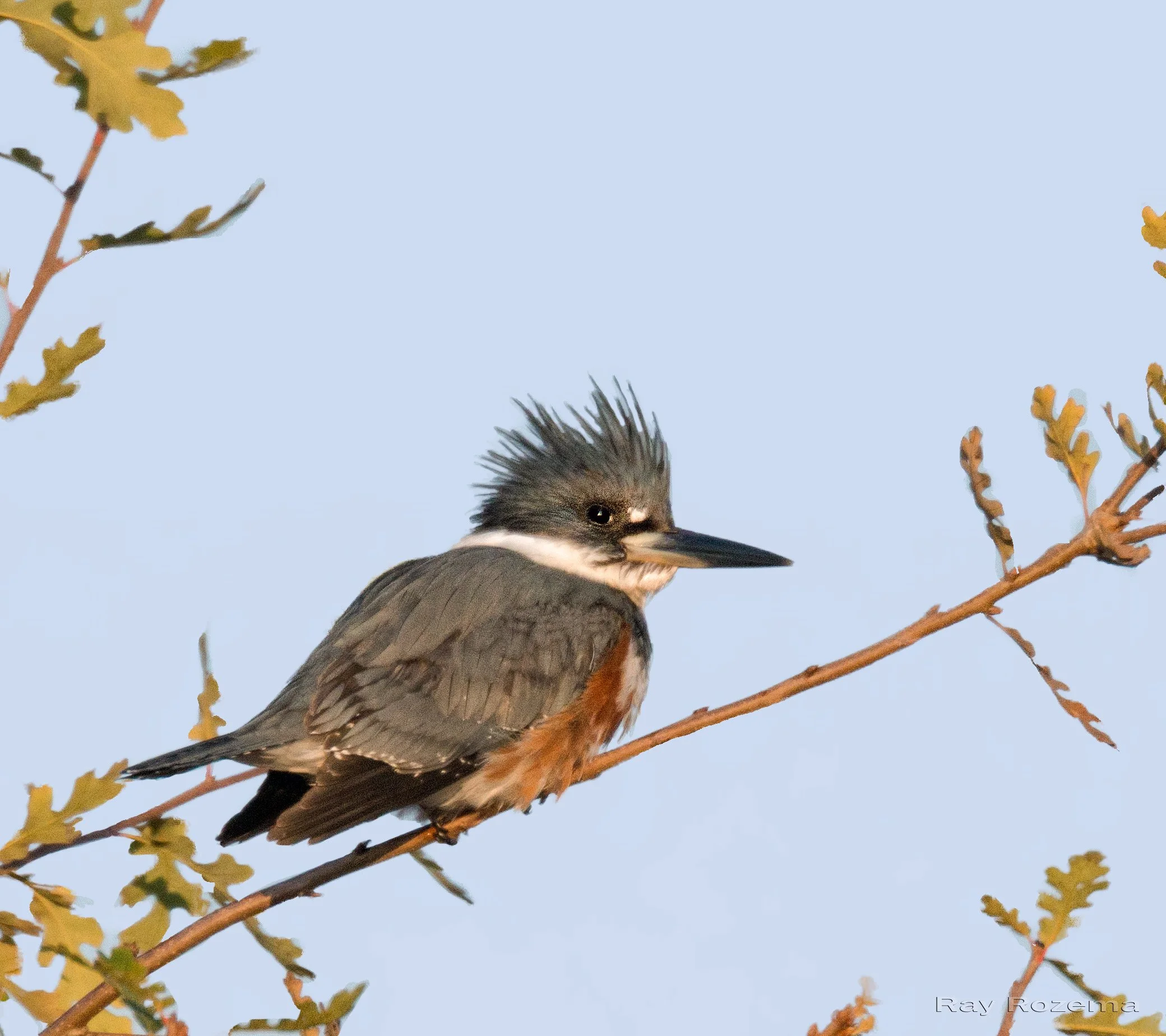
Female Belted Kingfishers have a rusty-orange colored belly band, in addition to the blue chest band. This rusty-orange color also runs down the females’ flanks. Juvenile birds of both sexes have a faint or spotty rusty-orange belly band, like their mothers. This orange band disappears as the male Belted Kingfisher matures into adulthood. 

Belted Kingfisher, female © Ray Rozema

Where do Belted Kingfishers live?

Look for Belted Kingfishers anywhere there is a smooth flat surface of water. You can find them near rivers, lakes, ponds, streams, estuaries, and coastlines. They build their nests in river levees or other types of banks. Belted Kingfishers dig their tunnels in these banks. They purposely avoid choosing nesting sites with lots of trees. Tree roots make it much too difficult to dig tunnels!

Belted Kingfisher, male © Daniel Lee Brown

What do Belted Kingfishers eat?

Belted Kingfishers are mainly carnivores and prefer small fish and crayfish over other types of foods. If fish aren’t available, they will eat small amphibians, reptiles, mollusks, butterflies and moths, and other insects. Rarely, they even eat berries.

The Belted Kingfisher hunts by perching on a branch, overlooking a body of water; or by hovering (remaining in one place in the air, using rapid wing beats) over a body of water. When prey is spotted, Belted Kingfishers plunge into the water, head first. They have a special membrane that covers and protects their eyes as they enter the water.

What do Belted Kingfishers sound like?

The call of the Belted Kingfisher will most certainly get your attention! Their loud, rattle-like call is usually the first signal that a Belted Kingfisher is near. 

You can listen to the sounds and calls of the Belted Kingfisher at xeno-canto. xeno-canto.org/species/Megaceryle-alcyon

Meet the Cedar Waxwing

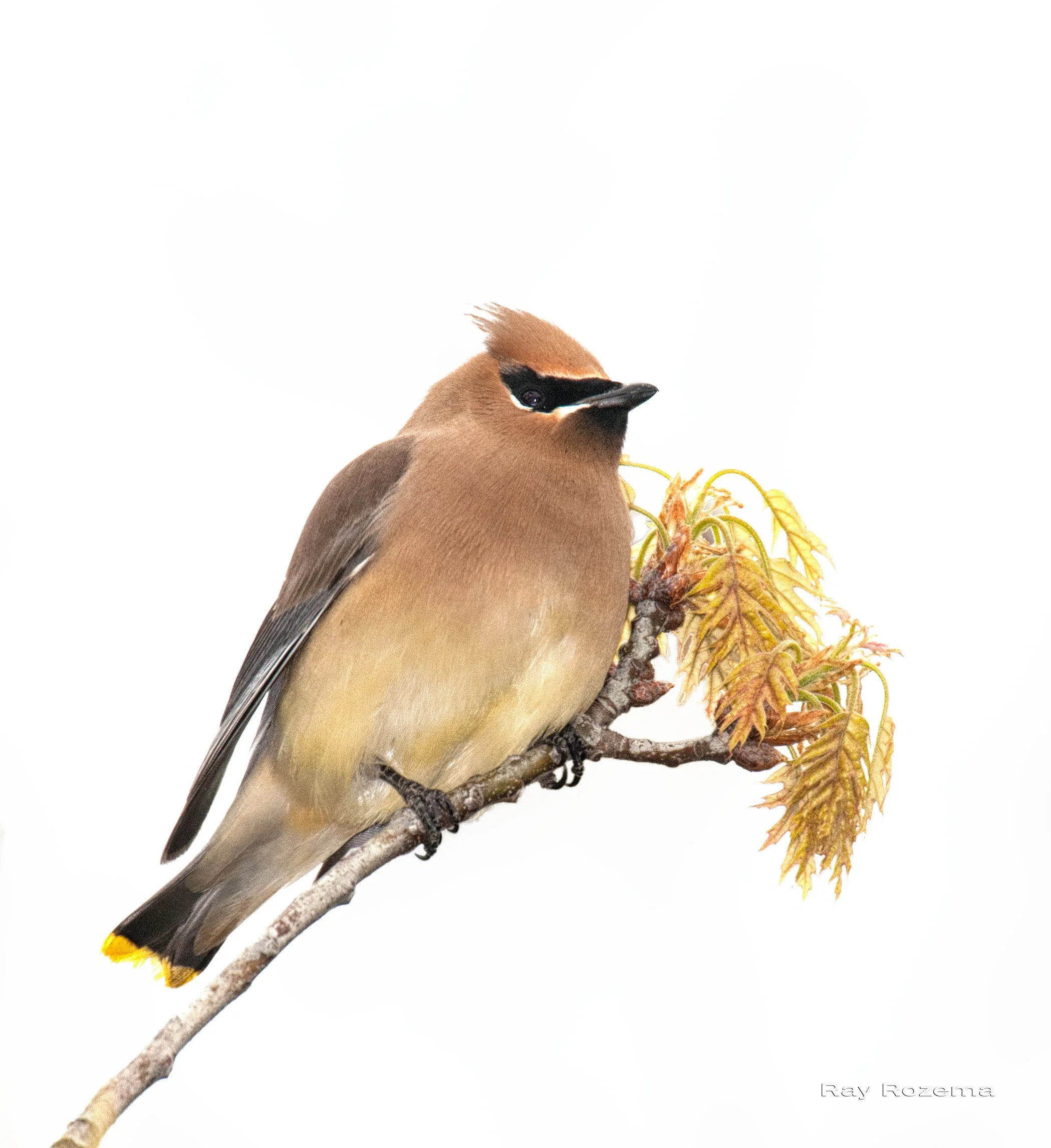
Cedar Waxwing © Ray Rozema

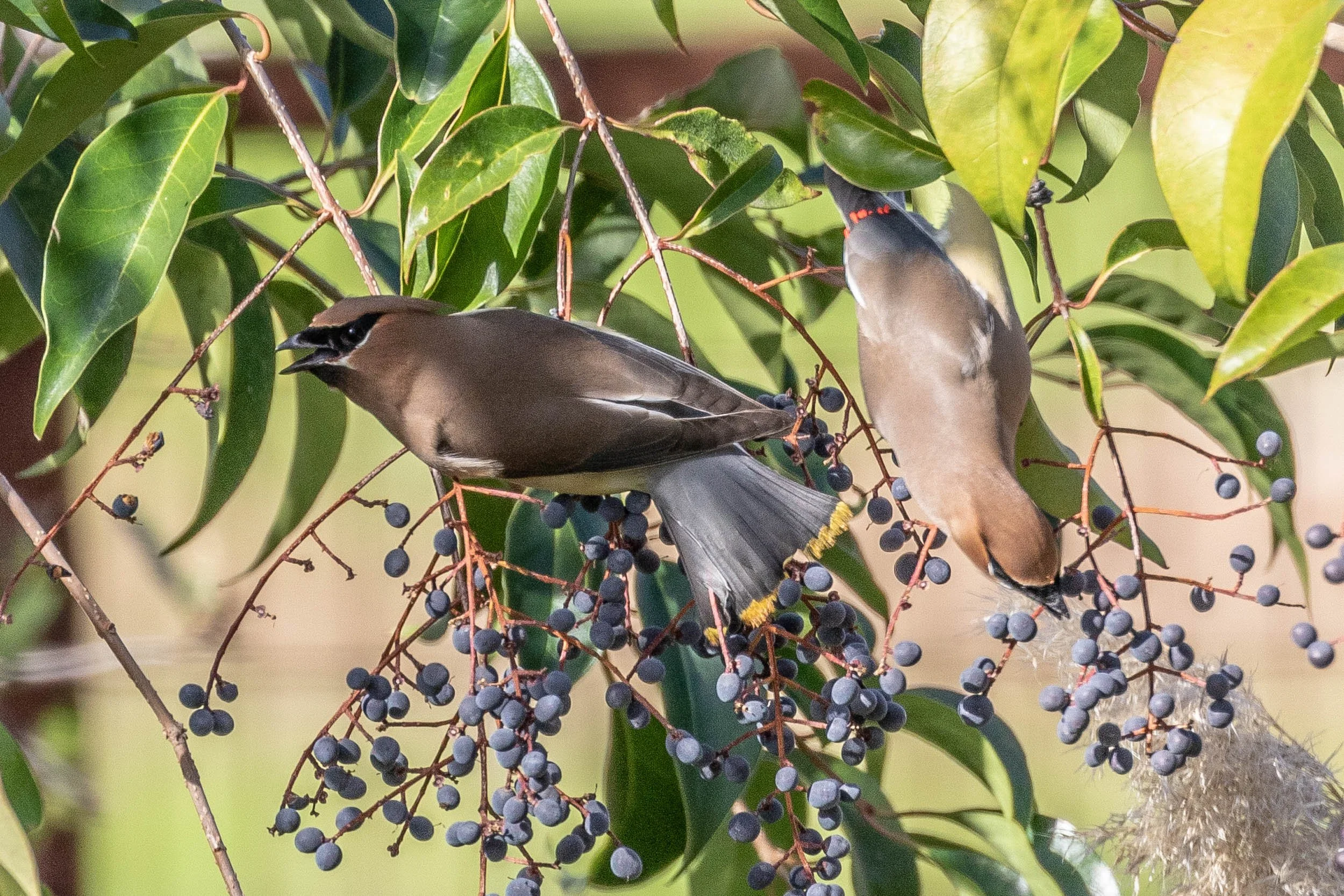
Cedar Waxwings are delightful birds and fairly common here in the Sacramento Valley. Most of the time, they fly in flocks and often show up in our yards. Cedar Waxwings are very social birds. There have been several reports of waxwings seen passing berries, one-by-one, down a row of birds! By using this technique, several birds obtained food that was difficult to reach. 

In the summer, Cedar Waxwings nest all across Canada and in the northern most states. But in fall and winter, many fly south in large flocks into the central and southern parts of the U.S. They can fly as far south as Central America and the northern part of South America. Cedar Waxwings do not have set migration routes. They fly in search of food, wherever it takes them.

What does a Cedar Waxwing look like?

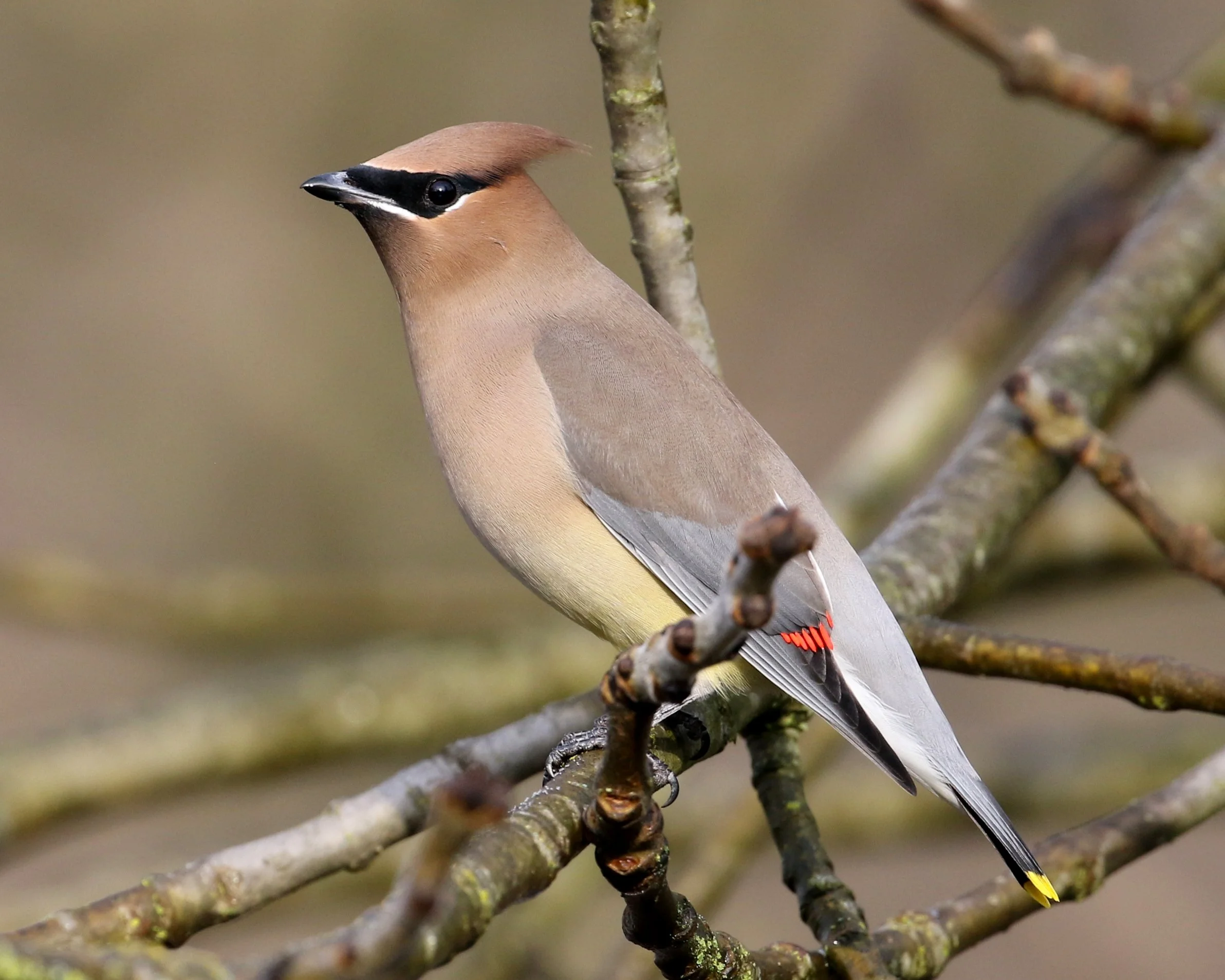
Cedar Waxwings are a treat to see because they are very unique-looking. Both males and females look alike. Adult birds have a group of pointed feathers on top of their heads, which is called a crest. A bold black color covers their eyes and faces and resembles a mask. They have pale yellow abdomens, gray upper tail and wing areas, brown heads, chests, and necks, and have bright yellow band on the tip of their otherwise dark tails. Young birds also have these yellow tail tips; but they look different from their parents. They have streaky bodies and do not have dark masks (or only have faintly colored masks). Often on Cedar Waxwings, you can see a wax-like red (or orange) substance on the tips of a particular set of flight feathers. This unusual and brightly-colored substance on their wings is why they are called waxwings. The color is related to the kind of berries the Waxwing has been eating! 

Cedar Waxwing © Chris Conard

What does the Cedar Waxwing eat?

Cedar Waxwings love berries and can remain healthy by eating only berries for several months of the year. Most other bird species need a more varied diet. Cedar Waxwings move around from location to location in search of berries and eat the berries by swallowing them whole! Waxwings have the anatomy to do this; humans do not, so please don’t try this yourself. Cedar Waxwings also enjoy other fruits, including apples and cherries, and they eat insects and cedar cones too.

Cedar Waxwing © Larry Hickey

How do Cedar Waxwings make their nests?

Even though a pair will search for a nest site together, it's the female Cedar Waxwing that makes the final decision on where the nest will be constructed. The nest site is usually in a fork or “v” of two branches. The nest is woven with twigs, grasses, cattail down, blossoms, string, and horsehair, and many other materials. Imagine this….. it takes more than 2,500 trips to the nest and 5-6 days before the nest is finally completed! It is also common to see several nests, or colonies, fairly close together in the same tree. This species is truly quite social and cooperative with one another. You can see a picture of a Cedar Waxwing on her nest at the USGS website.

What do Cedar Waxwings sound like?

Even though they are classified as songbirds, Cedar Waxwings do not have a song! They only make a few call notes. Their calls are generally heard when they are flying and have been described as a thin, high-pitched whistle or trill. Because Cedar Waxwings usually fly in flocks, you often hear lots of them calling together. Two terms have been given for a flock of Cedar Waxwings. One is an “ear-full.” You may come to understand the first term, “ear-full,” after listening to them. You can click on the box below to listen now. The second term for a flock of Cedar Waxwings is a “museum.” Perhaps this is because they are such attractive-looking birds. What do you think?

You can listen to the sounds of the Cedar Waxwing at xeno-canto. xeno-canto.org/species/Bombycilla-cedrorum


So if you have never noticed or seen Cedar Waxwings, hopefully you will sometime soon. Listen for their calls and then look high in the trees around you. Perhaps they are perched there enjoying a fabulous meal.

Meet the Dark-eyed Junco

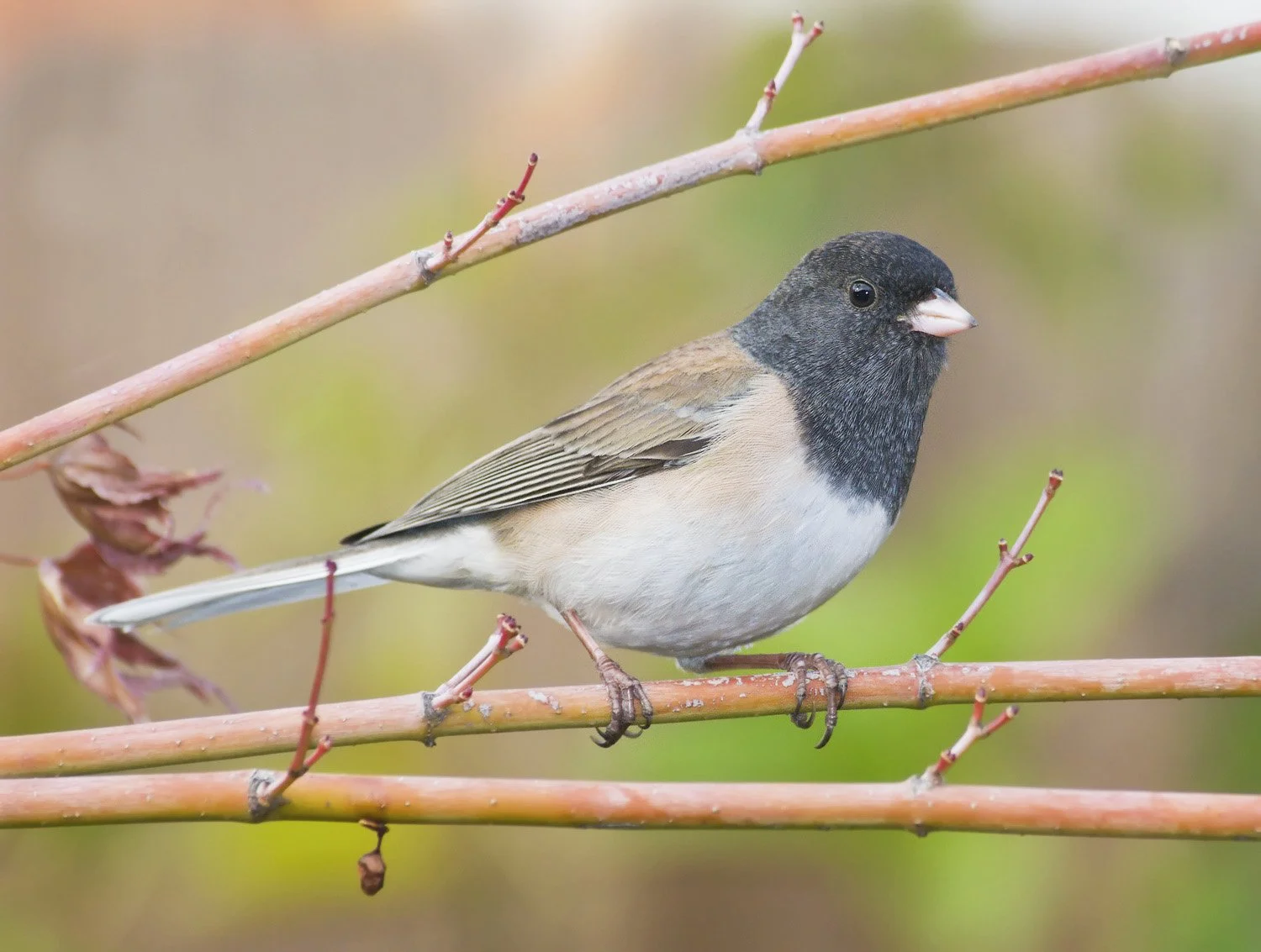
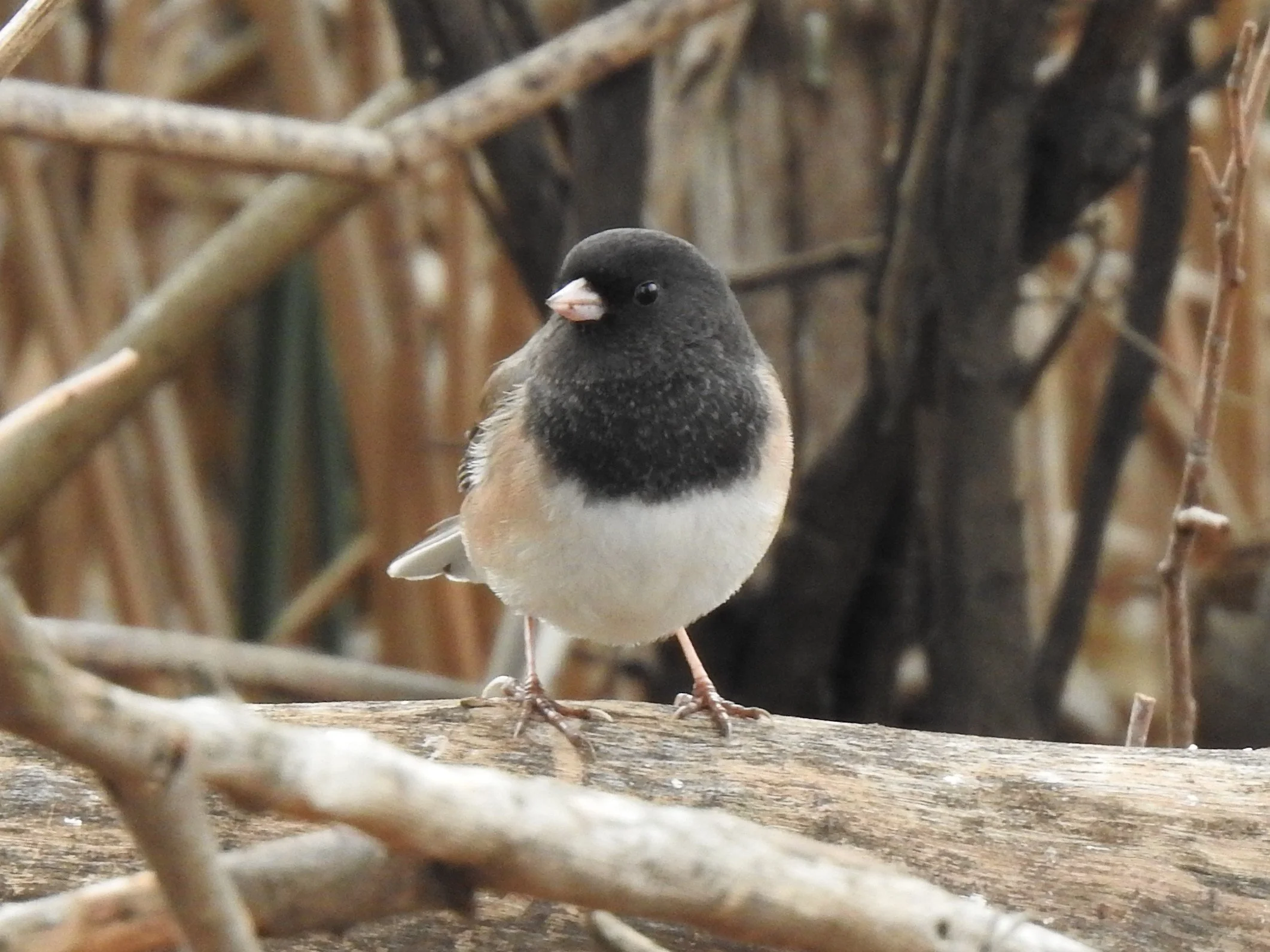
Dark-eyed Junco © Daniel Lee Brown

Now here is a bird you may often see in your own yards, the Dark-eyed Junco! It is a member of the sparrow family. They are frequently seen feeding on the ground and sometimes make ticking-like calls as they fly up to trees or bushes. This species is one of the most common birds on the continent; but you will only see them here in the Sacramento Valley from Fall through Spring. In summer, they nest and raise their young in coniferous forests or mixed woodlands, both to the west and east of us and also in Canada and Alaska. There are a few populations of Dark-eyed Juncos which live in other areas of the U.S. that do not migrate and stay in their areas all year long! Most Dark-eyed Juncos do migrate, however, and can be seen throughout much of the U.S. in the winter. They primarily eat seeds but during the nesting season will eat insects as well.

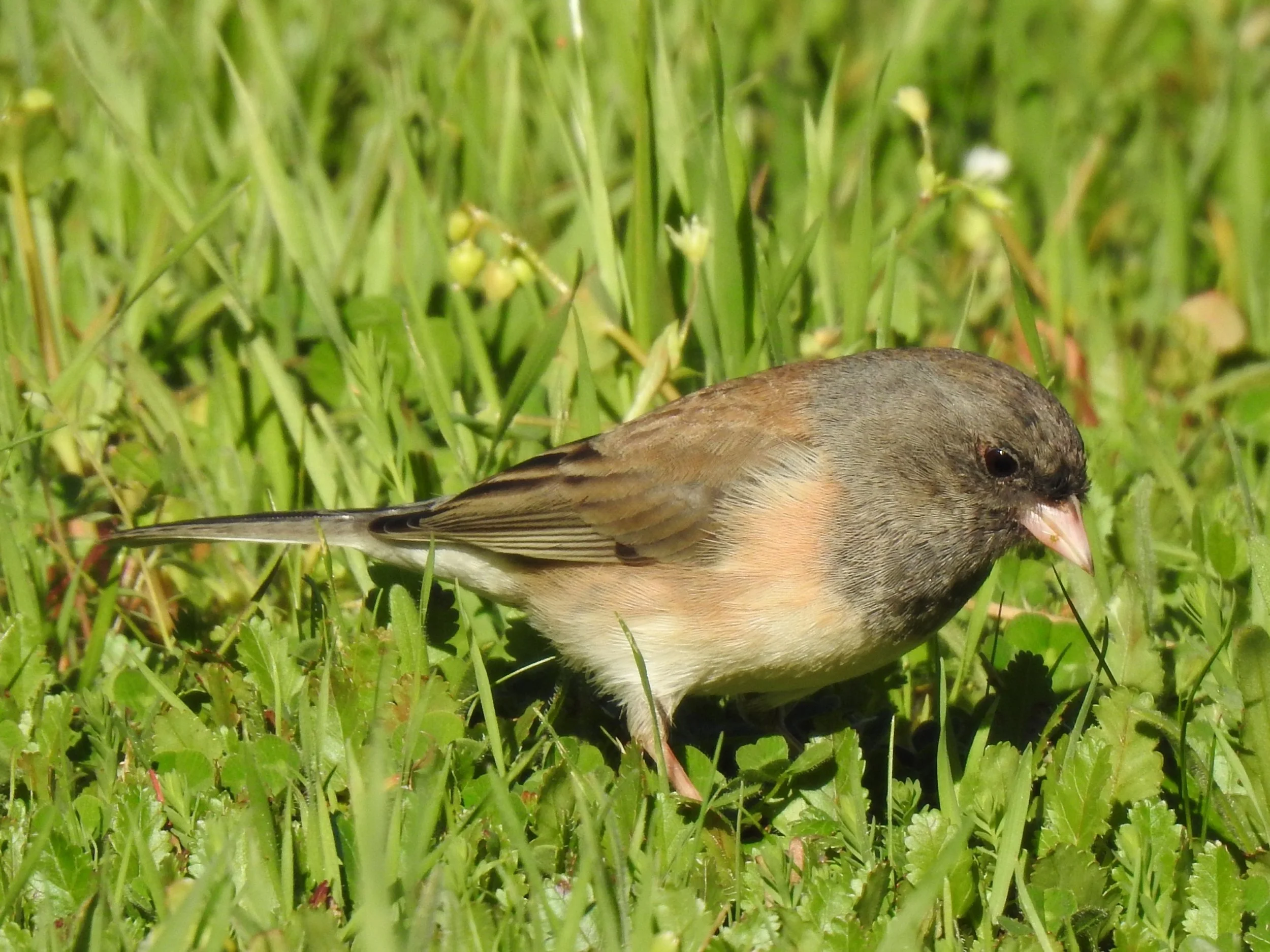
One of the interesting things about this bird is that its color patterns can be very different from bird to bird. Their appearance may make you believe that they are not the same species; but in fact they are. They have “coats” of many colors! (Hint: you can often suspect that you have spotted a Dark-eyed Junco when you observe their white outer tail feathers as they fly away.)

Dark-eyed Junco, male © Mary Forrestal

Dark-eyed Junco, female © Mary Forrestal

It’s the female that chooses the nest site and builds most of the nest. The nest site is usually on sloping ground, a low rock face, or amid the tangled roots of an upturned tree. Nests are sometimes in trees; but usually no higher than 10 feet. Males sing from treetops to defend their nesting territory. When around people, juncos may nest in or underneath buildings. Both parents help feed the young. Young birds leave the nest 9-13 days after hatching! 

Go outside and look on the ground in your backyard today. You may very well see a Dark-eyed Junco! 

You can listen to the songs and calls of the Dark-eyed Junco at xeno-canto. xeno-canto.org/species/Junco-hyemalis

Meet the Hermit Thrush

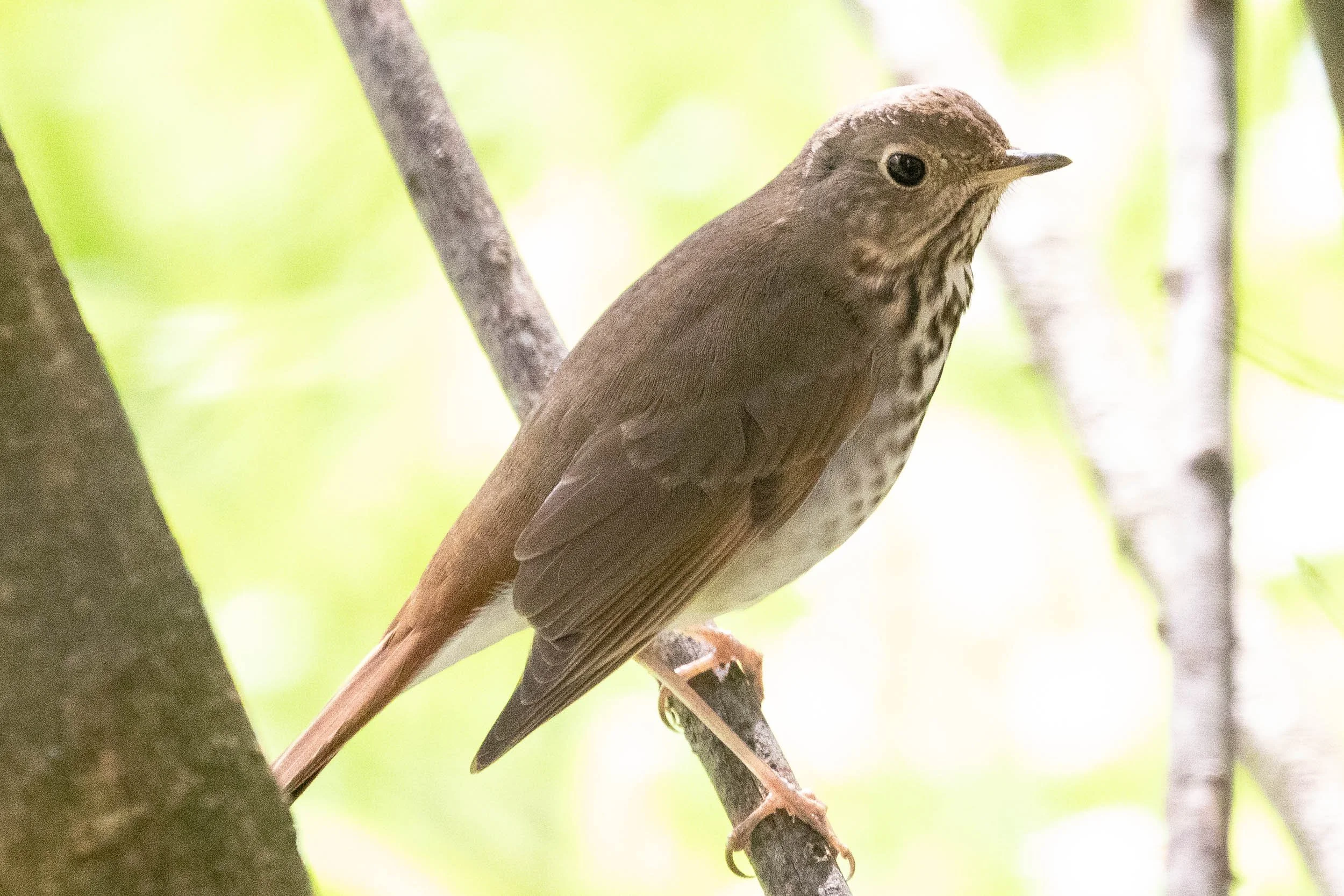
Hermit Thrush © Larry Hickey

Every fall, birdwatchers in the Sacramento area look forward to the arrival of the Hermit Thrush. The Hermit Thrush migrates from several northern states (including Alaska) and Canada. The species comes to our area because food is more available and to enjoy the milder winter climate.  Hermit Thrushes are in the same family group as the Robin. Just like Robins, Hermit Thrushes like to eat berries, insects, and sometimes invertebrates.  

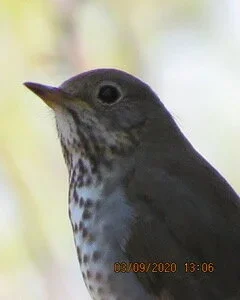
Can you see the triangle spots on the bird’s breast?

The Hermit Thrush often perches in one spot for a while; so you can frequently get a good look at it. There is nothing flashy or colorful about the Hermit Thrush. They are a grayish-brown bird that has triangular-shaped little spots on their breast and have reddish-brown tails. However, their sweet nature appeals to many who spot them. Often people refer to them as being their favorite bird.

Many think that the song of the Hermit Thrush is one of the most beautiful of all bird songs. Sadly, in the Sacramento area, we don’t hear them sing all that often. Hermit Thrushes usually save their delightful song for when they are in their breeding grounds, which are to the north and east of us. However, you CAN hear their calls here. Many species of birds have both songs and calls.
You can listen to the Hermit Thrush’s song and calls at xeno-canto. xeno-canto.org/species/Catharus-guttatus

So now, perhaps it’s time for you and your family to go out and see if you can find (or hear) a Hermit Thrush! Good luck!

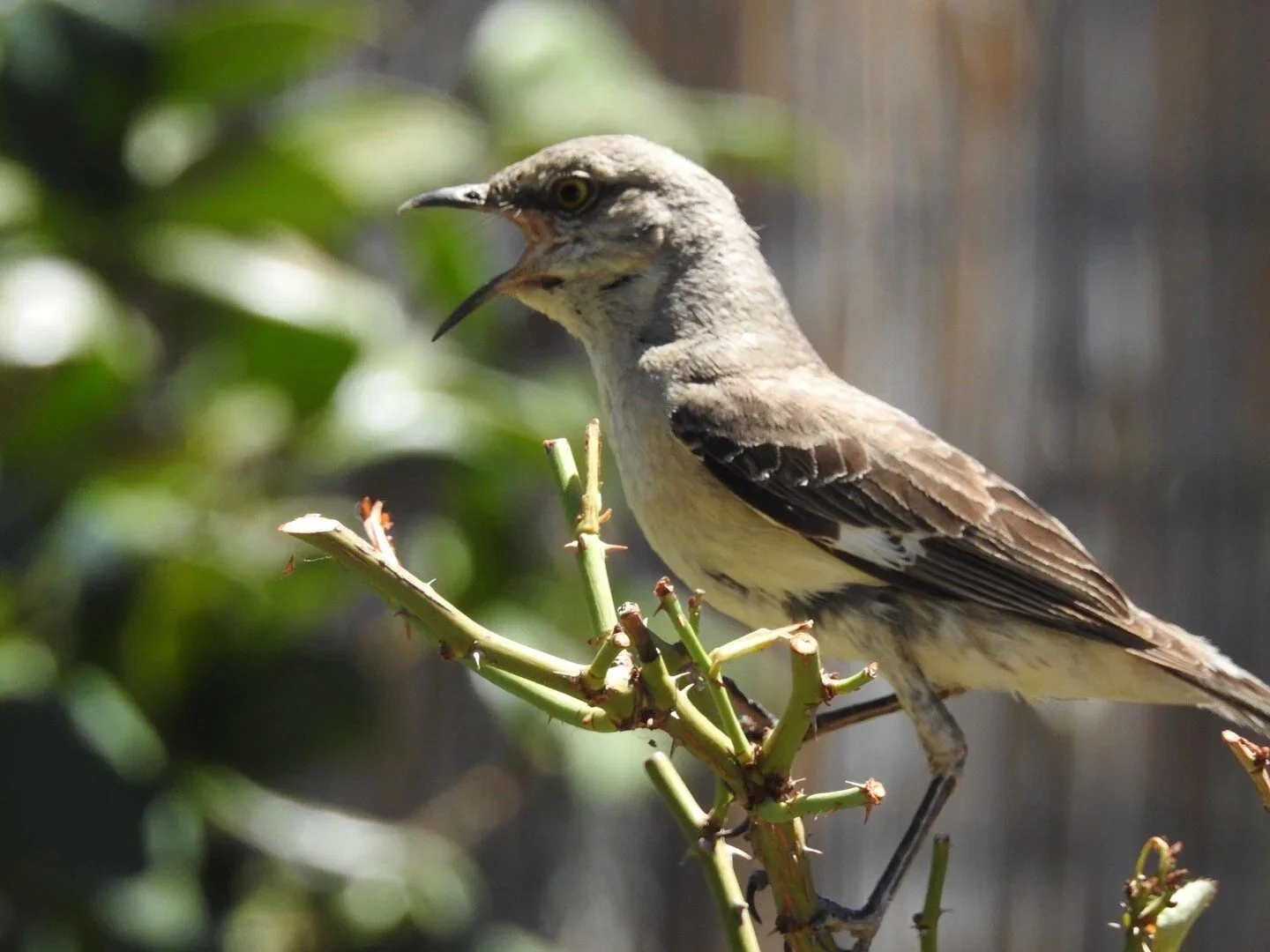
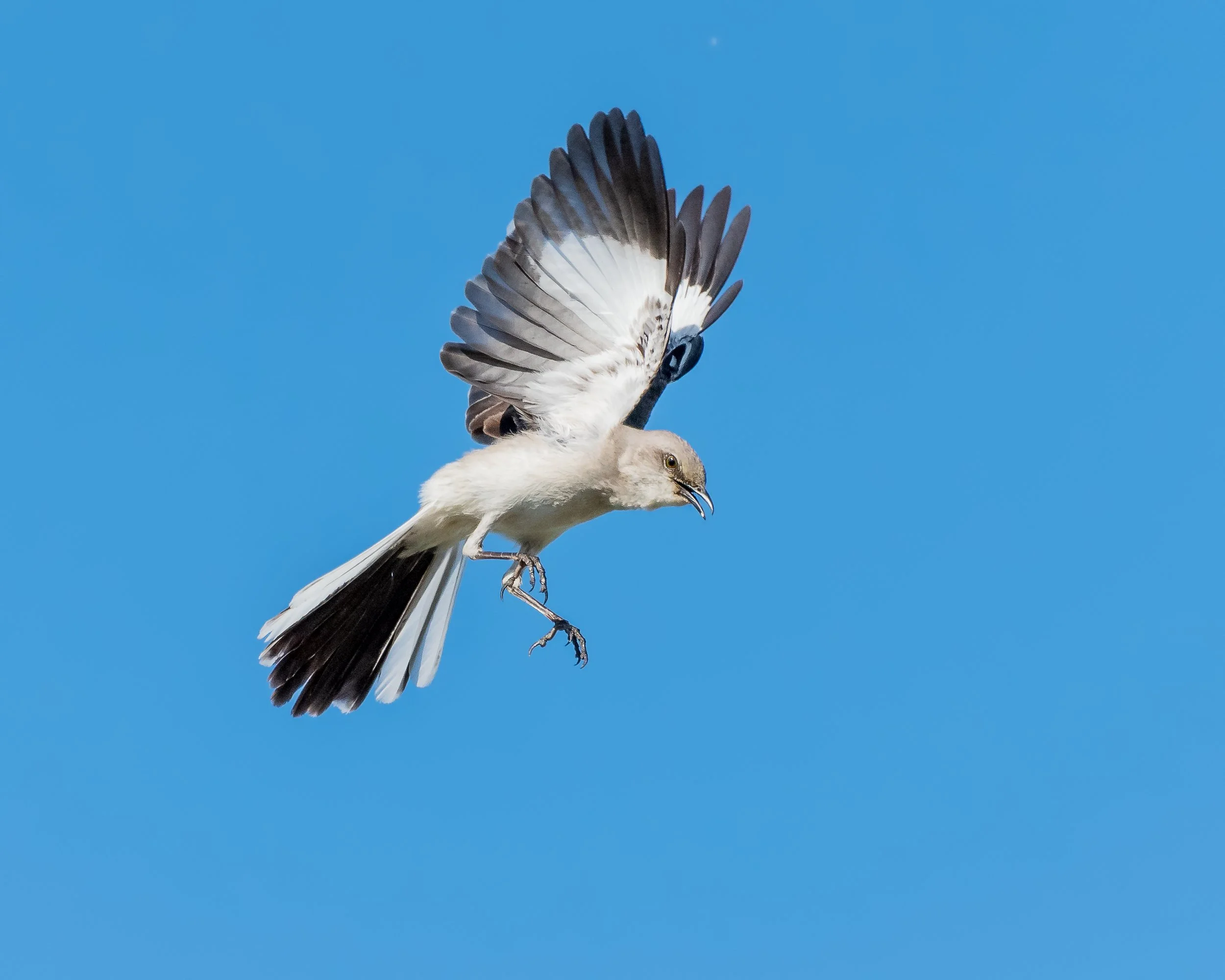
Meet the Northern Mockingbird

The Great Imitator

Northern Mockingbird © Gesna Clarke

Did you know that a bird can imitate the sounds of other birds?

Although many species of bird imitate other birds, the Northern Mockingbird is the best known in North America for doing it. It can learn up to as many as 200 sounds. It imitates not only birds but also other animals and mechanical sounds such as a car alarm and lawn  mowers, a gate opening. Scientist cannot say for certain why  mockingbirds mimic the sounds of birds, other animals, or objects. Click here for a sample of some of the sounds you may hear.

Why do mockingbirds sing through the night?

Northern Mockingbird © Daniel Lee Brown

In addition to being good mimics, mockingbirds are also some of the loudest and most constantly vocal of birds. They often sing through the night, or when the moon is full. Do you ever wonder why the mockingbird sings at night when most birds sleep? Wouldn’t you think that the  bird would be announcing his exact location to every cat on the block? Doesn’t the volume generated by the cacophony of loud sounds from the bird’s diaphragm and breast muscles take a lot of energy and rob the mockingbird of energy it needs to hunt for food for himself and his family? Some research has discovered that a  “sonic sparring” is happening between principalities within a neighborhood, each of which produces their food and provides the shelter they need forever. So the next time you are awakened in the early morning hours by a chorus of non-stop songs from a male mockingbird, remember it may not only be to attract a mate, but to protect its turf!

- Gesna Clarke

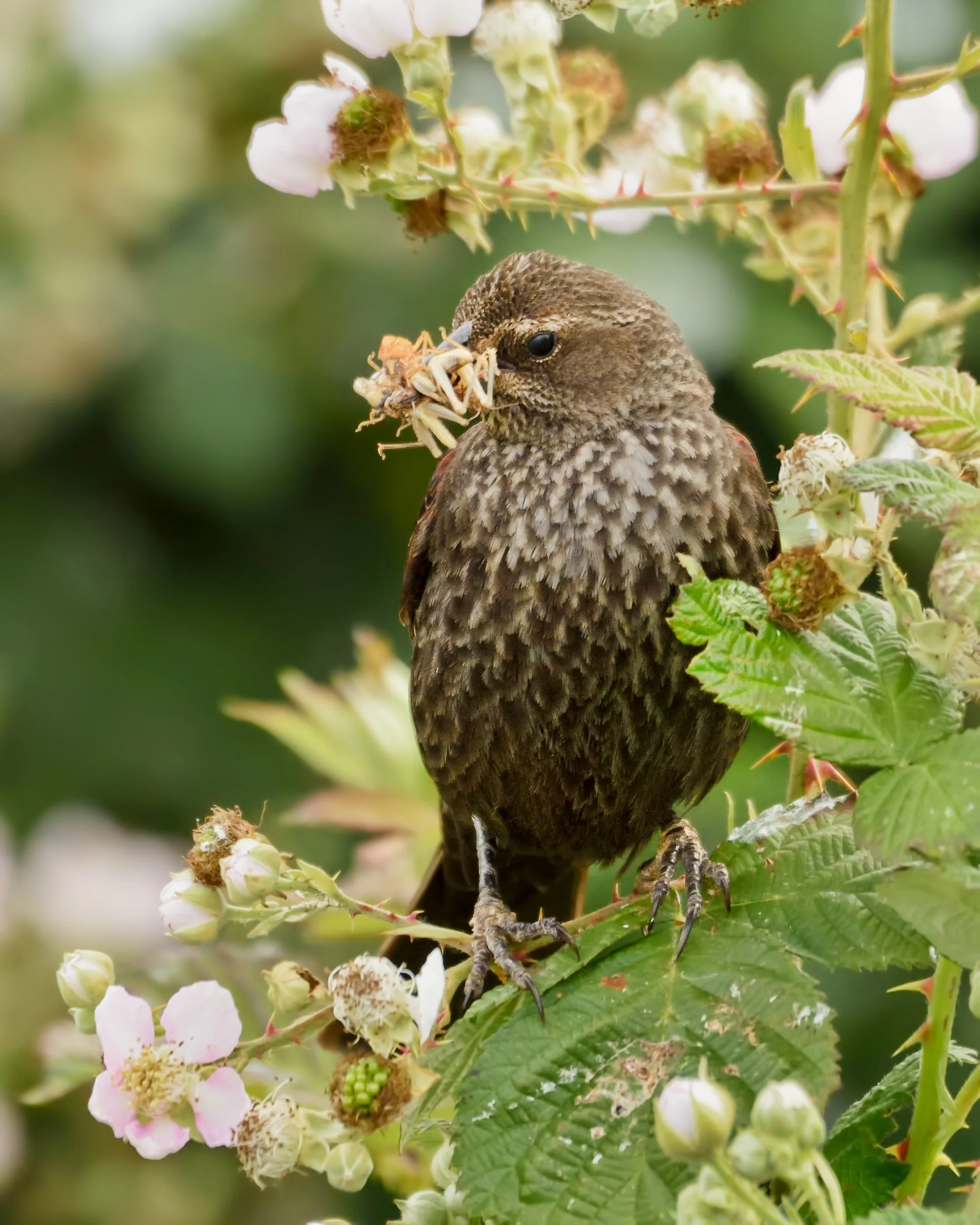
Sacramento Bird of Note: Tricolored Blackbird

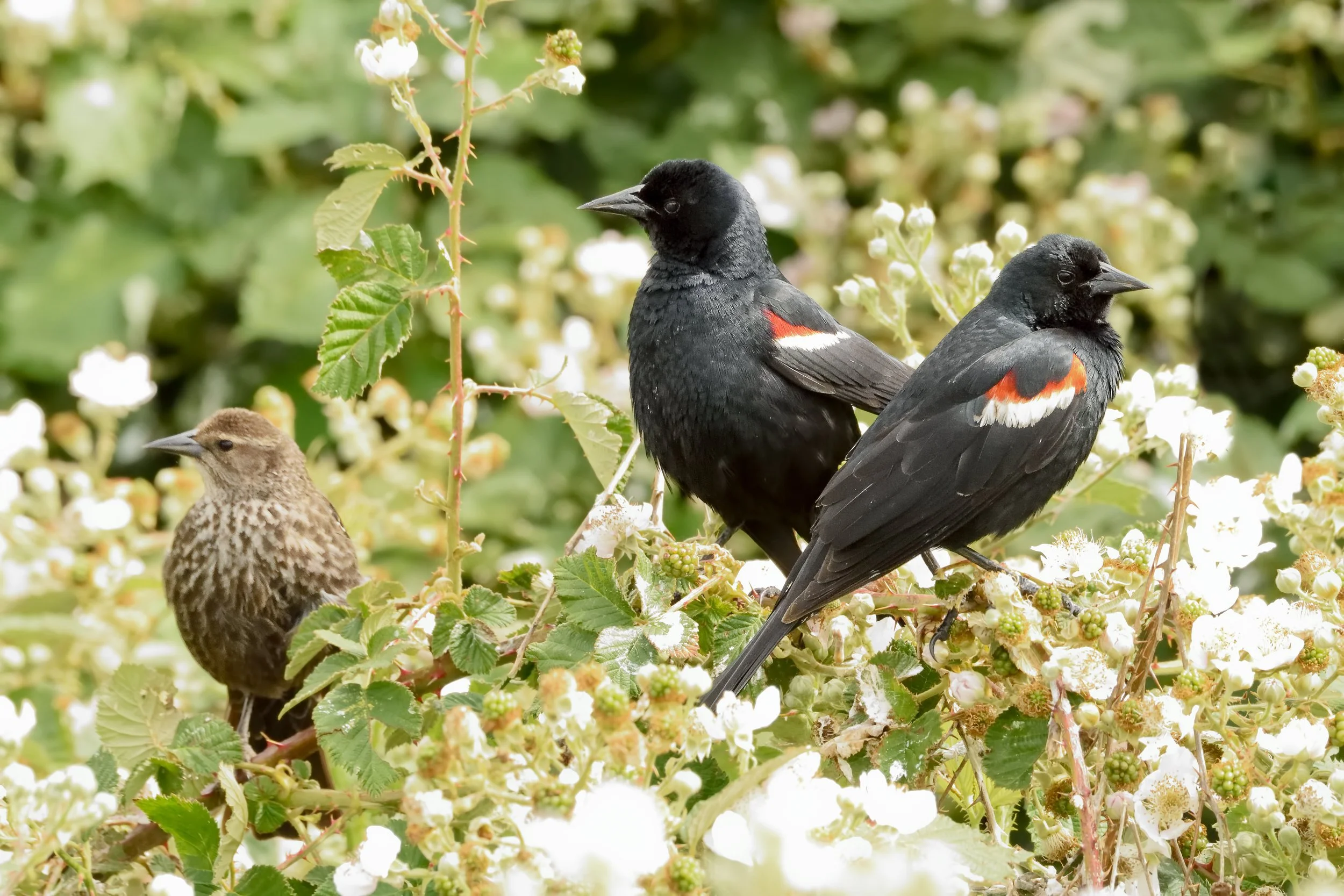
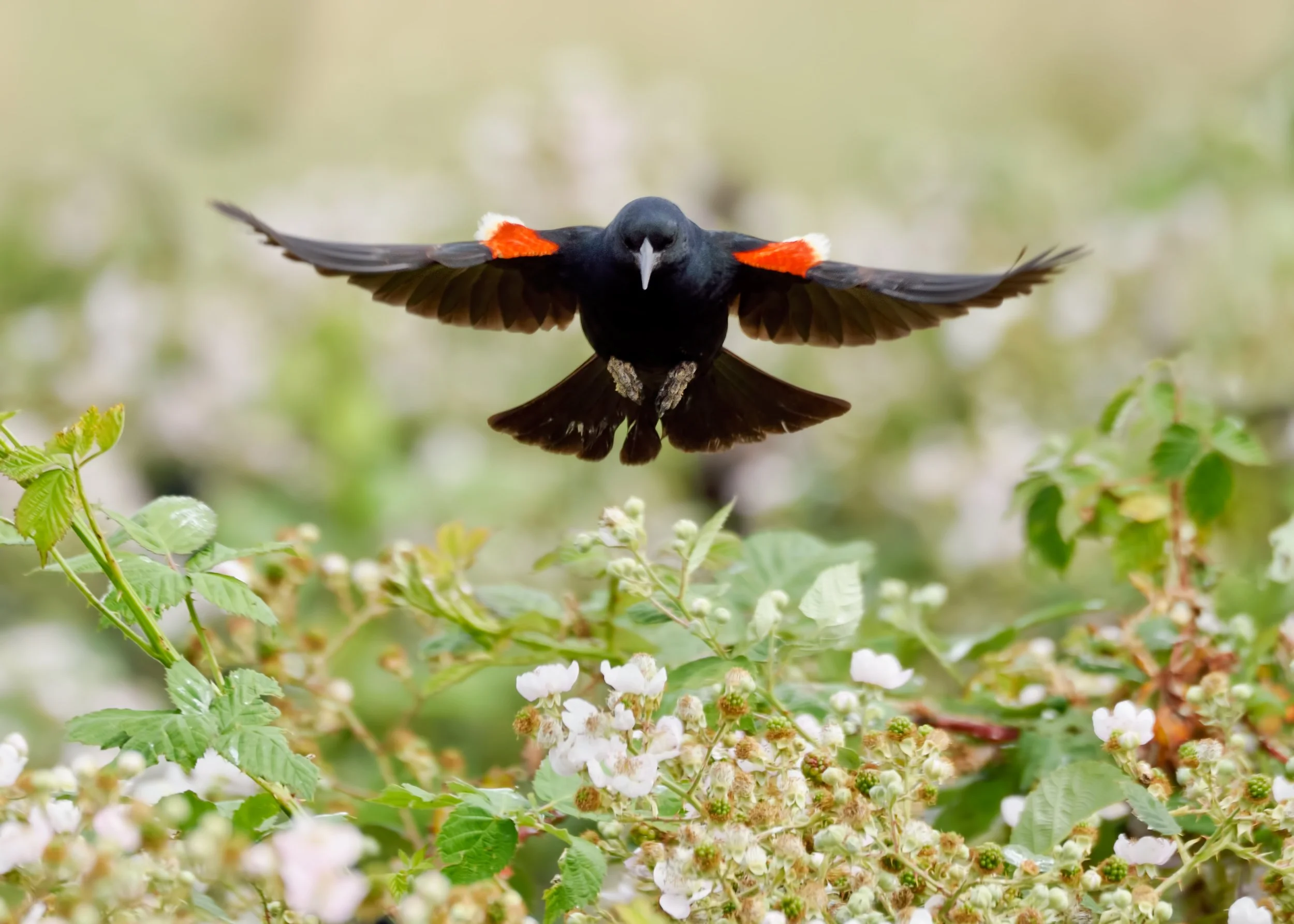
Found primarily in California’s Central Valley, Tricolored Blackbirds are often confused with their more numerous cousin, the Red-winged Blackbird. Once nesting in colonies of over 100,000 birds, they have declined precipitously in recent years and are now listed as a threatened species. Still, Sacramento County supports up to 25,000 nesting birds annually, a significant portion of the statewide population. Colonies move around from year to year, but can generally be found nesting in blackberry patches in grasslands and irrigated pastures such as those along Jackson Rd (Hwy 16).

In February 2021, Xerónimo Castañeda presented Tricolored Blackbird Conservation at the Sacramento Bird Alliance Monthly Meeting. You can watch a video of the presentation here.