Green Tech Education and Employment Grant

In the Fall of 2025, the Sacramento Audubon Board received a grant request from Green Tech Education and Employment ( https://www.greentechedu.org/ ) a nonprofit that offers innovate workforce skills to youth and young adults of frontline communities (i.e., communities of color, Indigenous peoples, and people with lower incomes who are impacted first and worst by environmental hazards and climate change) with an emphasis on environmental protection, justice, and economic development.

Green Tech students are learning workforce and entrepreneurial techniques that teach them a work ethic while focusing on reducing greenhouse gases, reducing pollution and improving living conditions in low income communities. Programs include Urban Farming, Urban Forestry, Aquaponics, Solar Technology, Weatherization, Energy Efficiency, Computer Programming, 3-D Printing, Arduino, Construction Trades, Landscaping, and General Labor. At the Green Tech Teaching Urban Farming, Forestry, and Aquaponics Urban Farm located at 4309 38th Street in Sacramento there was a desire to partner with Sacramento Audubon to attract birds to the garden site and develop a program around environmental/fish and wildlife employment opportunities and awareness.

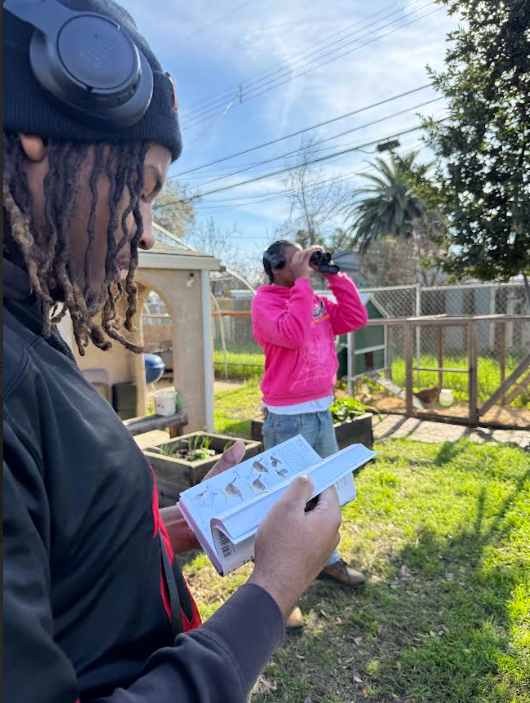
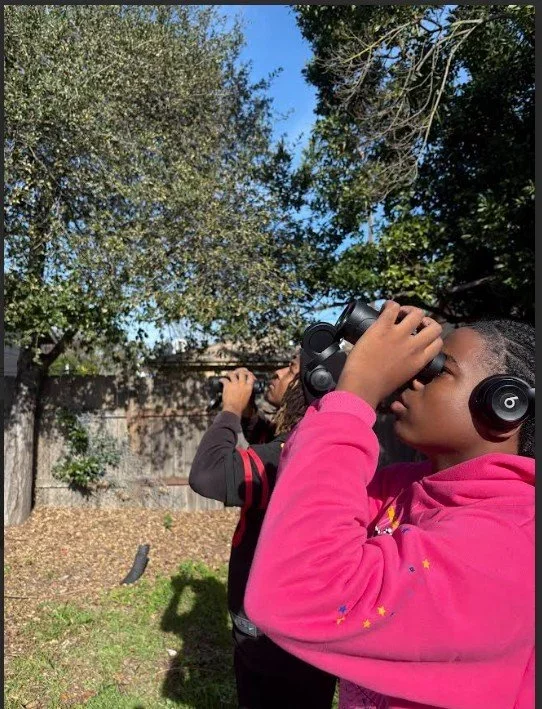
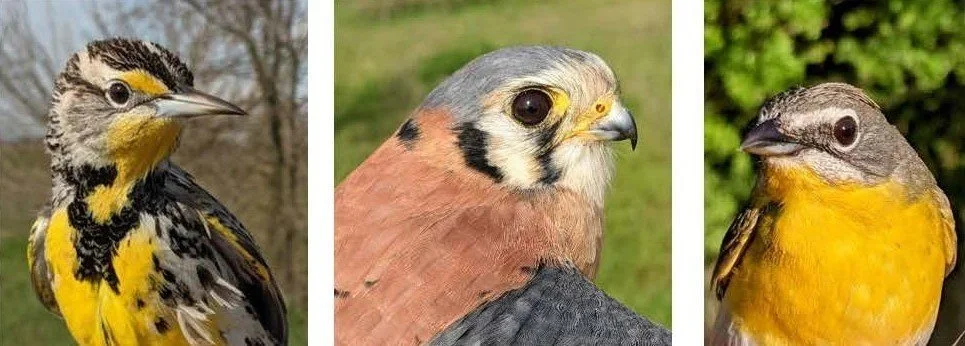
Sacramento Audubon funded the purchase of bird feeders, birdseed, binoculars, and bird identification books. After a recent visit to the Urban Farm, by Green Tech Board President Simeon Gant, I got a text from him with the pictures below that said, “When I came to the garden yesterday, this is what I saw.

As the students are getting familiar with birds and birding, the next step will be to take them on field trips locally to see birds in our local parks and areas of conserved habitat while discussing career options and conservation.

Photo by Simeon Grant

Photo by Simeon Grant

Bushy Lake Restoration Project

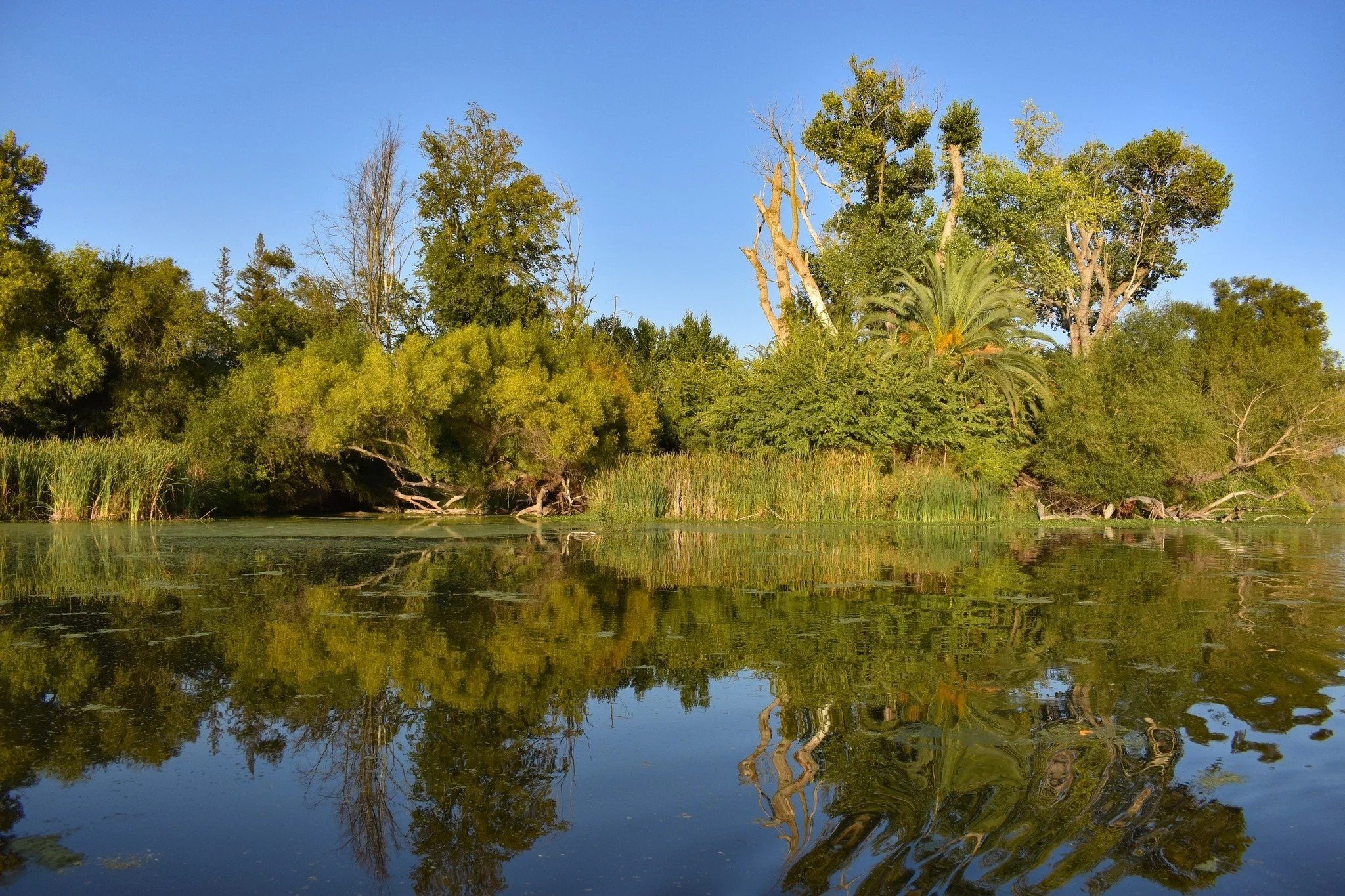
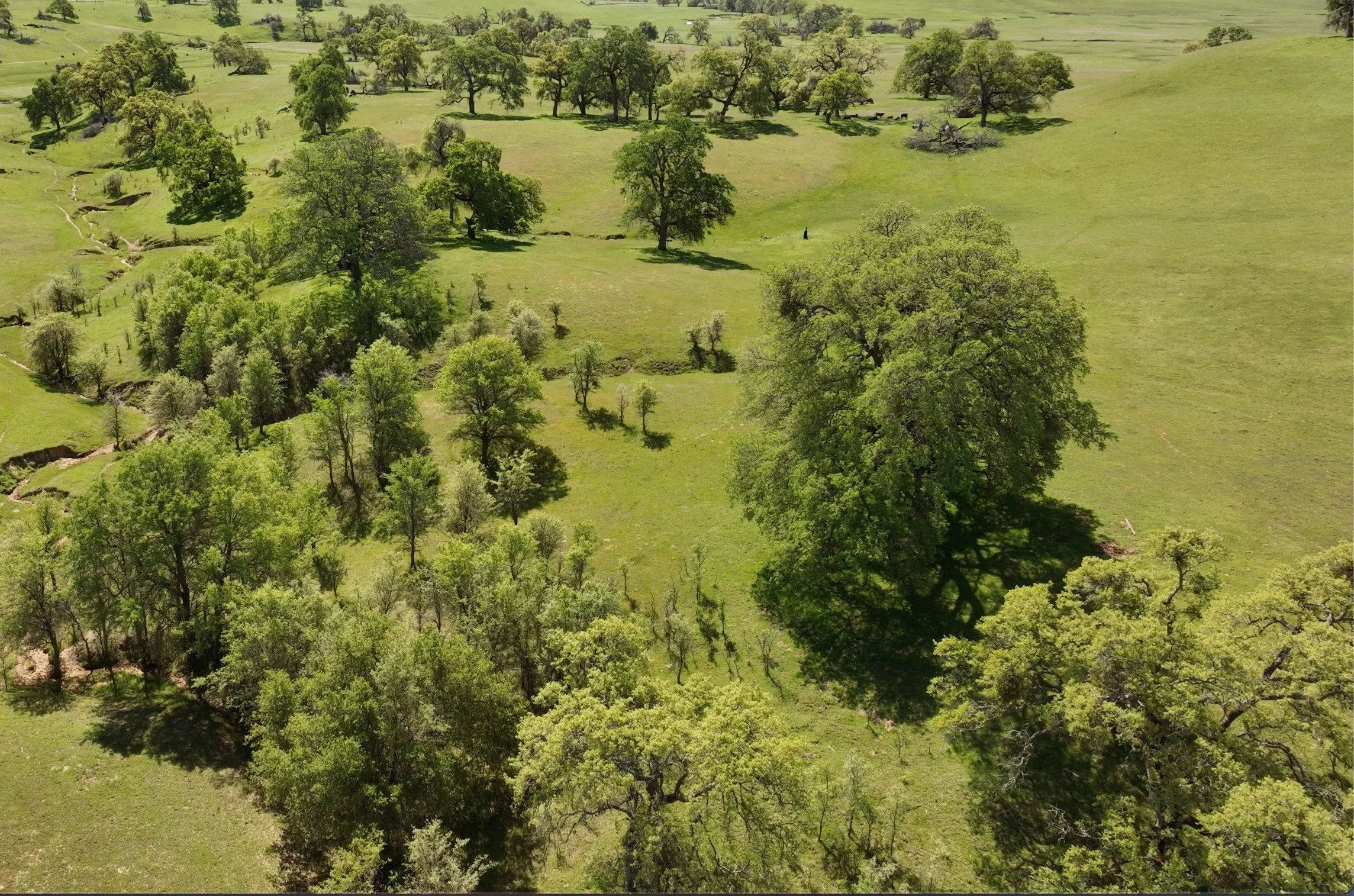
At the last Sacramento Audubon Board meeting, we received a proposal from Dr. Michelle Stevens at CSU Sacramento for work at Bushy Lake. Bushy Lake is located within the Cal Expo Area of the 2008 American River Parkway Plan. In the American River Parkway Plan, the lake is designated as a Nature Study Area and further protected by the 1976 Bushy Lake Preservation Act. The Bushy Lake Preservation Act designates the approximately 86-acre site as a State Nature Preserve, with the primary intent of preserving important vegetation and wildlife species and their supporting ecosystems. 

Bushy Lake is an important living laboratory for high-impact faculty-student research, citizen science, and community engagement.  In 2015, Dr. Michelle Stevens, Professor, Department of Environmental Studies at Sacramento State, spearheaded an eco-cultural restoration project at Bushy Lake. Restoration included native species that are fire resilient, beneficial to pollinators and wildlife, and plants that honor California Indian people. These included Mugwort (Artemisia douglasiana) which is an important spiritual, ceremonial and medicine plant and white root (Carex barbarae) which is an important basketry plant and a cultural keystone species. Acknowledging the relationship between Traditional Ecological Knowledge and Western Ecological Knowledge provides an opportunity to show respect for the distinctive contributions of both intellectual traditions.

The Bushy Lake Preserve presents a unique opportunity to provide high quality bird habitat while incorporating students from Sacramento State and engaging the public. Sacramento Audubon will be working with Dr. Stevens to create and implement a breeding bird survey, while gathering additional information on plants within the site, continue ongoing photo documentation of mammal communities and overall site condition, while incorporating students at Sacramento State into all phases of the work. This initial year of data collection will be used to develop a long-term breeding bird monitoring program.

The results of this work will guide short and long term management of the site, as well as inform habitat restoration/enhancement projects within the site to promote bird and native plant communities. The addition of wildlife cameras will document mammal use of the site to guide restoration actions and inform bird habitat restoration plans that promote nesting and increased nest success by creating habitat that reduces the probability of mammalian nest predation. Student internship honorariums will be established for Spring Semester with the goal of creating a long term program to incorporate Sacramento State students into the management and monitoring of the Preserve.

We are thrilled to support Dr. Stevens and working with her to both make the habitat at Bushy Lake the best it can be for a diversity of plants and wildlife and develop a long term CSU Sacramento student program the trains students in conservation, habitat conservation and management, while interacting with wildlife professionals and Sacramento Audubon volunteers.

photo courtesy of Bushy Lake Restoration Project

2026 GBBC 4 Kids a Great Success!

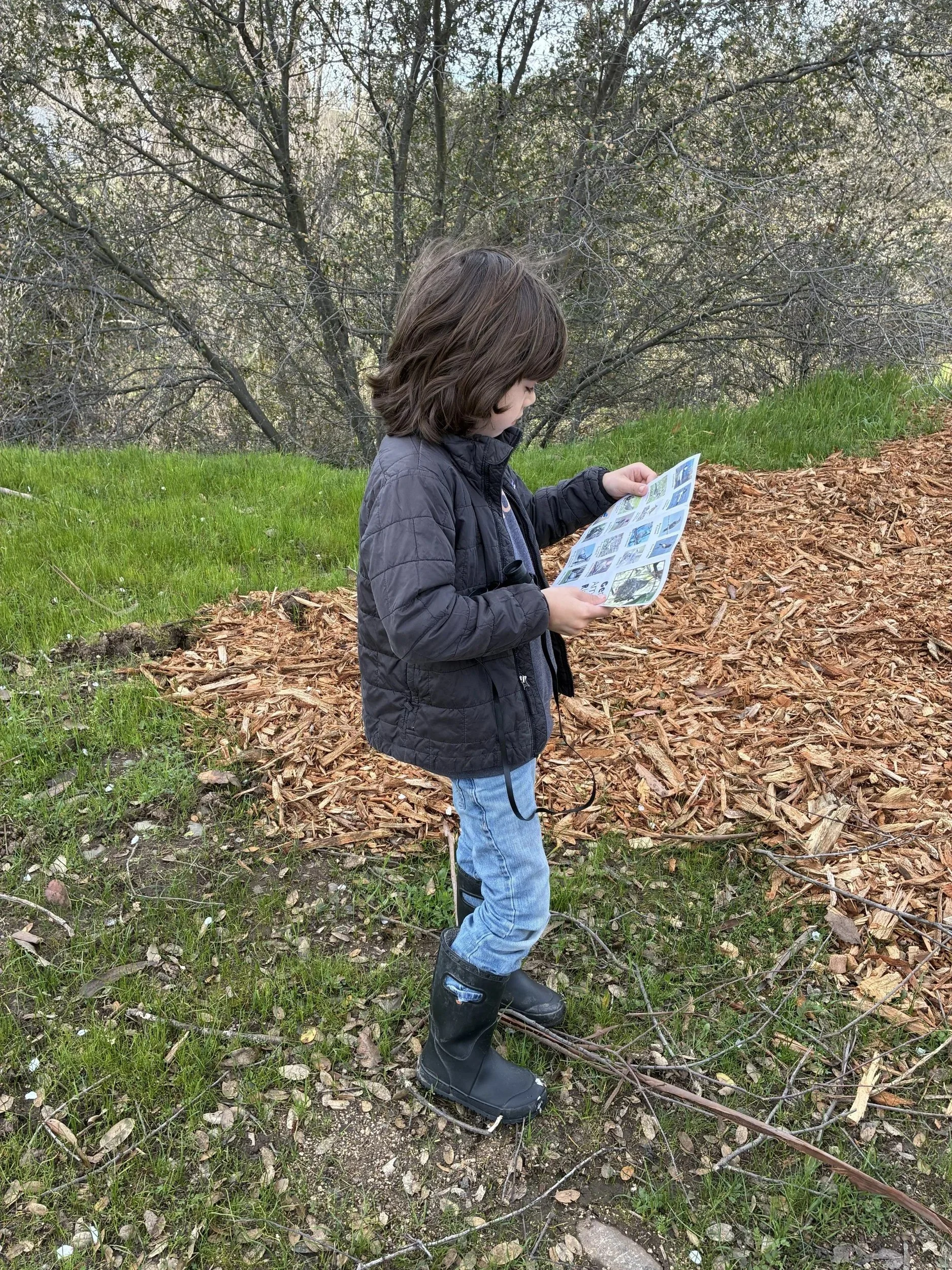
This year’s Great Backyard Bird Count 4 Kids was a great success, with 38 species counted by 28 young birders (mostly between the ages of 7-12) across this two-day event. To be counted, a bird had to be seen by two kids and confirmed by one adult bird leader. We started each day with a presentation on the importance of and reasons for counting birds and explored animated bird abundance maps that can be found on eBird under the Science tab. After counting, everyone returned to the starting location to eat lunch, report their findings, and listen to kid-led presentations from each team about what they saw. We are happy to report that the weather was beautiful both days, birds were very active, and overall it was a fun Valentine’s Day weekend (complete with pink sprinkled heart shaped cookies to mark the occasion).

On Saturday (February 14th), the count kicked off at Effie Yeaw Nature Center, with 21 total participants (kids and their parents) and 12 volunteers and staff. Everyone was split into four teams, and each group came up with their own team name. Saturday’s teams included The Scrub Jays, Love Birds, Eagle Eyes, and The 4 Birdateers.  Highlights for the day included many deer seen by all groups, a high-flying osprey, a low swooping Red-shouldered Hawk, and a shouting match between an Acorn Woodpecker and a Bewick’s Wren. After the presentations, Palomacy gave a presentation about pigeons, and everyone had the opportunity to pet a pigeon and see one of their live birds up close.

The count moved to the Folsom Powerhouse State Historic Park on Sunday (February 15th), where 28 participants (kids and their parents) and 9 volunteers and staff counted every bird that could be found by the kids. The four teams were named Super Great Blue Herons, Red-tailed Seekers, The Bird Seers, and the Red-tailed Hawks.  Highlights recorded by the teams included a Rufous-crowned Sparrow, a pair of Bushtits building a nest, 10 old nests found by one team, and a guided tour of the Powerhouse at the end of the day.

This event is a joint effort between State Parks, Effie Yeaw Nature Center, and Sacramento Audubon. Thank you Sacramento Audubon for providing the food and hospitality each day, also Effie Yeaw Nature Center and Folsom Powerhouse SHP for providing the meeting and birding spaces, and last but not least thank you to all the volunteers who make this event possible.

Great Backyard Kids Count at Folsom Powerhouse SHP, photo by Nicole Barden

Field Trip Findings for January 13 - February 8, 2026

SAS Field Trip: Gray Lodge, 01/17/2026

Trip Cancelled.

SAS Field Trip: Wintering Raptors of the Valley (Meiss Road/Michigan Bar), 01/18/2026

Leader Craig Swolgaard reported: The January 18 trip to find wintering raptors turned out to be pretty exceptional. The day began rather grim, but after a full day of incredible birding, we finally quit at 4:30 pm. As three of us left Folsom to meet the group at the Highway 16 meeting point, conditions changed abruptly driving south on Sunrise. The fog was so thick that I was lucky to see 50 yards ahead of the car. We arrived at the meeting point, where the group had gathered to carpool from there. We were thinking of calling it off because of the bad visibility, when someone mentioned that Michigan Bar Road (part of the route), was higher in the foothills and would possibly be good enough to try. So, the group of eight got into two cars and we started the route in reverse at Michigan Bar Road.

Later around noontime, the fog had lifted and we continued to Meiss Road. By late that afternoon we had recorded 58 species of birds, possibly the highest species count in any of these raptor trips. These included 13 species of raptors. The notable raptors were: Ferruginous Hawks, Peregrine and Prairie Falcons, Cooper and Sharp-shinned Hawks, Bald Eagle, Northern Harriers, several Burrowing Owls and a group of Short-eared Owls. The ponds were full of eleven species of waterfowl (and a small group of Long-billed Curlews) and at the Cosumnes River, we watched 22 Wilson’s Snipe fly in along the shore to forage near the bridge with a small group of male Hooded Mergansers upstream from the bridge. We ended the day on Meiss Road, watching the Short-eared Owls hunting over the grassland. What made this trip so good were the people who came. We all worked pretty hard at finding these birds and everyone there contributed to our sightings. I appreciate the resolve this group had and their enthusiasm. It made for a fun day.

SAS Field Trip: Beginning Birder Walk, William Pond Park, 01/18/2026

Leader Larry Hickey reported: Despite very foggy and cold weather, 13 hearty beginning birders joined us for a field trip at the William Pond section of the American River Parkway. It was very difficult to see much in the heavy fog, so we relied on calls, songs and silhouettes to identify Yellow-billed Magpies, Dark-eyed Juncos, and Cedar Waxwings. We were able to find a cooperative Red-shouldered Hawk, and found relatively good looks at a Snowy Egret at the river, but Common Goldeneye, American Coots, and even Pied-billed Grebes close to the shore were challenging to see. It was nice to find some of our wintering birds close by, including White-crowned Sparrows and Ruby-crowned Kinglets, and the group of beginning birders remained upbeat and enthusiastic despite the challenging conditions. 

SAS Field Trip: Sacramento National Wildlife Refuge, 01/24/2026

Leader Cliff Feldheim reported: On 01/24, 6 of us enjoyed a cold, windy, but sunny, morning at Sacramento National Wildlife Refuge. Although the large groups of geese were not present, we enjoyed great looks at a variety of waterfowl including Blue-winged, Cinnamon, and Green-winged teal. We enjoyed a couple of close looks at Bald Eagles and watched them fly in the distance flushing all the geese in the ponds outside of the tour route. In the afternoon, with the tour route just opened after flooding, we visited Colusa National Wildlife Refuge. A large group of a few thousand Snow and Ross's geese provided some good looks at them side by side. The sunshine provided great looks at both dabbling and diving ducks, with the male Ring-necked Ducks looking stunning in their breeding plumage, and the subtle beauty of the male Gadwall made us stop to look more than once. 

SAS Field Trip: Michigan Bar, 01/25/2026

Leader Chris Conard reported: Five of us had a really enjoyable half-day visit to grasslands and oak woodlands in eastern Sacramento County. We visited Michigan Bar Rd, a portion of Latrobe Rd, and Meiss Rd. Starting at Michigan Bar, we quickly picked up a Lewis's Woodpecker—a species that has been scarce this fall and winter. At the Michigan Bar bridge over the Cosumnes River, we saw Hooded Mergansers and Wilson's Snipe. A Hutton's Vireo was just up the hill in the oak woodland section, and for the rest of the day, raptors stole the show. We saw a total of four Bald Eagles, three Prairie Falcons, two Ferruginous Hawks, one Rough-legged Hawk, and one Burrowing Owl.

SAS Field Trip: Lincoln Grasslands, 01/31/2026

Leader Richard Barbieri reported: With 7 people attending my trip we headed north towards Lincoln making several stops along the route crisscrossing Hwy 65. The day presented us with a great variety of birds and weather was quite pleasant. All told we had a total number of species that reached 76 with several highlights. Birds of prey had rewarded us with Burrowing Owl, 2 Ferruginous Hawks, Prairie Falcon, and 5 Bald Eagles. We had several Say's Phoebes, 3 Hooded Merganser, Black-necked Stilts, American Avocets, and Long-billed Curlews. Camp Far West Lake shared its Rock Wren and Rufous-crowned Sparrow, and we finished the day with a great look at a Loggerhead Shrike.

SAS Field Trip: Robinson Road, Solano County, 02/01/2026

Leader Maureen Geiger reported: Sometimes it just works! Robinson Road did not disappoint and was one of those trips when you were just thrilled to be birding with other birders in beautiful country, counting all the birds you could see. These ranch lands give a wonderful sense of wide-open spaces and are home to a truly surprising number of Loggerhead Shrikes and Say’s Phoebes. Six of us reveled in the other birds as well, seeing more than 30 grassland species. And while you can’t go wrong with all those shrikes and Say’s Phoebes, less than a quarter mile from trip’s end - when we had given up hope - suddenly above us were 2 Ferruginous Hawks circling in the sun. A perfect ending for a really great trip.

SAS Field Trip: Folsom Point, 02/07/2026

Leader Rich Howard reported: An early start on a cold morning did not discourage nineteen folks from joining this trip to Folsom Point. We had several people new to birding and/or to the Sacramento area, and all the participants were very helpful. We started at the boat ramp and found large groups of Western Meadowlarks and very vocal Red-winged Blackbirds. Moving on the picnic area at the north end of the point, we scoped the lake for the recently reported Red-throated Loons with no success, but did manage to find one Clark’s Grebe in the many groups of Western Grebes and a group of 60 Eared Grebes. A circle walk through the oak woodland gave us closer looks at the typical species - Acorn Woodpeckers, Oak Titmice, White-breasted Nuthatches, Ruby-crowned Kinglets, and Bushtits. We also had nice flocks of Dark-eyed Juncos, White-crowned Sparrows, California Quail, and American Pipits. Raptors made a good showing, with scope views of a perched Red-shouldered Hawk, and multiple views of a pair of White-tailed Kites calling, kiting and eventually copulating.

Yellow-rumped Warblers, Anna’s Hummingbirds and European Starlings were scattered everywhere we went. Back at the point, we scoped the lake for loons again and found one Common Loon to the west toward Beals Point, a Gadwall, a trio of Bufflehead, and pairs of Mallards and Common Mergansers. An Osprey flew by with a huge fish and one of the participants remarked, “Now we just need a Bald Eagle to chase it.” Sure enough, an adult Bald Eagle came following behind soon after. A highlight for a good day. Thanks to Michael Curtis for keeping our eBird list, which can be found here: https://ebird.org/checklist/S298690451

SAS Field Trip: Nimbus Fish Hatchery, 02/08/2026

Leader Molly Shea reported: Our group enjoyed a beautiful sunny morning at the Nimbus Fish Hatchery, while walking along the American River. During the first portion of the walk, we saw 51(!) species, with highlights including a unique juvenile Iceland Gull, many sightings of Great Egrets and Great Blue Herons, a pair of drumming Nuttall's Woodpeckers, and of course, the season-regular individual male Northern Pintail in the settling ponds. It was clear that spring is in the air after seeing some Bushtits gathering nesting material and depositing it into their pendulous sock nest, and a Great Horned Owl holed up in her riverbank cave nest. In the latter half of the morning, a smaller group of us continued on to the Nimbus Basin and were rewarded with 24 species including some special sightings, like Barrow's Goldeneyes, a Bald Eagle, and a Peregrine Falcon! On top of that, we were amused to watch a sea lion smack a steelhead trout on the water for about 10 minutes straight! A wonderful day overall — Super Bowl or Superb Owl? You tell me! 

Field Trip Findings for December 9, 2025 to January 11, 2026

SAS Field Trip: Robinson Road, Solano County, 12/13/2025

Leader Maureen Geiger reported: Seven intrepid birders enjoyed the wide-open ranch/grasslands of Solano County birding the Robinson Road/Flannery Loop. While we were mainly searching for the Mountain Plovers, we failed to find them but did have other great species, such as half a dozen Loggerhead Shrikes, one Ferruginous Hawk, a male Harrier, close to 50 Horned Larks and many very wet, bedraggled Red-tailed Hawks fluffed up on poles. Wonderful to know that this land is still there for all these birds, at least for now.

Young Birders Club Field Trip: Winter Hawkwatching, 12/13/2025

Leader Mackenzie Hollender reported: Three young birders and two parents met my father and me on this fog-filled morning at the beginning of Michigan Bar Road. Our first birds we picked up were Western Meadowlark, American Kestrel, and Savannah Sparrow. We traveled down the road toward the bridge, scoping out Red-tailed Hawks on the telephone poles and getting extraordinary looks at a huge subadult Bald Eagle perched on a snag very close to the road. At the bridge, we watched four more adult eagles fly down the river and scoped two individuals that landed in the bare cottonwoods, adding to an incredible total of five Bald Eagles. Also at the bridge, we picked up many passerines, including Spotted Towhee, Acorn Woodpecker, Golden- and White-crowned Sparrows, and Oak Titmouse. A Pied-billed Grebe dove in the river. Tens of Turkey Vultures roosted in the oaks just past the bridge. Just after the bridge, a round-tailed Cooper’s Hawk perched at the top of a gray pine. As we drove up from the bridge and through the blue oak woods, we saw California Scrub-Jay, California Quail, Western Bluebird, and Ruby-crowned Kinglet.

We emerged out of the woods and into the broad open grasslands. The pressing tule fog did affect our ability to scope birds out at the grasslands, nevertheless, we found more Red-tailed Hawks, two Northern Harriers, a couple Say’s Phoebes, and some flyover Horned Larks. At the very top of the open grasslands, where the road intersects Latrobe, we were a bit surprised to find a Dark-eyed Junco. On our way back down, we paused to scope out what ended up being a Common Raven on a fencepost and were about to get back in our cars when a Prairie Falcon flew across the road and zipped down the grasslands. We noted the dark axillaries and solid clay-colored back. Through the fog, we could just make out the outline of a mid-sized raptor sitting on a distant rock and waited for ten minutes for the fog to blow away just enough to reveal that the raptor on the rock was the Prairie Falcon, and we all enjoyed nice looks at its white and brown face. At the grasslands right up from the oak forest, we spotted a brilliant Ferruginous Hawk perched on a nearby fence. We admired its bright white underside, yellow feet and base of bill, and handsome rusty shoulders—even more so when it lifted off and majestically flew across the road. We later spotted a second one at the top of an oak. Despite the fog, it proved to be a successful raptor-watching day, with Prairie Falcon and Ferruginous Hawk as a lifer for all attendees.

SAS Field Trip: Sacramento Bar, 12/14/2025

Leader Paul Cordero reported: Ten birders enjoyed a cold, foggy morning at Sac Bar.  Highlights included two White-throated Sparrows, Red-breasted Sapsucker, plentiful Bufflehead and goldeneye, and the expected hawks.

SAS Field Trip: Beginning Birder Walk, William Pond Park, 12/14/2025

Leader Larry Hickey reported: On a cold and very foggy December morning, 13 beginning birders joined us for a field trip at the William Pond section of the American River Parkway.  At first, we could only hear and see silhouettes of Yellow-billed Magpies in the fog, and glimpses of Dark-eyed Juncos and Bushtits in the trees.  However, it was not long before a cooperative White-crowned Sparrow and Ruby-crowned Kinglet provided the group with good views followed by an excellent eye-level view of a Red-shouldered Hawk perched close to the trail. Wood Ducks, Bufflehead, and Common Goldeneye were seen well, and we observed many Great Blue Herons already perching above nests at the rookery.

SAS Field Trip: Bridgeway Island Pond, 12/21/2025

Trip Cancelled

SAS Field Trip: Garcia Bend, 12/28/2025

Leader Ben Graber reported: 10 intrepid birders, including my 9-year-old daughter, Amy Graber, braved a cold and foggy day and made the full walk from the park to the water tower. Overall numbers of birds were somewhat low due to the weather, but we did have some notable sightings. We saw a Chipping Sparrow, which is somewhat uncommon in the valley. We heard Blue-gray Gnatcatchers and got some good looks at an Orange-crowned Warbler. We also had White-crowned, Golden-crowned, and Lincoln's sparrows, Great and Snowy egrets, a Common Goldeneye, and a flock of Snow Geese. 

Young Birders Club Field Trip: Effie Yeaw Nature Center, 12/28/2025

Leader Mackenzie Hollender reported: We had to reschedule this trip to the 28th of December due to unfavorable weather on the original date, December 20th. Four young birders and two parents joined my father and me on this overcast morning. Immediately from the parking lot, there was a lot of bird activity. A Bewick’s Wren called from a bush, Oak Titmouse and White-breasted Nuthatches foraged in the mid-levels of oaks. A Red-breasted Sapsucker landed briefly on the trunk of a gray pine. Ruby-crowned Kinglets and California Scrub-Jays met our eyes as we traveled to the start of the main trail. The entrance to the main trail ushered in a new mix of birds—a brilliant orange Red-shouldered Hawk, and a group of Wild Turkeys walking in the open grass areas, and some perched at the very tops of the oaks, which was very interesting to see! Acorn Woodpeckers were very abundant, visiting acorn caches in the thick branches of oak snags. We started on the main trail and then veered off on a smaller trail toward the small pond. We re-met the flock of Wild Turkeys, which followed us down the entire pond trail. We noticed one individual with a lot of white pigment in the wings. On the way to the pond, we paused to admire a flock of Lesser Goldfinches foraging in a live oak.

At the pond, we were greeted with multiple California and Spotted Towhees foraging feet from us, as well as White- and Golden-crowned Sparrows, and Northern Flicker. Suddenly, we heard a repeated, cheery one-note call coming from the live oak canopy just behind the pond. A Hutton’s Vireo!! We got quick glimpses of the small bird at the top of a live oak and noted the white spot behind the eye, giving the bird a gentle, “cute” look. We remarked at the unexpectedness of this find. We emerged out of the woods and onto the rocky riverbed, where we saw a male Belted Kingfisher, Common Merganser, Mallard, Common Goldeneye, Killdeer, and American Herring Gull. We got incredible looks at Spotted Sandpipers in winter plumage that bobbed their tails as they foraged along the river shore, sometimes coming up into the inland grass. A coyote with a gorgeous orange and silver pelt trotted yards from us, very relaxed despite our presence. Two Osprey circled and chirped above our heads, and Bufflehead dove farther down the stream. We headed back up from the river, and to a very birdy spot in the woods where we found Nuttall’s Woodpecker, Lincoln’s Sparrow, Downy Woodpecker (one of which almost hit me in the head as it dashed up from some low plants), Northern House Wren, and more Northern Flicker. We ended the trip with some Yellow-billed Magpie foraging in the lawn grass across from the parking lot. It was a very productive morning with a well-rounded host of open oak riverside valley birds!

SAS Field Trip: Cosumnes River Preserve, 01/03/2026

Leader Drake Stallworth reported: The weather left much to be desired this morning, as we experienced occasional showers and strong gusts spread out across the 4 hours. With only 3 people attending the event including myself, we remained positive and resilient, a sentiment shared by the birds themselves. Despite the rain, we saw a whopping 68 species while walking Wetlands and River Walk Trails. In the parking lot, Western Bluebirds, Golden-crowned Sparrows, Ruby-crowned Kinglets, and several other small songbirds were fluttering about not seeming to care about the sporadic rainfall. Tree Swallows and Turkey Vultures were circling above combatting the wind, and even a Sharp-shinned Hawk darted past us quickly seeking refuge back in the trees. Wetlands Trail gifted us with lots of waterfowl and our familiar wintering shorebirds. Northern Pintails, Northern Shovelers, and Green-winged Teals dominated the relatively small flock, but a surprising number of Cinnamon Teals were present. We even had some Blue-winged Teals in the mix. Greater Yellowlegs, Black-necked Stilts, and Long-billed Dowitchers took advantage of the variable depths of the wetland to forage in the shallower parts. The rest of the boardwalk provided us with some marsh-favoring birds like skulky Marsh Wrens and Red-winged Blackbirds. We even saw a Northern Flicker dip into the water from a nearby tree as if to cosplay the surrounding Brewer’s Blackbirds.

Crossing Franklin Blvd, we continued to behind the Visitor Center where a lone Hermit Thrush characteristically snuck through the low thickets only to disappear into the vegetation. We carried on to River Walk Trail which provided us with the typical wintering sparrows like White-crowned Sparrow, Dark-eyed Junco, and Spotted Towhees, but the marsh area proved to be interesting, as a Virginia Rail was making its not-well-known grunt calls, evocative of some sort of pig. However, the highlight bird was an American Bittern that was caught absentmindedly sitting outside of the reeds only to be flushed back into them as soon as we laid our eyes on it, displaying the diagnostic black flight feathers. Although the wind limited our raptor activity, a pair of White-tailed Kites was perched on the wire above the meadow, understandably reluctant to do much flying. As we approached the end of our walk, we decided to use our extra time to take a diverging path away from the parking lot to see what birds were east of the main trail. A Green Heron immediately greeted us as it stood still in the shallowly flooded forest. American Pipits were seldom seen but did make themselves known with their nominate flight calls, and a female Belted Kingfisher sat across the slough, making up some of the last birds we saw. Although there were some birds that we missed, getting just shy of 70 species on a terrible weather day is always a treat, and it continues to remind me just how special of a place is the Cosumnes River Preserve. The eBird checklist is listed here: https://ebird.org/checklist/S292192099

SAS Field Trip: Winter Raptors in Eastern Sacramento County, 01/04/2026

Leader Kevin Thomas reported: The forecast for this Sacramento Audubon field trip left little doubt that the day would be wet and windy. Despite the conditions, four participants joined me for this outing, which coincided with the Folsom Christmas Bird Count. Undeterred by the rain, we made several stops along White Rock Road to scan for raptors. Our first stop did not disappoint, yielding several Red-tailed Hawks and an American Kestrel. At the bridge over Coyote Creek, we were rewarded with excellent views of a Lewis’s Woodpecker, an adult Bald Eagle, and a Northern Harrier hovering against the wind. We also watched a perched Peregrine Falcon take flight, streaking across the creek and adjacent grasslands. At our next stop, the entire group enjoyed outstanding looks at a Ferruginous Hawk perched beside the road before it lifted off and hovered nearby for several minutes. Our final stop found us standing once more in driving wind and rain, patiently waiting for a Rock Wren to emerge from the rock piles at a new housing construction site. After a few minutes, the bird obliged, perching in the open and offering clear views. While the weather was far from ideal, the birds never disappoint, and the day proved rewarding despite the elements.

Young Birders Club Field Trip: Nimbus Fish Hatchery, 01/10/2026

Leader Mackenzie Hollender reported: Three young birders and three parents met my father and me at the Nimbus Fish Hatchery on this sunny morning. We quickly noticed White-throated Swifts trilling as they flocked high in the sky. Two Glaucous-winged Gulls perched at the top of wooden poles—we got to notice their dark eyes, pink feet, and uniformly soft gray wings. As we made our way down to the river, we noticed many ducks flying above the water—including Mallard, Hooded Merganser, and a Northern Pintail. At the river, Common Goldeneye dove just off the shore. Great Egret and Great Blue Heron hunted on the far grassy shore. A young Red-tailed Hawk sat perched in an oak while a male American Kestrel mobbed it. A male Belted Kingfisher perched on a concrete slab in the water, and a Spotted Sandpiper wobbled on shoreline rocks. We noticed a California Sea Lion that seemed to be “playing” with a group of California and Ring-billed Gulls. It would repeatedly surface from the water, teasing a piece of fish, and as a group of spectating gulls would swoop down towards it, the Sea Lion would disappear back under the water.

We paused at the fish ladders and watched an Osprey circling above make multiple dives down toward the fish ladder. We later saw an individual flying out with a caught fish. We traveled down the river, noting Double-crested Cormorants on a wire, Bufflehead in the water, a Black-crowned Night Heron. A White-tailed Kite traveled over the river, and a Pied-billed Grebe hunted in a large pond. In the bramble and cottonwood/oak woods up the river bluff, we saw Spotted Towhee, and beautiful male Anna’s Hummingbird, White-breasted Nuthatch, and briefly, a Red-breasted Sapsucker. As we headed further into the woods, flocks of Dark-eyed Junco, Acorn and Nuttall’s Woodpecker, Northern Flicker, Western Bluebird, Bewick’s Wren, and California Towhee were some birds we enjoyed.

SAS Field Trip: Lynch Canyon Open Space, Solano County, 01/11/2026

Leader Maureen Geiger reported: Very successful hike at Lynch Canyon on a beautiful sunny day. Eight of us walked up to the Reservoir and saw 43 species. It was a great raptor day with American Kestrel, Red-tailed Hawk, White-tailed Kite, Northern Harrier, a Sharp-shinned Hawk, a Rough-legged Hawk, and one possibly two Golden Eagles, all well seen. This Canyon is always a good place to look for birds.

Seasonal Sightings: December 2025

This December was beset by many grim days of fog and cooler than normal temperatures. It seemed to suppress bird activity, certainly visibility, and suppressed birder activity as well. There were still some good finds during the month, but many of the local CBCs took place in difficult weather conditions, leading to low numbers and diversity. A Red-breasted Merganser was seen periodically from 12/7 to 12/17 between the Nimbus Hatchery and lower Lake Natoma. The female Costa's Hummingbird first found at a private yard in Wilton in August of 2024 continued through 12/25, but was not seen toward the end of the month--is her long residency over? A Black Rail was heard calling on 12/28 from Sherman Island in the Delta portion of Sacramento County.

The only Mountain Plovers in the region continued to be reported from Flannery Rd, south of Dixon, with a high of 45. A Stilt Sandpiper was photographed (eBird Checklist S289401316) and seen by several birders on 12/20 at Cosumnes River Preserve. It may be the same bird that has been seen in the area sporadically since September. Probably the same Lesser Black-backed Gull that has been reported in recent months was seen on 12/1 at the Yolo County Central Landfill pond, visible from County Rd 28H.  A Red-necked Grebe was a nice surprise at the Port of Sacramento, Lake Washington, from 12/10-12/14. A Least Bittern was heard at the Yolo Bypass Wildlife Area on 12/15 and three were detected at Sherman Island on 12/28.

Rough-legged Hawks were more widely reported, especially in eastern Sacramento County, than in most recent years, and Short-eared Owls were also well-represented, most impressively with reports of up to 11 along Meiss Rd.

Lewis's Woodpeckers were found on both sides of the Valley, but reports were of singles or low single-digits, and a Red-naped Sapucker was found along Pleasants Valley Rd (eBird Checklist S289602481), a few miles south of Putah Creek on 12/21. CBC teams found single Hammond's Flycatchers on private property along Putah Creek, south of Winters, on 12/21, and along the Mokelumne River near I-5 on 12/29. An American Dipper continued at the traditional location along Putah Creek at the Hwy 128 bridge. Like Lewis's Woodpeckers, Varied Thrushes were few and far between. A calling flyover Evening Grosbeak on 12/3 was a surprise at Cosumnes River Preserve in a season with very little winter finch movement. A Lapland Longspur was a nice find along Flannery Rd in Solano County on 12/16. A Swamp Sparrow was photographed on 12/28 at a normally closed area of south Twitchell Island, Sacramento County. Another was present for most of the month at Lake Solano. A Nashville Warbler was quite a surprise (eBird Checklist S290618684) at Elkhorn Regional Park on the Yolo side of the Sacramento River on 12/27, and a Pine Warbler found near Larchmont Park (eBird Checklist S288066313) on the ARNHA Wildlife Count, and seen by many from 12/6-12/10, was a first of the Central Valley and one of few records for Northern California.

The Sacramento Area as covered here lies between Hwy 20 to the north, Hwy 12 to the south, and the 1000-foot contour to the east and west, plus all of Sacramento and Yolo counties. Many reports first appeared on the Central Valley Bird Club listserv (groups.io/g/centralvalleybirds) and in eBird (ebird.org). It is impossible to list everyone, but we thank the following for their reports: Eddie Bartley, Sylvia Bauer, Peyton Bounds, Brent Campos, Lyann Comrack, Chris Dong, Konshau Duman, Chris Dunford, Lynette Williams Duman, Andy Engilis, Gil Ewing, Stephen Fettig, Robert Furrow, Joshua Greenfield, Cliff Hawley, Mackenzie Hollender, Emmett Iverson, Julian Johnson, Logan Kahle, Jeri Langham, Andrew Lee, Mark Martucci, Eric McKinley, Roger Muskat, Michael Perrone, Zane Pickus, Linda Pittman, Ron Pozzi, Mark Sawyer, Samuel Schmidt, Steve Scott, Sean Smith, Gavin Stacey, Lucas Stephenson, Mark Stephenson, Kirk Swenson, Kevin Thomas, John Trochet, Noreen Weeden, and Dan Williams. Thanks to everyone for their reports--without them, this column would not be possible.

-Chris Conard

More Seasonal Sightings

SMUD Cancels Coyote Creek PPA

From Sacramento Municipal Utility District (SMUD):

SACRAMENTO, Calif. — In 2021, SMUD signed a power purchase agreement (PPA) with D.E. Shaw Renewable Investments (DESRI) to be an off taker of solar power from the Coyote Creek Agrivoltaic Ranch project. Due to project uncertainties, SMUD announced today that they will not be purchasing power from the Coyote Creek project. Some of the uncertainties include: supply chain constraints, rising prices, tariffs, schedule delays, environmental impacts and pending litigation.

SMUD CEO & General Manager Paul Lau issued the following statement about SMUD’s decision to terminate the PPA for the project:

“Over the years, SMUD and DESRI have delivered multiple important clean energy projects that benefit our community, and we look forward to continuing our partnership for years to come. We’d like to thank Sacramento County for all their work throughout the process and our SMUD Board of Directors for their leadership. We remain committed to following a flexible pathway to eliminate all carbon from our power supply by 2030.”

More information on the fight to stop the Coyote Creek Agrivoltaic Ranch Project.

Help Protect the American River Parkway

From SARA (Save the American River Association)

Help Protect the American River Parkway and Critical Wildlife Habitat Adjacent to Rio Americano High School

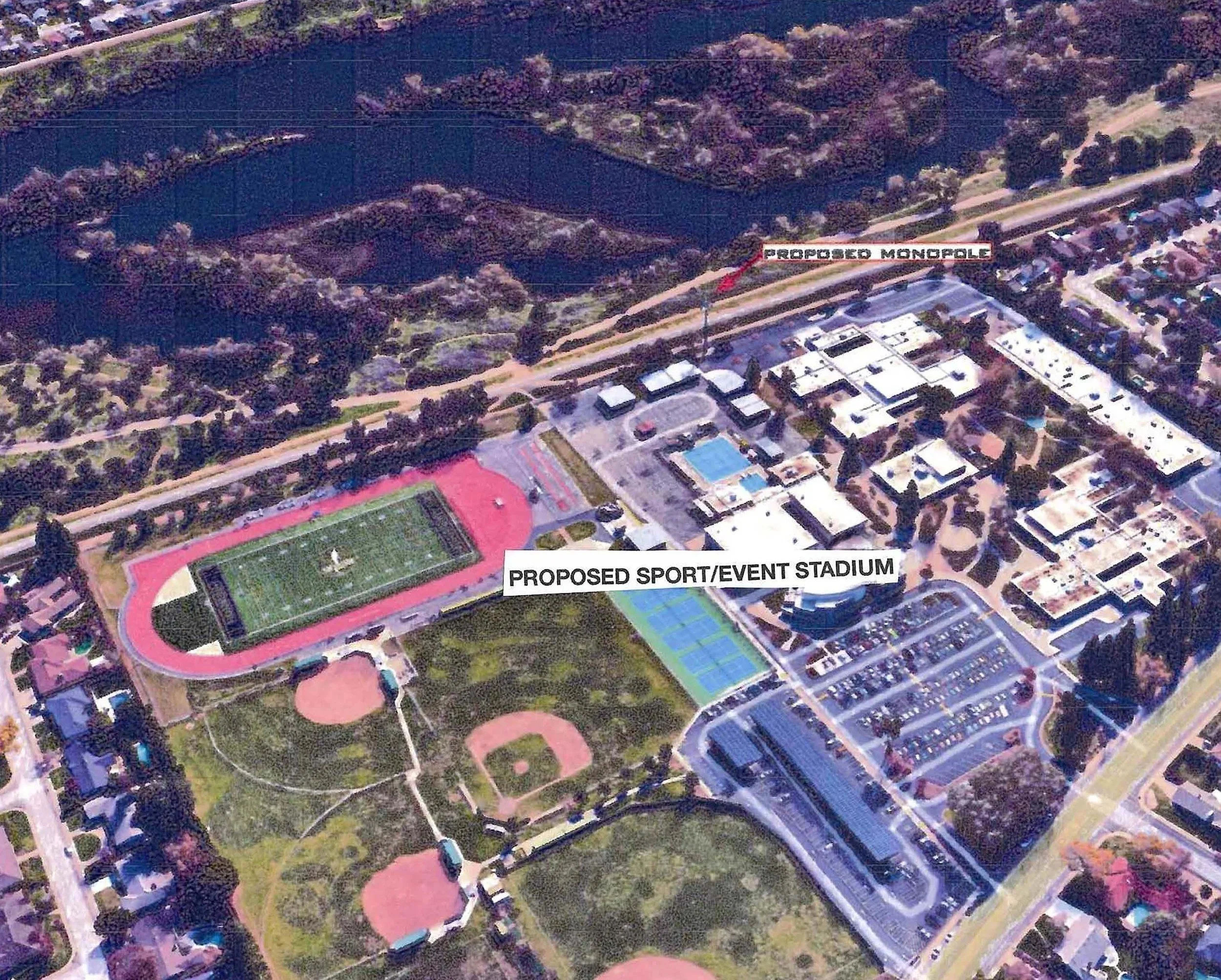
Rio Americano High School sits immediately adjacent to the American River Parkway, home to the only federally and state-designated Wild and Scenic River flowing through a major U.S. metropolitan area. The San Juan Unified School District’s proposed large capacity sports and event stadium at Rio Americano would introduce permanent lighting, sound systems, visible structures, and increased traffic just steps from the Parkway.

HOW YOU CAN HELP

1) Attend the Environmental Impact Report (EIR) Scoping meeting:

Wednesday, January 7, 2026 at 6:00 pm
Rio Americano’s Performing Arts Center
4540 American River Drive, Sac., CA 95864 [MAP]

2) Sign the petition: 

Protect the American River Parkway from a Proposed Outdoor Sport/Event Stadium

WHY THIS MEETING MATTERS

Help protect the American River Parkway and the natural habitat adjacent to Rio Americano High School. This area is a critical ecological resource and an essential wildlife corridor supporting endangered and threatened species that depend on the health of the river and surrounding land. The habitat supports eagles, river otters, deer, bobcats, foxes, beavers, salmon, steelhead, American shad, herons, egrets, owls, hawks, turtles, frogs, and hundreds of bird species.

Immediately adjacent to Rio Americano High School is a protected restoration area for the federally threatened Valley Elderberry Longhorn Beetle. The diverse wildlife and fishery that live in this area further confirms the area’s importance as an intact, functioning habitat.

Any loss or degradation of this land would cause irreversible harm to wildlife, water quality, and public recreational and educational values. The American River Parkway is not only a recreational asset, but an irreplaceable ecological refuge that deserves the highest level of stewardship and respect. This irreplaceable natural resource must be preserved and protected now.

ADDITIONAL INFO

Introduction to Ornithology at Sacramento City College

Expand your birding knowledge by taking Introduction to Ornithology taught by Stan Wright and Sherri Graves at Sacramento City College.  

Anyone can take the class, even if you have never taken any classes with Sacramento City College. You do have to register as a Sacramento City College Student but there are no pre-requisites.

Biology 332: Introduction to Ornithology

January 17, 2026 to May 21, 2026

Lectures: Tues/Thurs 4:30 – 5:50 pm (16606)

Lab: Tues 6:00 – 9:15 pm (16607)

Spring 2026 Sacramento City College In-person

Transferable to UC/CSU

This course is designed as an introduction to many of the fascinating topics within the field of ornithology – the study of birds. Topics include avian anatomy, evolution, special adaptations for flight, physiological systems, conservation issues facing birds, and a wide array of behaviors ranging from social behavior and communication to reproduction and parenting. In the bird labs and field trips, our focus will be on learning the characteristics of the major taxonomic Orders of birds, and learning to identify species found in the western United States, especially California. By the end of this course, you will have gained a broad understanding of avian ecology and behavior. Our plan is that you will become a better observer of the natural world and that your environment will seem richer thanks to an increased awareness of birdlife.

Contact Stan Wright at wrights2@scc.losrios.edu or Sherri Graves at GravesS@scc.losrios.edu for more information or with any questions.

January Monthly Speaker Presentation

Join us on January 15, 2026 at 7pm for Climate Change and the Birds of the Zuni Mountains Region of New Mexico presented by John Trochet, M.D. The meeting will be held in-person at Effie Yeaw Nature Center and online via Zoom (hybrid meeting). Registration is no longer required to attend via Zoom.

Zoom Link for January Meeting: https://us06web.zoom.us/j/82751344995?pwd=vxkpVmQbI1Tdaaaw9k6rRjKmyQDNWe.1
Passcode for January Meeting: 683702

About the Presentation

By accident of geography and history, the Zuni Mountains Region has a history of botanical and zoological study that must be the envy of every other inland location in western North America. I have integrated my natural history findings with those of others from the mid-19th Century to the present in an attempt to understand the changes in the regional avifauna.

More About Our Speaker

John Trochet is a Sacramentan, who is formerly with the Museum of Wildlife and Fish Biology at the University of California at Davis. He is still a research affiliate there. After a stint in the Indian Health Service at PHS Hospital, Zuni, he has returned regularly to Zuni Pueblo and the adjacent Zuni Mountains for some 45 years. Along with following the birds of the Cosumnes River Preserve and being part of a team in Louisiana trying to better document the persistence of ivory-billed woodpeckers there, this is one of three projects keeping him busy in retirement.

Attend the Meeting and Presentation

This meeting will be a hybrid session. Participants can join the meeting on-site at Effie Yeaw Nature Center or from the comfort of their home via Zoom.

Attend the Meeting in Person
John will give his presentation live at Effie Yeaw. Registration is not necessary to attend the meeting at Effie Yeaw.

 Effie Yeaw Nature Center
2850 San Lorenzo Way
Carmichael, CA 95608

Attend the Meeting Online via Zoom
The presentation will be streamed in real time on ZOOM from Effie Yeaw. To attend the meeting via Zoom use the link below then enter the passcode.

Zoom Link for January Meeting: https://us06web.zoom.us/j/82751344995?pwd=vxkpVmQbI1Tdaaaw9k6rRjKmyQDNWe.1
Passcode for January Meeting: 683702

You do not need a ZOOM account to join the meeting. The Zoom portion of our meeting is limited to 100 participants. Participants will be admitted on a first come, first serve basis.

Coyote Creek - Update

On December 19, the California Native Plant Society (CNPS) and the Environmental Council of Sacramento (ECOS) filed suit against the County of Sacramento for its recent approval of the Coyote Creek Agrivoltaic Ranch Project. Sacramento Audubon Society Board of Directors approved a $5,000 donation to support this lawsuit. If you’d like to contribute to this fund and this fight visit: https://www.ecosacramento.net/home/stop-coyote/

Background:
On November 18th, 2025 the Sacramento County Board of Supervisors approved the Coyote Creek Agrivoltaic Ranch project, sited in eastern Sacramento County between Prairie City SVRA and the Deer Creek Hills Preserve. If this solar farm goes ahead, it will remove 1,357 acres of native habitat, and it will fragment and disturb vernal pool and grassland habitats.

For more information and additional ways to help, visit: https://www.savecoyotecreek.com/ & https://linktr.ee/savecoyotecreek

Great Backyard Bird Count for Kids

Registration is closed for the 2026 Great Backyard Bird Count for Kids.

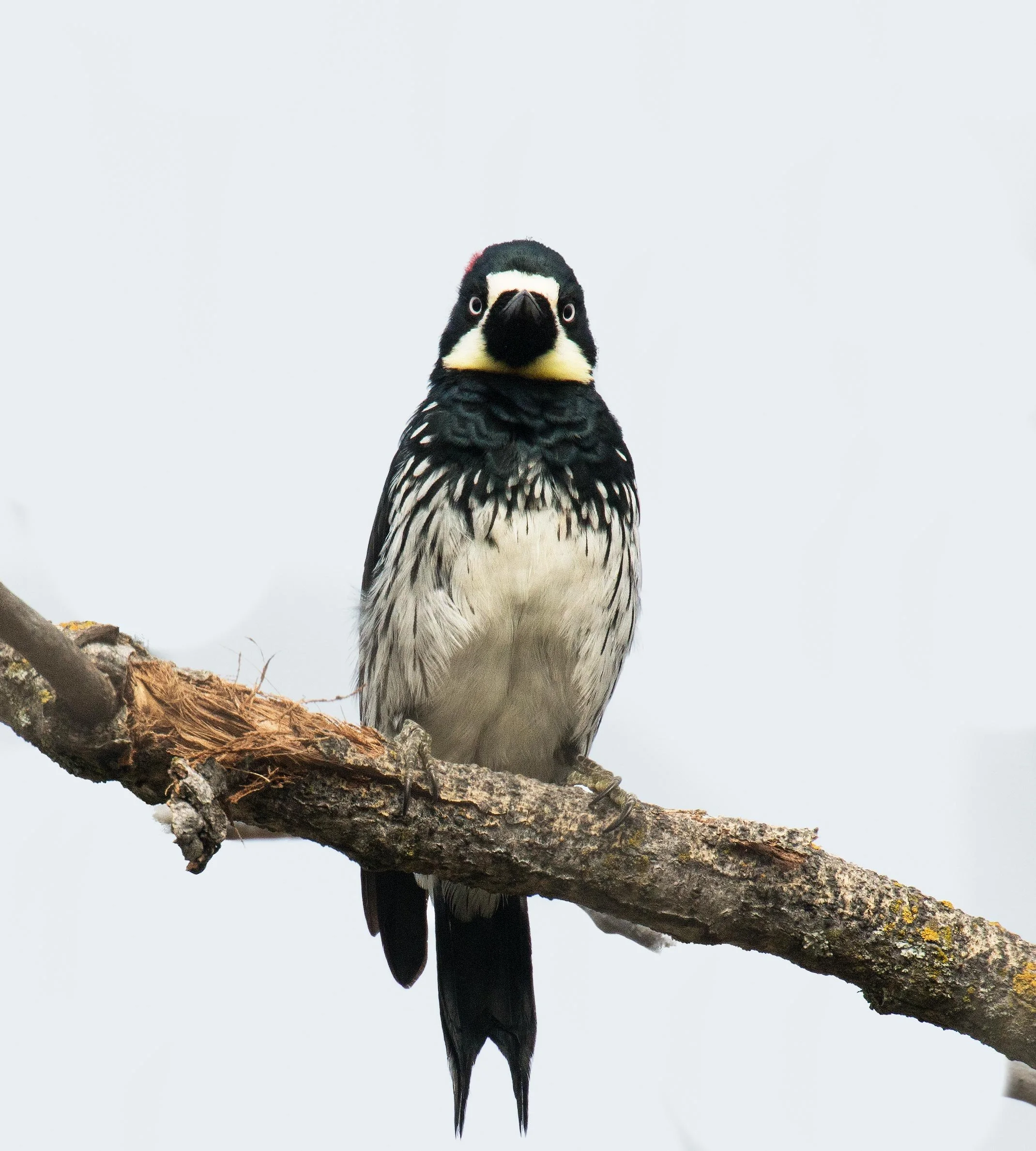
An Acorn Woodpecker is one of the birds we hope to see and add to our counts. Image by Ray Rozema.

Looking for a way to encourage the young birders in your life to get outside and observe birds? Sacramento Audubon Society is partnering with State Parks and Effie Yeaw Nature Center to host a Great Backyard Bird Count for Kids on February 14th and 15th. The Great Backyard Bird Count is an opportunity for people all over the world to contribute to our scientific understanding of bird populations by recording the birds found in their neighborhood. On Saturday, February 14th, we will contribute to the Great Backyard Bird Count at Effie Yeaw Nature Center. On Sunday, February 15th, our count will move to the Folsom Powerhouse State Historic Park, located on the shores of Lake Natoma in historic Folsom.

Dates and locations:

  • February 14th at Effie Yeaw Nature Center (2850 San Lorenzo Way, Carmichael, CA)

  • February 15th at Folsom Powerhouse SHP (9980 Greenback Lane, Folsom, CA)

Time: 9am - 1pm  (volunteers are asked to arrive at 8:30)

Ages: 7+ (children must be accompanied by an adult the whole count)

Please bring: Your kids or borrow someone else's, warm layers in case of chilly weather or rain, sturdy shoes, binoculars if you have them (or borrow some from us), a bagged lunch, and your observational skills for spotting birds!

What to Expect: Start the count day by borrowing a pair of binoculars and learning how to use them during a binocular boot camp. We will then have a quick chat about why it's important to count birds, before splitting into small groups and exploring along the trail. Adults are expected to bird alongside their kids and each group will have an experienced bird leader to help identify what we find. After counting, we will gather back together for lunch and short presentations from each group to share their findings. 

Young birders over the age of 7 and their beginner or experienced level adults are all welcome to join. Parking at the Folsom Powerhouse SHP is $10 for the day or covered with an annual State Parks pass. Parking at Effie Yeaw Nature Center is $7 per car, payable at the entrance. Both locations have easily accessible options for flat, paved trails, as well as ADA parking. Please let us know of any accessibility requirements when you register.

Registration: Registration is required. Please complete a separate registration for each child that wishes to attend. Registration is limited to the first 20 children registered for each location. If your child is one of the first 20 registered you will receive a confirmation email from folsomlake@ports-ca.us. All others will receive an email informing them they have been added to the waitlist. Click the button below to register.

Registration is closed for the 2026 Great Backyard Bird Count for Kids.

Interested in volunteering? Email Sue Darst at sasftcoordinator@gmail.com.

For more information about the GBBC and other ways to participate, visit birdcount.org.

Field Trip Findings for November 9 - December 9, 2025

SAS Field Trip: Nimbus Fish Hatchery, 11/9/25

Trip was cancelled.

SAS Field Trip: American Canyon Wetlands, 11/11/25

Leaders Amy McDonald and Nancy Gronert reported: 14 enthusiastic birders joined Amy and Nancy for a low tide visit to the American Canyon Wetlands along the Napa River on Veterans’ Day. We were lucky enough to have Mary Forrestal, SAS website champion to join us for extra leader help. A number of photographers of birds joined the group to discover the ID of birds they’d photographed and to share photography tips. The group enjoyed a wide range of waterfowl including all three species of teal, Pied-billed Grebe, Northern Shovelers, Gadwalls, American Wigeon, Canvasbacks and Ruddy Ducks.

At the Glass Beach overlook we got good looks at a Red-breasted Merganser and distant looks at two Bald Eagles. Along the Bay Trail at low tide, birders got excellent looks at various egrets, Black-necked Stilts, American Avocets, Long-billed Curlew, Marbled Godwit, Long-billed Dowitcher, Dunlin, Black-bellied Plovers, hundreds of Western Sandpipers, and Bonaparte’s Gulls diving for food along with Forster’s Terns. Along the Wetlands Edge trail, we glimpsed 20 Black-crowned Night Herons in a tree, a Merlin, Red-tailed and Cooper’s hawks, American Kestrels, several woodpecker species including Northern Flickers, and Black and Say’s phoebes along with wintering White, Golden-crowned, and Song sparrows. American Canyon Wetlands, especially at low tide, provides an incredible habitat variety and bird life.

SAS Field Trip: Lincoln Wastewater Treatment Plant, 11/13/25

Trip was cancelled.

SAS Field Trip: Bodega Bay, 11/15/25

Leader John York reported: A beautiful day at Bodega Bay produced some great looks and great photo opportunities, including several lifers for some of the younger birders in the group. Starting with all three cormorant species in the same scope shot at the marina, we were quickly treated to an Osprey flyover about 100 feet directly overhead. Highlight species were the three Red-necked Grebes bobbing for fish off the jetty. We had large gull numbers for Short-billed and Heermann's Gulls, plus the usual suspects. The shorebird enthusiasts got their fill of far scope looks at large flocks of Marbled Godwits hiding many other species, and a bunch of Brant floating next to an island of seals. For many of us, this was our first sighting of the Hudsonian Whimbrel, since it has had that name according to e-bird for about three weeks.

SAS Field Trip: Staten Island, 11/16/25

Leader Betty Cooper reported: We decided to brave the weather since the radar showed a break at the time we would be at Staten Island. Five folks cancelled but we had a group of 14 intrepid participants. There was a strong chilly wind, but we counted 33 species, including a phalarope sp. and Canvasback ducks. Seeing birds in such huge concentrations is always exhilarating and the Sandhill Cranes put on a magical show, floating gracefully onto the chosen roosting pond on the wind at the end of the day. Many thanks to Rich Howard and Bob Jensen for their help in scouting before the trip and providing additional scopes!

SAS Field Trip: East Yolo County, 11/19/25

Leader Bill Bianco reported: Seven of us visited 5 sites and had a total of 30 species. Weather was overcast but temperatures were good. Our highlights were Green Heron, Marsh Wren, and Spotted Towhee at the ponds by Nugget Market. At Stonegate holding pond, Say’s Phoebe, Ring-necked Duck, and Red-shouldered Hawk were observed. Bridgeway Pond provided views of Blue-winged and Cinnamon teal, American White Pelican, and Black-crowned Night Heron to name a few. Looked at Bee’s Pond for Wood Ducks but none observed. Everyone enjoyed the day birding and good conversation.

SAS Field Trip: William Pond Park, 11/23/25

Leader Mark Martucci reported: A small group of four detected 66 species of birds on an early morning walk along the American River Parkway. We started out with fog and ended up with bright sunshine. Highlights included Wood Duck, American Wigeon, Green Heron, Osprey, Cooper's Hawk, Red-breasted Sapsucker, American Kestrel, Merlin, Phainopepla, Fox Sparrow, American Pipit, and Purple Finch.

SAS Field Trip: Nimbus Fish Hatchery/Upper Sunrise, 11/29/25

Leader Kevin Thomas reported: Our group of ten got off to a foggy cool start to this post-Thanksgiving bird walk. The temperature may have been cold, but the birding was hot, starting with great looks at our first stop along the river of a male Barrow's Goldeneye. We followed that with great looks at Glaucous-winged, American Herring, California, and Ring-billed gulls; the higher-than-average salmon run has made for great gulling along the river this fall. We made several stops along the river picking up Common Goldeneye, Bufflehead, and Common Merganser. While stopped at the picnic benches along the bike trail, the gulls all flushed up and we knew something was coming through: a Bald Eagle circled and landed in the river just in front of us and began feasting on a rotting salmon. We watched for a long while as it grabbed chunks of salmon and gulped them down with ease. We continued on and ran into a large mixed flock of Dark-eyed Junco, Golden and White-crowned sparrows, Bushtits, Oak Titmouse, and White-breasted Nuthatch. The flock was very active foraging in the gravel along the road and in the nearby oak trees. It was a great morning spending time with a group of people who appreciate birds and getting outdoors.  

SAS Field Trip: Wintering Raptors of the Valley (Meiss Road/Michigan Bar), 11/30/25

Leader Craig Swolgaard reported: The hawk watch went well last Sunday, despite overcast skies and cold temperatures. A total of ten raptor species were counted, including Ferruginous Hawk, Merlin, several Prairie Falcons and Bald Eagles, and Burrowing Owls as well. The route was about 30 miles long and was done with two cars, ending at 3PM. The high number of Prairie Falcons (5) was unusual, but the individuals were found mostly with enough distance between them (along Meiss Road), along with distinctive features for us to keep the number. The four eagles were all observed at the same time from the bridge crossing Consumes River at Michigan Bar Road. The Merlin was a fortunate observation, perched on a fence post along the eastern portion of Meiss Road. Other birds, such as Canvasback, Snow Goose, Lewis’s Woodpecker, and five Mountain Bluebirds were observed along Meiss Road as well. Link to eBird checklist: https://ebird.org/checklist/S287107394

Young Birders Club Field Trip: Sankey Road, 11/30/25

Leader Mackenzie Hollender reported: Six young birders and four parents met my father and me on this cold, overcast November evening in the middle of a pocket of grassy marsh among miles of agricultural fields. A Red-tailed Hawk sat perched on a post, and an American Kestrel perched on a wire. A female Belted Kingfisher flew in vocalizing to a telephone wire that hung above a watery ditch. Flocks of Tundra Swan and Snow Geese constantly flew over our heads throughout the whole trip, and even after nightfall, we could hear them passing in the sky. As we drove down Sankey Road, we paused to admire a Loggerhead Shrike as it alternated perches on farming equipment in between disappearing on the grassy ground while hunting. We continued to the east end of the road and parked along a ditch filled with tall reeds, and upon getting out of our vehicles, a Virginia Rail grunted in the nearby ditch. We were all very surprised at this Virginia Rail using what seemed to be only a sliver of suitable habitat! We crept up to where we heard the bird, and, while we never got to see it among the thick reed cover, we got to hear it call again, right in front of us, clearer than we had ever heard one! We walked along some flooded farm fields, picking up Long-billed Curlew and Long-billed Dowitcher as flocks flew to roost sites, as well as Savannah Sparrow, Killdeer, Snow Geese, and American Wigeon using the flooded fields.

Walking back along the road as dusk fell, around 4:37, we picked up our first Short-eared Owl, hunting with buoyant bouncy flight, on the edge of the opposite end of the road, and saw the bird most clearly when it crossed the road between grassland parcels. We were all overjoyed to see the owl! We walked quickly close to the owls and steadily got better looks of the hunting birds until they flew behind a hill and did not reappear. We kept watching the area when the Short-eared Owl reappeared behind the hill, and flew over the farming equipment, followed by a second Short-eared Owl, that we all got to see briefly at close range! We admired its huge broad head, deep yellow-orange eyes, and large size for the few moments both owls were in view at close range. Then they both traveled behind the hill again and did not reappear. We kept watching until nightfall, when we were distracted by another owl hunting over the opposite side of the field. But this time, this owl was smaller, “rounder” and against the darkness we could just make out milky coloration—an American Barn Owl! We watched the bird hunt over the field for a few minutes before it disappeared into the night. Throughout the rest of the trip, we caught sporadic views of American Barn Owl silhouettes hunting over the field, and heard many, many more of their eerie shrieks. Overall, it was a very successful birding adventure, with the Short-eared Owl being a lifer for all attendees!

SAS Field Trip: Sacramento National Wildlife Refuge, 12/6/25

Leader Cliff Feldheim reported: On December 6, 7 of us enjoyed a cool foggy morning at Sacramento and Colusa National Wildlife Refuges. Dabbling ducks were abundant including good looks at Cinnamon and Blue-winged Teal, Northern Pintails, Northern Shovelers, and Gadwall. At one point, at Colusa NWR, we were treated to wave after wave of Snow and Ross’s Geese filling the horizon and landing in the two ponds next to us. Over the course of several minutes, we estimated that 15,000 geese were in the ponds and flying around the area. 

At Sacramento NWR, we enjoyed good looks at two adult Bald Eagles perched close near the tour route. In total we saw 48 species of birds including quick looks at a Loggerhead Shrike, Belted Kingfisher, and Nuttall’s Woodpecker. We had a great discussion about waterfowl habitat work and conservation in the Central Valley and with a drive through the rice country between Sacramento and Colusa NWRs, got a feeling for just how many Snow and Ross’s Geese were in the area, as seemingly every third rice field had hundreds to thousands of geese in it.  

SAS Field Trip: Folsom Historic Canal Trail, 12/6/25

Substitute Field Trip Leaders Mary Forrestal and Jane Van Kessel reported: What a pleasure to bird with so many wonderfully enthusiastic people and discover this lovely trail in Folsom. In spite of the gray and chilly morning, 19 mostly newer birders joined the walk. Before we even reached the trail, a flock of Bushtits introduced themselves. White-crowned Sparrows, California Scrub-Jays, Dark-eyed Juncos, American Robin, and Lesser Goldfinch were seen and greeted with excitement throughout the morning. The sky above was constantly filled with gulls, numbering in the 1000’s. An Osprey and Red-shoulder Hawk were possible highlights for many, while the beauty of 14 female Common Mergansers floating in a long chain was a wonderful reward for walking to the end of the trail. The complete eBird list is here https://ebird.org/checklist/S287542226 

SAS Field Trip: Lincoln Grasslands, 12/7/25

Leader Richard Barbieri reported: I started off with three others on a cold miserable morning and was joined by five others at our first stop at Jessup University. There we saw a Ringed-necked Duck, Green-winged Teal, and others on the pond. As the day wore on, it actually became even colder and challenged our success. All and all, the outcome was average with some highlights like 2 Ferruginous Hawks, 3 Bald Eagles, 2 Prairie Falcons, and Hooded Merganser. Total for the day was 66 species.

SAS Field Trip: Lake Solano County Park, 12/9/25

Leaders Nancy Gronert and Amy McDonald reported: Three well-layered birders showed up to a gray winter day at Lake Solano with a low of 42 and high of 45 degrees: perfect duck weather. Lake Solano County Park had hundreds of Bufflehead, 17 Greater Yellowlegs on the exposed mud flats, some Common Goldeneyes, more Wood Ducks, rattling Belted Kingfishers, squawking Sora and Virginia Rails along with a good number of egrets, herons, Pied-billed Grebes, and Hooded Mergansers. Raptors included a flyover Bald Eagle, Red-shouldered, Cooper’s, and Red-tailed hawks. Birders saw the expected Phainopepla and variety of woodpeckers (although no Lewis’s), many Ruby-crowned Kinglets, and a variety of towhees and sparrows. The far end of the Day Use area at Pad E had the most goodies with a lifer Swamp Sparrow found Dec 1 by Chris Dunford still lurking around the mudflats, Blue-gray Gnatcatcher, Townsend’s Warbler, and Brown Creepers jumping from a nearby tree onto the high windows at the bathroom to glean insects off the metal grates.

Birders headed over to the dam area of Lake Solano to see American Wigeon, Northern Pintail, some Canvasbacks and Ring-necked Ducks along with the Bufflehead and Common Goldeneye. Along the far shore reeds were numerous Common Gallinules, Common Yellowthroat, egrets, herons, American Coots, and a glimpse at an American Bittern who popped out for a couple seconds then lurked one foot behind the reeds - a glimpse of moving horizontal stripes had by all. Such an enjoyable winter birding day. 

Lake Solano Park checklist: https://ebird.org/checklist/S287979619

Lake Solano dam area checklist: https://ebird.org/checklist/S287979778

Seasonal Sightings: November 2025

While it is technically fall, November has a wintry feel and list of expected species. Numbers of waterfowl and raptors are still building, and songbirds are still migrating at a much-reduced level, but in terms of expectations, it feels like winter. There were no truly unexpected waterfowl or raptors this month, so for notable observations, we have to look elsewhere. On 11/11, 17 Band-tailed Pigeons were a nice find along Michigan Bar Rd in eastern Sacramento County. A Greater Roadrunner was found throughout the month along Yolo County Rd 81 in the Capay Valley, and four Common Poorwills were seen along Rayhouse Rd after dark on 11/6. The female Costa's Hummingbird first found at a private yard in Wilton in August of 2024 has continued through this November. 

The shorebird spectacle slowed down, but didn't stop. A Pacific Golden-Plover continued at the Woodland WTP (WWTP) from last month through at least 11/21. The only local Mountain Plovers were along Flannery Rd, south of Dixon, with a high of 39 reported; none have been seen so far at the consistent location in Yolo County along Hwy 45, just south of the Colusa County line. The Ruff found at the Yolo Bypass Wildlife Area on 10/25 continued through at least 11/4. On 11/13, a Stilt Sandpiper was found at the EchoWater Facility (formerly known as the Sacramento Regional WTP), becoming a first for the property (eBird Checklist S284341085) and one of just a handful for Sacramento County. The WWTP hosted a continuing Lesser Black-backed Gull, with additional reports of the species at Jepson Prairie on 11/24 and Beals Pt, Folsom Lake (eBird Checklist S286159608), on 11/25. A Red-necked Grebe was a nice find at Beals Pt on 11/14 (eBird Checklist S284453688), and a Brown Pelican was a surprise flyover at the SacSewer Bufferlands on 11/24 (eBird Checklist S285969255).

The Yellow-bellied Sapsucker found at Slide Hill Park in Davis on 10/28 continued until at least 11/11. A Winter Wren was an excellent find near the traditional "Dipper spot" along Putah Creek at the Hwy 128 bridge from 11/8-11/17. An American Dipper was there as well--this is the only consistent location for the species in the Sacramento Area as covered in this column. At least two Lapland Longspurs were found along Latrobe Rd in the Deer Creek Hills from 11/7-11/10. They were seen and heard among a large flock of Horned Larks, lesser numbers of American Pipits, and with many Savannah Sparrows nearby. White-throated Sparrows were unusually conspicuous this month, and for the second month in a row, a locally very rare Sagebrush Sparrow was found in our area; this bird was along Yolo County Rd 152 to the southeast of Davis from 11/15 until at least 11/16. A Black-and-white Warbler was reported from the Bobelaine Sanctuary on 11/9, and a female/immature Northern Parula was found on 11/19 along Wood Duck Slough, at the Tall Forest, Cosumnes River Preserve.

The Sacramento Area as covered here lies between Hwy 20 to the north, Hwy 12 to the south, and the 1000-foot contour to the east and west, plus all of Sacramento and Yolo counties. Many reports first appeared on the Central Valley Bird Club listserv (groups.io/g/centralvalleybirds) and in eBird (ebird.org). It is impossible to list everyone, but we thank the following for their reports: Sylvia Bauer, Peyton Bounds, Lyann Comrack, Chris Dong, Konshau Duman, Lynette Williams Duman, Andy Engilis, Gil Ewing, Stephen Fettig, Joshua Greenfield, Cliff Hawley, Mackenzie Hollender, Marcel Holyoak, K.K. Hudson-Bates, Emmett Iverson, Julian Johnson, Jeri Langham, Andrew Lee, Mark Martucci, Roger Muskat, Michael Perrone, Zane Pickus, Linda Pittman, Ron Pozzi, Mark Sawyer, Samuel Schmidt, Steve Scott, Sean Smith, Gavin Stacey, Kirk Swenson, Kevin Thomas, and John Trochet. Thanks to everyone for their reports--without them, this column would not be possible.

- Chris Conard

More Seasonal Sightings

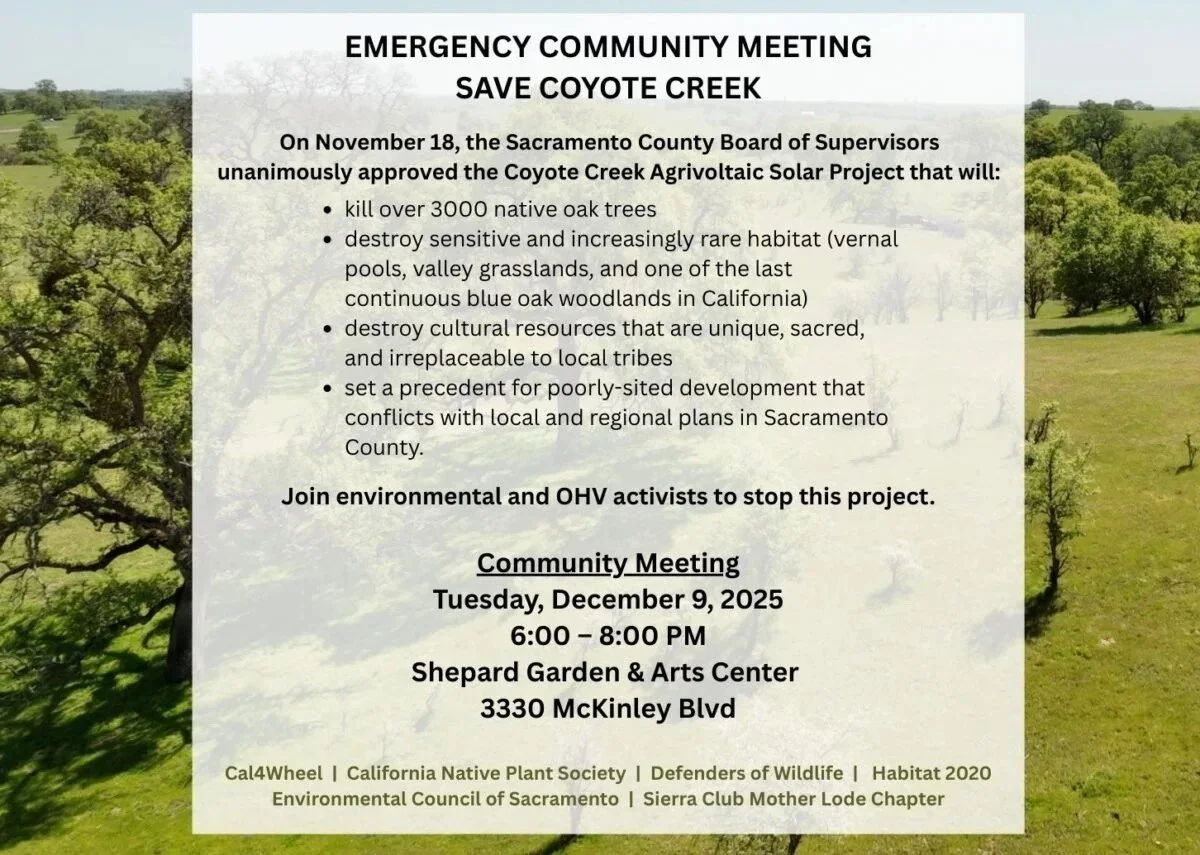
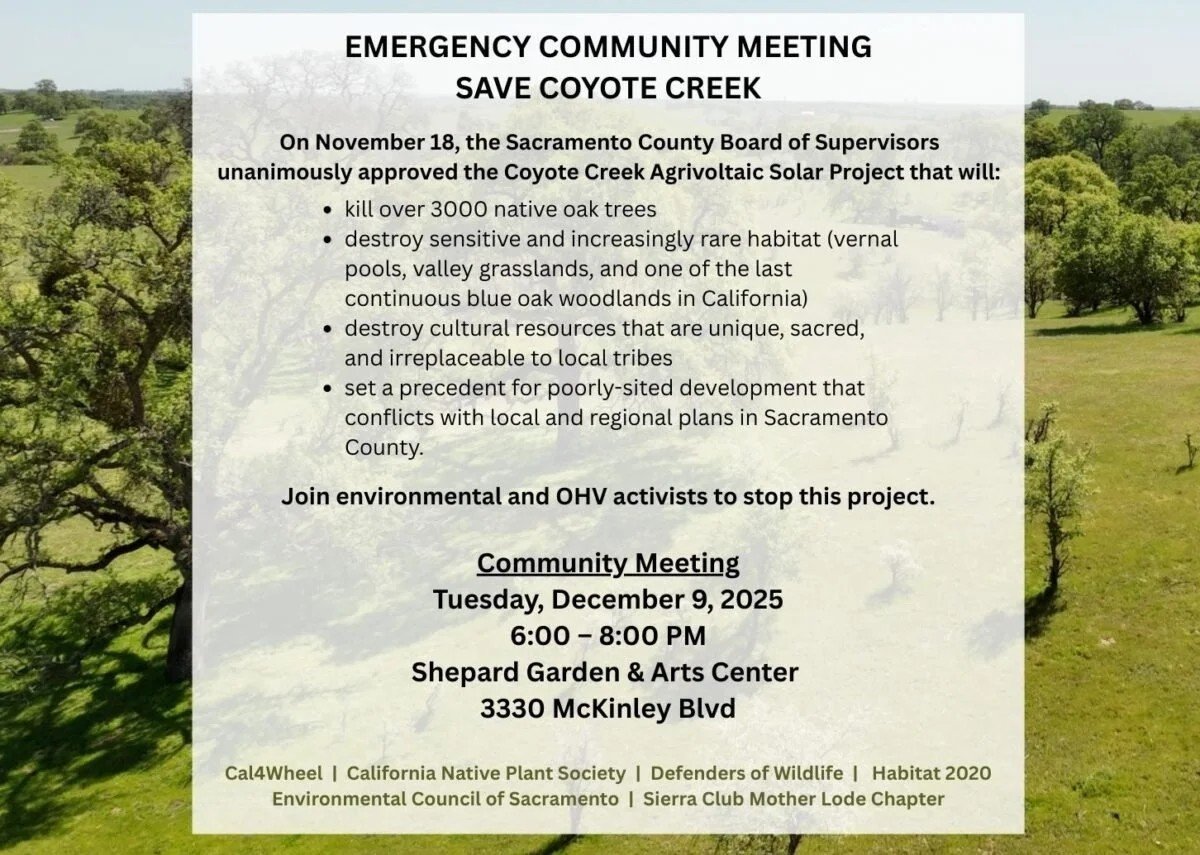
Community Meeting to Save Coyote Creek, Dec 9

From ECOS (Environmental Council of Sacramento):

Community Meeting to Save Coyote Creek
Tuesday, December 9, 2025 6:00 – 8:00 PM
Shepard Garden & Arts Center
3330 McKinley Blvd, Sacramento, CA

Background:

On November 18, 2025, the Sacramento County Board of Supervisors unanimously approved the Coyote Creek Agrivoltaic Solar Project that will:

  • kill over 3000 native oak trees

  • destroy sensitive and increasingly rare habitat (vernal pools, valley grasslands, and one of the last continuous blue oak woodlands in California)

  • destroy cultural resources that are unique, sacred, and irreplaceable to local tribes

  • set a precedent for poorly-sited development that conflicts with local and regional plans in Sacramento County.

Join environmental and OHV (Off-Highway Vehicle) activists to stop this project near Scott Road south of Folsom.

Injunction Granted

From American River Trees:

Our injunction was granted!

On Thursday, Nov 20, the U.S. District Court for the Eastern District of California granted American River Tree’s request for a Preliminary Injunction to enjoin any ground or vegetation disturbing activity on the American River Parkway authorized under Contract 3B until the Court reaches a decision on our case.

This means that tree clearing and other vegetation removal cannot start this Fall. This work cannot occur until our lawsuit is resolved on the merits by the Court. 

In its ruling, the Court stated:
"The court understands the importance of the Project, and Contract 3B specifically, in reducing the overall flood risk in the Sacramento metropolitan area. However, the Ninth Circuit has recognized the well-established “public interest in preserving nature and avoiding irreparable environmental injury.” The public interest in preserving the natural landscape along the Lower American River for recreational purposes is especially strong, where, as here, the river is designated for protection under both the federal Wild and Scenic Rivers Act and the California Wild and Scenic Rivers Act."

"The court also recognizes the potential economic hardship to Defendants now that Contract 3B has been awarded. Although Defendants’ economic hardship and the overall flood risk in Sacramento are of serious concern, in balancing the equities, the scale tips sharply in favor of preserving the natural landscape along the Lower American River and the at least 675 trees, some of which are heritage trees, while this case is resolved on the merits."

Read the full document HERE

This is a GIANT step in the right direction!

Thank you all for continuing to step up and stand up for the Parkway in a grand display of “well-established public interest”. We could not have achieved this important step without you!

Over the next few months we will be continuing to pursue our legal action, increasing awareness among the public and elected and appointed officials, and raising funds to cover our legal and consulting expenses. 

Thanks again for your financial support! If you would like to donate to support our ongoing legal efforts, please donate here. 

Donations are made through the Save the American River Association (SARA) to the American River Trees (ART) Fund. SARA is a 501(c)3 non-profit organization, and your donation is tax-deductible. 

What’s the lawsuit all about? 

"The goal of the lawsuit is not to stop the project," said Patrick Soluri, who is representing the Sacramento nonprofits [ART and SARA]. "The goal of the lawsuit is instead for the Army (Corps) to give meaningful consideration to the bioengineering alternative - which has been recommended by other federal agencies and even promised by the Army Corps in the past - so that the project does not destroy the natural resources of the American River."

-SacBee News Article, August 28, 2025

Read (or skim) the request for a Preliminary Injunction filed by ART on October 3rd to legally prohibit the Army Corps of Engineers, the Central Valley Flood Protection Board and the National Park Service, and their contractors and assigns from “undertaking any ground or vegetation disturbing activities—including site preparation, vegetation removal and tree felling—within the Project area” as part of the unnecessarily destructive American River Contract 3B Erosion Control project.

Read (or skim) the legally filed Complaint to see all the components of the Contract 3B Erosion project that ART is challenging. These include violations of the National Environmental Policy Act, the California Environmental Quality Act, the federal Wild and Scenic Rivers Act and the California Wild and Scenic Rivers Act. 

You can also visit our website at AmericanRiverTrees.org for additional project information and details of our concerns. 


OTHER WAYS TO AID THE EFFORT

Connect with American River Trees on Facebook
Save the American River Parkway Group
Save the American River Parkway Page

Visit the ART YouTube channel youtube.com/@AmericanRiverTrees

Visit the ART website AmericanRiverTrees.org

Thank you for supporting efforts to preserve Sacramento’s Crown Jewel!

Sacramento Area CBCs For 2025-2026

Christmas Bird Counts are an annual tradition for many local birders. Here are some of those being held in the Sacramento Area this year.

Please contact the compiler if you would like to participate. Click on the compilers name for their contact information.

Sunday, December 14
Stockton
Compiler: Donna Marciano

Tuesday, December 16
Peace Valley (Sutter Buttes & Gray Lodge)
Compiler: Laura Lush

Wednesday, December 17
Woodfords
Compiler: Dan Williams

Thursday, December 18
Marysville
Compiler: Asher Perla

Saturday, December 20
Auburn
Compiler: Sarah Roeske

Sunday, December 21
Putah Creek
Compiler: Bart Wickel

Saturday, December 27
Sacramento
Compiler: Dan Williams

Monday, December 29
Rio Cosumnes
Compiler: Zane Pickus

Tuesday, December 30
Lincoln
Compiler: Ed Pandolfino

Friday, January 2
Woodland/Davis
Compiler: Bruce Christensen

Saturday, January 3
Wallace - Bellota
Compiler: Kasey Foley

Saturday, January 3
Grass Valley
Compiler: Rudy Darling 

Sunday, January 4
Folsom
Compiler: Chris Conard

Field Trip Findings for October 8 - November 8, 2025

SAS Field Trip: Del Campo Park, 10/8/25

Leader Ed Harper reported: As our group was assembling at 8:00 AM, the rumble of trucks and equipment into the park told us we had company. The Carmichael Recreation and Parks Department had commissioned a private contractor to cut and trim trees. The September 3rd microburst had felled and damaged numerous trees in the park and the tree crew was in the clean-up mode. But today the mantra was to take out any tree with a dead branch. Chain saws out and about to take down some magnificent redwoods with dead spikes topping otherwise healthy trees, the crew paused as we approached and pleaded for them to spare the trees. As we talked, we pointed out a dozen or more Yellow-billed Magpies gathering atop the redwoods. Then a couple of Western Tanagers flew in, followed by eight more species of birds giving us ten species of birds that were drawn to these sentinel trees. The birds and our earnest pleading paused the operation, and the crew went elsewhere in the park to work. We completed our walk garnering 23 species in spite of the noise from saws and chippers. A major disappointment was to discover the granary established by a family of Acorn Woodpeckers was completely gone; just a pile of wood chips, sawdust, and shattered acorns. In spite of the challenging scenario, the group of eight eager and charming folks persisted to the end. Many were delighted to have discovered this park and its birding potential, and they will be even happier to learn that we have been successful and were informed the tree cutting has been called off. It’s too late for the many dead limbs that hosted nests for bluebirds, nuthatches, titmice, and woodpeckers, but maybe some nest boxes can help fill the gap until time heals the wounds.


SAS Field Trip: Cosumnes River Preserve, 10/11/25

Leader Cliff Feldheim reported: On October 11th, 8 of us enjoyed a nice morning at the Cosumnes River Preserve. We walked along the wetlands alongside Middle Slough and south to the River. We observed 32 species of birds. As the morning warmed up, we got good looks at some raptors, including a White-tailed Kite, American Kestrel, Northern Harriers, Red-Tailed and Red-shouldered Hawks, and a quick glimpse of a Cooper's Hawk. Although the warblers and songbirds were hard to come by, the wetlands had abundant Northern Pintail, Gadwall, American Wigeon, Green-winged Teal, Northern Shoveler, Mallard, Greater White-fronted Geese, and a handful of Cinnamon Teal. In the shallow waters/mud there were groups of Long-billed Dowitchers, Greater Yellowlegs and a smattering of Least and Western Sandpipers, with the occasional Black-neck Stilt. In addition to the birds, we enjoyed discussing the history and management of the Preserve, salmon ecology and waterfowl life history.

SAS Field Trip: Reichmuth Park, 10/17/25

Leader Eric Johnson reported: Eight birders ranging from brand new to very experienced gathered at Reichmuth Park on October 17. People were hoping to see warblers, woodpeckers or “anything at all.” Our first hear was the Nuttall’s Woodpecker chitter-chatter, so an auspicious beginning. As we headed north into the canal trail, it was quiet. Too quiet. A Cooper’s Hawk sitting sentinel explained the lack of action. We backtracked and headed toward the oaks in the north, picking up several Ruby-crowned Kinglets, California Scrub-Jays, and Black Phoebes. Exiting the wooded area for the grass, we saw…nothing. Literally zero birds for five minutes while we stood there. We were just about ready to take it personally but determined to hold out hope. Venturing back toward the canal trail, we picked up a late Black-throated Gray Warbler, a lifer for several. On the canal, all was redeemed: White- and Golden-crowned Sparrows singing their hearts out, Hermit Thrushes (another lifer), a Fox Sparrow (lifer), Yellow-rumped Warblers, White-breasted Nuthatch, Cedar Waxwings, and others previously seen made the brush come to life. Despite a rocky beginning, we all left happy, with 28 species on a truly lovely morning.


Young Birders Club Field Trip: Tall Forest Survey, 10/19/25

Leader Mackenzie Hollender reported: Two young birders and one parent met my father, John Trochet, Chris Conard and I on this chilly pre-dawn morning behind Nicolaus gate. We saw the silhouette of an American Barn Owl on a telephone wire, our first bird of the outing, and as we traveled farther into the agricultural fields and light rose in the sky, we noticed many more American Barn Owls hunting low over the fields. We arrived at the equipment pad while it was still pretty dark—hearing Great Horned Owls. We traveled towards the Love Shack and paused at the edge of a woodlot and farmland just in time for the dawn chorus to start—Song Sparrows, Marsh Wren, Virginia Rail are among some that we heard. We were awestruck by many small groups of Sandhill Cranes passing directly overhead and hundreds more Greater White-fronted Geese lifting from the fields. A Say’s Phoebe sat on a telephone wire, a White-tailed Kite passed overhead, and an American Kestrel landed in a nearby oak tree. A flock of about 20 Yellow-billed Magpies, known to roost here, landed at the top of a eucalyptus and stayed for a few minutes before taking off again. We briefly saw a Wilson’s Snipe descend rapidly and disappear into a field.

Moving on from the love shack, we headed down to the Accidental Forest, pausing to look at a Lark Sparrow, less common for this location, on a telephone wire. Arriving at the accidental forest, we were greeted by many Ruby-crowned Kinglets, vocal Downy Woodpeckers, sunning Turkey Vultures, and American Robins. Inside of the Accidental Forest, we picked up Hermit Thrush and Spotted Towhee. Emerging out of the thick forest and onto a dry sandbar, we noticed inconspicuous Golden-crowned Kinglets foraging in the oak canopy, calling softly. We briefly heard a Hutton’s Vireo, and realized we had a mixed flock. Upon Chris Conard’s imitation of a Northern Pygmy-Owl call, three Orange-crowned Warblers popped up along the forest edge, along with one Townsend’s Warbler. Many Wrentits sang, a lone Cackling Goose flew overhead, along with a Brown-headed Cowbird, and a Long-billed Curlew called in the distance. We left the Accidental Forest, then headed down along Wood Duck slough towards the Tall Forest, stopping along the way for another Townsend’s Warbler, an Acorn Woodpecker, Fox Sparrow, Wood Ducks flushing from the slough, Northern House Wren, and a Sharp-shinned Hawk that cruised just above the tree line. Due to time, we had to double back through Warbler Woods, where we picked up Western Bluebird, White-breasted Nuthatch, another Golden-crowned Kinglet flock with yet another Townsend’s Warbler, and a small flock of Oregon Dark-eyed Junco. Overall, it was a very diverse day full of exploration in a preserved, special natural area, and we learned a lot of natural history too!

SAS Field Trip: Nimbus Fish Hatchery, 10/21/25

Leader Molly Shea reported: Our group had a wonderful morning birding along the American River trail next to the Nimbus Fish Hatchery. We saw 42 species overall, many of which were recently arriving following the start of the Chinook salmon migration in the river. Highlights included a female Belted Kingfisher eating a crayfish, a great view of a male California Quail perch on top of a bush, and a unique view of a large flock of Cedar Waxwings eating insects high above us. Other species included White-throated Swifts, an Osprey, some territorial Great Egrets, many Double-crested Cormorants, and a variety of gull species (California, American Herring, and Ring-billed)!


SAS Field Trip: Sacramento Bar, 10/23/25

Leader Rich Howard reported: A nice blend of ten birders, from very new to decades of experience, braved a cool foggy start to the day along the American River. We were rewarded with good views of an interesting hybrid gull (we finally decided on American Herring x Glaucous-winged), Acorn Woodpeckers, and Cedar Waxwings. We found California Scrub-Jay, California Quail, California Gull, and the near-endemic Nuttall’s Woodpecker for a visitor from Virginia, and directed him to some good Yellow-billed Magpie spots nearby. Snowy and Great Egrets offered nice side-by-side comparison looks in the scope, but a Green Heron that landed near them was a bit harder to see. Diving ducks had not returned to the river, so we headed inland and had a nice showing of Turkey Vultures, Cooper’s and Sharp-shinned Hawks, and White-throated Swifts in the air. Returning winter visitors were nice to see, including Dark-eyed Junco, Yellow-rumped Warbler, and American Robin. San Juan Rapids gave us our first Double-crested Cormorants, two Killdeer, and a perched American Herring Gull in good light. A good morning and a good group. A participant generously kept our eBird list; it can be found here: https://ebird.org/checklist/S280977759


SAS Field Trip: Sailor Bar, 10/25/25

Leaders Mary Forrestal and Jane Van Kessel reported: The overcast skies and possibility of rain didn’t keep 13 birders from joining us on this Saturday morning field trip along the American River. Bird sound proceeded sightings, but we were soon rewarded with looks at Oak Titmice, Yellow-rumped Warblers, Ruby-crowned Kinglets, a White-breasted Nuthatch, and a Nuttall’s Woodpecker. At our first river overlook, across from Nimbus Fish Hatchery, an Osprey provided excitement along with Double-crested Cormorants, Ringed-billed and California Gulls, Great Egrets and our first Common Merganser. White-crowned Sparrows provided background music for most of the walk. The burbling of California Quails was realized when a small group was seen by the boat launch. Here we were also rewarded with up-close looks at an American Herring Gull, showing pink legs while seeming to pose on a rock, and a Snowy Egret who seemed to take offence at the gulls’ position. Further down the river, we enjoyed a Spotted Sandpiper, numerous Turkey Vultures, a male Bufflehead, a female Shoveler, and two Gadwall. Perhaps the sighting of the day was two Sharp-shinned Hawks chasing each other about and posing in trees. It was altogether a good raptor day with two Red-shouldered Hawks, a Red-tailed Hawk, a Cooper’s Hawk, two American Kestrels, and a Bald Eagle seen in addition to the Sharpies. You can see the complete eBird list here: https://ebird.org/checklist/S281313469.


Beginning Birder Walk: William Pond Park, 10/26/25

Leader Larry Hickey reported: Despite a sprinkling of early morning rain, eight beginning birders joined us on a late October morning at the William Pond section of the American River Parkway. Right away we had excellent views of male and female Northern Flickers, Black Phoebe and Yellow-billed Magpies once they were spotted on the road by one of our beginning birders. We saw and heard several Red-shouldered Hawks and mostly heard White-crowned Sparrows and Ruby-Crowned Kinglets. We saw several flocks of Cedar Waxwings and enjoyed good views of a Great Blue Heron. Highlights were side-by-side views of a Great Egret and Snowy Egret and excellent views of a cooperative male American Kestrel.    


SAS Field Trip: River Bend Park, 10/30/25

Leader Dana Miller-Blair reported: 8 of us met on a lovely clear autumn morning for birding in River Bend Park. We walked up river through the woods and back down along the riverbank. We saw only a few other people in the park, but leaf blowers in the distance made birding by ear difficult at times. Our day started with Western Bluebirds near the parking lot. Approaching the bicycle bridge, we were rewarded with a distant view of my first of season Phainopepla. Oak Titmouse, White-crowned Sparrows, Golden-crowned Sparrows, Ruby-crowned Kinglets, Acorn Woodpeckers and California Scrub-Jays and Mourning Doves were numerous throughout the walk. Standout species in the woods included a Lark Sparrow, a Hutton's Vireo, and 3 Red-breasted Sapsuckers. We also enjoyed seeing a Cooper's Hawk fly by, and a perched Red-shouldered Hawk afforded good views. Also in the woods, we heard California Quail, and a Downy Woodpecker. We saw and heard many Northern Flickers, a few American Crows, many Bushtits, a few European Starlings, 4 American Robins, many Cedar Waxwings, a large flock of Lesser Goldfinches, 4 California Towhees, 3 Spotted Towhees, a few House Finches,  Anna's Hummingbirds, a couple each of White-breasted Nuthatches and Bewick's Wrens, along with a House Wren and one Yellow-rumped Warbler. Turning to the River, we enjoyed counting 26 Killdeer on 2 rock islands, and saw a couple of Spotted Sandpipers, a Belted Kingfisher, along with several Canada Geese, Mallards, a couple Common Mergansers, a few Black Phoebes, 2 Great Egrets, 8 Turkey Vultures and 3 American Herring Gulls. We carefully examined the trees on the opposite shore looking for Bald Eagles (which are often perched on the tall trees on the north side of the river) but didn't see them today. We appreciated having Jim Joye carrying his scope along so we could carefully examine and identify the more distant perched birds. 


SAS Field Trip: Michigan Bar, 11/1/25

Leader Chris Conard reported: We had beautiful weather and an enjoyable outing to a couple of the Sacramento area's best open spaces. We started at Michigan Bar Rd, with an immature Bald Eagle and a Wilson's Snipe at the Cosumnes River Bridge, where we also viewed salmon in the river. We had Lark Sparrows in addition to regular foothills species, but Lewis's Woodpeckers, rare sparrows, and additional uncommon raptors were elsewhere. As we moved to Meiss Rd, the lack of uncommon raptors mostly continued. Between the two locations, we recorded over 15 Say's Phoebes. After several flybys, we finally found an observable flock of Horned Larks. We scanned several traditional Burrowing Owl sites without luck, but accidentally flushed one from a pile of dumped roadside trash. Unfortunately, it flew into tall vegetation, not allowing much of a look.


Young Birders Club Field Trip: Staten Island Road, 11/1/25

Leader Mackenzie Hollender reported: Three young birders and three parents met my father and I along this farmland road. We parked at a spot where an open grassland lay to our right, and a flooded ag field to our left. In the grassland, an American Kestrel sat perched on a fenceline, Western Meadowlarks flew up from the grass clumps to cross to another spot in the field, and White-crowned Sparrows hopped up from a patch of blackberry lining the road. In the flooded field, we enjoyed beautiful long looks at preening Sandhill Cranes, resting Cackling Geese, and we viewed a pair of Green-winged Teal through a scope. A Northern Harrier sailed along a horizontal strip of vegetation, and Brewer’s and Red-winged Blackbird flocks moved overhead. A Greater Yellowlegs called and flew across the field, and a Ring-billed Gull flew in and landed, carrying a Crawfish, which it began to hack into with its bill upon landing. We inched our way down the road, pausing for more kestrels, Snowy Egrets, and an empty dirt field to catch a glimpse of American Pipits walking among a flock of Killdeer.

Our next full stop was at a long, flat grassy field that was absolutely covered in Cackling Geese. We estimated 7,000 Cackling Geese just in this field and picked out many minima subspecies among the more common aleutions subspecies. A Great Egret flew into the beginning on the field, interestingly, causing some of the Cackling Geese around it to fly up and land farther away from it, leaving the egret with a wide area of the field devoid of Cackling Geese, to itself. A few minutes later, a Ring-billed Gull crossed into the field, and flew around the far right area. This caused a great stir in the Cackling Geese, and in a domino effect, starting with the geese nearest to the gull, the majority of the 7,000 bird flock lifted off the field. It was an incredible sight, and deafeningly loud too. We noted that we could feel vibrations in the ground when the flock lifted off. The birds filled all corners of the sky and surrounded us, heading in all directions. We watched, mesmerized. After the geese had settled, we traveled onward, picking up White-tailed Kites that traveled south, flocks of Greater White-fronted Geese, and watched more Sandhill Cranes foraging in dry fields.

A large dirt pullout on the side of the road revealed Horned Larks, many adults with the beautiful creamy yellow face and striking black masks. We noticed one where the wispy ends of the black masks extended slightly up from the top of the head. We continued to a large flooded field with very little vegetation, where a flock of American Coots foraged. Through a scope, we picked out a female Canvasback, two Eared Grebe, and a female Ring-necked Duck among the coot flock. It was around six, and the sun was setting fast when, behind us, we spotted an American Barn Owl coursing just above a strip of vegetation that divided the fields in a buoyant mystical flight. Further down the road, a field that was shallowly flooded with small stalks of new grass revealed Dunlin, Least Sandpiper, and two Wilson’s Snipe. A second Barn Owl foraged the same way as the first and crossed unusually high above the flooded field to get to another vegetation strip. We arrived at the old water tower at 6:20 and waited around for a chance of seeing a great horned owl, instead seeing yet another foraging American Barn Owl, and hundreds of waterfowl flying against a deep red sunset to end off the extremely well rounded, beautiful evening. Savannah Sparrow and Red-tailed Hawk were two other highlights. 


SAS Field Trip: Gibson Ranch, 11/2/25

Leader Kevin Thomas reported: A wonderful morning on the first day of the fall back time change. We started a half hour after sunrise while there was still a bit of fog sticking to the ground and temperatures were in the low 50s. We were greeted in the parking lot by White-breasted Nuthatch and a flock of Bushtits and Kinglets. We worked our way along the pond edge and heard Marsh Wren singing and saw flocks or Red-winged and Brewer's Blackbirds. As we passed along a group of tule and came within view of the shallow grass edge we flushed up a Wilson's Snipe that took off up and out of view. Following the Snipe, we heard the grunt of a Virginia Rail coming from deep inside the tule patch. We made our way over to scan the grasslands and a pair of White-tailed Kites were hanging out on the barbed wire fence. We made our way through the grassy park area and picked up many Dark-eyed Junco, White-crowned Sparrow, and House Finches. A lone Chipping Sparrow hanging out with the other birds forging in the grass was a treat. The riparian area was slow this morning with a few Hermit Thrush calling but never coming into view and Acorn Woodpeckers caching acorns in the dead cottonwood snags. We worked our way along the trail parallel to the horse stables and had great looks at a Red-breasted Sapsucker. It was just above eye level for several minutes foraging on the oak tree trunks. We had a fantastic morning with a great group of 7 birders who were happy to share sightings and stories with all.  


SAS Field Trip: Cosumnes River Preserve, 11/8/25

Leader Cliff Feldheim reported: On November 8, 13 of us had a nice walk around the Cosumnes Preserve primarily along the River Walk Trail. After the fog lifted, we were treated to waves of Greater White-fronted Geese with about 1,500 landing in a nearby pond. We got nice looks at a Cooper’s and a Sharp-shinned Hawk as well as a Merlin and distant Bald Eagle. There was a relatively big group of 25 Cinnamon Teal in one pond, and we were able to see Cinnamon, Blue-winged, and Green-winged Teal all standing next to each other. In total we enjoyed seeing 47 species of birds and great conversation about conservation, ecology, and the history/management of the Cosumnes Preserve.

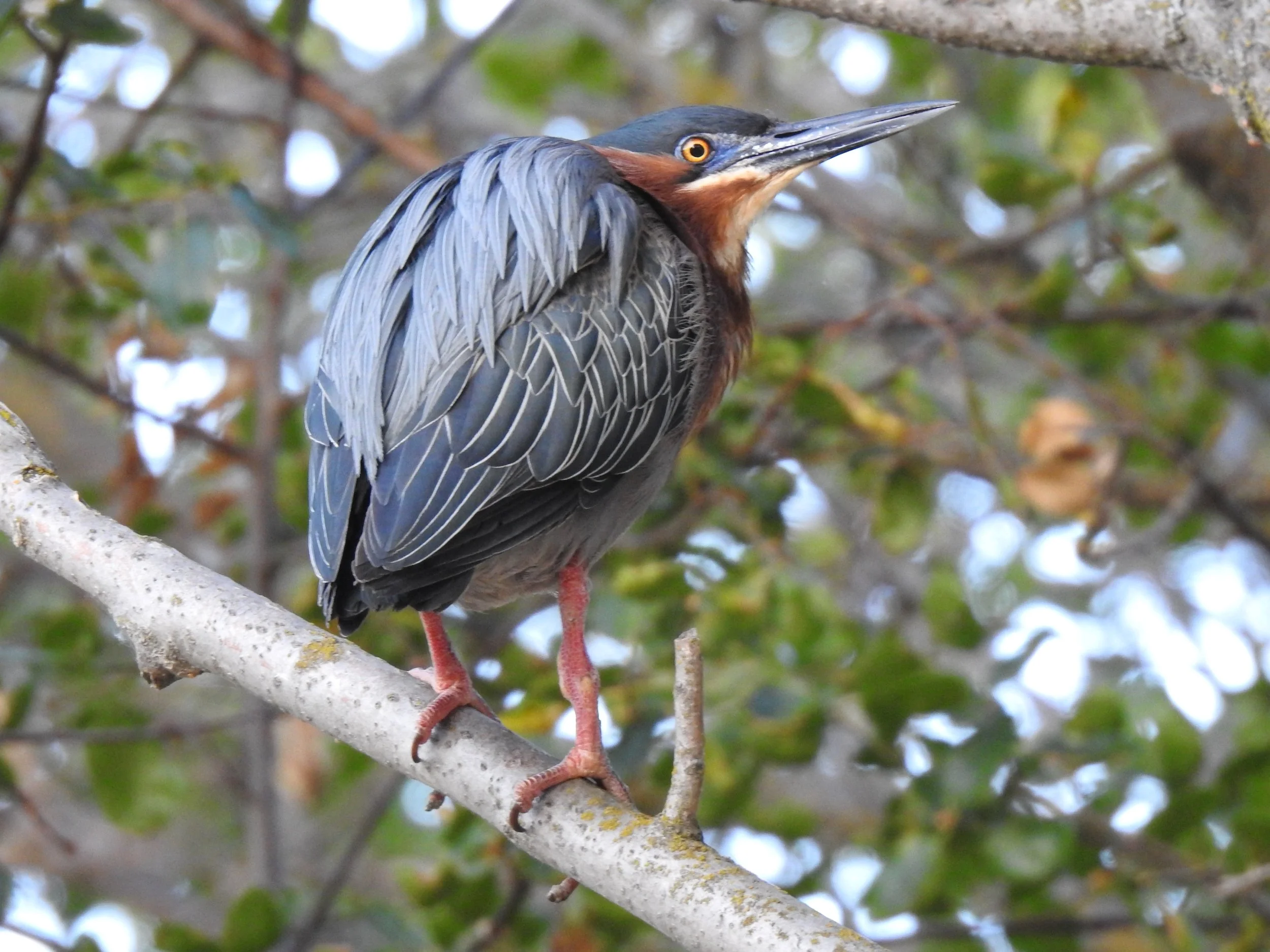
ACTION NEEDED Coyote Creek Solar

The Coyote Creek Solar Project will be before the Sacramento County Board of Supervisors tomorrow November 18th.

Solar is an important part of our energy future, however this project is being proposed in the wrong location. This approximately 1,200 acre industrial solar facility will be located in the eastern part of Sacramento County.  This is an unacceptable location to site such a facility because:

  • They are proposing to cut down as many as 4,787 native oak trees, many of which are older mature oak trees that take decades to grow that large;

  • It will destroy habitat for numerous local and protected wildlife species;

  • It will disrupt an important wildlife corridor in an area where there is very little Oak Woodland Grassland habitat remaining;

  • There are many far more appropriate sites in the county;

  • SMUD does not need this project to be able to close local fossil fuel plants or meet its 2030 net zero carbon goals;

  • It disrupts the ability of the South Sacramento Habitat Conservation plan to achieve its conservation goals;

  • It runs counter to Sacramento County general plan directives for the use of this area;

  • It will destroy sacred ground and the associated cultural resources for local tribes;

  • It will be a visual blight in a very scenic part of the county;

  • It will negatively impact operations and events in the Prairie Creek state vehicular recreation area, immediately adjacent to the proposed facility. These events generate 57 million dollars for the local economy and that revenue would be at risk with the degradation of a massive industrial solar facility being installed immediately adjacent to their facility.

It is important the Supervisors know the level of opposition to this project.

Please let the Sacramento County Board of Supervisors know that this is the wrong location for solar development! Action needed prior to the meeting on November 18, 2025.

Call, write, or visit in person to let your supervisor know that you are opposed to this project. The district map is available here, or search by address here.

If you can, please join us at the November 18th Board of Supervisors meeting to voice your opposition to this project. This project will be discussed at 2 PM at 700 H Street, Suite 1450. Even if you are not comfortable speaking, it is important that we pack the room with opposition to this development!

To learn more you can visit:
https://www.ecosacramento.net/2025/11/day-of-action-november-18-2025/

I hope you are all getting the opportunity to get out and see the wintering and migrating birds.  The White-fronted and Snow Geese have arrived at places like Sacramento National Wildlife Refuge and the Sandhill Cranes are in good numbers in the Delta.  Thank you for your ongoing commitment to conserving our natural resources!

Cliff Feldheim
Conservation Chair, Sacramento Audubon
sacaudubonconservation@gmail.com