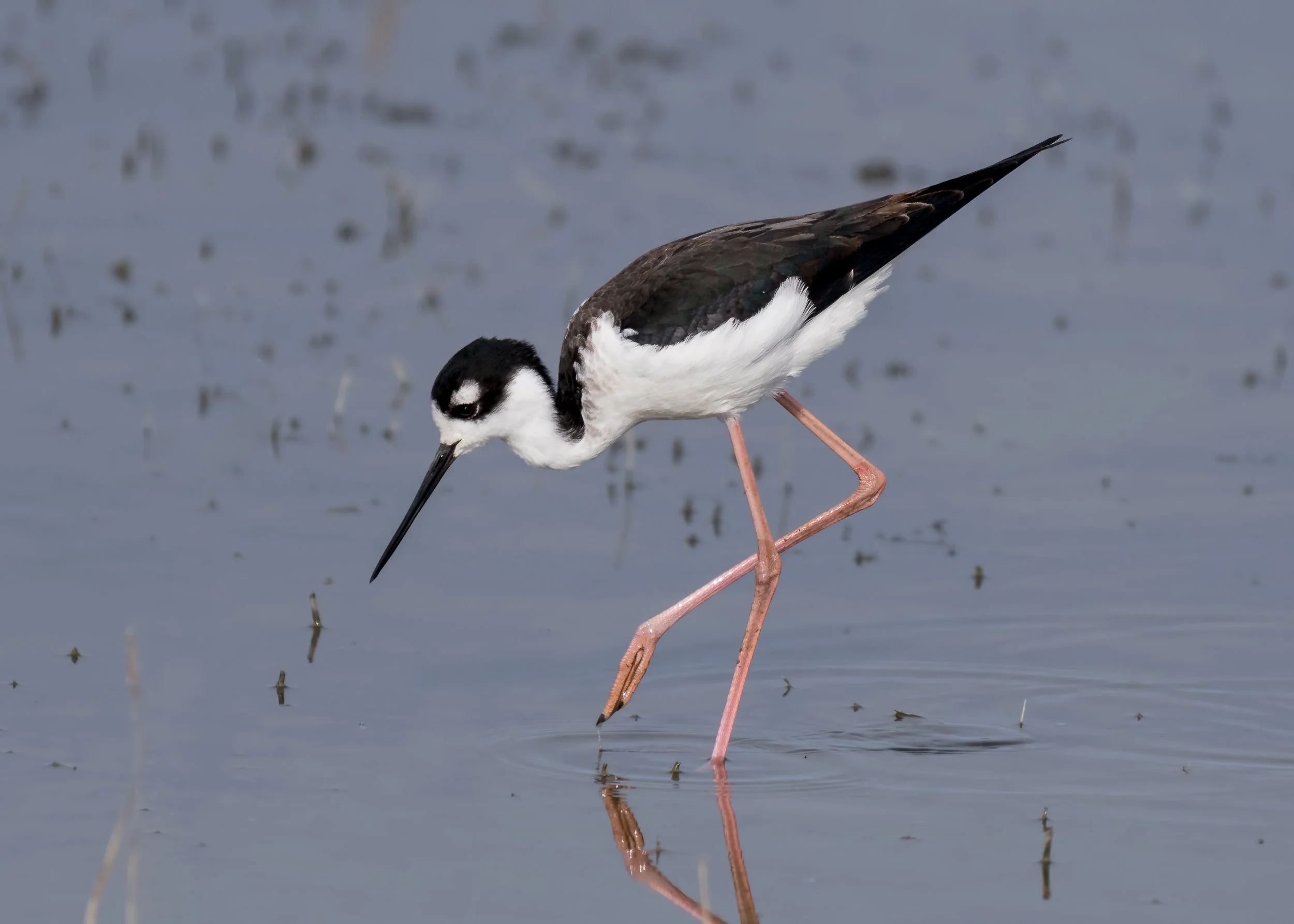
Adult Black-necked Stilt © Daniel Lee Brown
This month let’s learn about a graceful and elegant shorebird called the Black-necked Stilt (Himantopus mexicanus). Black-necked Stilts share the genus Himantopus with other similar stilt species. The name Himantopus is from the Greek, imantopus, which means: “spindle shanked bird with extremely thin legs”. Black-necked Stilts avoid deep water and, due to their extremely long legs, they usually never get their bodies wet. Only flamingos have longer legs in relation to body size. The Hawaiian subspecies of Black-necked Stilt ((H. m. knudseni) was hunted to near extinction; but is now protected and recognized as endangered.
Black-necked Stilts are usually found below 5,250 feet in (mainly) the western U.S., western Canada, Mexico, and South America. They are also found along the Texas coast. Beginning in 1960, scientists noticed that Black-necked Stilts had expanded their nesting range northward to Washington State and Canada. With their larger range, their numbers also increased. The Hawaiian subspecies is the only population that is currently endangered.
Black-necked Stilts are considered short to medium-distance continental migrants. In the Greater Central Valley of California, Black-necked Stilts are present all year round because there are optimal and stable habitats that allow a large population to remain. In the Sacramento Valley, seasonal population shifts occur and local population migration is usually only a short distance to the San Joaquin Valley or to coastal mudflats. Other populations of Black-necked Stilts, including those from the Great Basin, Pacific Northwest, and the interior northern U.S., migrate south and spend their winters either along the California coast, the Gulf Coast, Florida, Mexico, Central America, or northern South America. Due to the constant overlap of local residents and regional migrants, you can successfully spot Black-necked Stilts in the Sacramento Valley during any month of the year.
With their dainty and delicate appearance, one may think Black-necked Stilts are fragile birds. Actually, they are quite hardy and bold. They will often forage for hours in the scorching sun and can be very aggressive, especially during the nesting season. When foraging, Black-necked Stilts are seen alone, in pairs, or in small flocks. They travel by walking, running, or direct flight; and can swim but rarely do. However, juveniles are known to escape predators by diving and swimming underwater.
What do Black-necked Stilts look like?
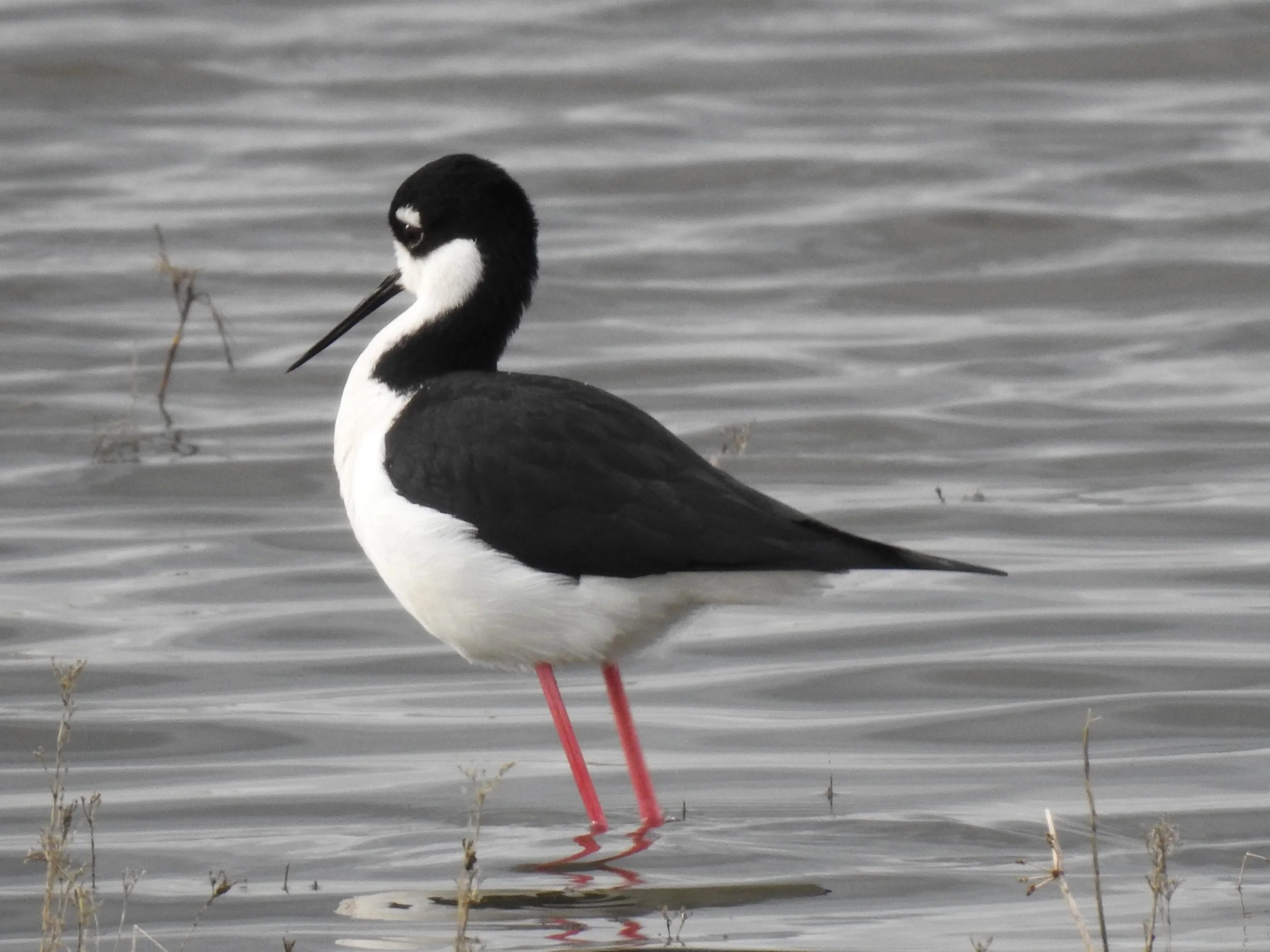
Adult Black-necked Stilt © Mary Forrestal
Black-necked Stilts are tall, eye-catching shorebirds with a body length of about 14 inches. They have long and extraordinarily thin and lanky dark coral-pink legs; long necks; large red eyes; and a distinctive “formal” or “tuxedo-looking” plumage which makes identification easy. The upper body of Black-necked Stilts is black and their lower body is bright white. They also have slim wings; a white spot above their eyes; short, inconspicuous, white tails that are often hidden by their wings; and long, very thin black bills. Black-necked Stilts have large feet with three toes that all face forward. The outer toe is free of webbing. This free toe prevents the birds from sinking in the mud and helps with traction and balance. In addition, there is a thin membrane or webbing between the inner and middle toes which aids in swimming. During flight, Black-necked Stilts fully extend their legs and feet horizontally beyond their tails.
In breeding season, the males’ black plumage becomes shiny or glossy and they develop a pink tinge on their upper chests. Adult females look similar except for having slightly shorter legs and the center of their backs and scapular regions is brown. Females also have paler red eyes, lack the shiny plumage, and do not have a pink tinge on their chests like males can have. Hatchling birds are downy and have tawny (or olive-brown) upper bodies with jet black blotching or streaking. They have pinkish-tan legs, short bills, creamy white chests, and pure white bellies. (They can be distinguished from American Avocet chicks by their pinkish leg color, the lack of a back toe, and having less webbing on their feet.) Juvenile birds are similar to adults. However, their back plumage is slightly browner and has a faint scalloping pattern (or feather edging). In addition, they have pale pink legs, brown eyes, have pink at the base of their bills, and have white on the trailing edge of their wings in flight.
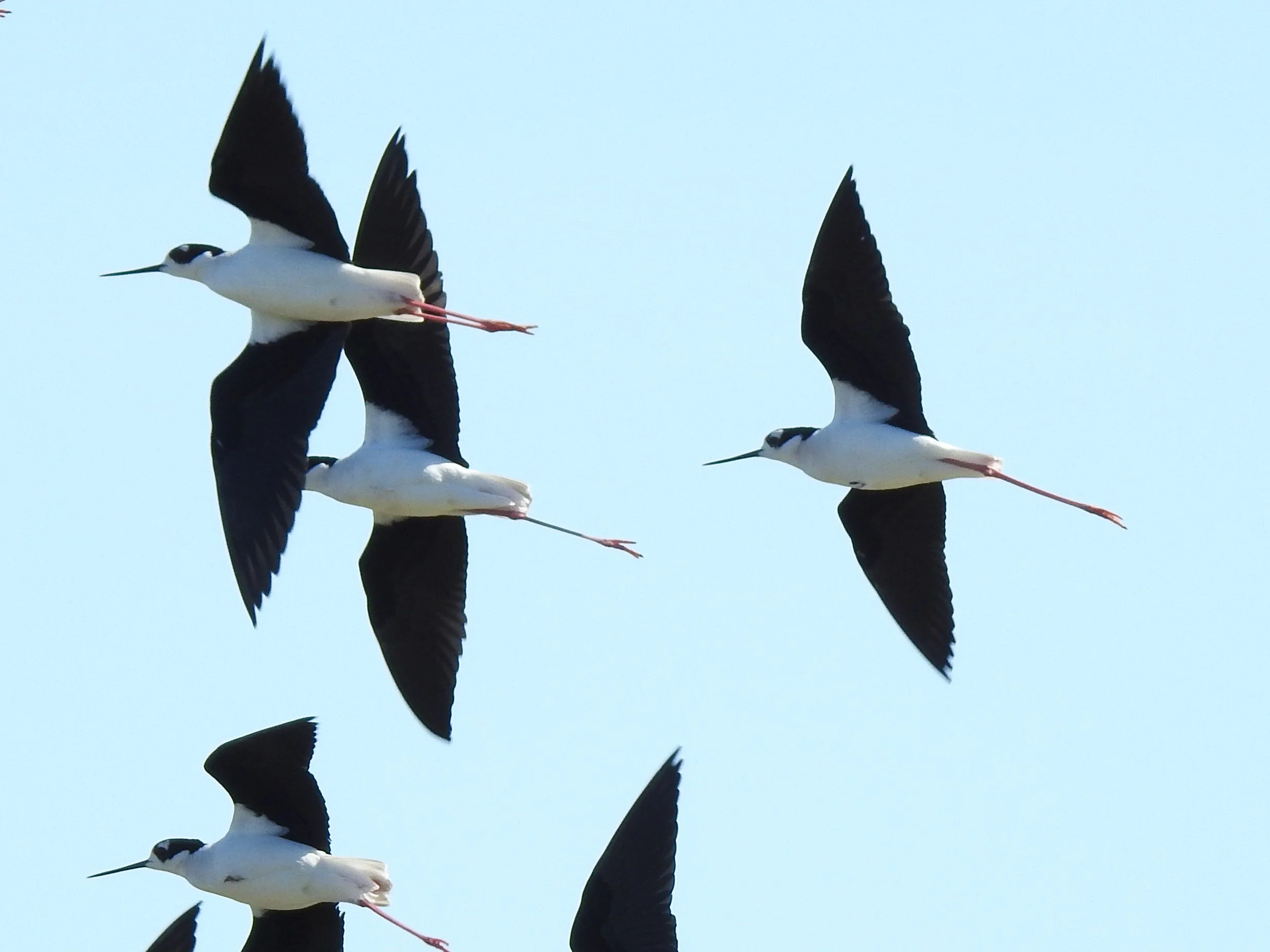
Black-necked Stilts © Mary Forrestal
Where do Black-necked Stilts live and nest?
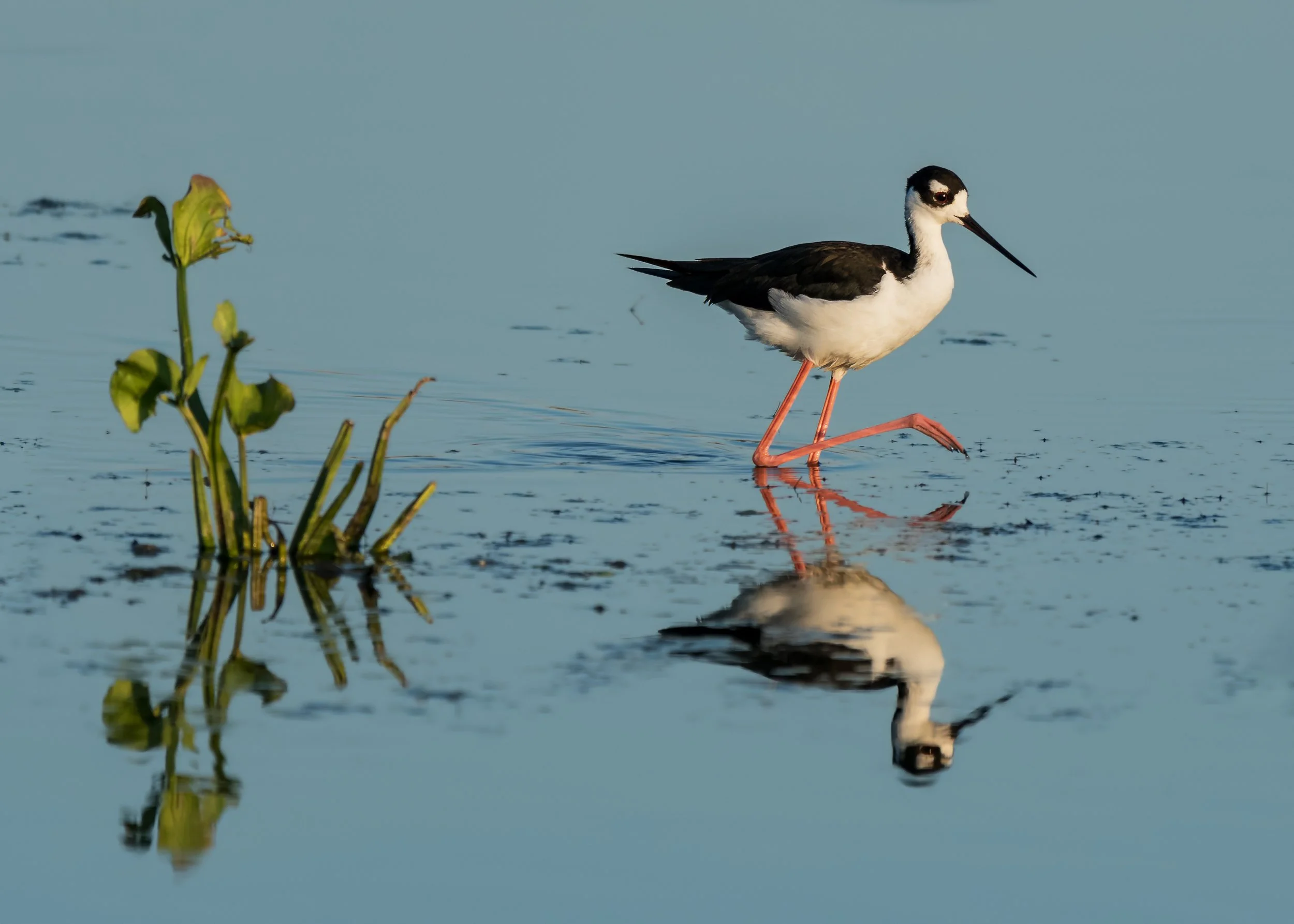
Adult black-necked Stilt © Daniel Lee Brown
Black-necked Stilts nest and spend their winters in areas that offer open and shallow freshwater or saltwater. These areas can be along coasts, in inland wetlands, in saltwater wetlands, lakes, ponds, land flooded by rivers, levees, swamps, and salt marshes. This species is adaptable and has developed a strong tendency to nest on human-made water habitats like sewage ponds, evaporation ponds, agricultural fields, and flooded rice fields. However, human-made ponds holding irrigation drain water have not always been beneficial to Black-necked Stilts. Chemical contaminates such selenium cause nests to fail and fatal deformities in young birds. In drought conditions, the concentration of selenium increases even more. Sections of the Kesterson NWR in central California have been drained and soil has been replaced in the past to correct this problem.
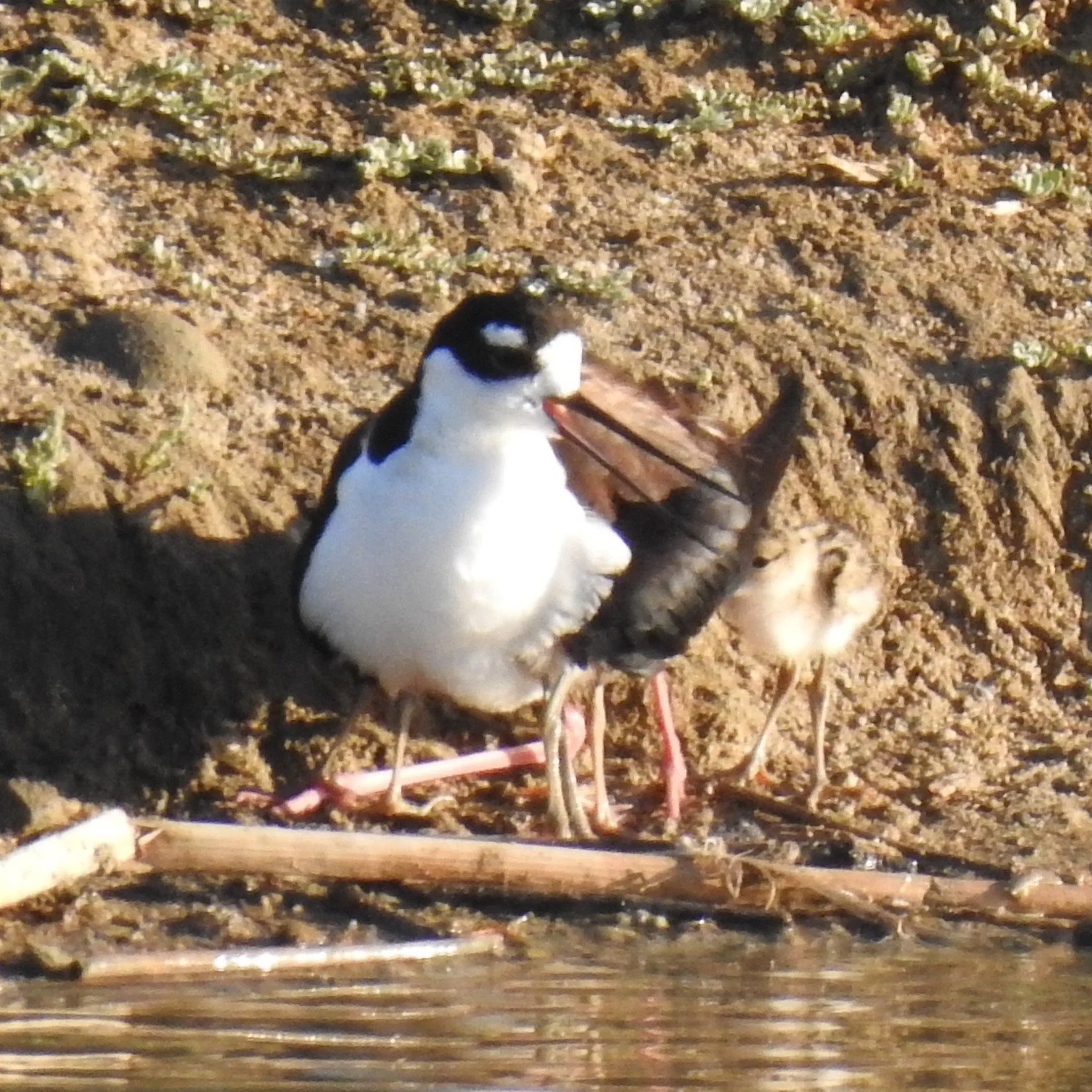
Adult Black-necked Stilt with chicks © Mary Forrestal
Black-necked Stilts usually build one nest per year that is near water on bare open ground with little vegetation. In contrast, most other shorebird species work very hard to conceal their nests. Black-necked Stilt nests are usually located on a slightly elevated surface or mound that’s above the level of the surrounding water. Both parents scrape the ground to make a depression and then line the nest with materials that are close to the nest site; such as pebbles, grasses and other vegetation, shells, mud chips, feathers, and bones. When the surrounding water level rises, parents may add additional objects under the nest lining to raise the nest. The female lays 4 eggs on average. The parents share the duties during a month-long incubation which can entail behaviors necessary for cooling and sheltering rather than for warming. In hot climates, parents take turns to repeatedly soak their belly feathers and return to the nest several times per day to keep their eggs or chicks cool. After hatching, both parents help feed the young. Two hours after hatching, the young are able to walk, swim, and feed themselves but return to the nest for a few days to rest. Frequently, the parents will lead the brood to an area that has both shallow water and increased vegetation for cover. Young birds start to fly in a little over a month but remain dependent upon their parents for a few more weeks after that. Black-necked Stilts begin to breed at 1–2 years of age.
Black-necked Stilt’ nests are not located close to other pairs in their flock. (In contrast, American Avocets nest fairly close to each other and seek areas with more vegetation.) Even though they are territorial and can be extremely aggressive at times, Black-necked Stilts are considered semi-colonial. This is because they join with other adults in their flock to ward off predators to protect their nests, eggs, and young. Since Black-necked Stilts’ nests are exposed, the parents must work constantly to protect them. If a predator approaches, these calm and graceful birds suddenly become frantic and extremely vocal. Agitated stilts will yap incessantly, dive at predators, and can deliver mortal injuries. Flock members sometimes participate in a "popcorn display,” where a group of birds gather around a ground predator and jump, hop, or flap to drive it away from their nests. Additionally, Black-necked Stilts have tactics to distract or confuse predators. They sometimes fake having a broken wing, similar to Killdeer, to lure away the danger. They may also pretend to be incubating, then fly off to another site and repeat the deception.
What do Black-necked Stilts eat?
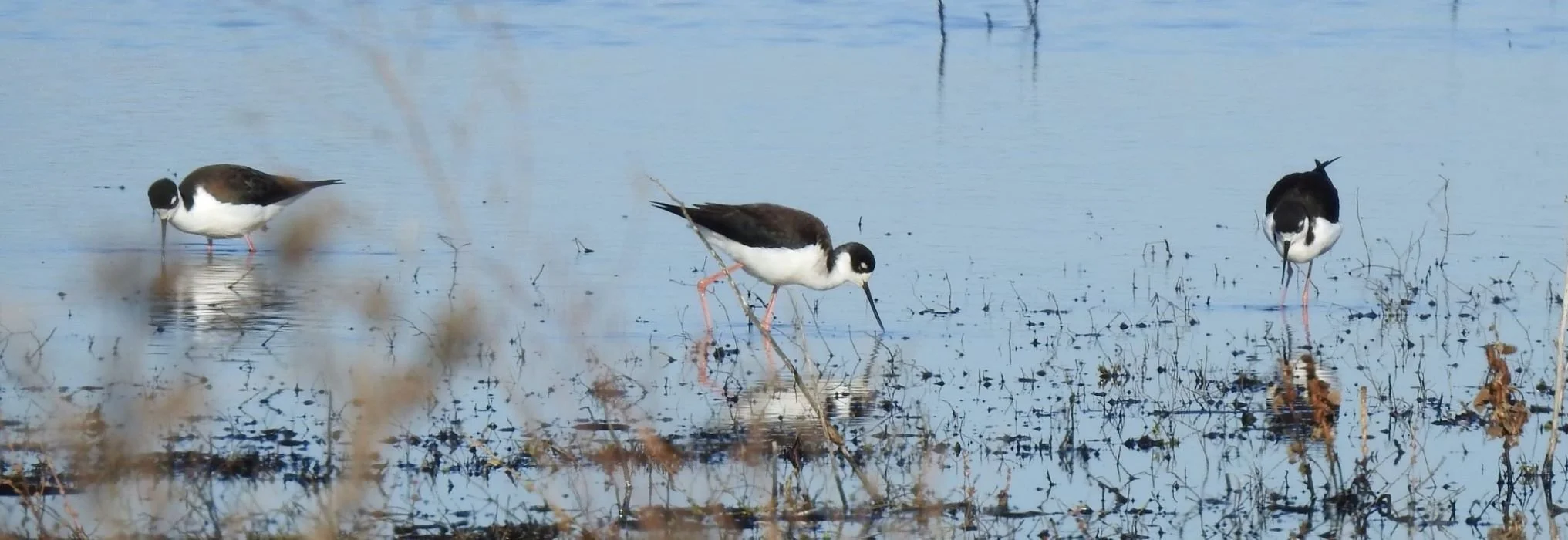
Adult Black-necked Stilts foraging © Mary Forrestal
Black-necked Stilts move and probe for food in mud or shallow water. They spend much of their daytime hours doing this. The diet of Black-necked Stilts is dependent on the location where they are foraging. When hunting, they walk slowly and tilt their bodies forward in search of aquatic prey such as flies, worms, shrimp, crayfish, snails, tiny fish, larval mosquitoes, dragonflies, crickets, grasshoppers, many kinds of beetles (including aquatic species of weevils), aquatic bugs, brine shrimp, mollusks, tadpoles, and very small frogs. Black-necked Stilts have great vision and fast reflexes and can capture their prey using a quick peck, sometimes with their heads partly and briefly submerged. They have been observed chasing small fish into very shallow areas where fish become trapped and easier to catch. Seeds and vegetation are a very small part of their diet. When visibility is poor, Black-necked Stilts resort to tactile hunting for food. They do so by swinging their necks and bills from side to side to skim invertebrates from the water’s surface or just below the surface. Their bills are very sensitive so they can actually feel for prey.
What do Black-necked Stilts sound like?
Black-necked Stilts are often extremely vocal birds. They become quite vocal when predators come near. Especially when nesting, they quickly utter a series of loud and persistent sounds. Black-necked Stilts have a nickname of Pond Poodle because of their persistent yapping call.
Black-necked Stilts’ sounds have been described as chirps, chips, screams, yaps, yips, or grating. Their often repeated calls are sharp, high-pitched, and often explosive and sound like: kip-kip-kip-kip, yip-yip-yip-yip, kik-kik-kik, kek-kek-kek, or keef-keef-keef-keef. Their contact calls between flocks or when parents tend to their young are similar but quieter. Their flight call has been described as kek-kek-kek-kek. Black-necked Stilt calls are lower in pitch than that of American Avocet. You can listen to the calls of Black-necked Stilts below.
This article was compiled by Jane Van Kessel.
Sources include Cornell’s All About Birds; Cornell’s Birds of the World; National Audubon Society’s Online Field Guide; 150 Frequently Seen Birds of California’s Great Valley, pages 78-9; Wikipedia; National Geographic Field Guide to the Birds of the United States and Canada West, 2nd Edition, pages 102-3; The Sibley Field Guide to Birds of Western North America (Sibley Birds West) by David Allen Sibley, page 127; Kaufman Field Guide to Birds of North America by Kenn Kaufman, page 172; The Stokes Field Guide to the Birds of North America by Donald & Lillian Stokes, 2010, page 224; Peterson Field Guide to Birds of Western North America by Roger Tory Peterson, Fifth Edition, pages 112-13.