local bird

Meet the Red-shouldered Hawk

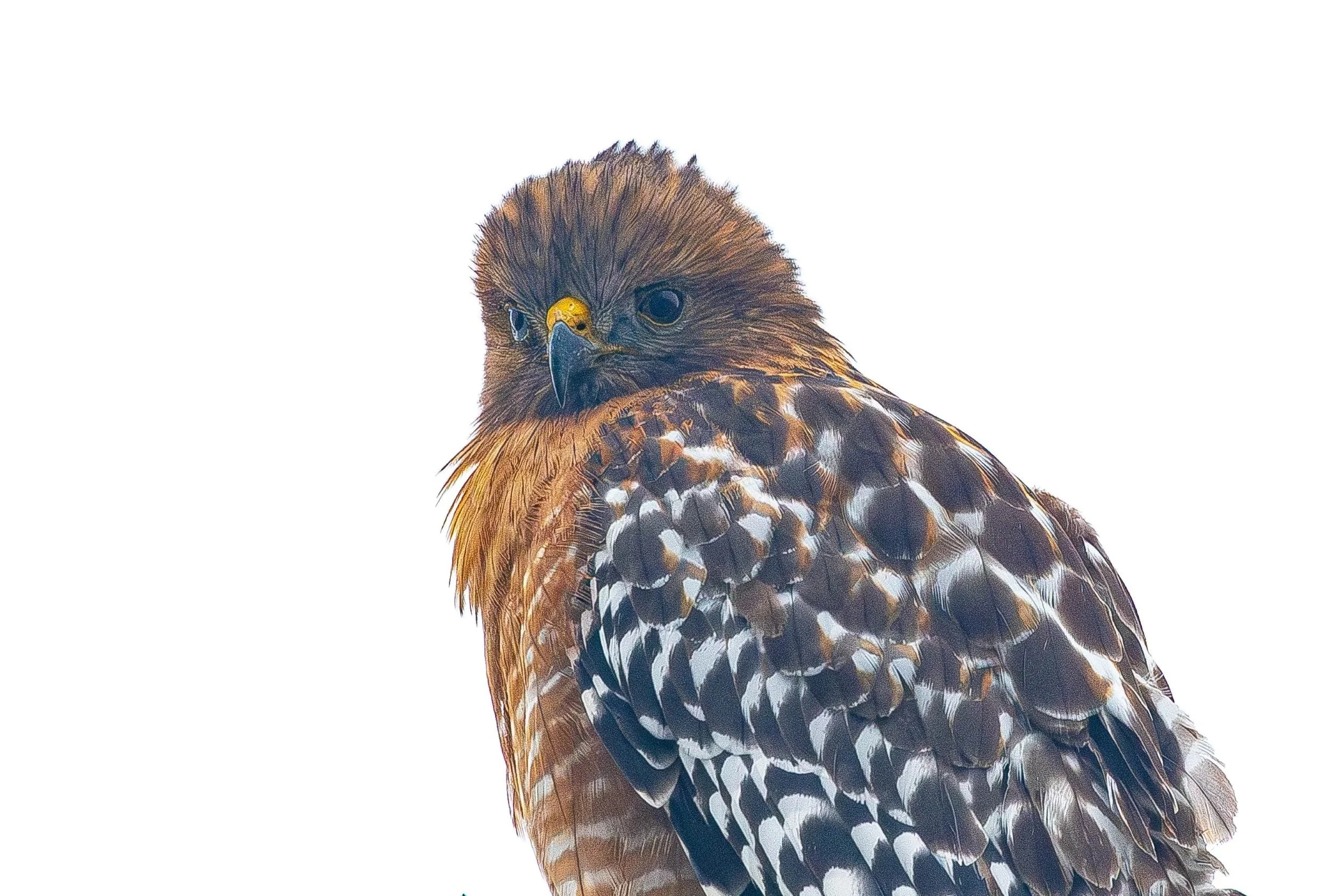
Red-shouldered Hawk © Larry Hickey

This month, let’s learn about a magnificent raptor in the Buteo genus called the Red-shouldered Hawk (Buteo lineatus). Red-shouldered Hawks are found only in North America and inhabit several states in the U.S.; a small area in south-eastern Canada; and in Mexico, where the Canadian and the northern-most populations in the U.S. spend their winters. Most Red-shouldered Hawks are permanent residents of the areas they inhabit. Migration is necessary for far-northern populations since less food is available in colder months and hunting becomes difficult due to snow and freezing temperatures. Here in the Sacramento Valley, Red-shouldered Hawks are year-round residents and are fairly common.  

What do Red-shouldered Hawks look like? 
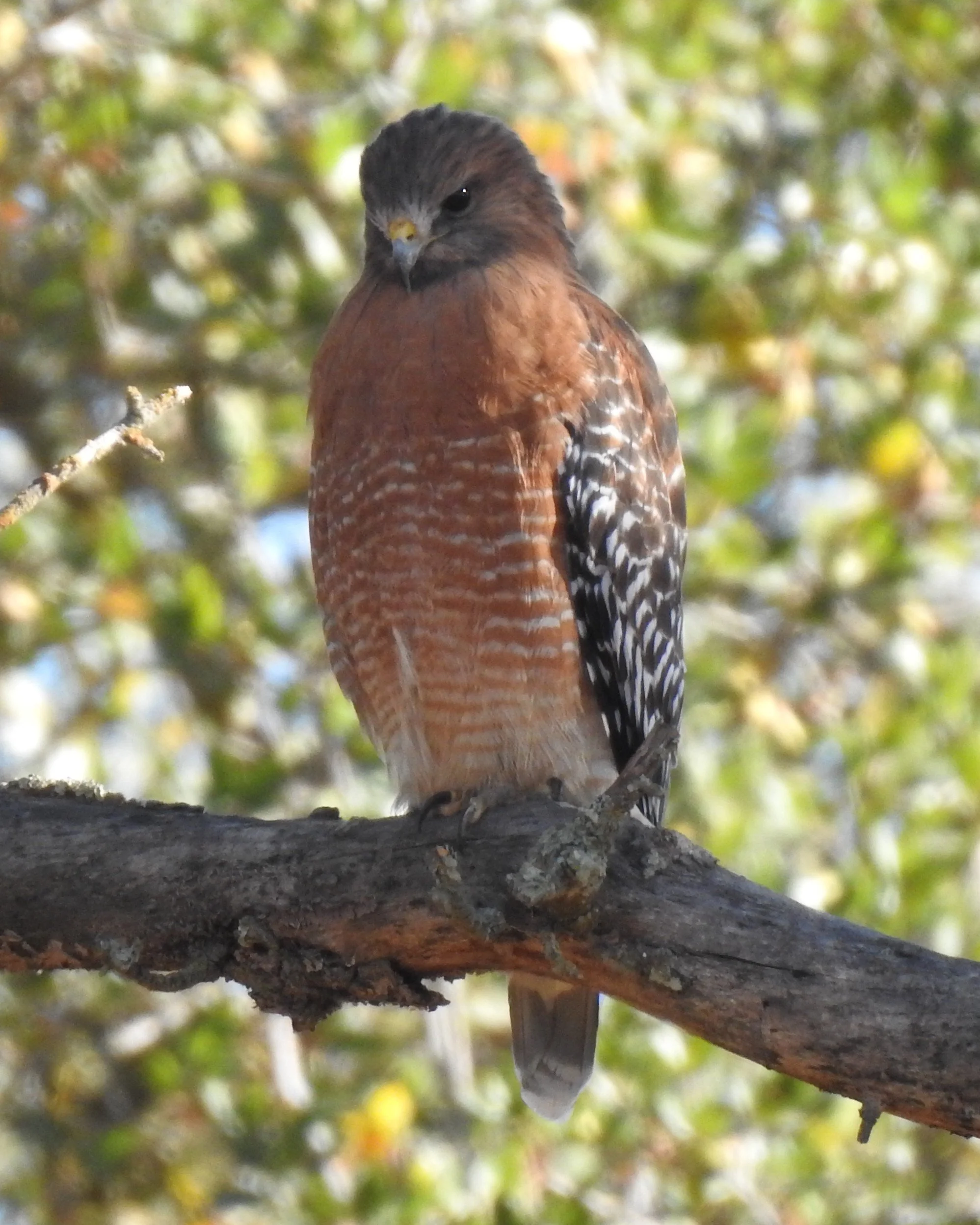
Red-shouldered Hawk © Mary Forrestal

Red-shouldered Hawks are slightly smaller than most of the other North American Buteo species. Male and female birds look similar but females are larger and heavier.  

Five subspecies of Red-shouldered Hawks have been identified. The subspecies differ in size, darkness of chest barring, and/or head color. Birds of northeastern populations are often larger than those in the west and south, and birds found in Florida have paler plumage. The single western subspecies range ends west of the Sierra Nevada and is, therefore, separated from the other four eastern subspecies by 1,000 miles or more. 

Red-shouldered Hawks have a dramatic feather pattern and coloration (plumage) which makes them quite eye-catching. Their wings have a striking black-and-white checkerboard pattern. Here in California, where the elegans subspecies is seen, Red-shouldered Hawks often have brown or reddish-brown heads; brown backs with white mottling; dark rufous (cinnamon) shoulders that are visible when perched; solid orange-rufous chests; broad, rounded, fingered wings having orange-rufous underwing linings that are visible in flight; reddish-brown horizontal stripes on their bellies; and yellow legs. The pattern of their tail feathers has alternating wide black bands with narrow white bands. There are several alternating black and white bands on their flight feathers as well. Some sources describe Red-shouldered Hawks’ tails to be longer than the tails of most other Buteos. Juveniles in the west resemble adult birds, but their chests lack the solid rufous color that adults have. Their chests are white and rufous-brown; streakier; spottier; and more heavily barred than adult birds.  
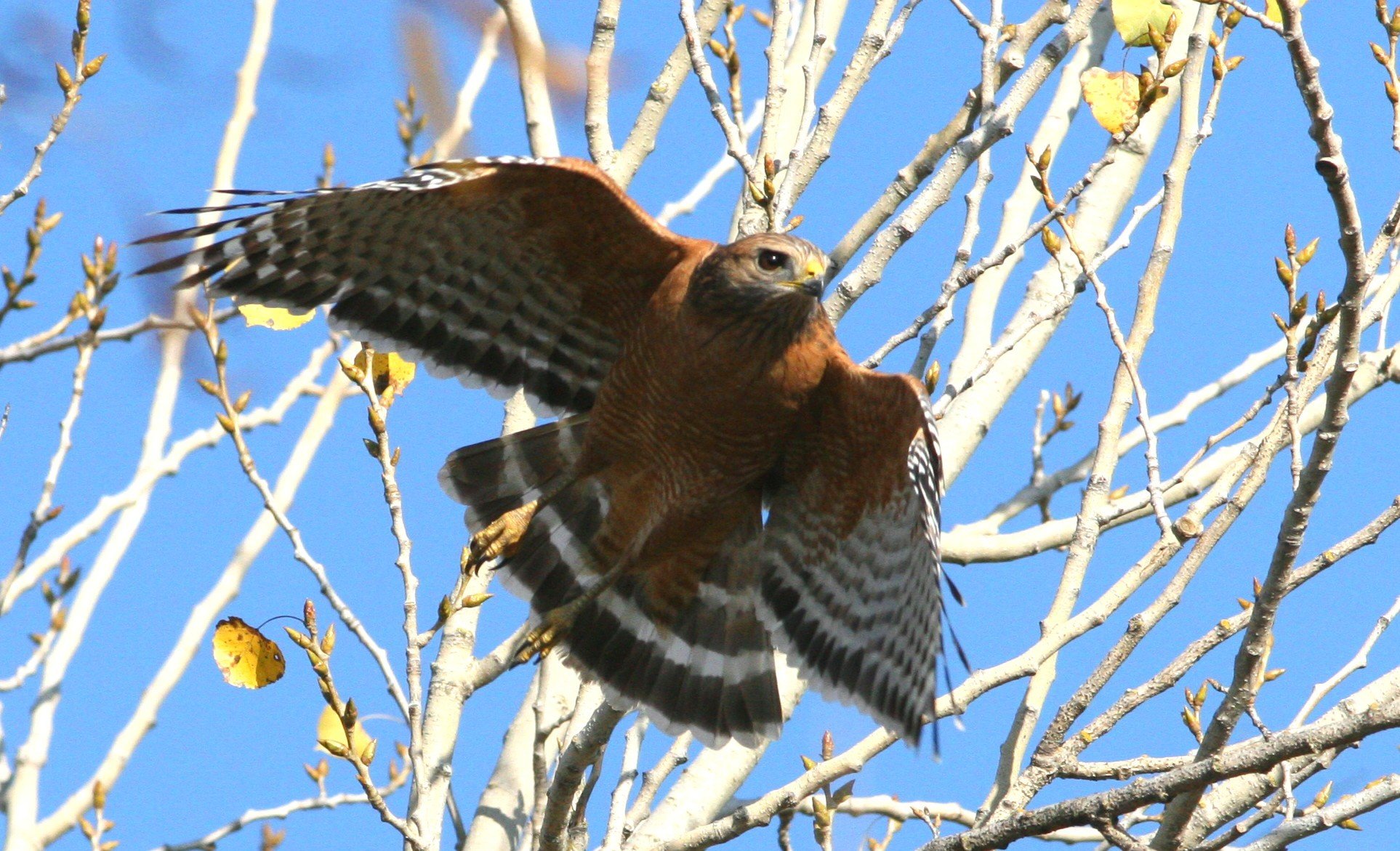
Red-shouldered Hawk © Craig Swolgaard

In flight, a key ID point to look for are the white translucent, crescent-shaped (or square-shaped) patches, often called “windows”, that are present on the outer part of Red-shouldered Hawks’ wings. Seeing these patches often helps to identify the species and can be noticed even when a hawk is flying in the distance. It is often useful to look at the flight pattern of raptors to identify them. Red-shouldered Hawks use a few different flight patterns. They may fly directly to a close spot; or fly for longer durations using a repeated pattern of quick flaps changing to a glide; or soar high with their wings and tails fully spread and their wings slightly positioned forward. Males can be seen performing a courtship “sky-dance” which is described as a sudden dive from a high point followed by spirals and then rapid ascent. While calling loudly during flight, courting pairs will soar together making broad circles or will dive toward one another. 
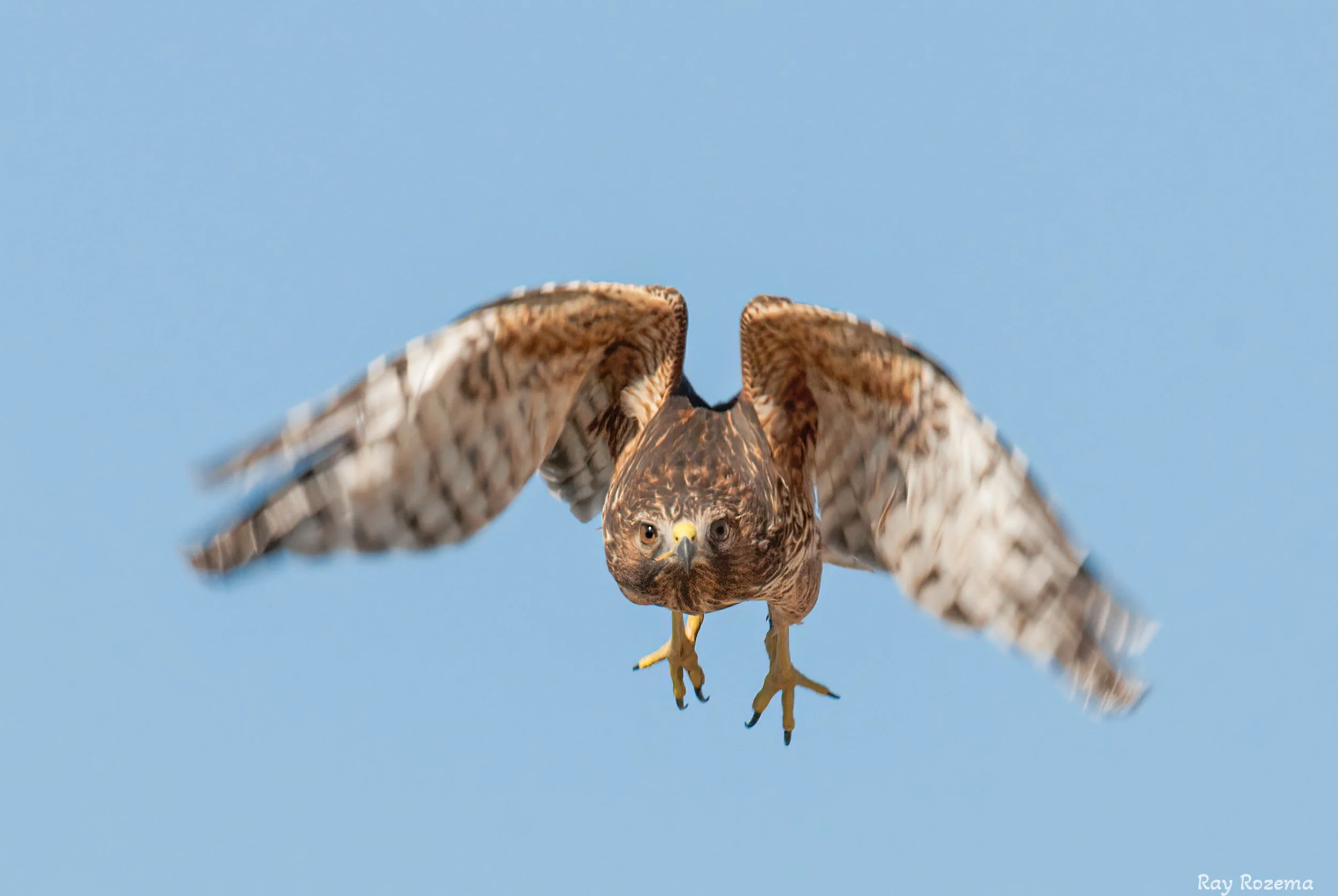
Red-shouldered Hawk in flight © Ray Rozema

Where do Red-shouldered Hawks live and nest? 

Red-shouldered Hawks are found in a variety of habitats. They are seen in forests with clearings, oak woodlands, eucalyptus groves, lightly wooded foothills, near rivers, streams, creeks, other waterways, agricultural lands, and in suburbs and city parks that have abundant trees.  
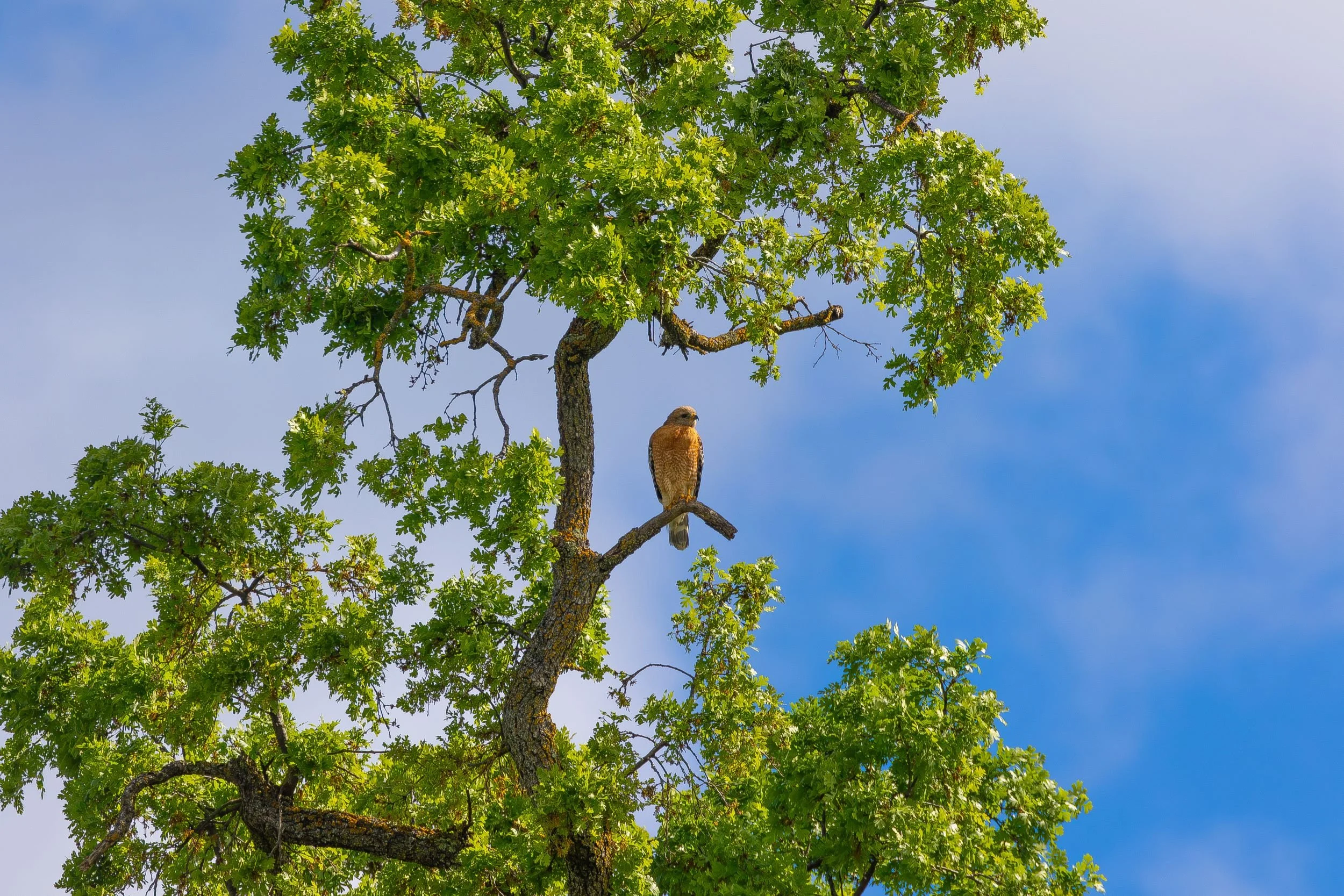
Red-shouldered Hawk © Larry Hickey

Pairs bond together for life. They are both extremely territorial and protective of their chosen territory.
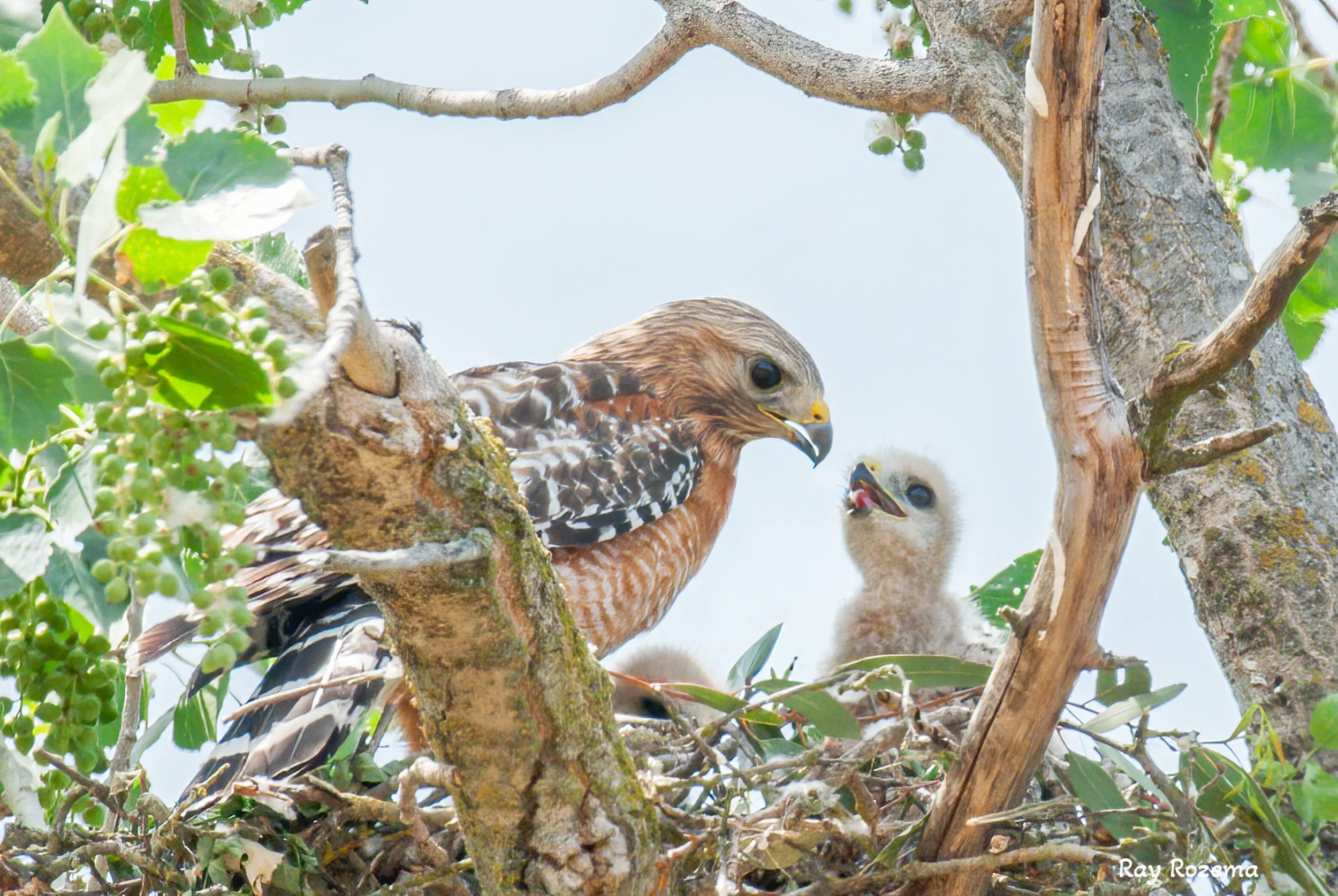
Red-shouldered Hawks, adult with nestling © Ray Rozema

Both male and female Red-shouldered Hawks participate in nest construction. In late winter or early spring, pairs often refurbish the same platform-style nest from year to year. Nests are 20-65 feet above the ground and often located in broad-leafed trees near the trunk and below the canopy. Occasionally, Red-shouldered Hawks will nest in conifers. Nest locations are usually near a body of water but they are also seen in trees in suburban neighborhoods or parks. Nests are about two feet in diameter and are constructed from sticks and lined with lichen, moss, shredded bark, and conifer sprigs. A pair has one clutch per year and the female usually lays 3-4 eggs. While it’s mainly the female that incubates the eggs for approximately 1 month, the male brings food to the female. Eggs hatch on sequential days, with the first chick hatching up to a week before the last. For several weeks after the eggs hatch, the female remains on the nest with the nestlings. The male continues to bring food to the nest. The young birds leave the nest at around 6 weeks old. However, the parents continue to feed them for another 8-10 weeks. The young birds become independent when they are 4 months old, but they still may roost close to the nest at night. 

What do Red-shouldered Hawks eat? 
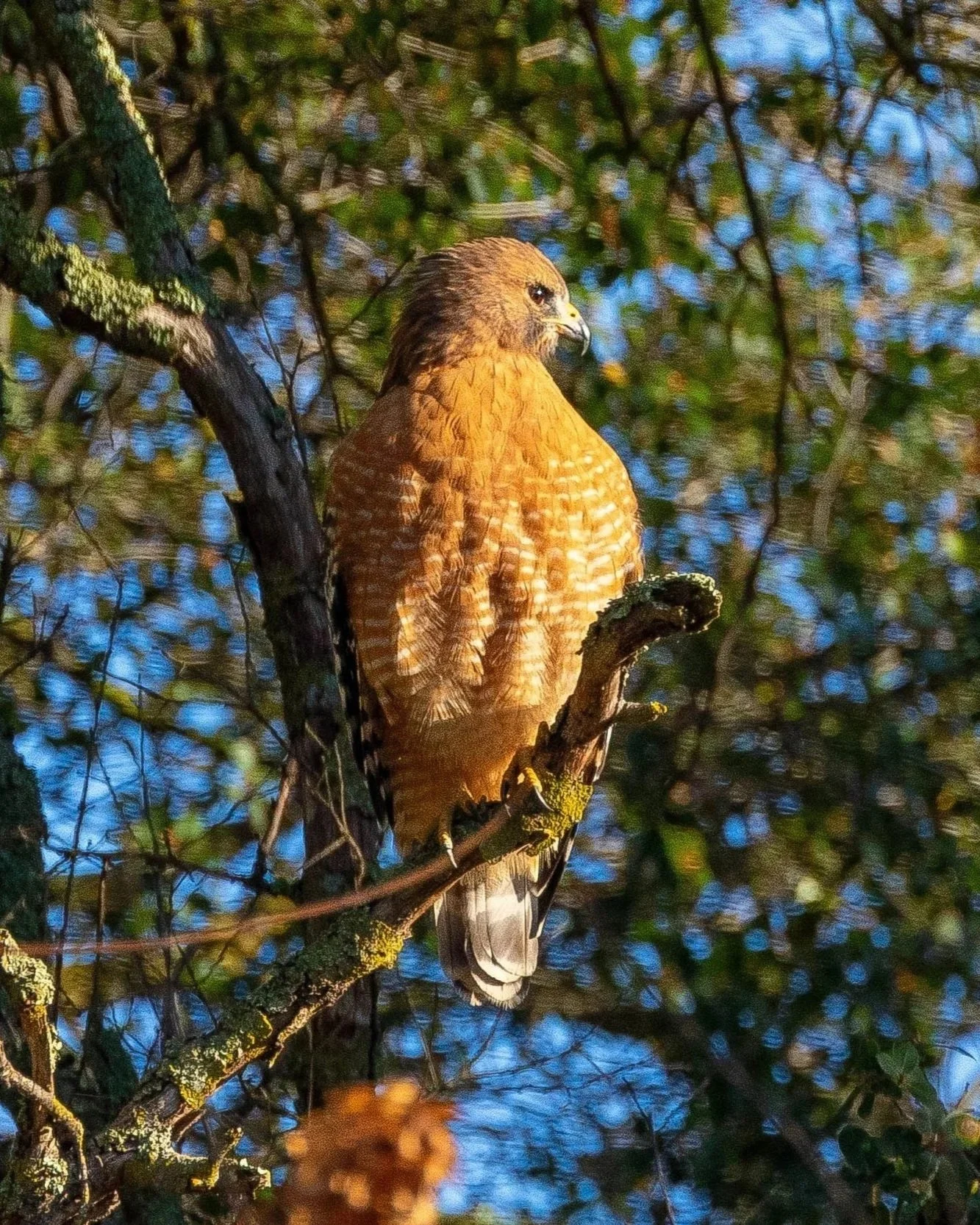
Red-shouldered Hawk © Larry Hickey

Red-shouldered Hawks are superb hunters due to their powerful talons and great vision. Their diet is dependent on the region where they live and the food that is available. Their broad wings allow them to soar looking for prey for long periods of time without tiring. Red-shouldered Hawks hunt while perched in a tree (often at mid-level) or while perched away from trees in a clearing, perhaps on a utility wire or post. They sit silently, patiently, and still until they see prey appear below. Then they descend swiftly, gliding and snatching an animal off the ground. They also look for prey while flying low and will surprise prey by directly landing on top of them. 

Small mammals, such as mice, voles, and chipmunks are typically the most common prey of Red-shouldered Hawks. Red-shouldered Hawks are an important part of our ecosystem because they keep rodent populations in check benefiting agricultural, natural, and residential areas alike. They will occasionally eat larger mammals, such as opossum, rabbits, or squirrels and help normalize these populations too. In addition, Red-shouldered Hawks eat snakes, lizards, frogs, crayfish, large insects, and earthworms. Occasionally, they will eat birds or fish. 

What do Red-shouldered Hawks sound like? 
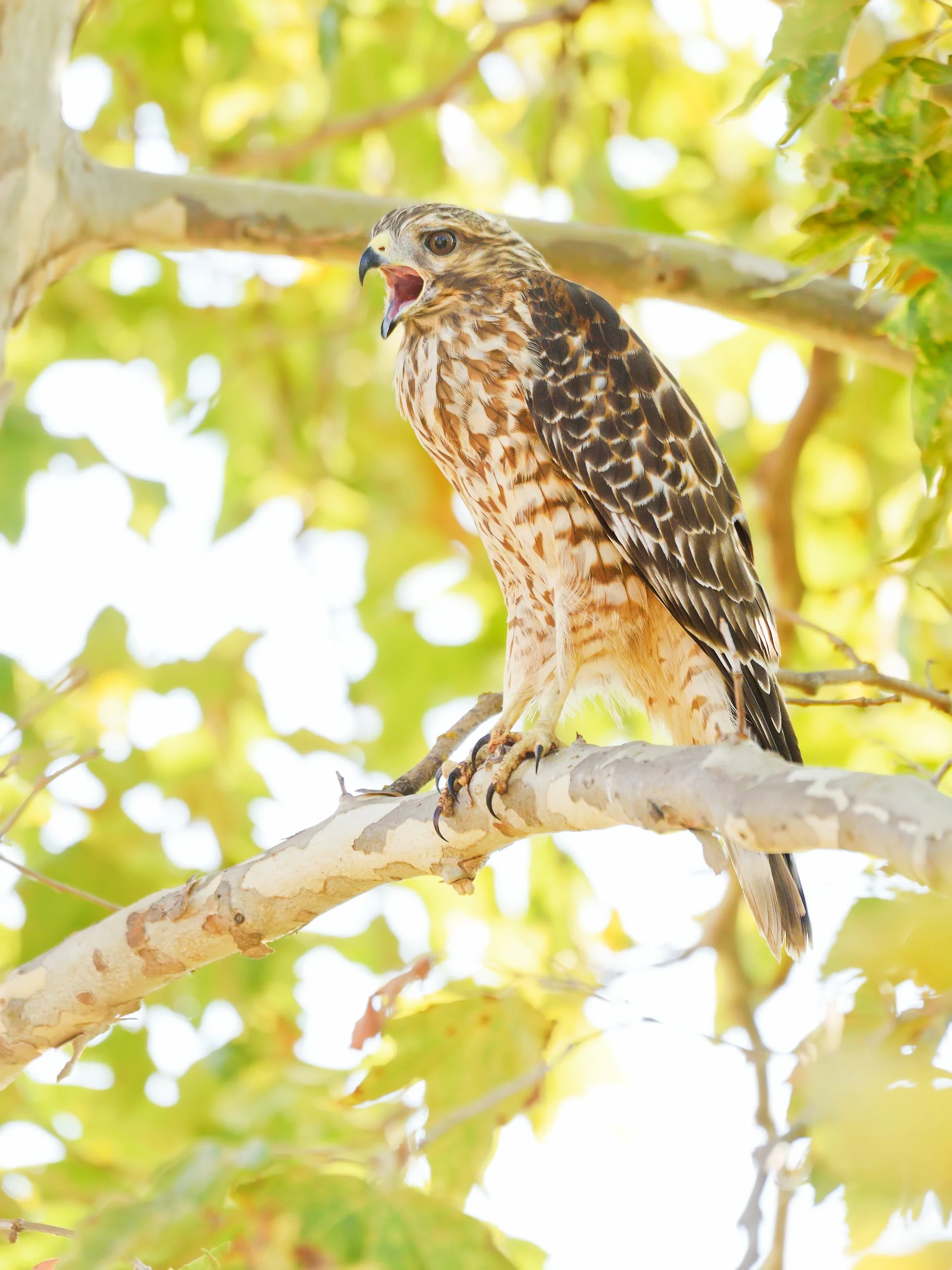
Red-shouldered Hawk © Daniel Lee Brown

Red-tailed Hawks are often heard calling before they are seen. Their call typically is a two-syllable scream. Female vocalizations are noticeably lower pitched than those of males. 

Red-shouldered Hawk calls have been described as falling, squealing, mournful, distinctive, deliberate, simple, sharp, chattering, and shrill. Their calls usually have downward inflection or pitch and are often repeated over and over. They have been described as sounding like: kee yah; kee yuur; kee yar; kee-aahh; or kee yeeear. Calls are heard most often in the spring and summer, often made by birds in flight. The common call kee aah is used to announce that a particuliar area is occupied or to sound an alarm. 

You can listen to the calls of the Red-shouldered Hawk below: 

Red-shouldered Hawk (Buteo lineatus)
Ed Pandolfino
Red-shouldered Hawk (Buteo lineatus)
Dan Kopp
Red-shouldered Hawk (Buteo lineatus elegans)
Jonas Katona
Red-shouldered Hawk (Buteo lineatus)
Lance A. M. Benner

This article was compiled by Jane Van Kessel.

Sources include Animal Diversity Web, University of Michigan; Cornell’s All About Birds; Cornell’s Birds of the World; National Audubon Society’s Online Field Guide; 150 Frequently Seen Birds of California’s Great Valley, pages 140-1; Wikipedia; National Geographic Field Guide to the Birds of the United States and Canada West, 2nd Edition, pages 224-5; The Sibley Field Guide to Birds of Western North America (Sibley Birds West) by David Allen Sibley, page 102; Kaufman Field Guide to Birds of North America by Kenn Kaufman, pages 112-13; The Stokes Field Guide to the Birds of North America by Donald & Lillian Stokes, 2010, pages 164-5; Peterson Field Guide to Birds of Western North America by Roger Tory Peterson, Fifth Edition, pages 188-9.
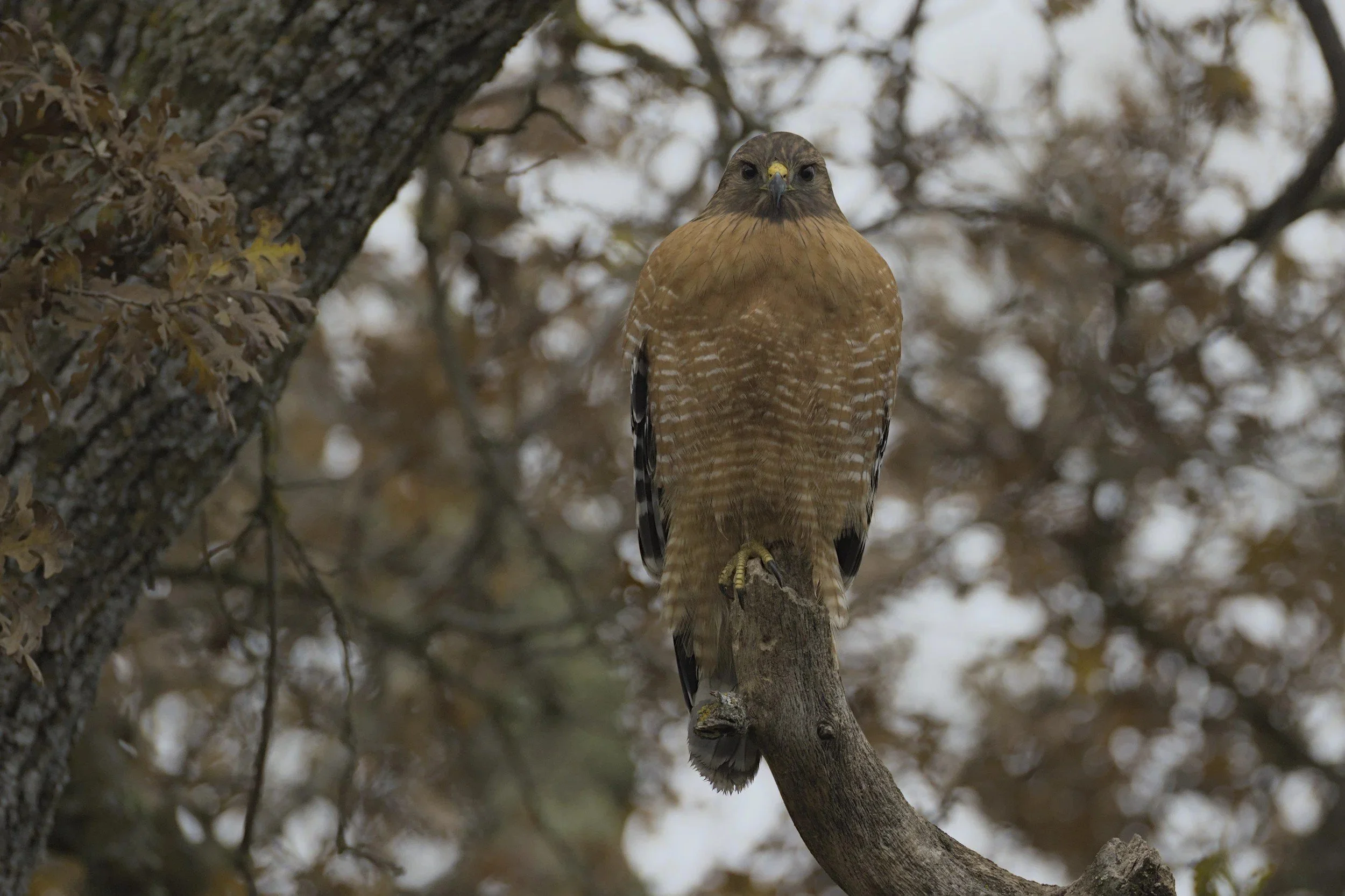
Red-shouldered Hawk © Timothy Jackson
Meet the American Kestrel

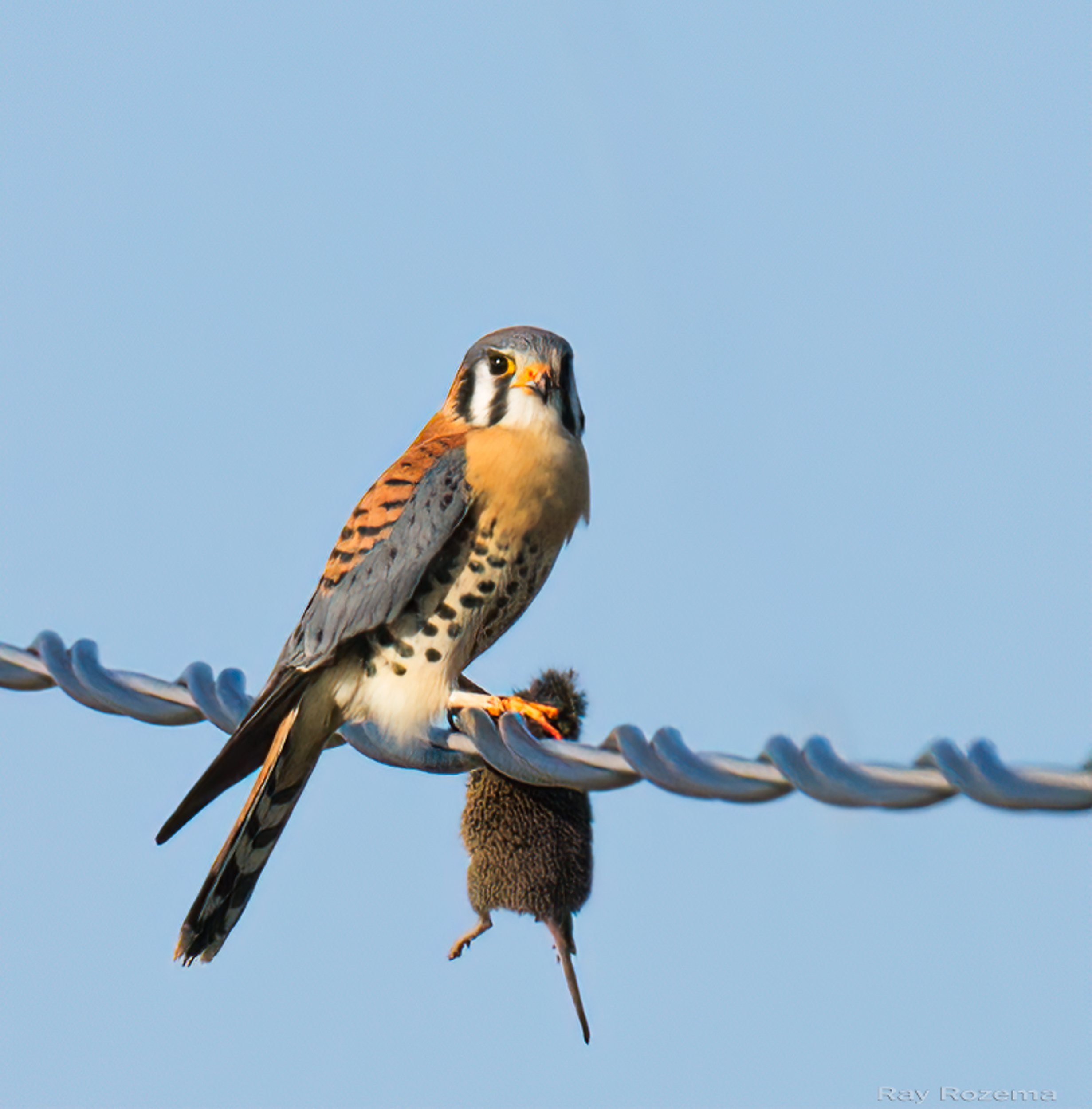
American Kestrel, male © Ray Rozema

This month, let’s learn about a colorful and common falcon in North America called the American Kestrel (Falco sparverius). American Kestrels are small raptors. However, even with their small size, they can be quite bold. They will attack Golden Eagles if necessary to defend their territory.

American Kestrels are widespread throughout the Americas from the boreal forests in Canada and Alaska to the southern tip of Argentina. Breeding populations in the north migrate for long distances in both spring and fall; whereas those that nest in southern regions usually do not migrate. In the fall, birds nesting in northern regions migrate to the southern United States, Mexico, Central America, or the Caribbean and then return to the north in the spring to breed once again. Migrating birds usually migrate alone.

In the past, American Kestrels were called “Sparrow Hawks” by some. The name is inaccurate for two reasons. First, American Kestrels are true falcons, not hawks. Second, sparrows and other small birds are seldom part of their diet.

The American Kestrel population has been declining across North America for many years. Their current number is about half of what it was in 1960. The primary reason for the decline is thought to be a lack of nest sites due to habitat change and conflicts (or nest site competition) with other species. One invasive species, the European Starling, has had a very negative impact. Another theory looks at increased use of insecticides, which dramatically decreases the amount of available prey. More significantly ingesting pesticides can also harm and even kill the kestrels.

What do American Kestrels look like?

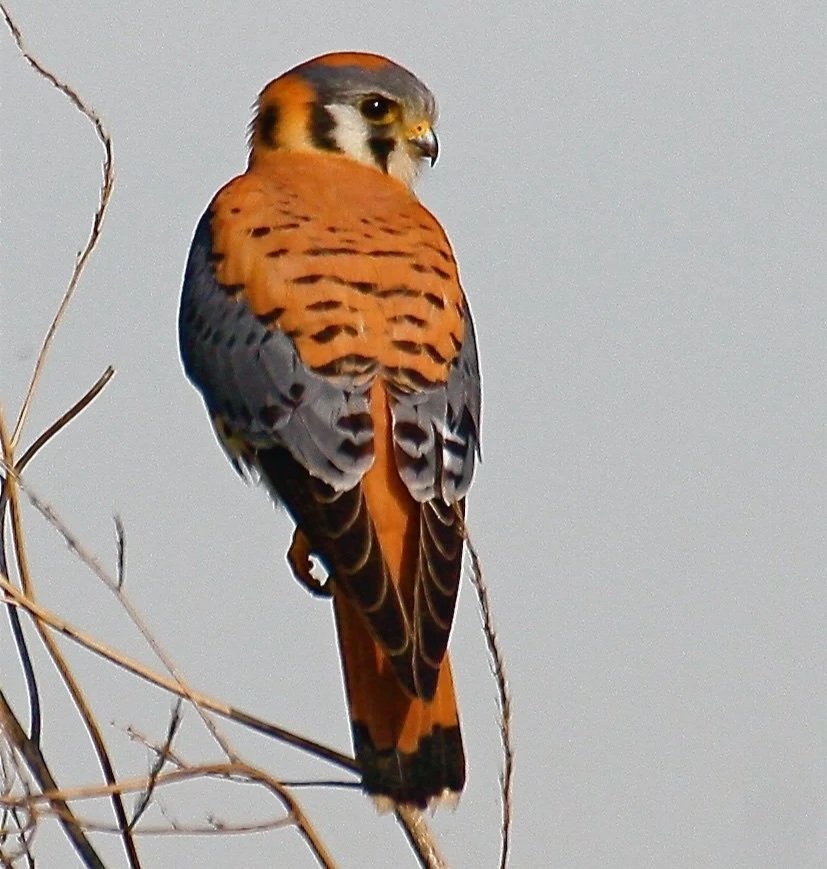
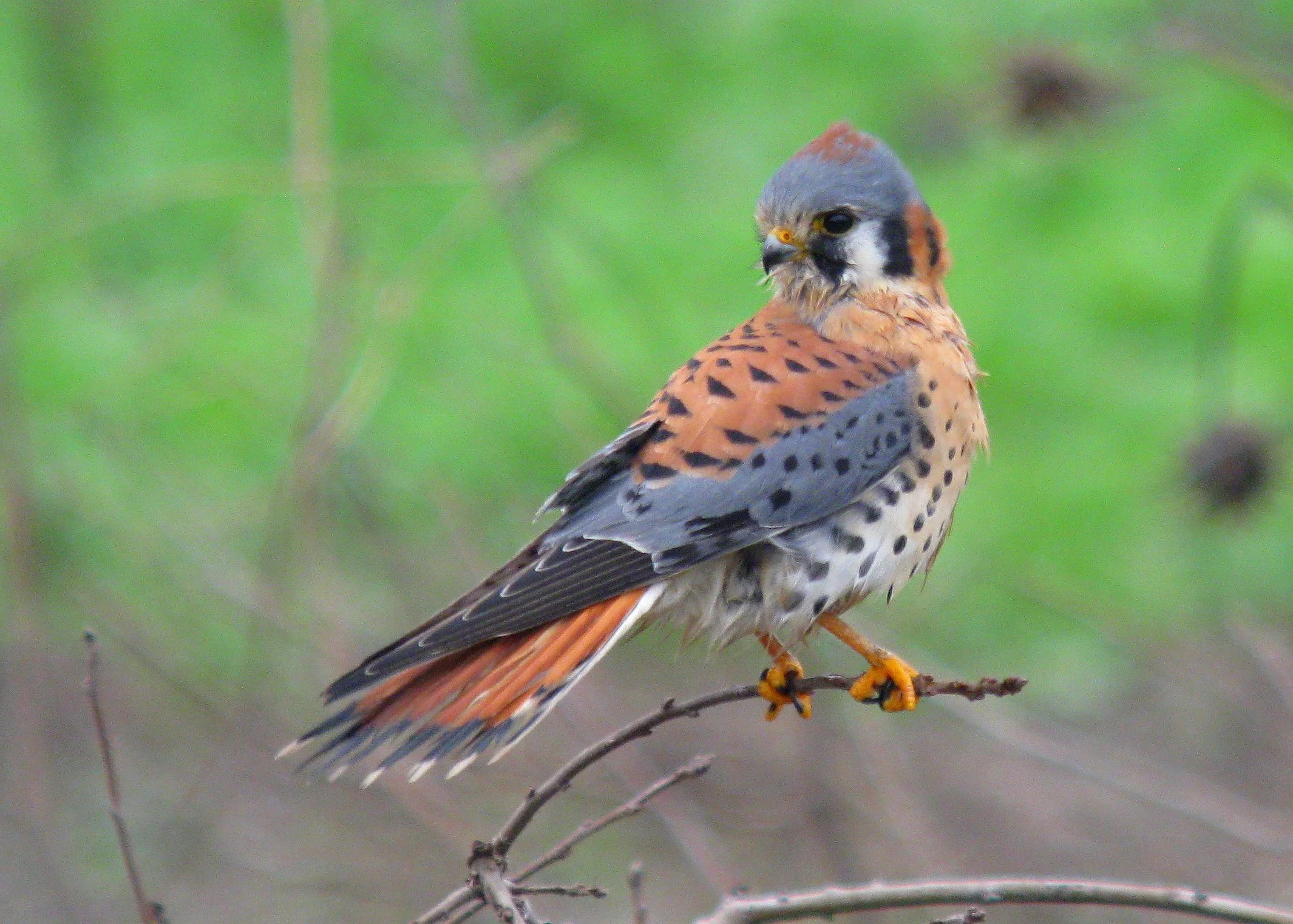
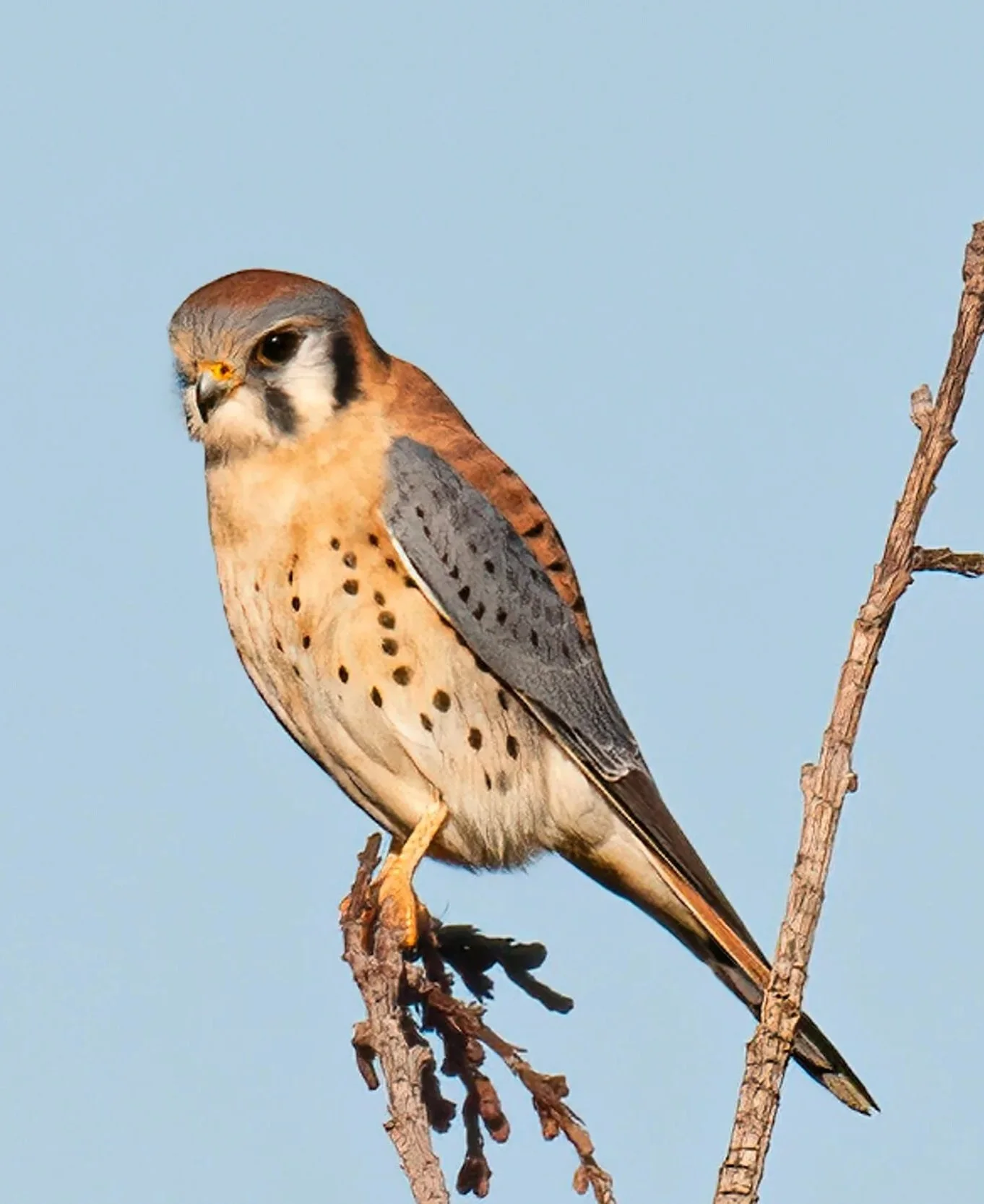
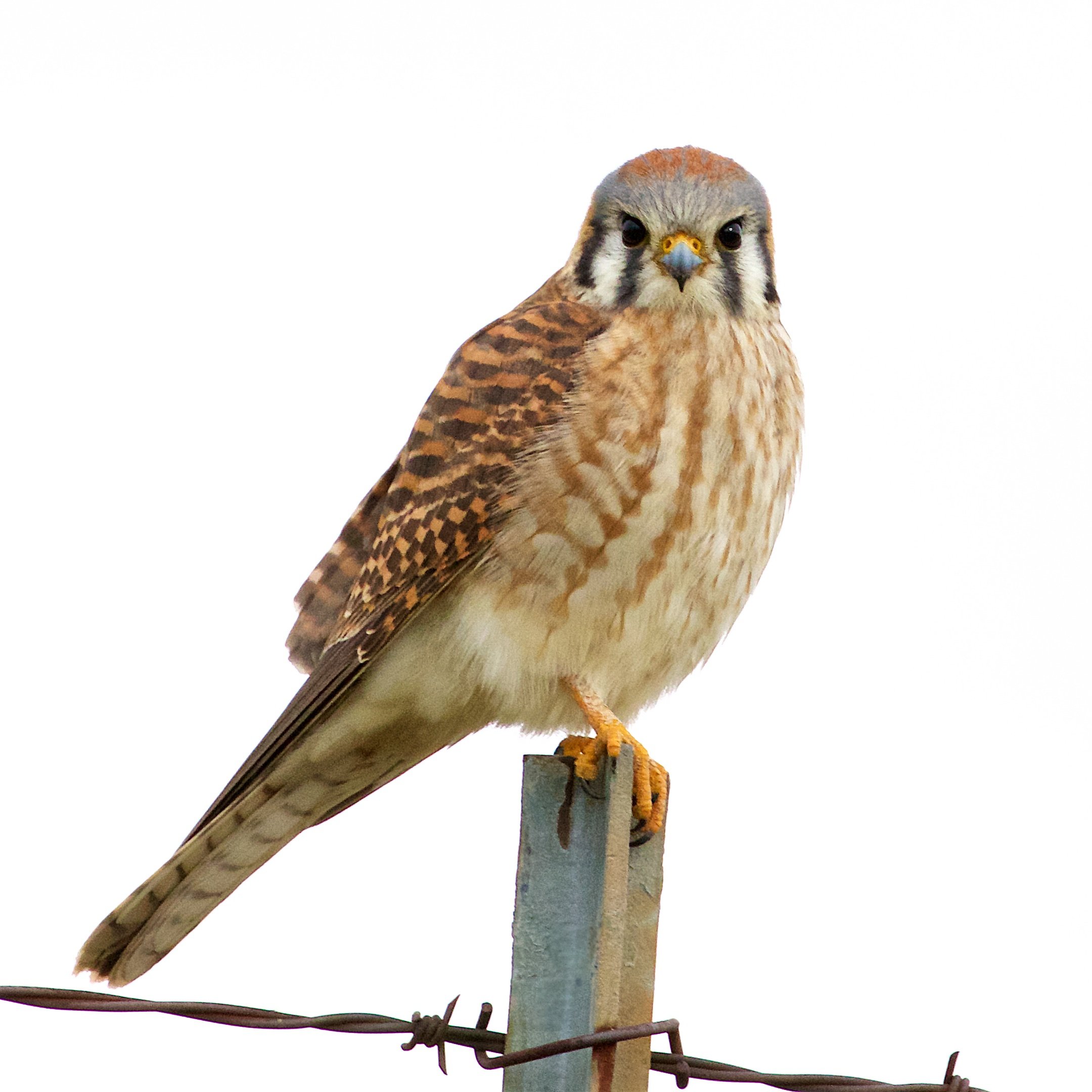
American Kestrels are about the same size as a Mourning Dove or an American Crow. They are leaner and less muscular than the other falcons seen in the Sacramento Valley. American Kestrels have long tails with squared tips; narrow, pointed, and strongly tapered (or sickle-shaped) wings; and have rusty or rufous caps or head patches. The underside of their wings are white or cream with thin dark barring. While most other area falcons have a single vertical dark cheek stripe, American Kestrels have two stripes on their white cheeks. In addition, they have two large dark spots (or bars) on the back of their necks called ocelli. Researchers think these spots may act as “false eyes” and can actually deter predators. A predator may think a kestrel is facing them when actually it is in a more vulnerable position facing away.

American Kestrel, female © Ed Harper

American Kestrel, male © Ed Harper

American Kestrels are unique because, unlike most raptors, the plumage of the male and female is noticeably different. This plumage difference is called sexual dimorphism.

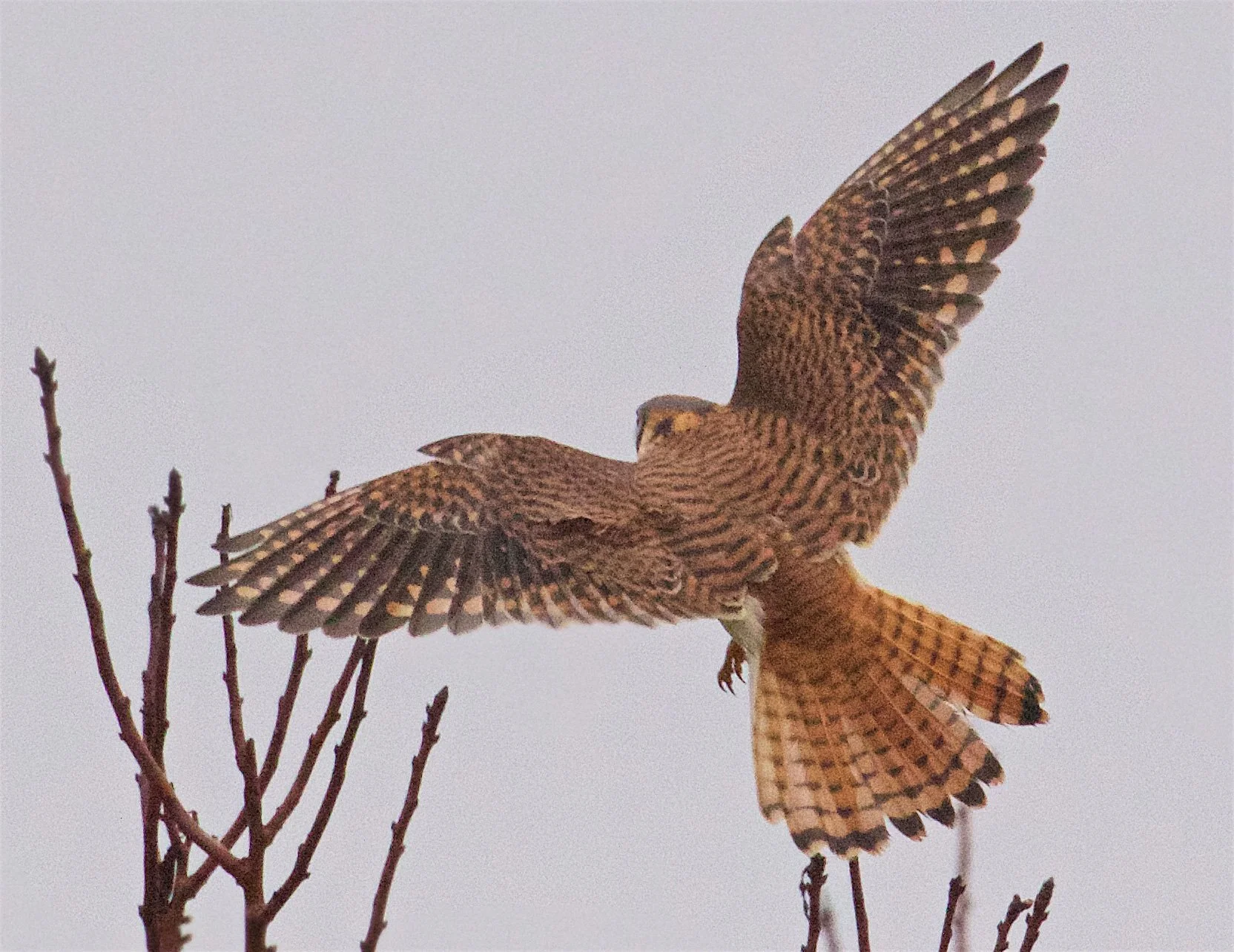
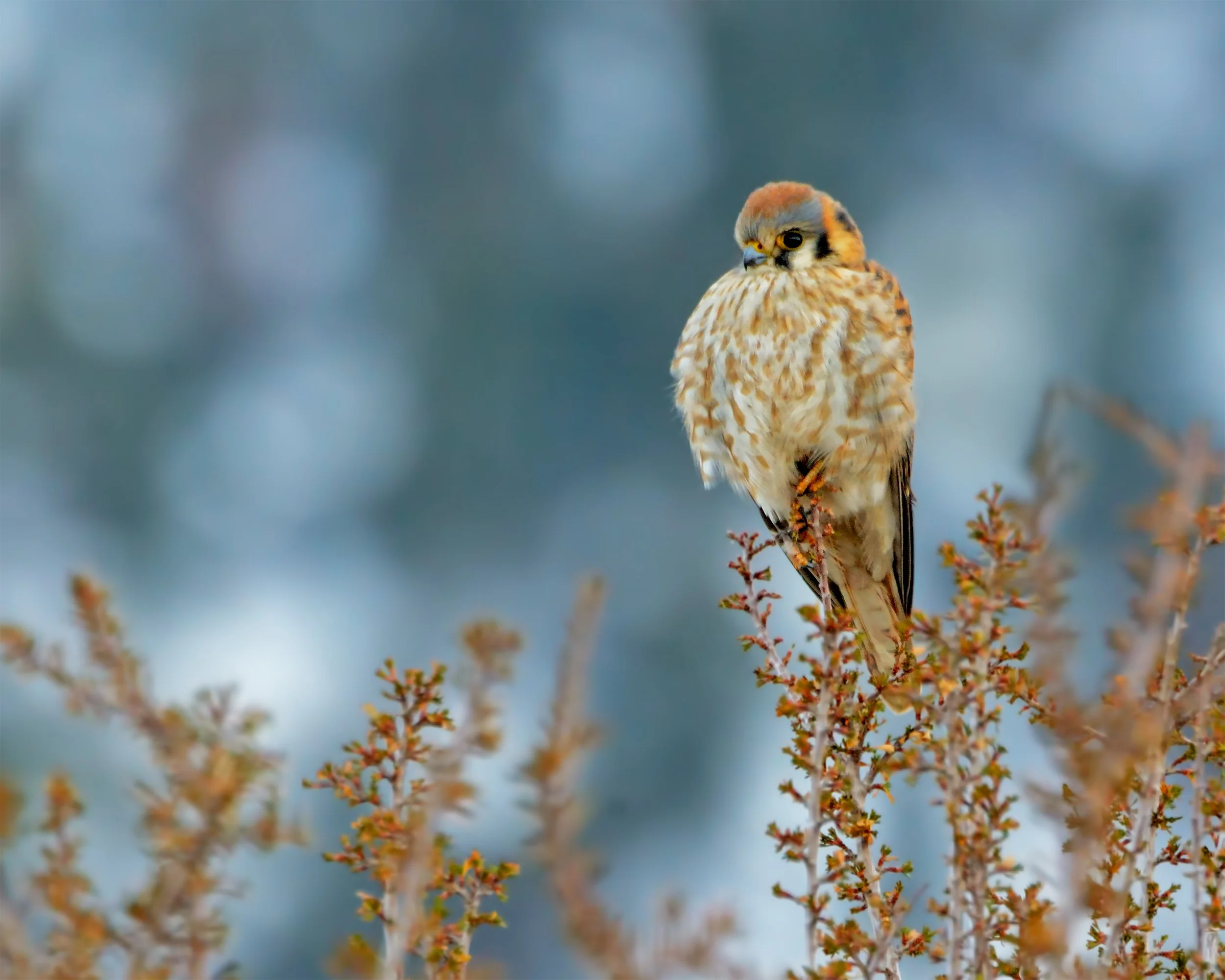
American Kestrel females have rusty-brown backs, wings, and tails which are completely barred or striped. They often have heavy brown streaking on their chests and abdomens too. The heads of females are gray or bluish-gray and they usually have a duller (or blended) rufous crown patch.

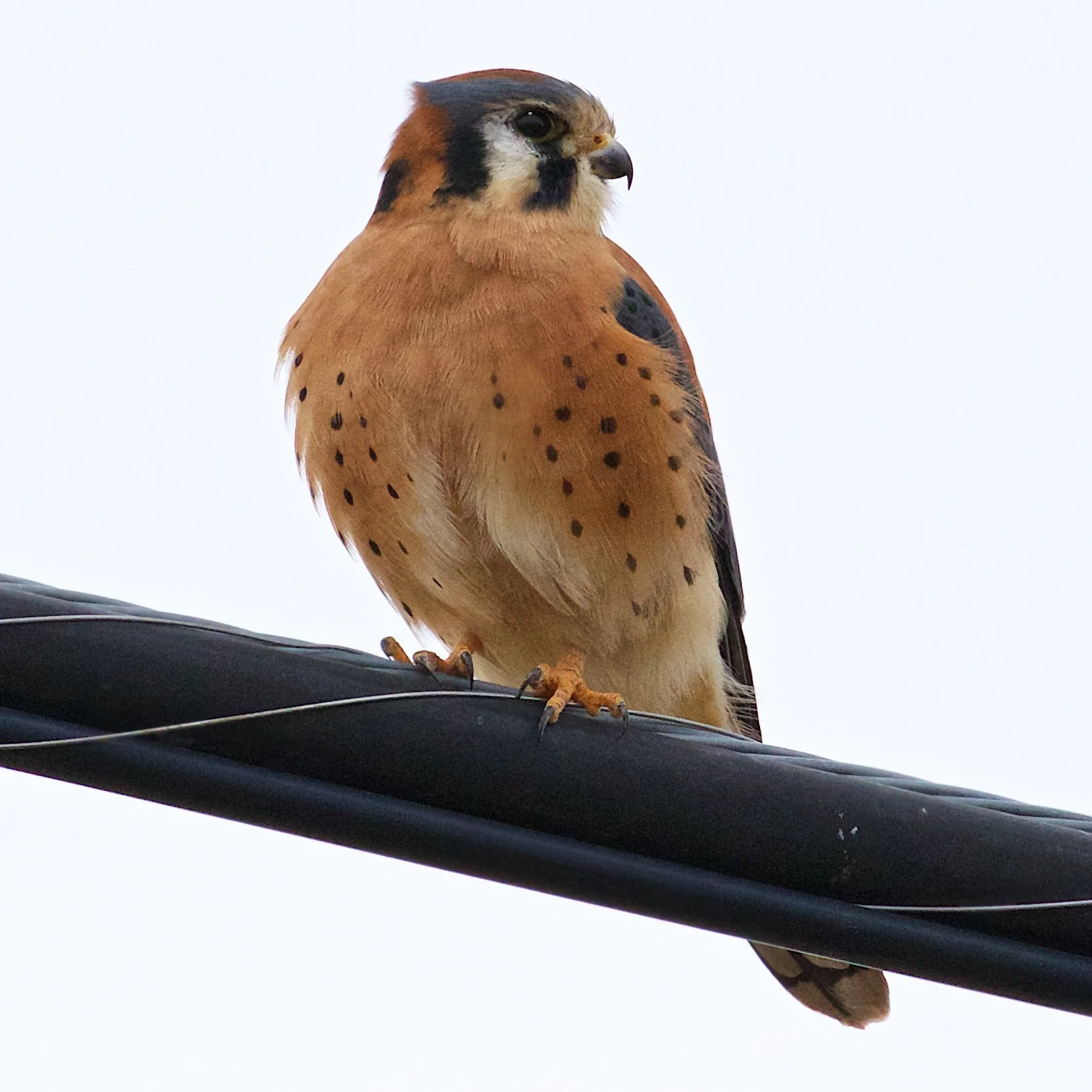
American Kestrel males are slightly smaller than females but are more colorful. They have deep slate-blue heads and upper wings which contrast beautifully with their deep rufous-red backs and tails. Males lack the barring on their backs and tails that females have. They also have a wide black band at the tip of their tails, which isn’t present on females. Males have scattered black spots, instead of streaks, on their backs, wings, flanks, and abdomens. The underside of males is more colorful than females and is quite variable from light to dark orange along with buff lower down. However, it’s easiest to distinguish between female and male American Kestrels by simply comparing their wings and tails.

American Kestrel, female © Ed Harper

American Kestrel, male © Ed Harper

Juvenile American Kestrels are similar in appearance to adults of the same sex. Although it can take up to two years for juveniles to exhibit complete adult plumage, the sex of a bird can often be identified early on, even before it’s time to fledge.

The flight pattern can also be used to help identify an American Kestrels as it is different from that of other falcons found in California. American Kestrels fly with erratic and fluttery wingbeats compared to the more powerful wingbeats of Peregrine Falcons, Prairie Falcons, and Merlins. In direct flight, American Kestrels hold their wings bent backwards making a “drawn bow” silhouette in the sky.

Where do American Kestrels live and nest?

American Kestrels live in diverse conditions throughout their range. They favor open habitat near fields, desert grasslands, farmland dotted with trees and snags, meadows or pastures, parklands, woodland edges, deserts, and along suburban or urban roadsides near residential areas. They remain where they can find adequate prey and have access to raised perches used to hunt. Open or semi-open terrain is critical for kestrels to spot their prey. When looking for prey, they are often seen alone and perched on utility lines, fence posts, or in bare tree tops along roadsides where there is low vegetation and few trees. However, during the breeding season they are limited to habitats that offer nest sites.

American Kestrel © Daniel Lee Brown

American Kestrels are cavity nesters but they do not have the ability to create their own cavities. They either need to find an unused cavity or evict the current residents. They generally prefer natural cavities (such as in hollowed trees) that have closed tops and tight-fitting entrances. These features provide good protection for their eggs and young. However, American Kestrels will settle for less desirable places to nest. They adapt to a wide range of nesting situations and will nest in nooks or crevices that are either natural or human-made. Occasionally, they will use abandoned nests in trees and will also nest on cliff ledges, rocks, and on tops of buildings. Nest sites are usually 10-30 ft above ground but can be found at any height. In the southwest, they often nest inside holes found in giant cacti.

American Kestrels will readily accept manmade nest boxes. Despite the fact that American Kestrels are the most abundant falcon in the U.S., they are in decline and struggling. In an attempt to help, over a thousand boxes have been set up across the U.S. and many nesting pairs have used them. Some boxes have hosted kestrel families for decades. Homeowners and scientists alike have set up nest boxes to provide nesting sites. Here is a link with instructions and tips from Cornell Lab’s NestWatch on constructing kestrel nest boxes: American Kestrel Nest Box. In some areas, artificial nest boxes have enabled kestrels to increase in number and have helped populations thrive in formerly unused locations.

Males locate nest sites and will entice females to come evaluate a site by using food. Females make the final decision on whether a site is acceptable or not. American Kestrel pairs often stay together for several years or permanently. They usually raise one brood per year but females will lay replacement clutches if their first clutch is lost early on. Females often create a depression or “scrape” in the floor of a cavity before laying eggs and then lay three to seven eggs. Incubation lasts around 30 days and is done mostly by females. According to one site, males help with incubation about 15-20% of the time. Egg hatching takes place over three to four days. Hatchlings are totally dependent on their parents for food and warmth and are able to sit up after the fifth day of life. The female cares for the nestlings continuously until they are about nine days old. The growing nestlings can eat twice as much food in a day as an adult bird! These tiny nestlings eat 2 to 3 mice or voles a day and grow rapidly, reaching adult weight in a little over two weeks. The males hunt and provide food for both the female and young until the young are two weeks old. After that, both parents supply food to their young and begin to leave intact prey in the nest. After 28–31 days, the young birds’ wings are fully developed and they are able to fledge or fly from the nest. Young fledglings depend on their parents for food for two to three weeks after leaving the nest. During this time, the young sometimes return to the nest cavity to roost and to remain close to their siblings. Unlike some other species of birds, sibling kestrels are very tolerant of each other. Siblings often perch and fly together before leaving the area. When young kestrels first begin to hunt, they are accompanied by their parents. This gives the young birds an opportunity to become skilled hunters before they leave the area. The young will leave the area and become independent about 30 days after fledging. They sometimes will join a group of other young kestrels.

What do American Kestrels eat?

The diet of American Kestrels is comprised of many types of food. They mainly eat large insects. While their favorite insects are grasshoppers, American Kestrels also eat crickets, butterflies, moths, dragonflies, caterpillars, beetles, small mammals, crayfish, lizards, frogs, earthworms, spiders, and occasionally small birds and bats. Rarely, they will prey on animals larger than themselves, occasionally eating squirrels and snakes.

American Kestrel, male © Ray Rozema

American Kestrels prefer to hunt using an energy-conserving “sit and wait” tactic. They wait for prey to come near their perches, then they swoop down to the ground to make a capture. Kestrels are a common sight in rural areas, perched on utility poles. They need to be at a height where they can survey a large area and spot movement of potential prey. They may change perches a few times throughout the day. Before striking, kestrels characteristically bob their heads and tails.

If a secure perch is not readily available, American Kestrels will hover in the air to hunt. They are very skilled at hovering and can do so for along periods of time. While hovering, their heads remain completely still even in high wind, then suddenly they drop to the ground to grab prey.

Occasionally, American Kestrels will hunt for food when flying low over fields. Birds, in general, are able to see ultraviolet (UV) light. UV light makes the urine trails left by small animals glow bright yellow. This visual ability makes it easy for kestrels and other raptors to know where prey is likely to be.

American Kestrels are known to store or cache excess food. They will cache food in tree roots, in clumps of grass, tree limbs, bushes, fence posts, or in tree cavities. Caching is a common behavior among predators to ensure that they have access to food if there is a sudden lack of prey.

What do American Kestrels sound like?

American Kestrels can be extremely vocal and loud at times. Their calls have been described as klee klee klee klee or killy killy killy. Sometimes combinations of klee and killy are heard. In addition, American Kestrels have a whine-like call and a chitter call. The calls of juveniles are similar to those of adults. Listen the to calls of the American Kestrel below. All sound files sourced from xeno-canto.org/.

American Kestrel (Falco sparverius), flight call
Denise Wight
American Kestrel (Falco sparverius), adult call
Thomas G. Graves
American Kestrel (Falco sparverius), juvenile call after being fed by a parent
Paul Marvin
American Kestrel (Falco sparverius), flight call, juvenile
Paul Marvin
American Kestrel (Falco sparverius), call
Ron Overholtz
American Kestrel (Falco sparverius), begging call of nestling
Thomas G. Graves

This article was compiled by Jane Van Kessel.

Sources include Cornell’s All About Birds; Cornell’s Birds of the World; National Audubon Society’s Online Field Guide; 150 Frequently Seen Birds of California’s Great Valley, pages 170-71; National Geographic Field Guide to the Birds of the United States and Canada West, 2nd Edition, pages 258-9; The Sibley Field Guide to Birds of Western North America (Sibley Birds West) by David Allen Sibley, page 258; Kaufman Field Guide to Birds of North America by Kenn Kaufman, pages 126-27; The Stokes Field Guide to the Birds of North America by Donald & Lillian Stokes, 2010, pages 184-85; Peterson Field Guide to Birds of Western North America by Roger Tory Peterson, Fifth Edition, pages 200-01.

American Kestrel, male © Chris Conard

Meet the Bullock's Oriole

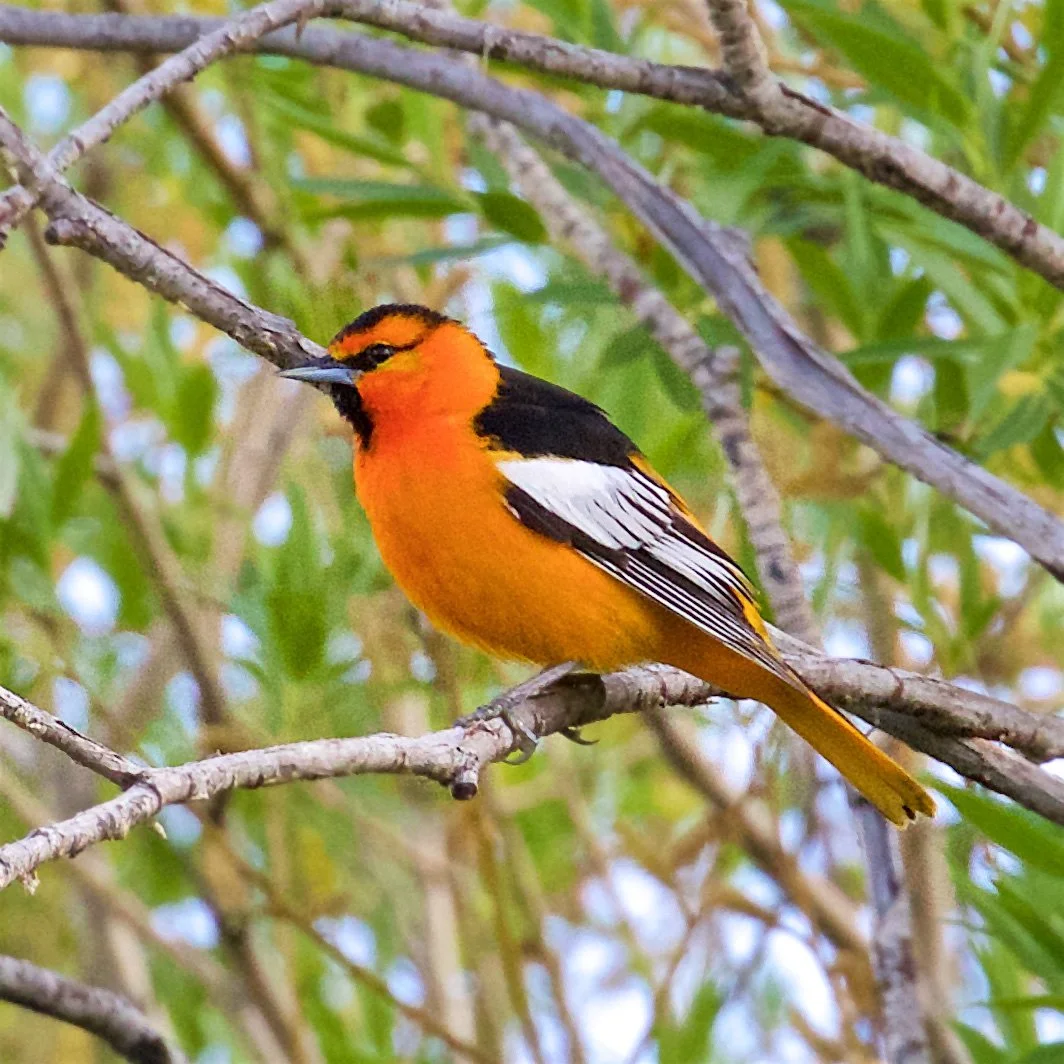
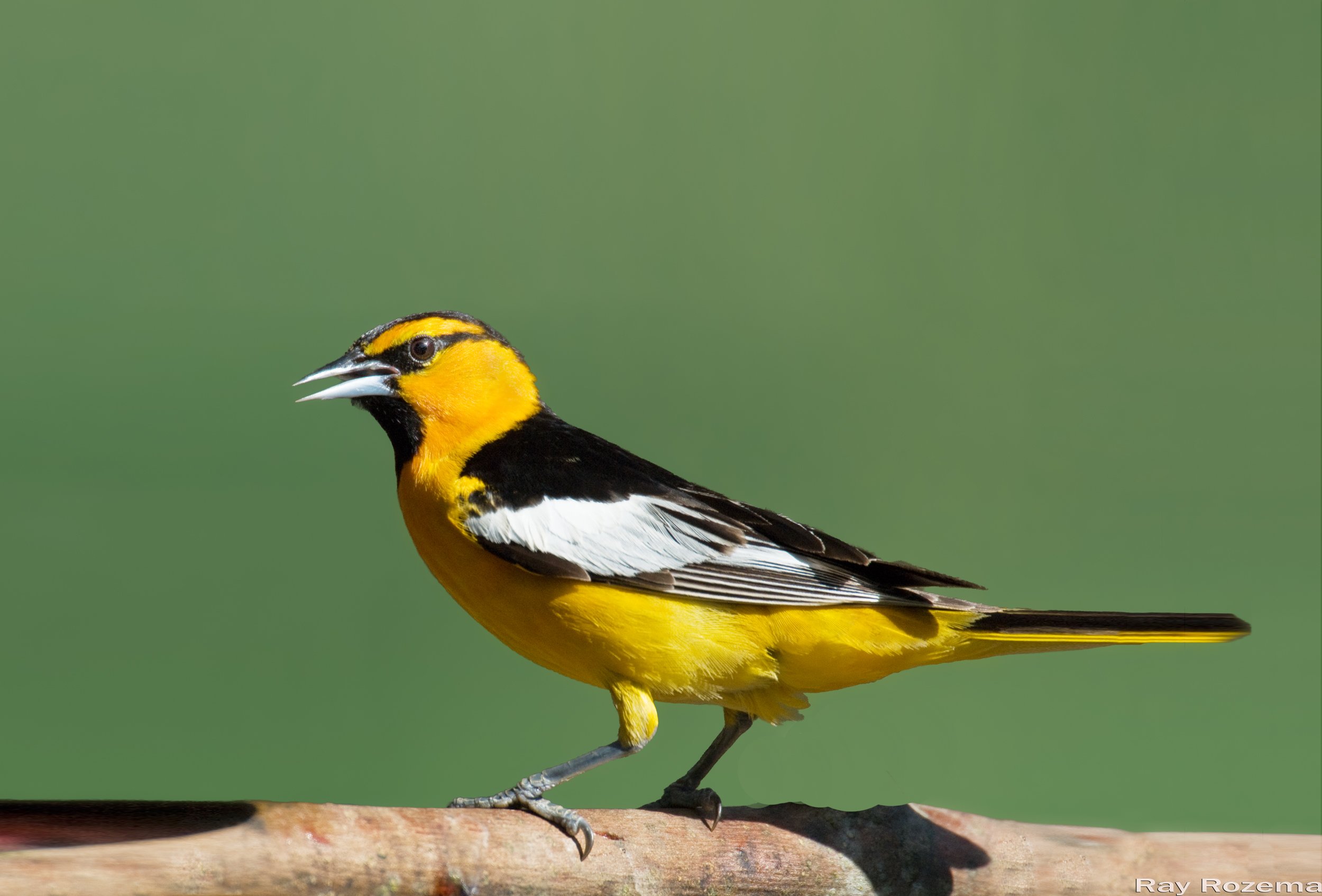
Bullock’s Oriole, adult male © Ed Harper

This month, let’s talk about an eye-catching, boldly-colored song bird called the Bullock’s Oriole (icterus bullockii). Bullock’s Orioles are “New World” orioles (those found in the Americas). They are related to New World blackbirds. Both orioles and blackbirds are in the same bird family (Icteridae), along with grackles, cowbirds, meadowlarks, and oropendolas. The 30 plus species of New World orioles are not closely related to “Old World” orioles found in Africa, Asia, and Europe.

The Bullock’s Oriole is the most common oriole species seen throughout the western United States. Of the 4 species that are usually found the in western U.S., Bullock’s Orioles nest further north and in the most western states. The species was named after English naturalists William Bullock and his son, who was also named William. Because this duo had collected a large amount of information on the species, the American Ornithologists’ Union wished to honor them.

From 1973 to 1995, Bullock’s Orioles and Baltimore Orioles were considered the same species and were called the Northern Oriole. The two species interbreed where their range overlaps near the western Great Plains. However, in 1995 after further DNA analysis and new data indicating that the area of interbreeding was not expanding, the two were once again classified as two separate species.

Bullock's Orioles are said to be Neotropical migrants because they breed in western North America and spend their winters primarily in tropical/subtropical regions. Their fall migration begins early, with many birds leaving northern breeding areas by the end of July. They migrate south in small, loose flocks at night from late July to September and return to their northern breeding grounds by late March to May. 

What do Bullock’s Orioles look like?

Bullock’s Oriole, male © Daniel Lee Brown

Bullock’s Orioles are 17-19 cm long and have slender bodies, dark eyes, medium-long tails, and sharply pointed, black to bluish-gray bills, which are wide at the base. The lower part of the bill is lighter in color than the upper part.

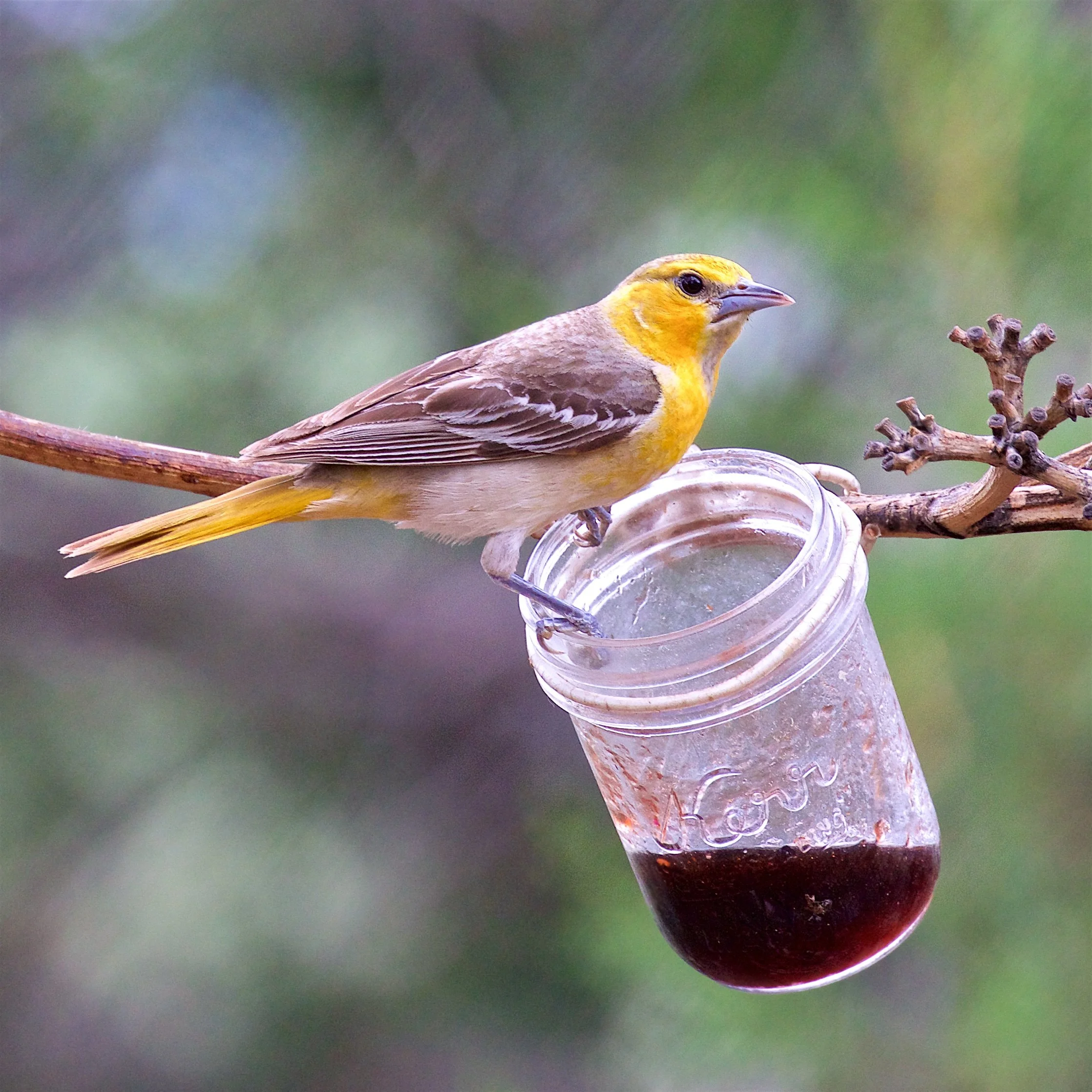
Bullock’s Oriole, female at feeder © Ed Harper

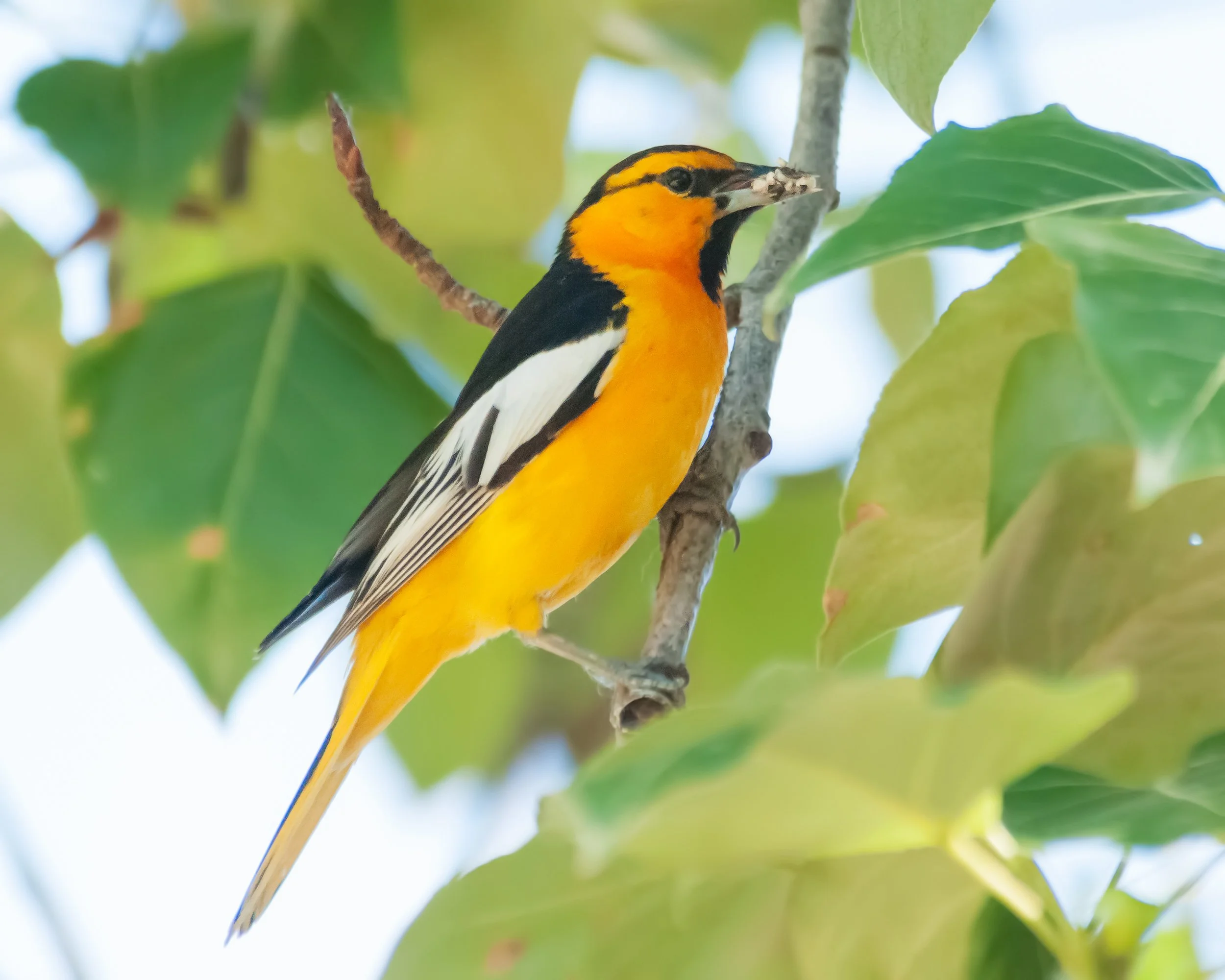
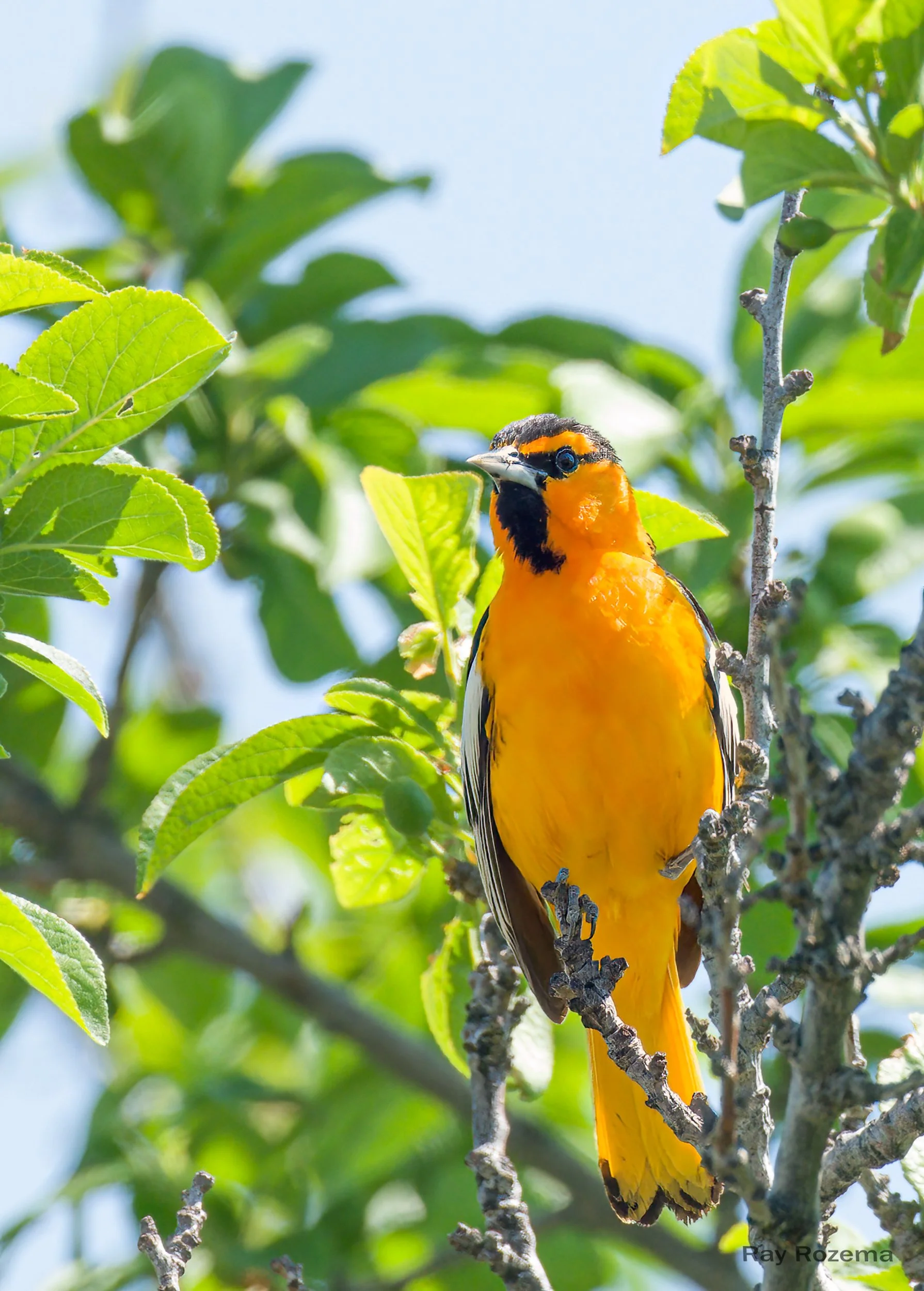
Adult male Bullock’s Orioles can be quite stunning. They are slightly larger than females and are considerably darker and brighter in color. Adult males are often a brilliant orange or yellow-orange and have a dark line running from their eyes to the back of their heads. Their range in color is thought to be somewhat diet related. Males have black crowns (the tops of their heads), black lores (the area between the eye and the bill), black backs and wings, large white wing patches, black throat patches, and black upper tails. In contrast, the faces, throats, chests, and tails of female Bullock’s Orioles are dull yellow or yellowish-orange. They have grayish-brown wings with white (sometimes yellowish) wing bars, whitish- or light gray bellies, grey-brown backs, and their crowns are olive-gray. Females lack dark eye lines (many photos suggest that a faint line is present), dark lores, wide wing patches, and usually the dark throat patches on males. However, sometimes older females have small black throat patches.

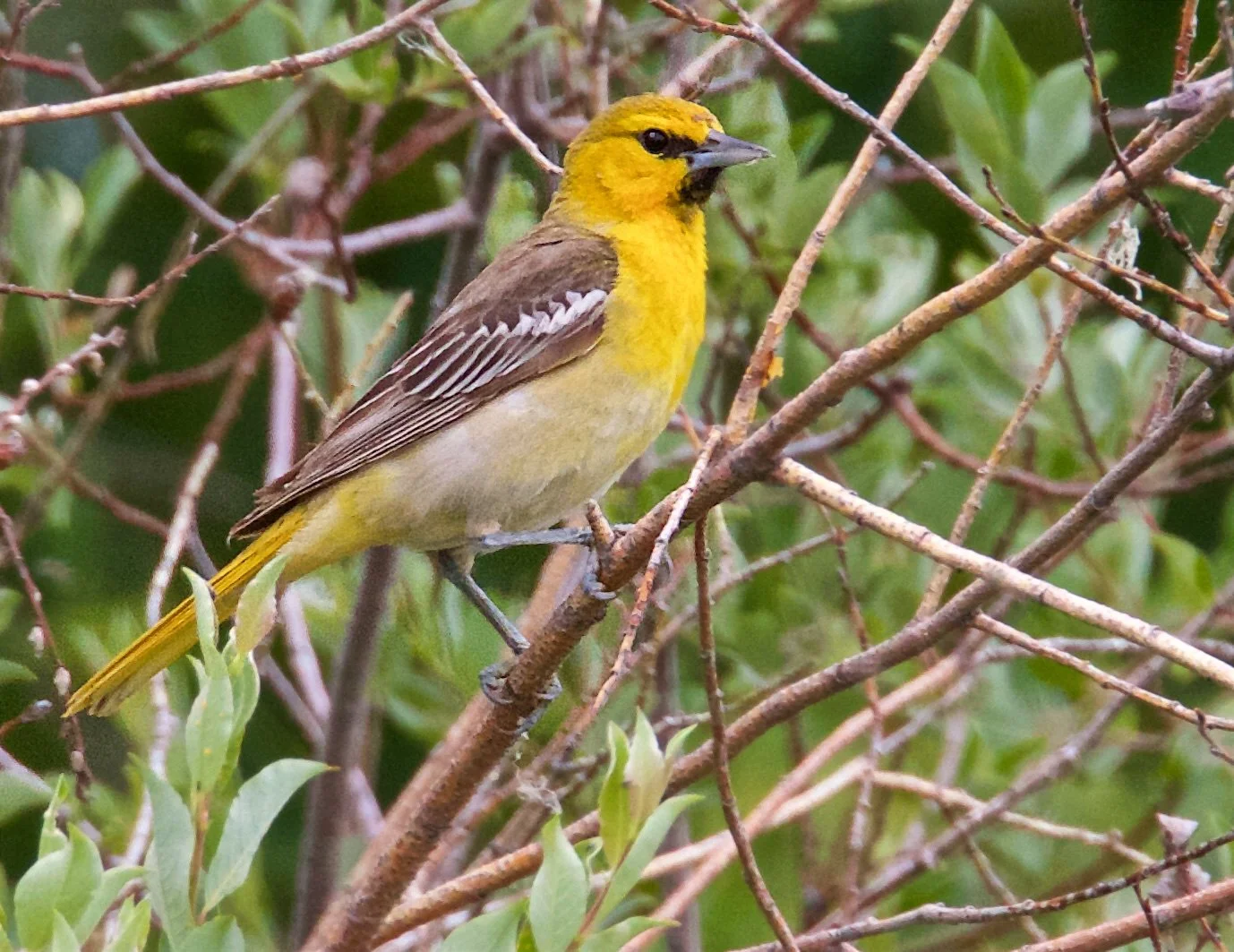
Bullock’s Oriole, immature male © Ed Harper

Male and female juvenile Bullock’s Orioles are similar. Juveniles resemble adult females but tend to have darker wings and have less-extensive wing bars. One may notice that many photographs of Bullock’s Orioles are captioned with “female/immature male”. Immature males frequently will have dark eye lines, lores, and some black on their throats, but only have faint black crowns.

FYI- Another oriole species, called the Hooded Oriole (icterus cucullatus), is also found in the Sacramento Valley region. Hooded Orioles have similar black and orange color but their bills are longer and have a more pronounced downwards curve. Their bodies are more slender, and their tails appear longer. Male Hooded Orioles differ from male Bullock’s Orioles because they lack a black crown, have narrow white wing bars (compared to the large white patches on male Bullock’s Orioles). Female Hooded Orioles are olive-yellow on both their chests and bellies; whereas female Bullock’s Orioles’ have yellow chests fading into light-gray bellies.

Where do Bullock’s Orioles live and nest?

Bullock’s Oriole, adult male © Ray Rozema

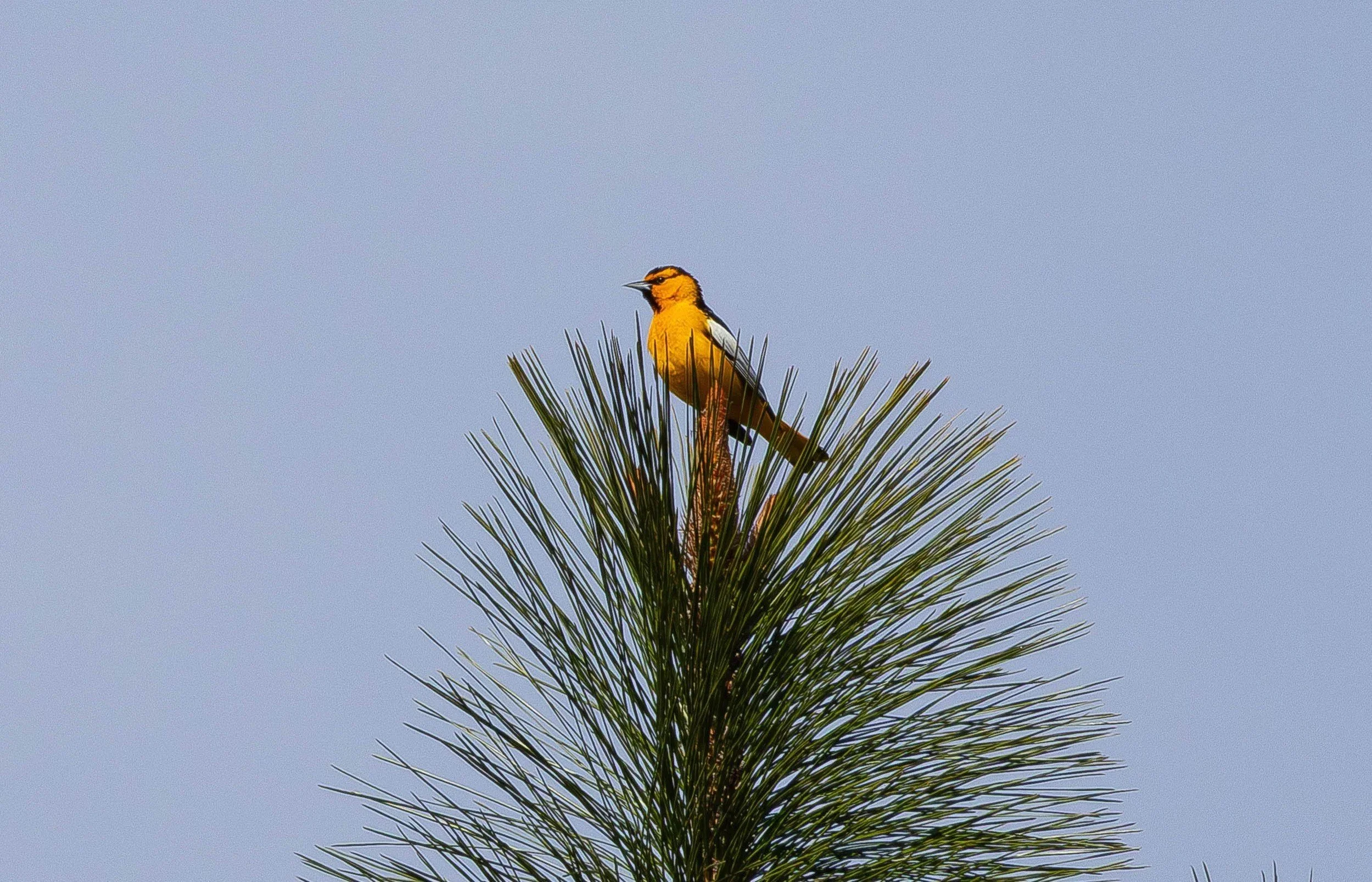
In spring and summer, Bullock’s Orioles mainly nest in the western U.S., but also nest in southern Canada and northern Mexico. They prefer to nest in open deciduous woods with trees that offer them good canopy. Look for them in tall, forked, broadleaf trees, such as cottonwoods, live oaks, sycamores, maples, and willows that line streams and rivers. In other regions, they nest in pecan trees and scrub tree forests, such as mesquite, and salt cedar. In addition, Bullock’s Orioles nest in leafy suburban gardens, parks, trees in floodplains, ranch yards, and along irrigation ditches.

Bullock’s Orioles nest once per breeding season and building a nest takes them about 15 days to complete. Being very nimble birds, they will hang upside down as they construct their suspended, dome-like nests. They often select nest sites that are at the end of flexible, drooping branches. Hanging nests may act to deter predators from coming to the nest. Bullock’s Oriole nests are fastened to a branch or twigs in three places: around the rim and on both sides. Females select the nest site and tightly weave the materials together to form a nest. Males often assist females with both collecting materials and nest construction. Nests are constructed out of plant fibers, strips of bark, vine tendrils, hair, grasses, or wool and are lined with hair, plant down, and fine grasses. Bullock’s Orioles are also known to use litter to build their nests, such as fishing line, yarn, and twine. Unfortunately, the use of these materials can cause injury. Females incubate the eggs over a 12-14 day period. The drab coloration of females may help protect the nest during incubation. After hatching, the nestlings will fledge (leave the nest) in around 14 days. Both parents help to feed their young.

After the nesting season is over, Bullock’s Orioles migrate back to their wintering grounds in western Mexico and sometimes as far as Guatemala, El Salvador, and Costa Rica. They spend the winter in various types of wooded habitats. However, there are small populations that live year-round along the southern California coast (from Santa Barbara to San Diego) and in the panhandle region of Florida.

What do Bullock’s Orioles eat?

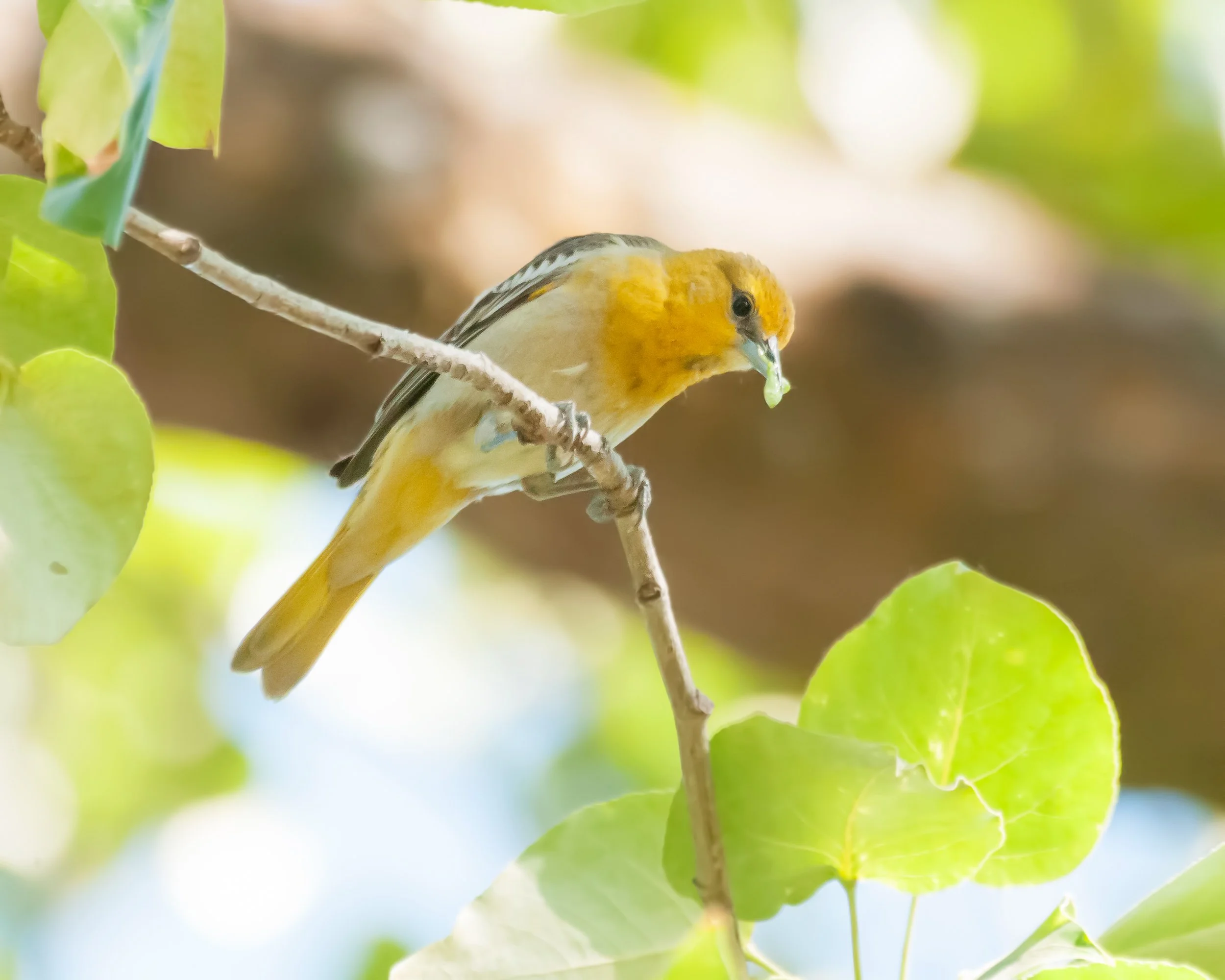
Female / immature Bullock’s Oriole, female / immature © Daniel Lee Brown

In the spring and summer, Bullock's Orioles actively hop inside trees or shrubs when searching for insects on trunks, branches, leaves, and twigs. They are quite agile and will often hang upside down on skinny branches and stretch to reach food. Bullock’s Orioles aren’t often found on the ground. They will sometimes fly out in midair to catch insects. While especially favoring caterpillars, they will also eat beetles, true bugs, ants, grubs, wasps, bees, grasshoppers, crickets, scale, small spiders, moth and butterfly pupae, earwigs, and other invertebrates. They consume nectar from certain types of flowers. In California, they take nectar from the flowers of many non-native eucalyptus trees that have been introduced. Bullock’s Orioles may visit feeders in the spring when nectar, orange slices, or grape jelly are provided. Nestlings are fed a high-protein diet that are mainly the same foods listed above. Caterpillars, crickets, and grasshoppers have a very high protein content. Occassionally, parents offer berries to their young too.

Orioles, in general, have interesting ways of consuming two types of food. They obtain fruit nectar by first poking their sharp, pointed bills through the fruit’s skin. Then with bills still inserted, they pry their bills open and lap up the pooled juices with their brush-like tongues. In addition, orioles also remove and discard the stingers prior to consuming bees!

Bullock’s Oriole, adult male © Ray Rozema

What do Bullock’s Orioles sound like?

Bullock’s Oriole, adult male © Larry Hickey

Bullock’s Orioles are considered to be very vocal birds and often sing from tall riparian trees or call during flight. Listen for their whistling, chuckling song in tall trees along rivers and streams. Their unique and variable songs often will cause one to pause and listen. Sometimes they make a chattering sound as they take flight; and this call can help you locate them.

The song of Bullock’s Orioles is usually a rapidly changing mixture of harsh chattering, squeaks, creaks, and sweet flute-like whistles. Some describe their song to be similar to the sound of a squeaky toy. Both male and female Bullock’s Orioles sing. It has been found that the female of a pair is often the one that’s singing very close to the nesting site. The males’ songs have been described as being sweeter than the females’.

One call of Bullock’s Orioles is a rough chatter or scolding rattle. It is used to communicate with the family unit, to defend territory, or as an alarm call. They also have a low chirp that’s a single note “wheet”, “chet”, or “check” call. Their flight call is a rising nasal “wreent” or a harsh chattery rattle.

Listen to the Bullock’s Oriole below. All sound files sourced from xeno-canto.org/.

Bullock's Oriole (Icterus bullockii), song
Ed Pandolfino
Bullock's Oriole (Icterus bullockii), song, call, chatter
Thomas G. Graves
Bullock's Oriole (Icterus bullockii), song, call
Paul Marvin
Bullock's Oriole (Icterus bullockii), calls, rattles
Richard E. Webster
Bullock's Oriole (Icterus bullockii), song
Ed Pandolfino
Bullock's Oriole (Icterus bullockii), song, call, chatter
Paul Marvin

This article was compiled by Jane Van Kessel.

Sources include Cornell’s All About Birds, Cornell’s Bird of the World, National Audubon Society’s Online Field Guide, 150 Frequently Seen Birds of California’s Great Valley, pages 282-3, Animal Diversity Web , National Geographic Field Guide to the Birds of the United States and Canada, West, 2nd Edition, pages 416-17, Sibley Birds West (Field Guide to Birds of Western North America) by David Allen Sibley, 2nd Edition, page 441, Kaufman Field Guide to Birds of North America, Kenn Kaufman, pages 340-1, The Stokes Field Guide to the Birds of North America, 2010, page 734, Peterson Field Guide to Birds of Western North America, Roger Tory Peterson, Fifth Edition, pages 368-9.

Meet the Wilson's Warbler

Adult Male Wilson’s Warbler © Ed Harper

This month let’s learn about another interesting bird species, the Wilson’s Warbler (Cardellina pusilla). Wilson’s Warblers are brightly colored songbirds named after Alexander Wilson who came to America in 1794 from Scotland. Wilson was an ornithologist and was the first to describe the species in 1811. The Wilson’s Warbler is one of the smallest warblers found in the U.S. and also can be one of the easiest warblers to identify. Here in the Sacramento Valley, Wilson’s Warblers are seen when they pass through the area during their spring and fall migrations. For some Wilson’s Warbler populations, the distance can be quite a long one: flying from their tropical wintering grounds to the upper regions of North America and back again after their nesting season. 

Wilson’s Warblers are in a large group of around 115 species called New World warblers (aka Wood Warblers) which make up the family Parulidae. During migration, New World warblers are the birds seen in the U.S. In contrast, the species of warblers found in Europe are called Old World warblers (Family Sylviidae). Old World Warblers are not closely related to New World warblers. However, the birds in both families have at least one thing in common: they sing pleasant songs. 

Wilson’s Warblers are extremely active birds, moving about almost constantly. In addition, they often are seen raising or flipping their tails back and forth and spreading their wings. “Hyperactivity” is a behavior trait common among warblers, but it’s been documented that Wilson’s Warblers are one of the most active warblers. With all this movement it can be a challenge to get a glimpse of one, especially since they are frequently hidden by foliage. 

Many warbler species migrate to either the western or to the eastern part of the U.S. However, Wilson's Warblers are one of the few warblers found in every state in the lower 48. Scientists have named 3 subspecies of Wilson’s Warblers (based on plumage color, the size of a darkened area on their heads, and body size). However, some think there may be as many as 6 subspecies and that each of these 6 potential subspecies spend its winter in a different location.

The widespread population of Wilson's Warblers has been declining. The species is currently still considered common; but their numbers have dropped significantly due to the loss of riparian habitat in the West, chemicals used to clear brush, collisions with man-made structures, etc. You can help by planting a native plant garden in your yard. Native gardens attract native insects that wild birds such as Wilson's Warblers like to eat. 

What do Wilson’s Warblers look like?

Wilson’s Warbler, adult male © Ray Rozema

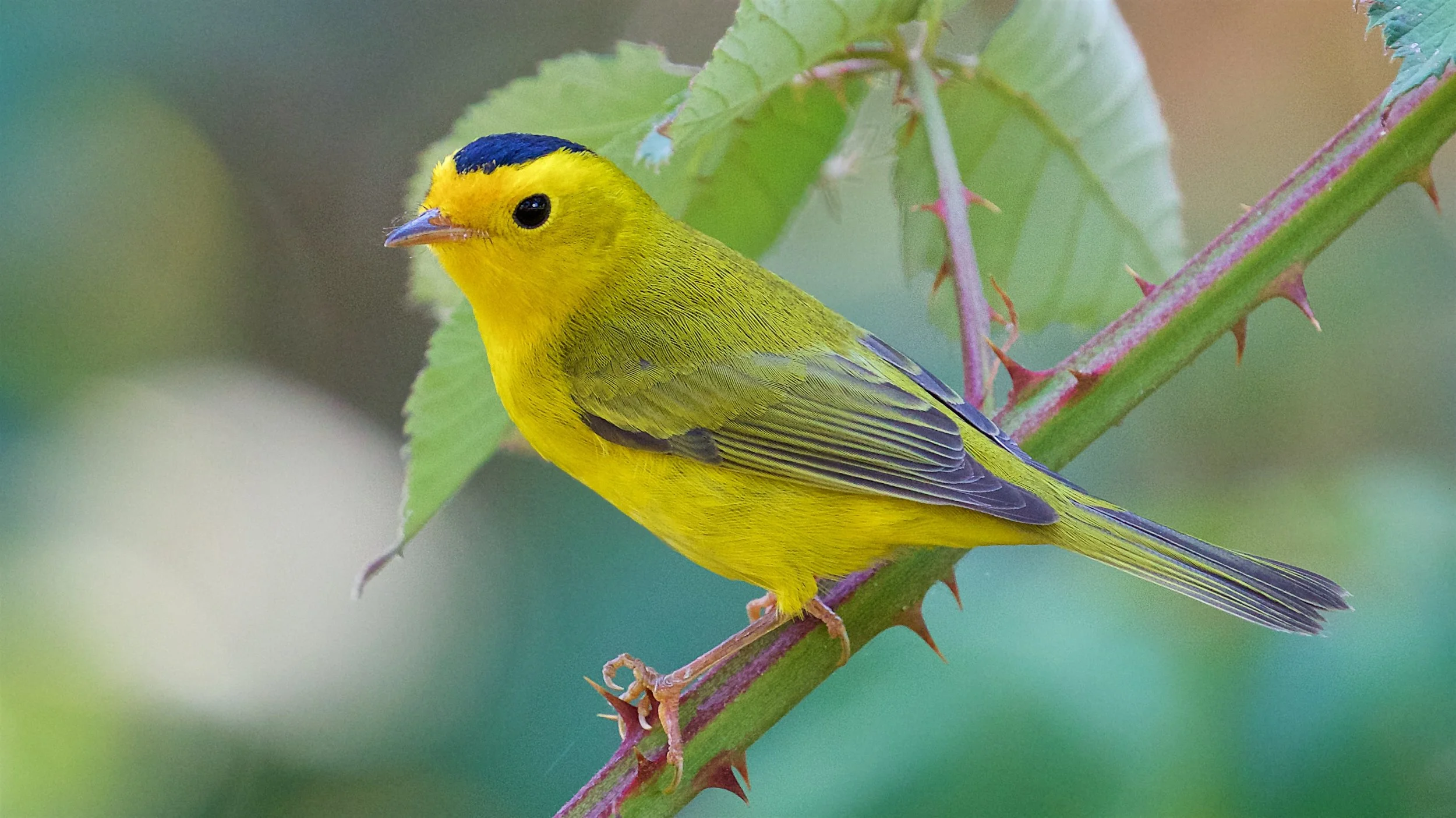
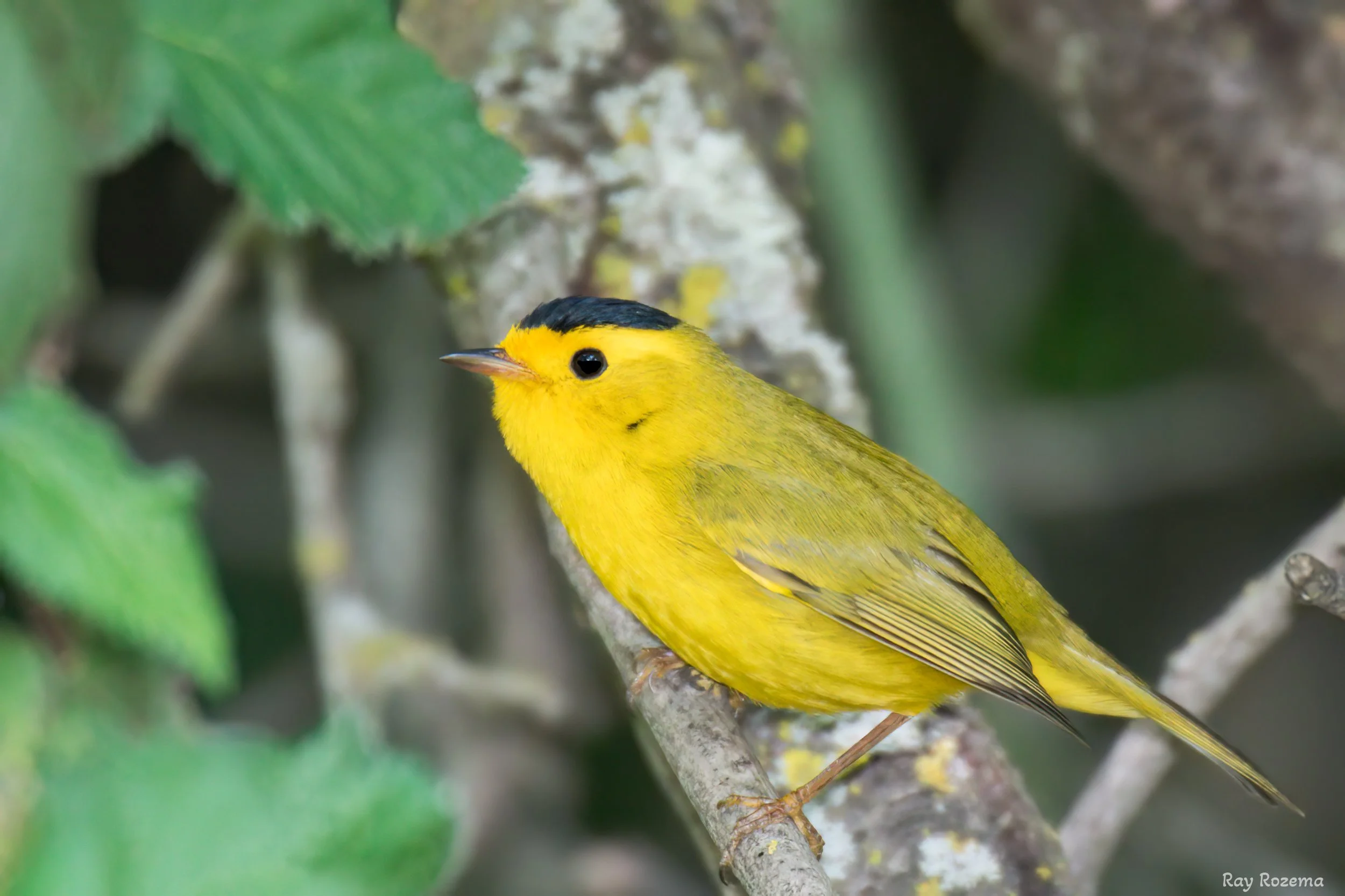
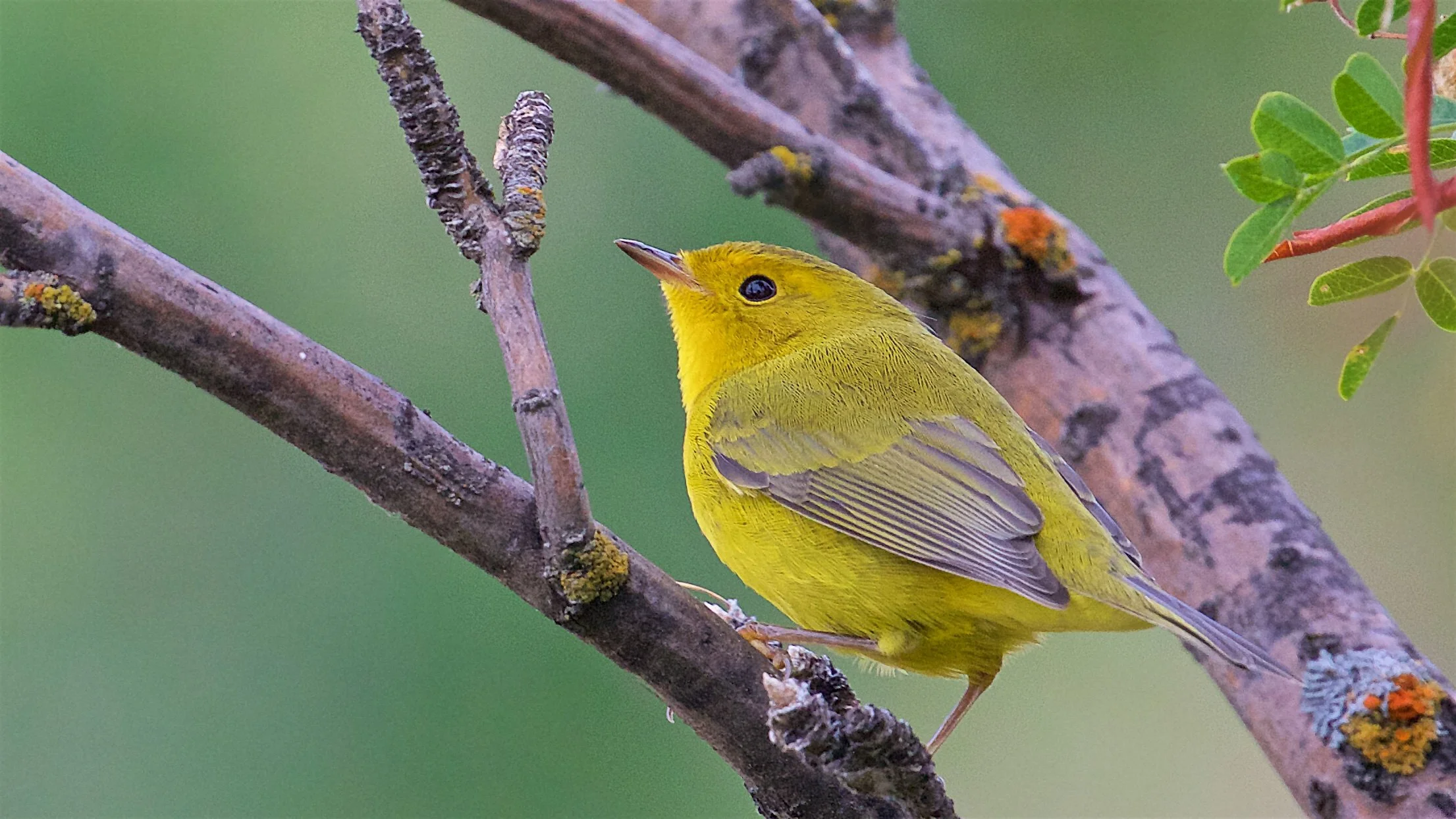
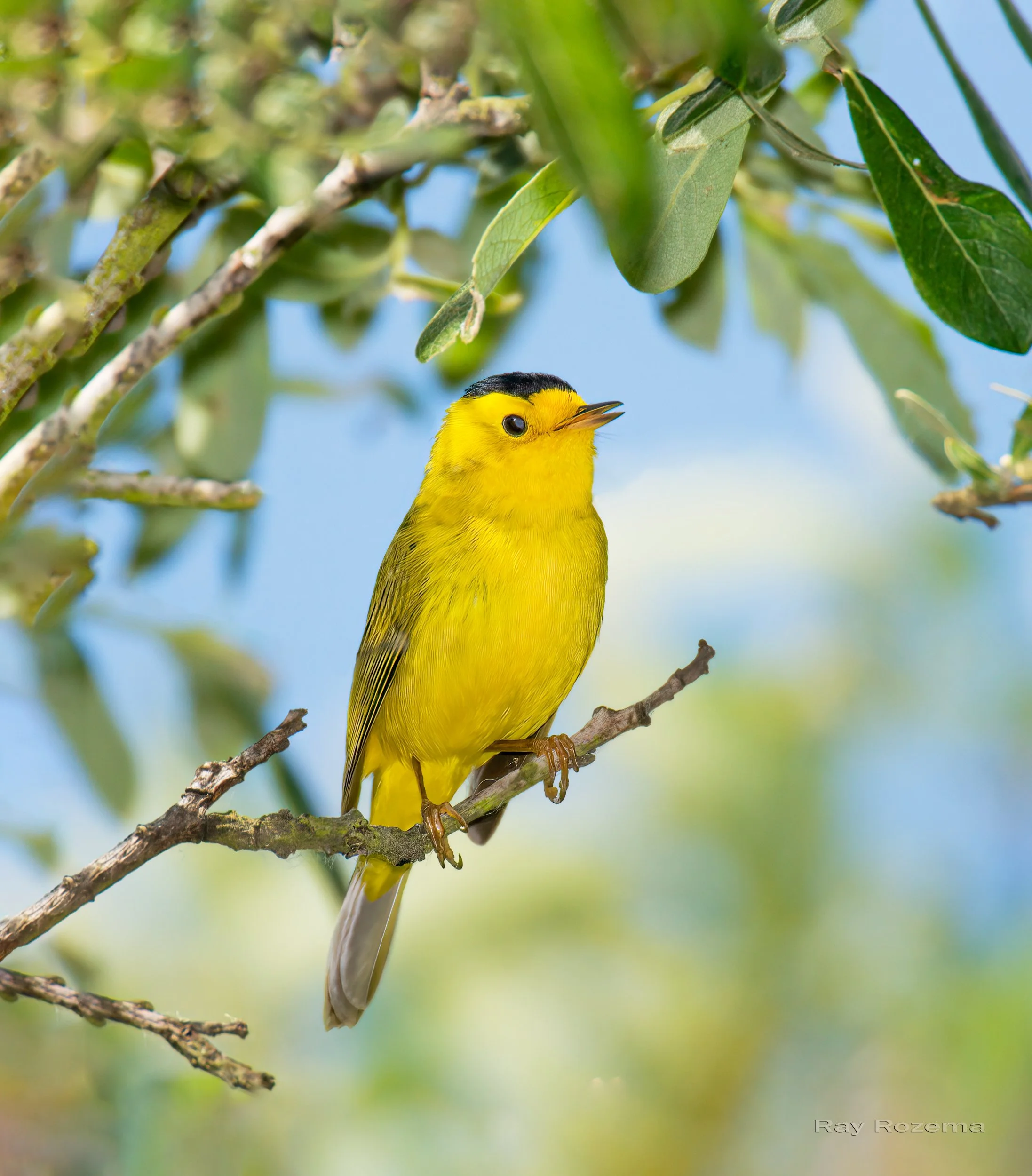
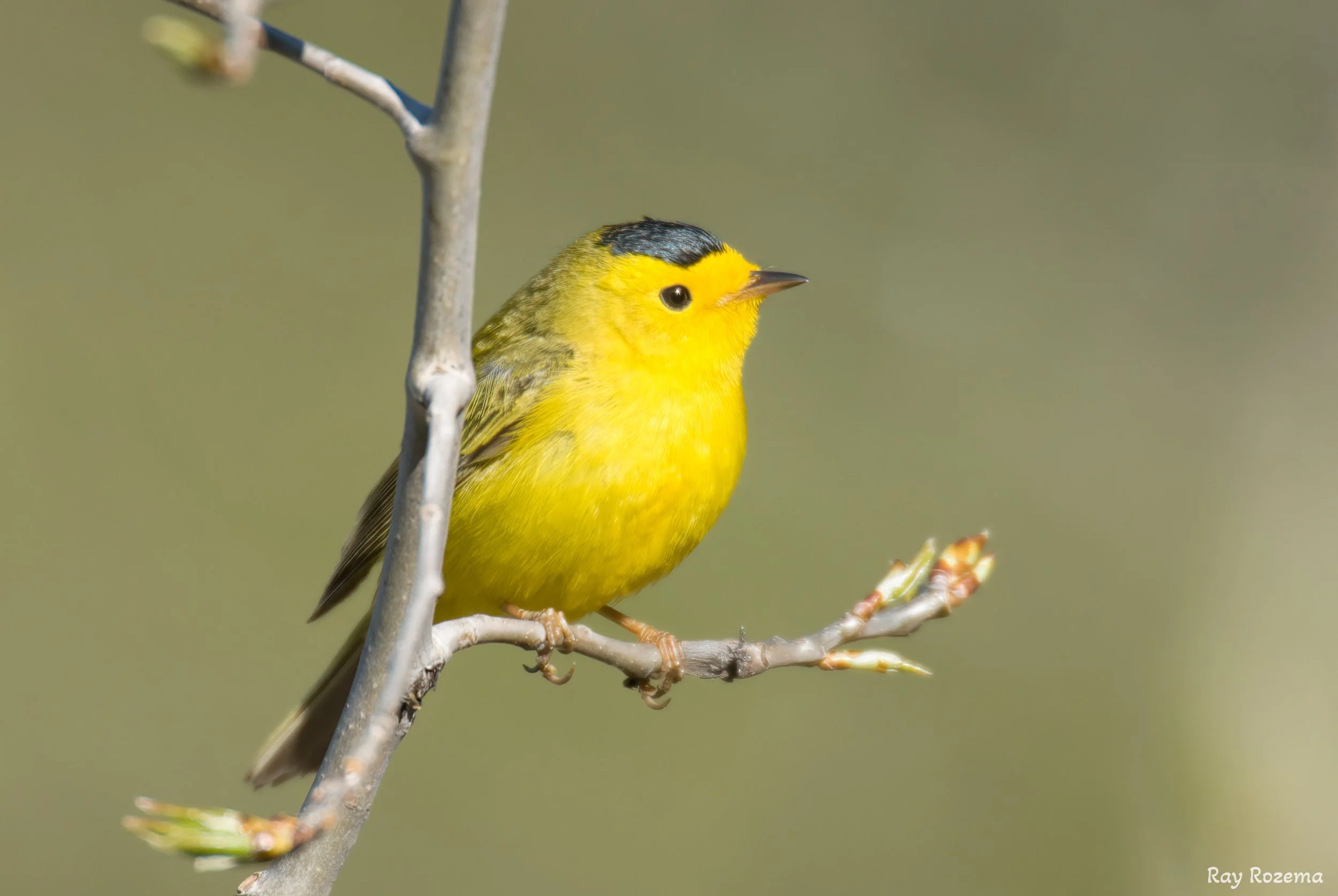
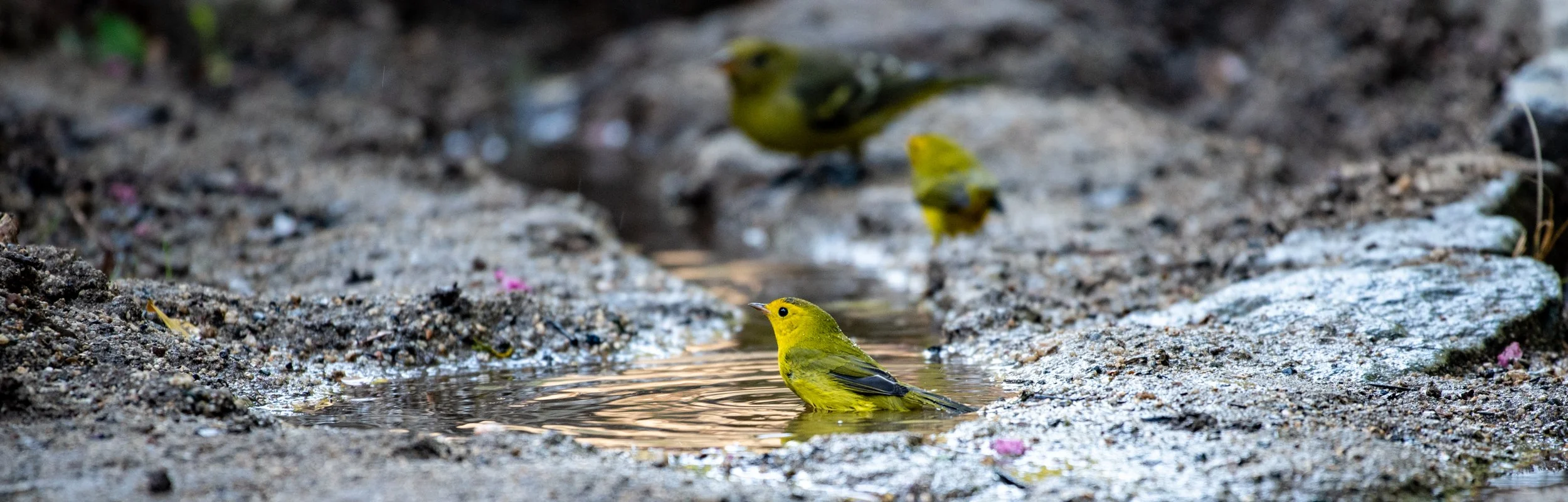
A quick way to identify male Wilson’s Warblers is the visible black cap on top of their heads or crowns. The caps on females can be fainter, smaller, olive-colored, or absent entirely. Wilson’s Warblers are about 4-5 inches long and have unmarked, golden yellow chests and bellies, small, thin, and pointed bills, large black eyes, rounded bellies, thin, orange legs, plain, brownish olive-green backs and wings, long, slender tails without wing bars, thick necks, blocky heads, and solid, dark undertails that continue to the tip of their tails. Another key ID point is that Wilson’s Warblers have a distinctive yellow eyebrow area which contrasts with their darker head and cheek color. Juveniles, as well as females, typically have an olive-green or brownish crown and frequently can be duller overall.

Female Wilson’s Warbler © Ed Harper

Sometimes, it can be tricky to tell Wilson’s Warblers apart from a similar species called the Northern Yellow Warbler. Northern Yellow Warblers lack the dark cap or crown area, often have thin rusty vertical streaks on their breasts, long thick bills, smooth or rounded heads, their necks do not appear thick nor do their bellies appear rounded, have a more pronounced yellow edging on their wing feathers, and have yellow undertail areas that continue to the tail tip. Also, the heads and faces of Yellow Warblers are completely yellow; lacking the contrasting yellow eyebrow area like on Wilson’s Warblers.

Where do Wilson’s Warblers live and nest?


Wilson’s Warbler, adult male © Ray Rozema

Most populations of Wilson’s Warblers spend their winters in various habitats in Central America, Mexico, and Baja California, where they either have specific territories or form into foraging flocks. A few spend their winters in southern Texas or Louisiana along the Gulf Coast.

In the spring, Wilson’s Warblers migrate to their nesting grounds, which are usually below the timberline. They spend their breeding season in Canada, Alaska, Newfoundland, the coastal mountain regions of California, Oregon, and Washington, the mountains of the Sierra Nevada, and the Rocky Mountain states. Wilson’s Warblers are seen around young conifers, maple, coyote bush, blackberry, oaks, alders, and/or willows. 

Wilson’s Warblers seek a moist and cool understory in mountainous, open-forested, and/or riparian habitat for nesting. They are not usually found inside a dense forest interior. Instead, they are seen in wet meadows, thickets, low shrubs, and along brushy woodland edges. 

Wilson’s Warbler pairs usually remain together for one breeding season. Male Wilson’s Warblers choose the nesting territories and will attempt to scare or distract predators away by lowering their wings, uttering harsh calls, raising their tails, or by performing a broken wing display. Females build the nests and they are usually located near a base of a tree or shrub, on or near the ground, and close to a water source. The populations of Wilson’s Warblers that build their nests along the Pacific Coast are exceptions and position their nests slightly higher at around 3-5 feet. The nests are cup-shaped and made using leaves, moss, and rootlets and sometimes are lined with fine grass and hair. They are well hidden: either surrounded by moss or dense grass on the ground or inside tangled thickets. Females also perform all (or most) of the incubation; but both parents feed the young. Nestlings begin to leave the nest when they are 8-13 days old. Parents continue to care for the fledglings for a few weeks. Brown-headed Cowbirds have been known to place their own eggs inside Wilson’s Warblers’ nests so that their brood will benefit from both incubation and later feeding. This phenomenon occurs more often in western populations and is called parasitic brooding. 

What do Wilson’s Warblers eat?

Wilson’s Warbler, adult male © Ray Rozema

Wilson’s Warblers are middle to low elevation foragers and do most of their foraging in the understory of willows, alders, or shrubs. In some areas they hunt close to the ground. Like other warblers, Wilson’s Warblers primarily eat adult and larval insects including caterpillars, aphids, leafhoppers, bees, beetles, wasps, and mayflies. They also eat spiders. Occasionally, they will eat berries in the winter and will snack on the sugary liquid that’s secreted by scale insects. These energetic birds move almost constantly inside trees in search of food to tug off leaves and twigs. Sometimes, they will hover around a tree and remove prey from the outer branches or will flycatch by darting to catch an airborne insect and then return to their previous perch. 

What do Wilson’s Warblers sound like?

Wilson’s Warbler, female / immature © Susie Nishio

Although female Wilson's Warblers do occasionally sing, males sing much more often when defending their territory or attempting to attract mates. When females do sing, their songs have been reported as being quite different from the males’ songs. 

The calls of Wilson Warblers have been described as a chirp, sharp chip, husky  jimp, low flat timp, or zip, a soft chet, or a flat chuff. Their flight call is a tilk or schkwrit.

Their song has been described as a rapid series of chips which drop in pitch at the end, or a clear trill like chi chi chi chi chi chet chet, rapid and thin chattering, and whistling. You can listen to songs and calls of Wilson's Warblers below.

All sound files sourced from xeno-canto.org/.

Wilson's Warbler (Cardellina pusilla), song
Thomas G. Graves
Wilson's Warbler (Cardellina pusilla), song
Steve Hampton
Wilson's Warbler (Cardellina pusilla), song and call
Ed Pandolfino
Wilson's Warbler (Cardellina pusilla), call
Bobby Wilcox

This article was compiled by Jane Van Kessel.

Sources include Cornell’s All About Birds, Cornell’s Birds of the World, National Audubon Society’s Online Field Guide, 150 Frequently Seen Birds of California’s Great Valley, pages 306-7, National Geographic Field Guide to the Birds of the United States and Canada, West, 2nd Edition, pages 442-3, Sibley Birds West (Field Guide to Birds of Western North America) by David Allen Sibley, 2nd Edition, page 388, Kaufman Field Guide to Birds of North America, Kenn Kaufman, page 304, and The Stokes Field Guide to the Birds of North America, 2010, page 636.

Meet The Song Sparrow

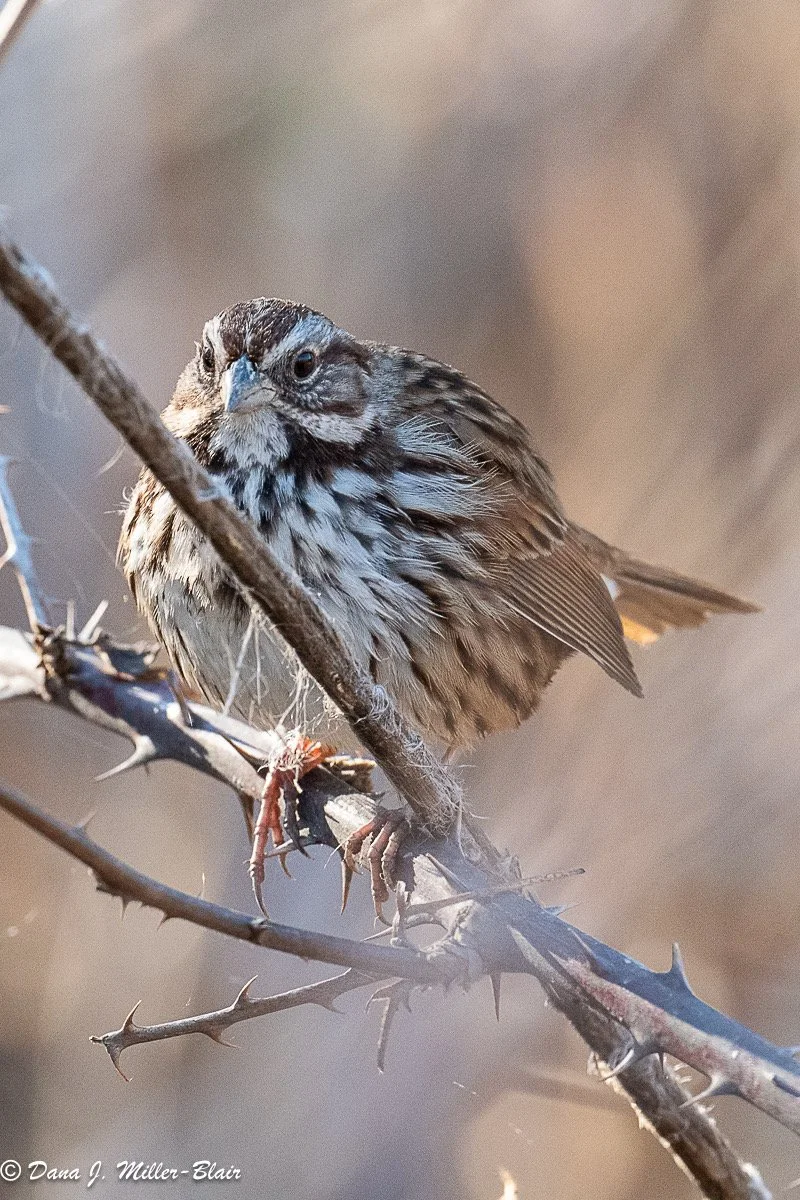
Song Sparrow © Dana J. Miller-Blair

This month let’s learn about a species in the sparrow family called the Song Sparrow (Melospiza melodia). Song Sparrows are both common and year-round residents in the Sacramento Valley. In contrast, other populations that nest in colder climates further north may migrate south for the winter. Song Sparrows do not form large flocks and are frequently seen alone (or in pairs during the nesting season). However, juveniles sometimes form small groups and migrating birds either travel alone or in small flocks.

Song Sparrows vary regionally in size, song, and color. There are many subspecies of the Song Sparrow. Birds of the individual subspecies can look quite different from one another. This is called local adaptation. Studies suggest that Song Sparrows benefit from these geological differences. Here are 3 examples. Subspecies that live in colder regions tend to have larger bodies. Larger birds experience less heat loss compared to smaller birds. Subspecies living in desert habitats tend to be paler in coloration. Their light color may make it less likely for them to be noticed by hawks in an open habitat. Birds living in wet and humid coastal locations tend be darker. There is a larger amount of a pigment called melanin found in darker feathers. Besides making feathers dark, a high melanin concentration also makes feathers stronger and may offer some degree of protection from the damage caused by feather mites (which are common near coastal locations). In summary, scientists feel that regional morphological differences are not just random variation.

What do Song Sparrows look like?

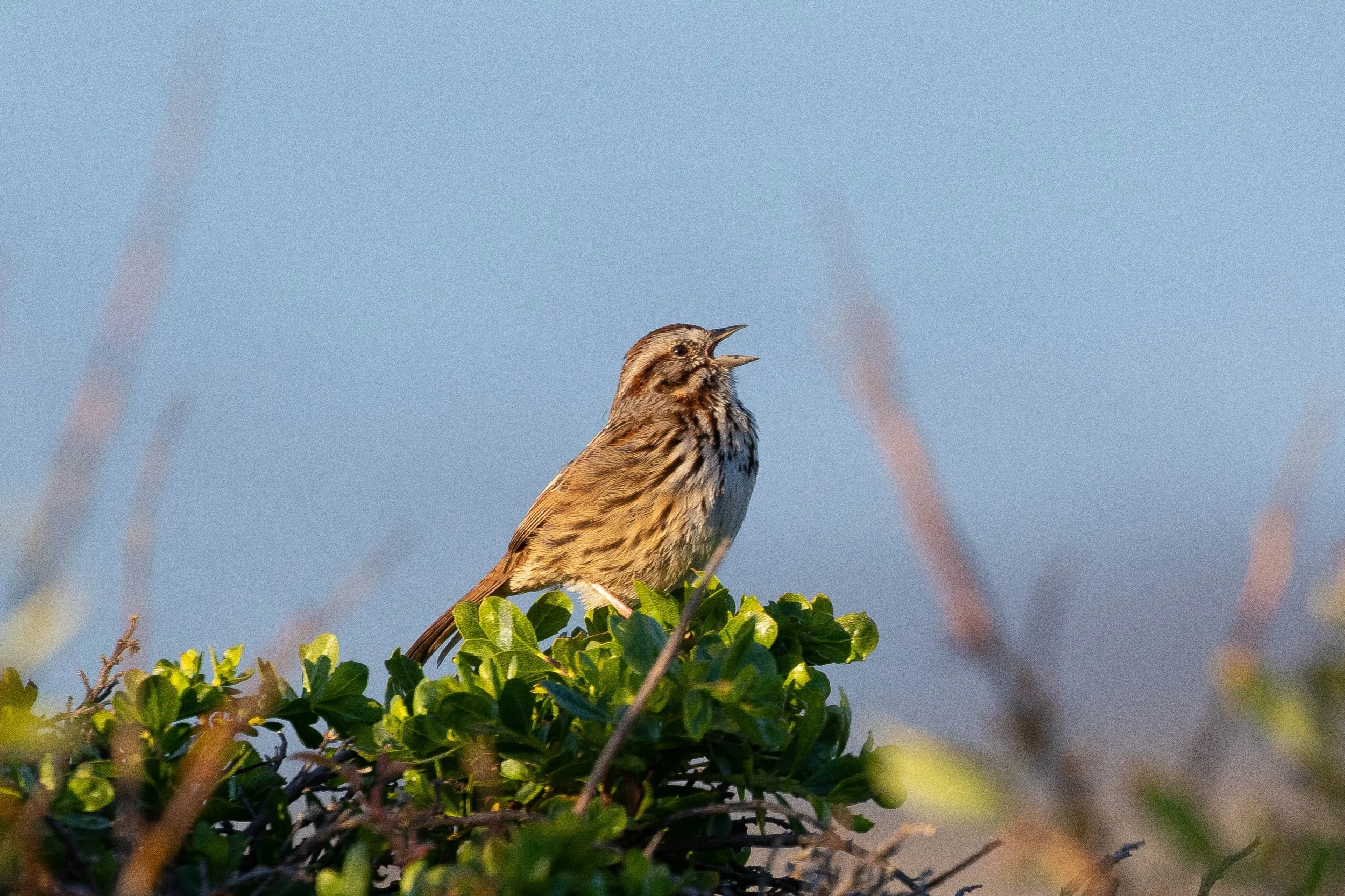
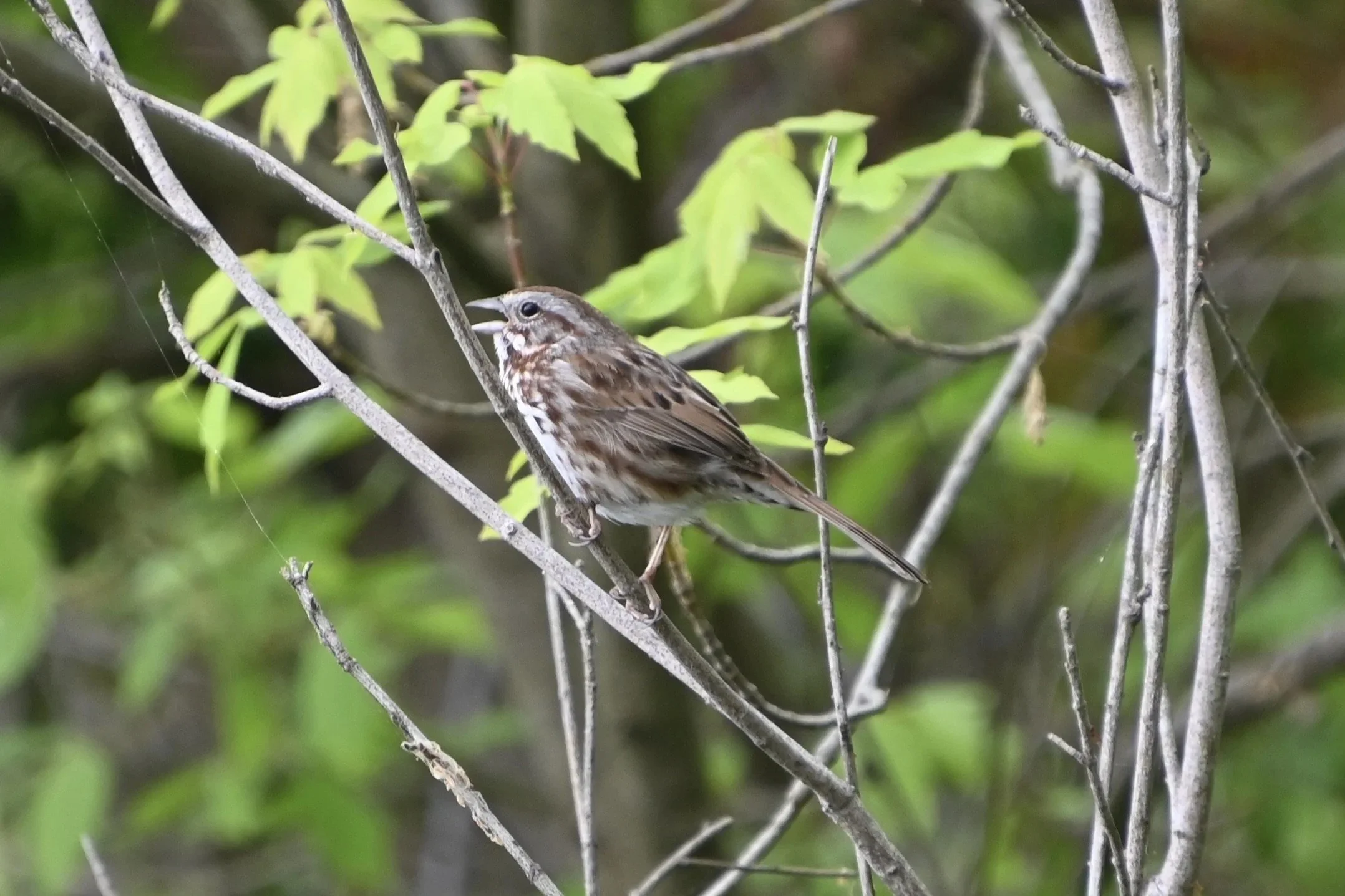
The Song Sparrow is one of the first birds one should suspect in the Sacramento Valley when there’s a streaky sparrow perched and singing on the top of a bush near a water source. Since this is a very diverse species that has many subspecies, this article will focus on the plumage (or feather color) of Song Sparrows found this area.

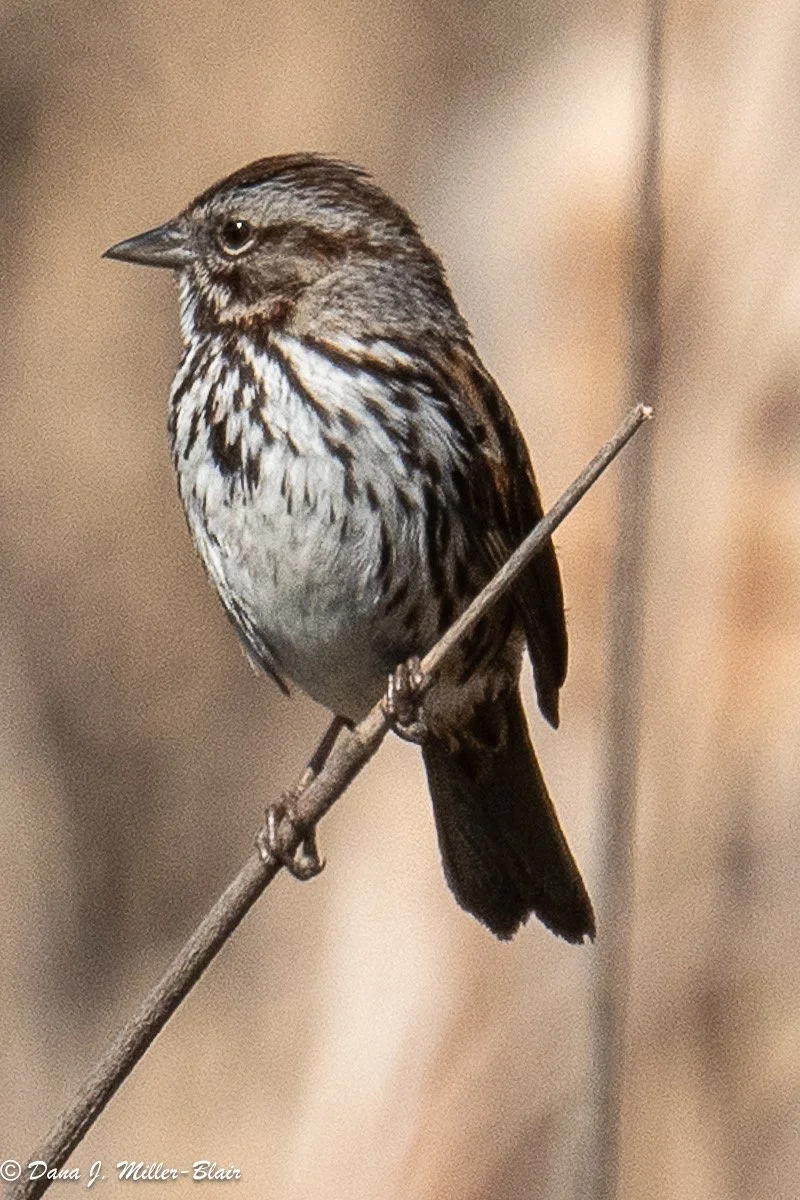
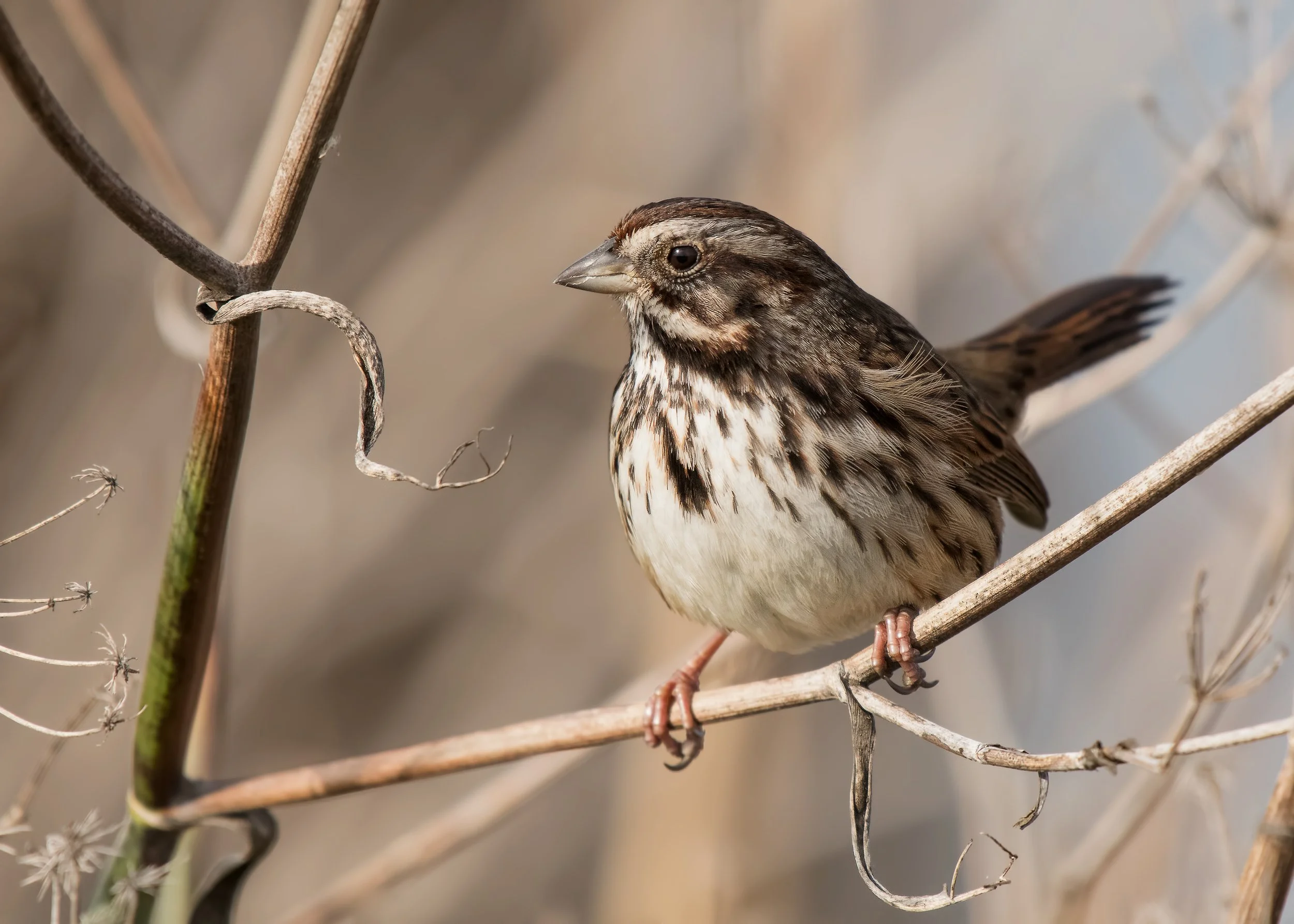
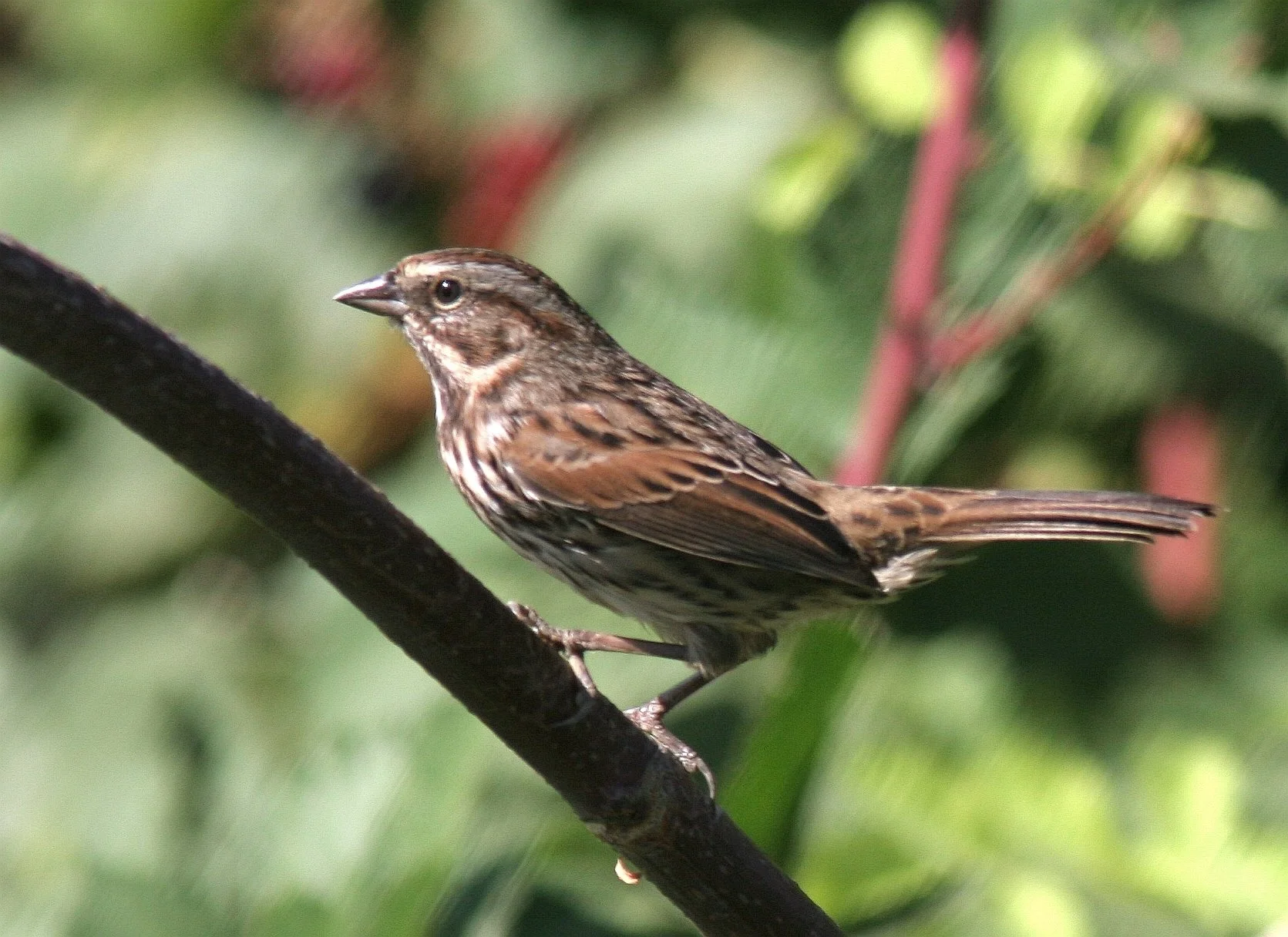
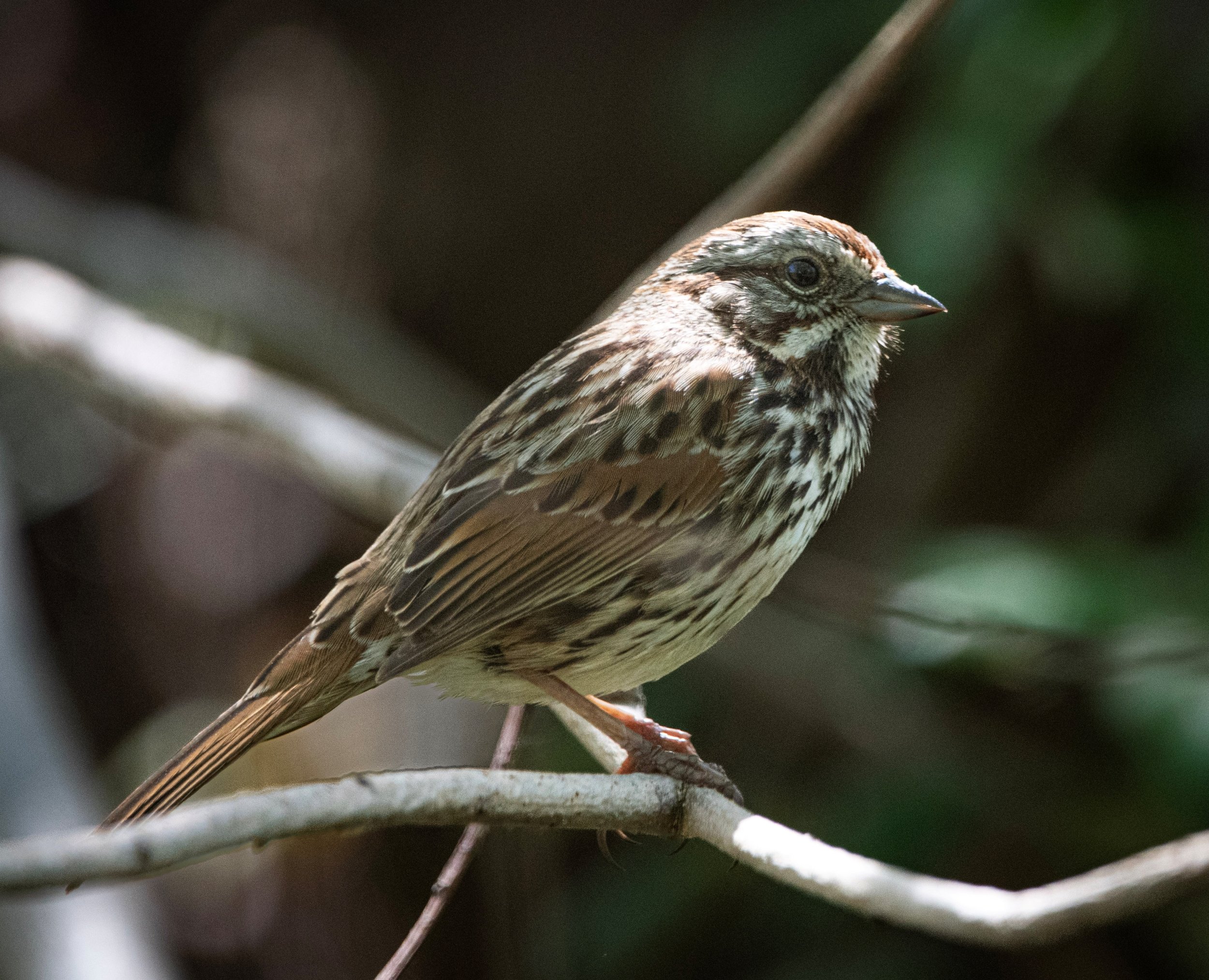
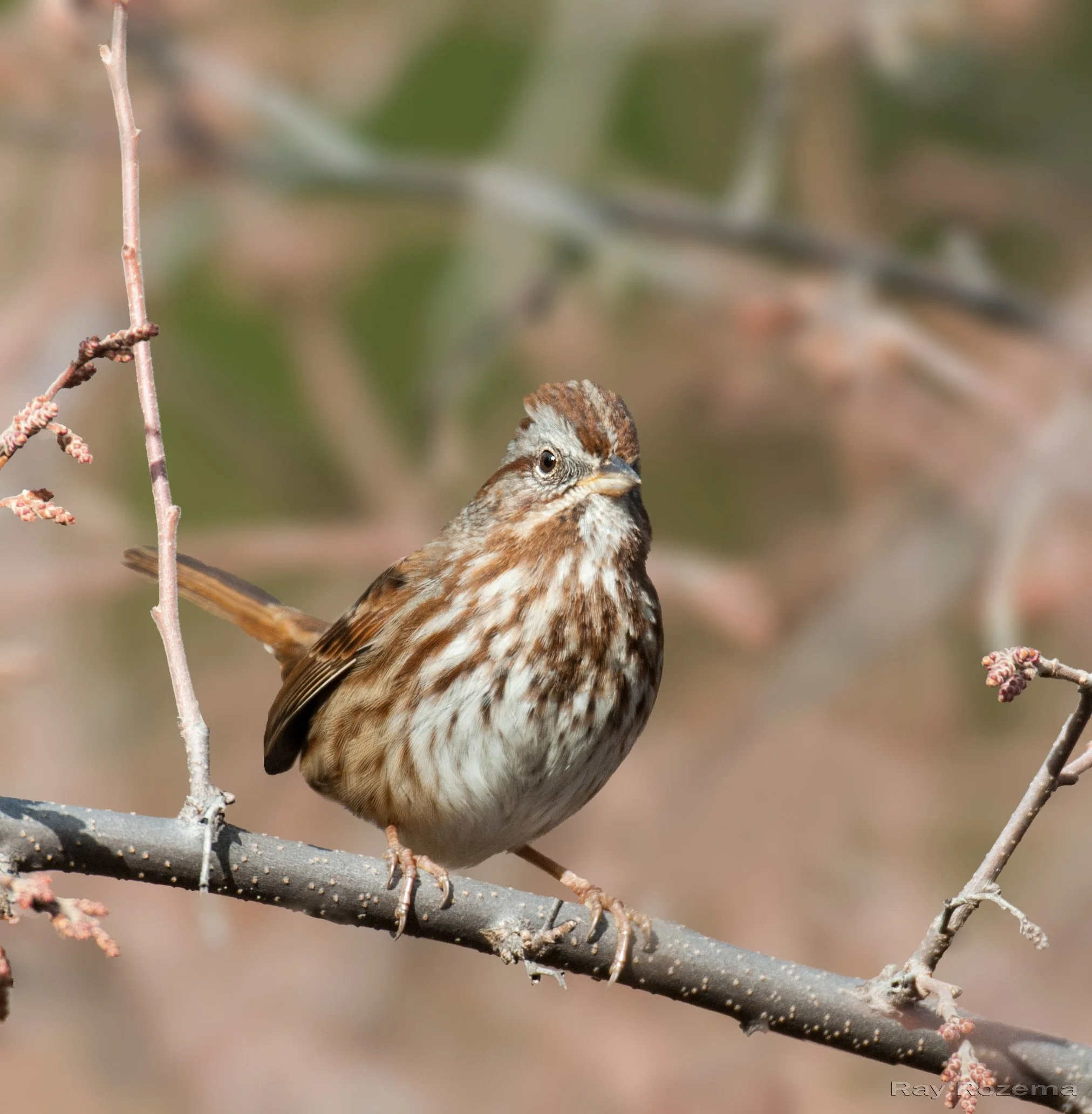
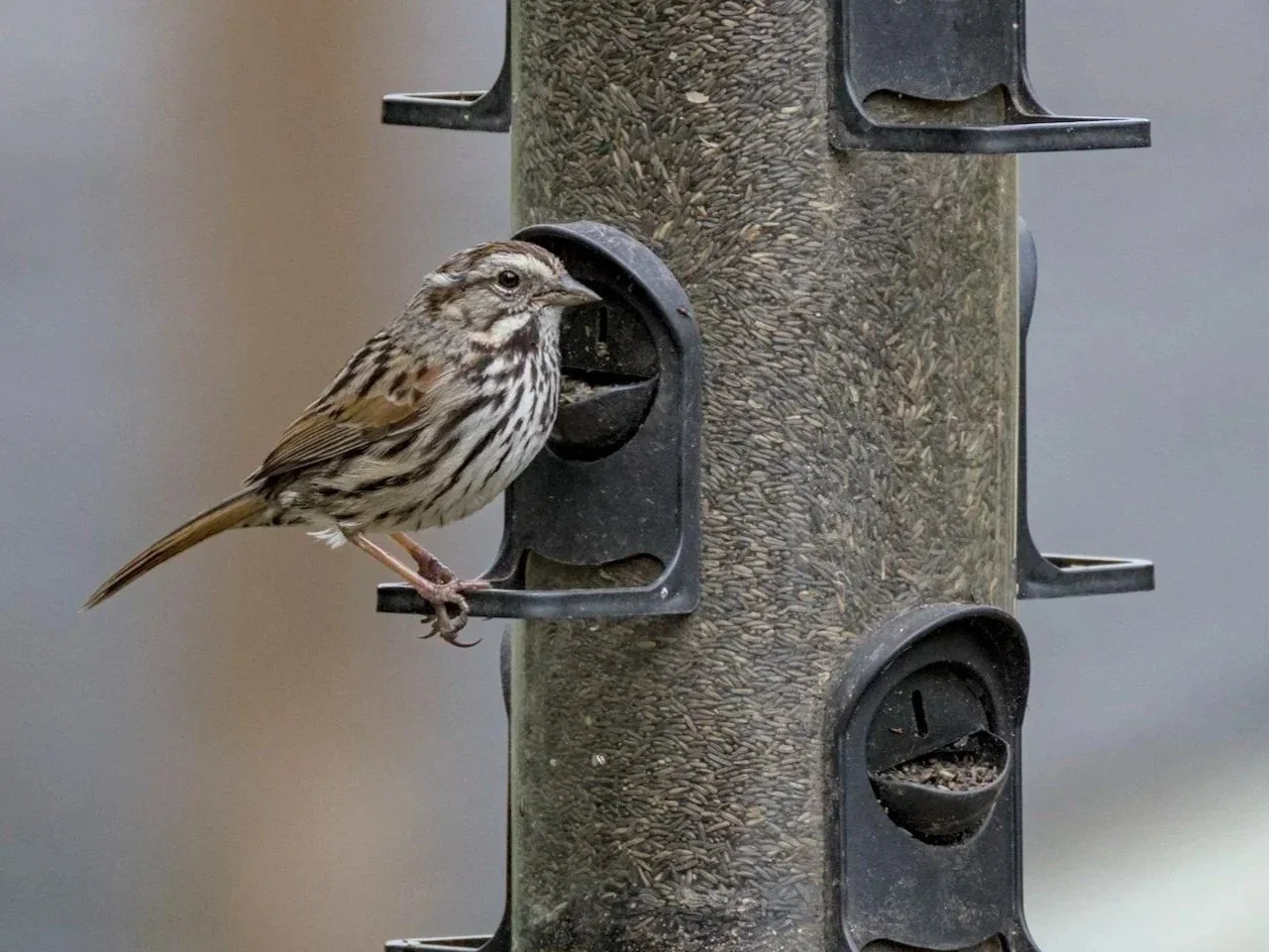
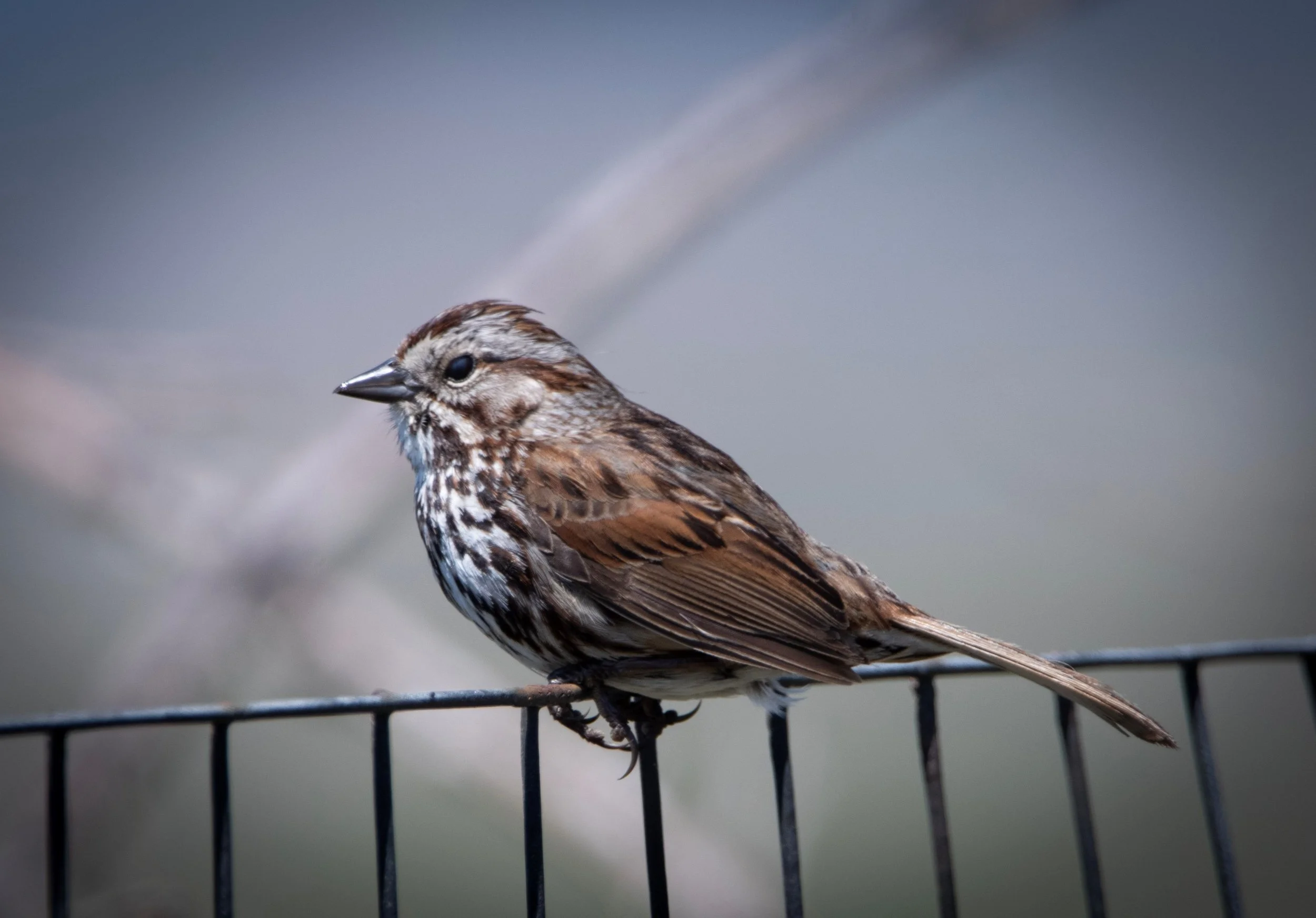
The Song Sparrow is described as a bulky or stocky sparrow approximately 6 inches in length. They are mostly gray and russet-brown birds. They have whitish breasts and flanks that are heavily streaked with brown, short thick bills, thick dark brown splotches or streaks on their upper side, reddish-brown crowns except for a central thin gray stripe, pale bellies, reddish-brown wings and tails, broad gray eyebrows, dark brown stripes running laterally behind their eyes, whitish eye rings, a dark brown and broad streak that begins under their bills and runs down each side of their throats (the malar area), and another light colored streak above the dark malar streak (in the moustachial region). As wish many species of sparrows, there’s often a central dark blotch or spot on their breasts where their streaks merge together. Juveniles are paler overall compared to adult birds. They can lack the central breast spot and have less noticeable facial stripes.

Song Sparrow © Daniel Lee Brown

Song Sparrow © Chris Conard

Song Sparrow © Paul Miller

Where do Song Sparrows live or nest?

Song Sparrows have an extensive range across North America and are found in all 50 U.S. states as well as in Canada and Mexico. Their habitats vary greatly over their wide range. Song Sparrows are often seen near water and in riparian habitats, woodland edges, desert scrub, brushy fields, coastal shorelines, stream sides, fresh and salt water wetlands, open forests, arctic grasslands, and also in urban and suburban neighborhood gardens that have a more lush vegetation. They are not adverse to building nests near humans and will tolerate other Song Sparrow pairs that nest nearby. Males only defend their immediate nesting territory.

Song Sparrow © Ray Rozema

Whereas a pair of Song Sparrows will search together for nest sites, females alone build the nests and incubate the eggs. Incubation takes place about 12-14 days. Their nests are often built on the ground in tall grasses or in marsh vegetation, such as reeds, about 4 feet above ground. However, Song Sparrow nests can sometimes be located higher inside trees or bushes; but are rarely in tree cavities. Their sturdy and cup-shaped nests are completed in approximately 4 days. The outside of the nest is constructed of grasses, leaves, weeds, and strips of bark and the inside is lined with rootlets, animal hair, and fine grass. Both parents help to feed the young. Nestlings fledge (or leave the nest) around 10-12 days after hatching and the fledglings usually stay close to their parents for another 3 weeks. Song Sparrows often lay 2 or more clutches per breeding season.

Many bird species solely rely on ‘an increasing day length’ to indicate when they should begin nesting. It has been discovered that Song Sparrows also use temperature as a gauge on when to begin nesting. They may start nesting earlier when the temperature warms to a desired point even before there’s a significant day length increase.

What do Song Sparrows eat?

Song Sparrow © Timothy Jackson
Song Sparrows often forage (or hunt for food) on the ground but also seek food in bushes, trees, and occassionally in shallow water. They can exhibit a somewhat timid behavior while foraging, staying low, hiding in thickets, and seen only when flying from bush to bush.

There are two main factors that determine what’s on a Song Sparrow’s menu: the time of year and the bird’s habitat. In winter, Song Sparrows eat mostly weed or grass seeds or grains. They will visit backyard feeders if adequate cover is provided and enjoy millet and other seeds. In the warmer months, Song Sparrows continue to eat their staple of seeds and grains, but seek a more high-protein diet consisting of insects, invertebrates, and spiders. (It may be interesting to note that Song Sparrows are particularly fond of Wolf Spiders.) Besides spiders, they eat beetles, caterpillars, ants, wasps, flies, dragonflies, grasshoppers, earthworms, snails, and also small crustaceans when they live near coastal or marshy habitats. Their high-protein diet in the warmer months is necessary because they are working to build nests, produce eggs, and feed their nestlings and ensure their rapid growth. Song Sparrows also consume fruits, such as blackberries, raspberries, and cherries.

Like many other sparrow species, Song Sparrows sometimes use a very efficient technique to uncover food by disturbing the ground called the double-scratch technique. This is where they first hop forward with both feet and then kick the soil and leaves backwards. One source described this technique as the Song Sparrow samba!

What does the Song Sparrow sound like?

Song Sparrow © Larry Hickey

As their name implies, the calls and sweet songs of Song Sparrows are heard throughout the year. Some people have described their songs as: beautiful, melodic, somewhat complex, stuttering, clattering, and musical. Their songs usually begin with three or more loud, well-spaced single notes, followed by a long trill, and end with a few other notes or buzzes. The tempo is said to be somewhat like: Madge-Madge-Madge, put-on-your-tea-kettle-ettle-ettle. The flight call of Song Sparrows is a high-pitched and thin seeet. Their other calls are described as: a husky jimp, buzz, chirp, chip, or whistle.

Males frequently sing while perched and exposed on top of a bush or cattail, especially during nesting season. They often sing to attract a female or to defend their territory. Females also sing; but do so less often. Their songs are usually softer and shorter. When females sing, it usually happens just prior to their nest-building activities.

You can listen to some calls and songs of Song Sparrows below. All sound files sourced from xeno-canto.org/.

Song Sparrow (Melospiza melodia heermanni), song
Steve Hampton
Song Sparrow (Melospiza melodia), call
Thomas Magarian
Song Sparrow (Melospiza melodia gouldii), song
Joseph Morlan
Song Sparrow (Melospiza melodia melodia), call
Greg Irving
Song Sparrow (Melospiza melodia), "tseet" call
Paul Marvin

This article was compiled by Jane Van Kessel.

Sources include Cornell’s All About Birds, Cornell’s Birds of the World, National Audubon Society’s Online Field Guide, 150 Frequently Seen Birds of California’s Great Valley, pages 268-9, National Geographic Field Guide to the Birds of North America, 2nd Edition, pages 737-8, Sibley Field Guide to Birds of Western North America, page 422, and Animal Diversity Web.

Song Sparrow © Dana J. Miller-Blair

Song Sparrow © Paul Miller

Song Sparrow © Rich Howard

Meet the Sandhill Crane

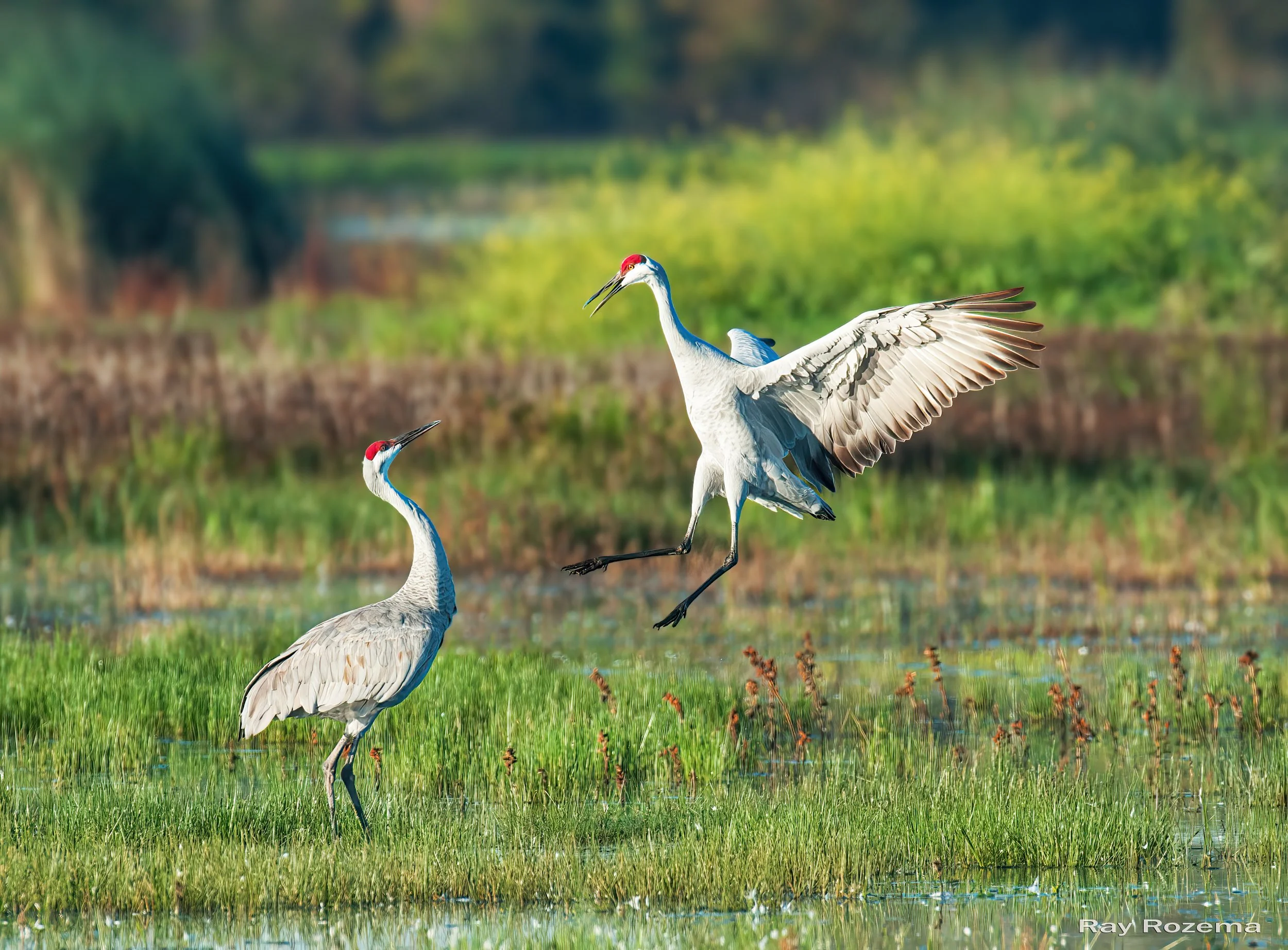
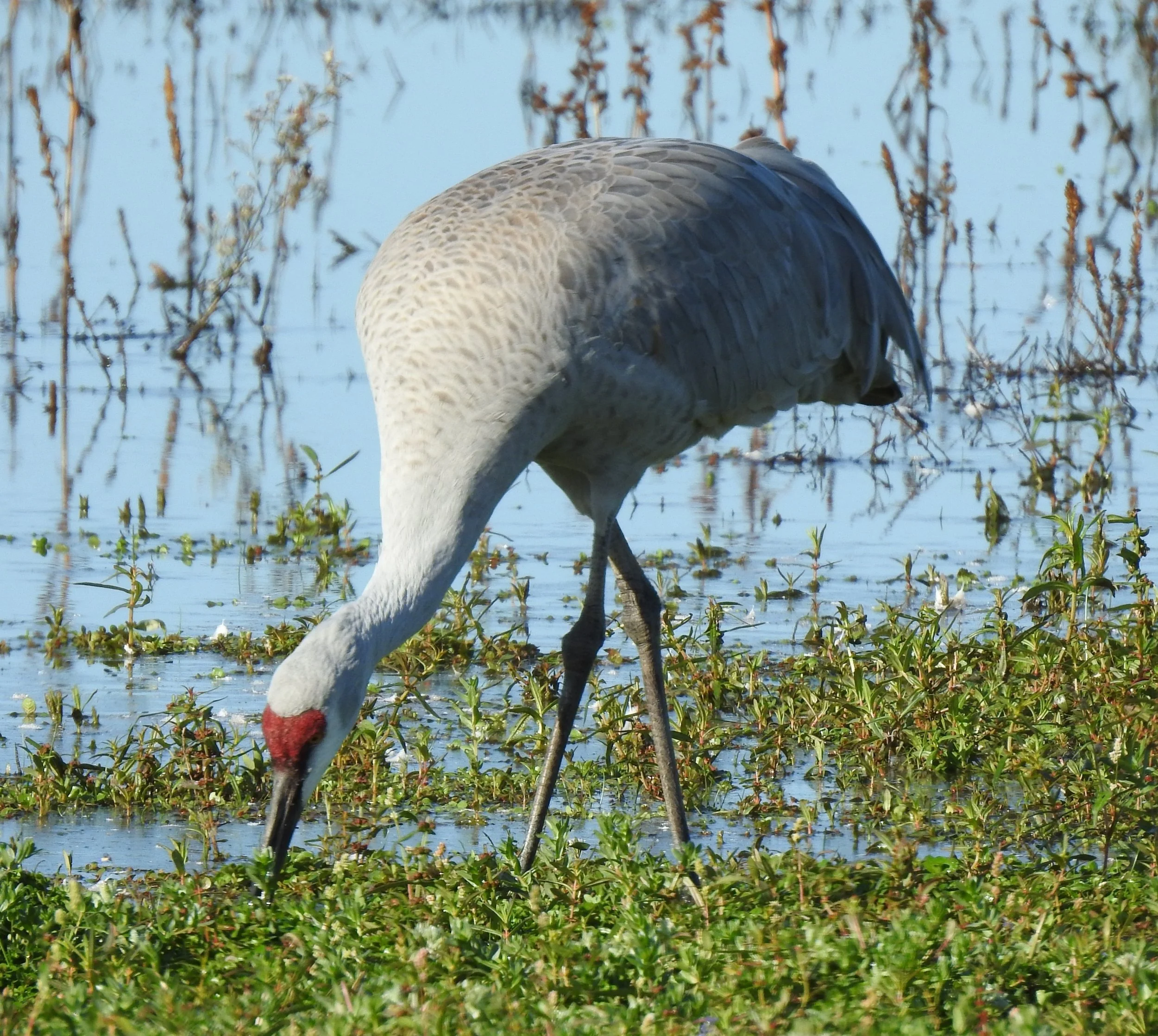
Sandhill Cranes, dancing, © Ray Rozema

This month, let’s learn about a tall and graceful wading bird called the Sandhill Crane (Antigone canadensis). This species has one of the longest histories in fossil records for birds still alive today. The earliest Sandhill Crane fossil is estimated to be 2.5 million years old. They are social birds and usually live in pairs or family groups throughout the year. Pairs remain together for life and are known for their dancing skills. Although the dancing occurs most often in the breeding season, the cranes can dance all year long. During courtship, pairs may perform elaborate "dances” by spreading their wings, leaping into the air, and calling to each other.

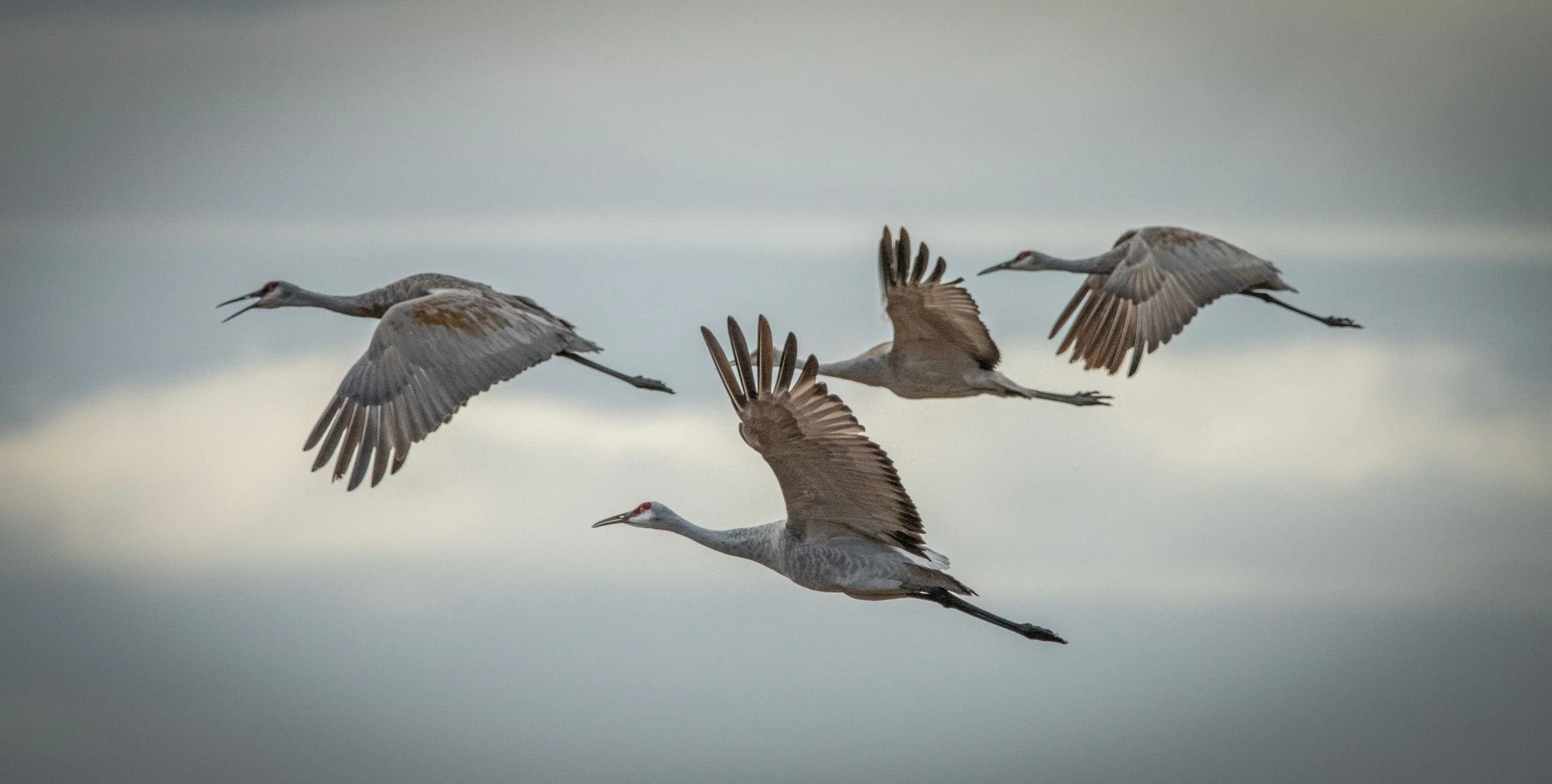
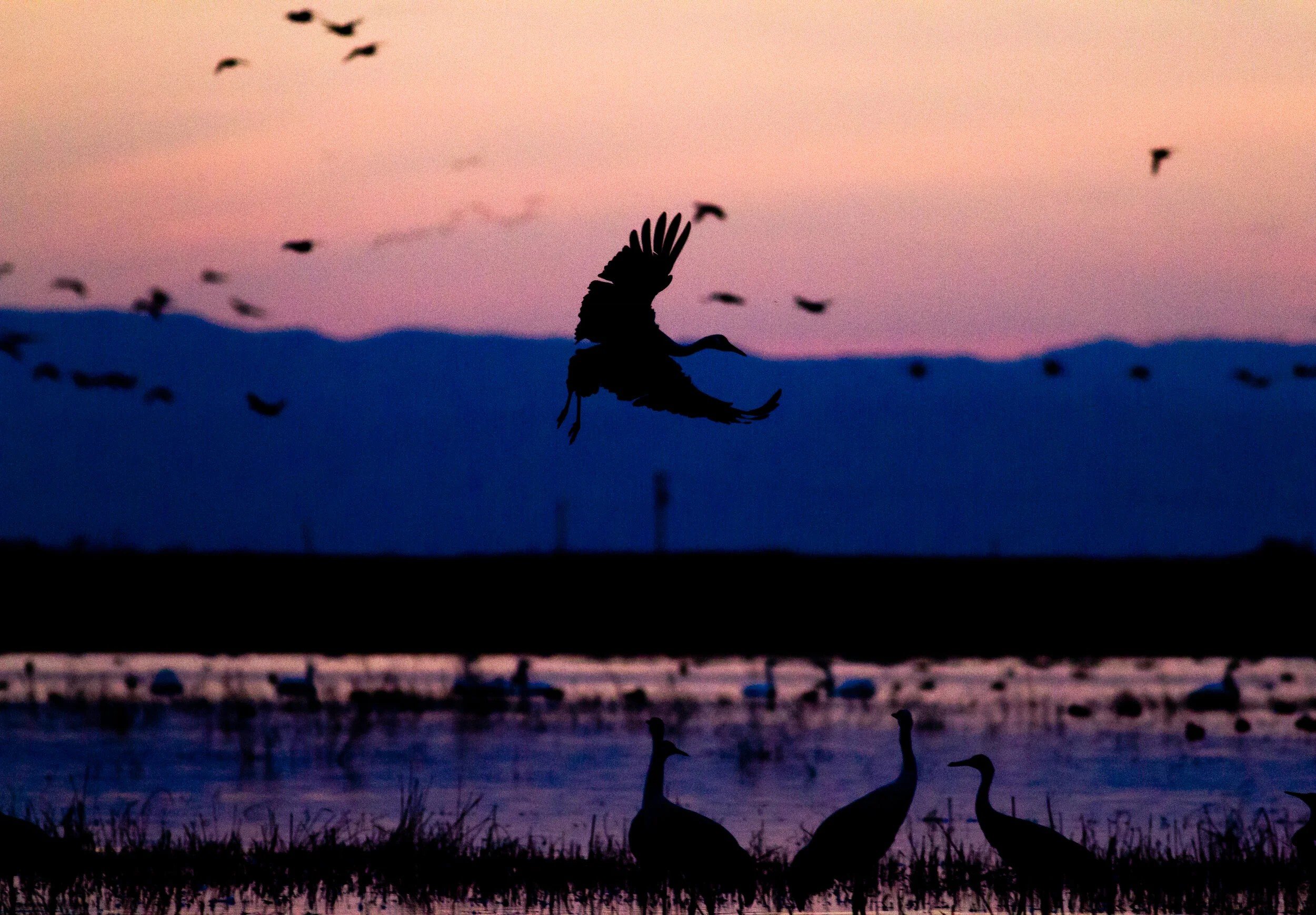
Every year, Sacramento Valley residents welcome the Sandhill Cranes’ fall arrival. The birds’ familiar calls prompt us to look upward. Seeing them fly so high with their broad, outstretched wings is always amazing and humbling. We realize they have flown such a long distance to be here. Throughout the winter, Sandhill Cranes can usually be found in large numbers at area Delta hotspots such as Stone Lakes, Cosumnes River Preserve, Staten Island, and Woodbridge Ecological Reserve.

The majority of Sandhill Crane are migratory. There are five known ‘subspecies’ of Sandhill Cranes. Two of these migratory subspecies are seen in the Sacramento Valley, the Greater (A. c. tabida) and Lesser (A. c. canadensis). The three other subspecies are non-migratory and live year-round in Mississippi, Florida, and Cuba.

Because Sandhill Cranes use upper currents of warm air (or thermals) to obtain lift, they are able to soar for many hours without consuming much energy. Not having to flap their wings conserves energy. When Sandhill Cranes fly, their necks are outstretched, their feet trail behind their tails, and they are often in a V formation.

Sandhill Cranes, © Paul Miller

What do Sandhill Cranes look like?

Sandhill Cranes, adult and juvenile © Mary Forrestal

Sandhill Cranes, adult and juvenile © Mary Forrestal

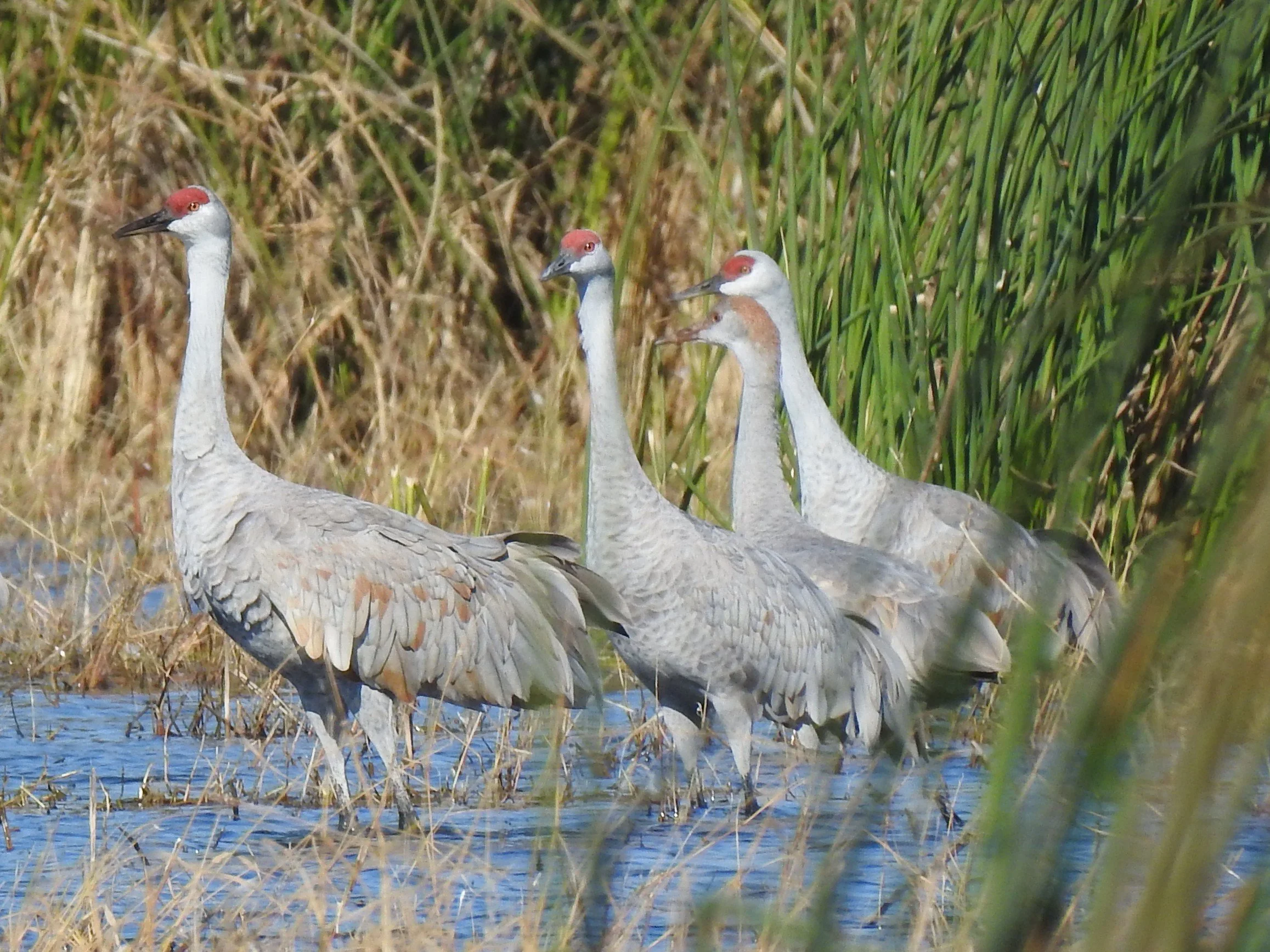
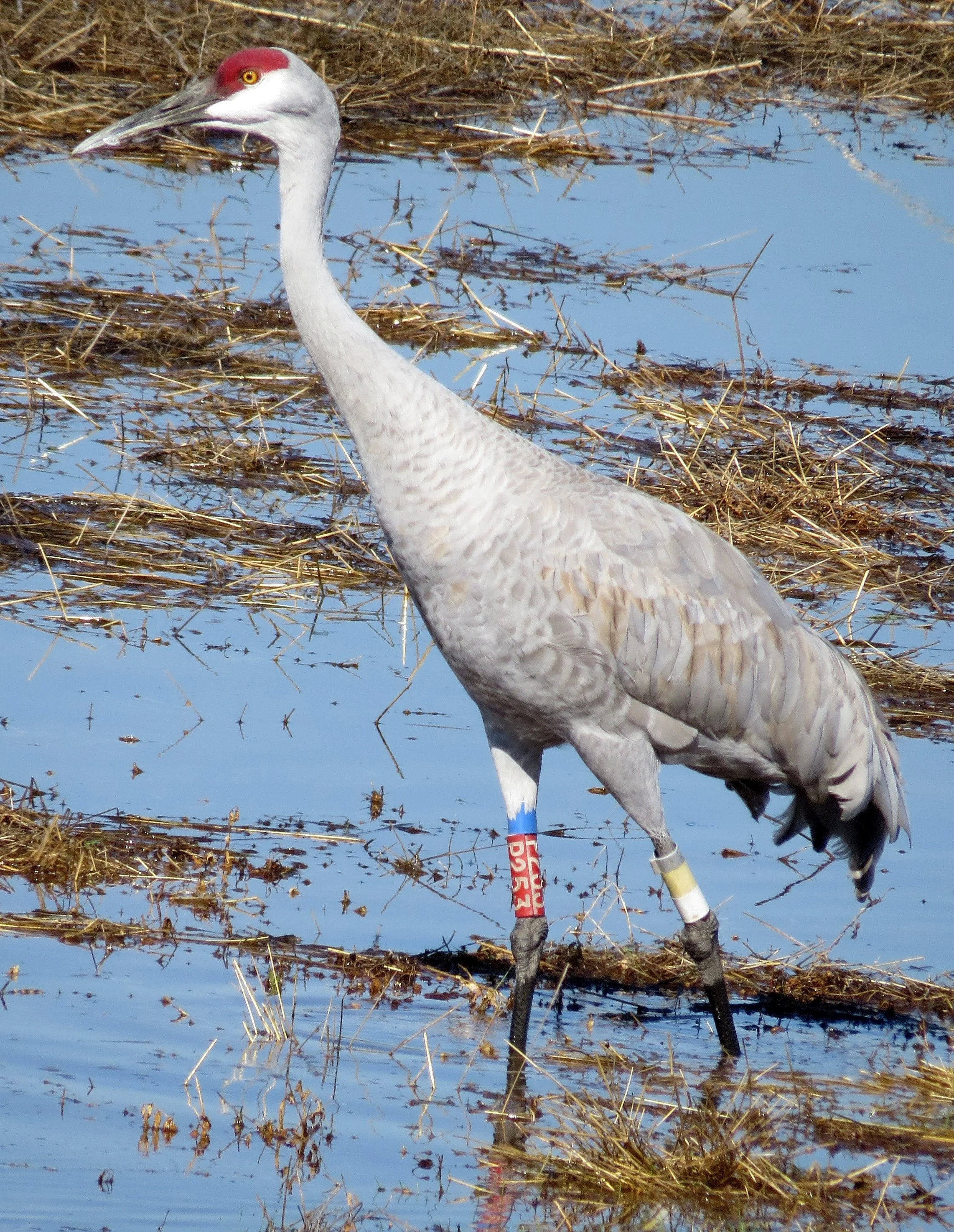
At first glance, Sandhill Cranes look somewhat similar to herons. However, the two have a few different physical characteristics. Sandhill Cranes have shorter bills and also have characteristic hind-end feathers which hang down towards the ground which herons lack. Adult Sandhill Crane males and females are similar. They have long, slender bodies, are mainly ashy-gray (but can also have tan or orangish-tan feathers in summer caused by iron oxide staining from the soil in some locations), have yellowish eyes, long necks, long dark legs, have bright red forehead skin patches that partially encircles their eyes, broad, pointed, and fingered wings, long, dark, sharp, and pointed bills, short tails, and white cheeks, chins, and throats. Their wingtips are a little darker than the rest of their wings, which is easier seen in flight. Immature birds lack the red crown and white cheeks. Instead, they have pale to rust-colored crowns, brownish heads, gray underparts, and their necks, backs, and wings are mottled with a rusty color. Much of the rust-brown color will fade by the first winter; but full adult plumage is not reached for over two years.

Of the two subspecies of Sandhill Crane seen in the Sacramento Valley region, the Greater subspecies is slightly larger than the Lesser. The Greater also has a larger red crown area.

Where do Sandhill Cranes live or nest?

Sandhill Crane, © Chris Conard

Sandhill Cranes are found at various times of the year in open grasslands, savannas (areas mixed with scattered trees and grasslands), meadows, coastal areas, marshes, river valleys, agricultural fields, edges of large bodies of water, shallow wetlands for roosting at night, tundra, and boreal habitats. During migration and winter, unrelated cranes come together to form huge flocks that forage (hunt for food) and roost (rest) together. These large groups number sometimes in the thousands!

In spring, the migratory subspecies of Sandhill Cranes travel north to breed in Canada, Alaska, Siberia, and a few areas in the northern-most United States. In winter, they migrate south to central California, the far-southern U.S., or Mexico. They spend the daytime in croplands, pastures, grasslands, or wetlands. At night, they roost in areas where shallow water surrounds them which tends to discourage predators. Seasonal rain and the planned flooding of fields provide them with larger and safer roosting areas. They can form large flocks in winter of over 10,000.

Sandhill Cranes were named for one of their migratory stopover points (or staging areas). Large numbers of cranes congregate from February to early April on the edge of the Nebraska Sandhills on the Platte River basin. Birds migrating to their northern breeding grounds use this crucial area to rest and consume nourishing food before they finish their long journey.

Sandhill Cranes are ground nesters and nest once per year in open wetlands, marshes, fields, and prairies. Of the two subspecies that come to the Sacramento Valley, the Lesser subspecies nests in far-northern tundra habitat and the Greater subspecies nests in grasslands or muddy ground further south. Sandhill Cranes prefer to nest in areas where plants are growing in standing water. Their nests may actually float on the water and are anchored to nearby plants. Nests are 30-40 inches across and 4-6 inches high. Sometimes Sandhill Cranes will also nest on dry ground. Sandhill Cranes build their nests out of surrounding plant material and there are usually two eggs per nest (sometimes 1 or 3). Both parents help build and tend to the nest Males will also guard the nest. At the time of hatching, the chicks are well-developed, covered with down, active, and have open eyes. The young usually leave the nest within a day after hatching and will then follow their parents. Both parents feed their young until the young learn to feed themselves. Sandhill Cranes will defend both themselves and their young from aerial predators by jumping and kicking. If land predators such as dogs, foxes, and coyotes attack, the birds begin to hiss and will advance forward with open wings and pointed bills. Sandhill Cranes may both kick and use their bills to stab a predator. Their sharp bills can be lethal; even coyotes have been killed. The young begin to fly at 2-3 months of age, just in time to join their parents on their first fall migration journey. They will remain in close proximity to their parents for about 9-10 months.

What do Sandhill Cranes eat?

Sandhill Crane foraging for food © Mary Forrestal

Sandhill Cranes have a varied diet and are said to be opportunistic feeders. They will change their diet to what’s available in their current habitat. Sandhill Cranes are omnivorous which means they eat foods of both plant and animal origin. Their diet consists mostly of plants (berries, bulbs, tubers) and grains. They readily eat cultivated foods such as corn, wheat, and cottonseed. Sandhill Cranes will also eat invertebrates, small mammals, amphibians, and reptiles.They often probe for food underground by inserting their bills below ground level. Except during the breeding season, Sandhill Cranes mostly forage in flocks.

What do Sandhill Cranes sound like?

Sandhill Cranes do not have a voice box (or larynx) like humans to produce sound. Their tracheas (or windpipes) are extremely long and reach from their necks to their sternums (or breastbones)! The unique anatomy of their tracheas enables Sandhill Cranes to produce their long-ranging sounds. The calls made by Sandhill Cranes have been described as either loud or soft, distinctive, rattling, rolling, sharp, bugling, or yodeling. Young birds have a very different call which has been described as being high-pitched or squeaky. Some say they sound like crickets.

Sandhill Crane pairs have duet calling sessions when they call to each other in unison. It’s thought that these events create a strong pair bond. The female makes two calls for every one from the male.

You can listen to Sandhill Cranes’ sounds below. All sound files sourced from xeno-canto.org/.

Sandhill Crane (Antigone canadensis), call
Thomas Magarian
Sandhill Crane (Antigone canadensis), begging call, call
Thomas Magarian
Sandhill Crane (Antigone canadensis), duet, call
Sue Riffe
Sandhill Crane (Antigone canadensis), call flying over a lake in Alaska
Sue Riffe
Sandhill Crane (Antigone canadensis), call, large distant flock
Richard E. Webster

This article was compiled by Jane Van Kessel.

Sources include Cornell’s All About Birds and Cornell’s Birds of the World, National Audubon Society Field Guide, 150 Frequently Seen Birds of California’s Great Valley, pages 76-77, National Geographic Field Guide to the Birds of North America, 6th Edition, page 162, Wikipedia, National Wildlife Federation, Ducks Unlimited

Sandhill Cranes, © Elliott Chasin

Meet the Western Meadowlark

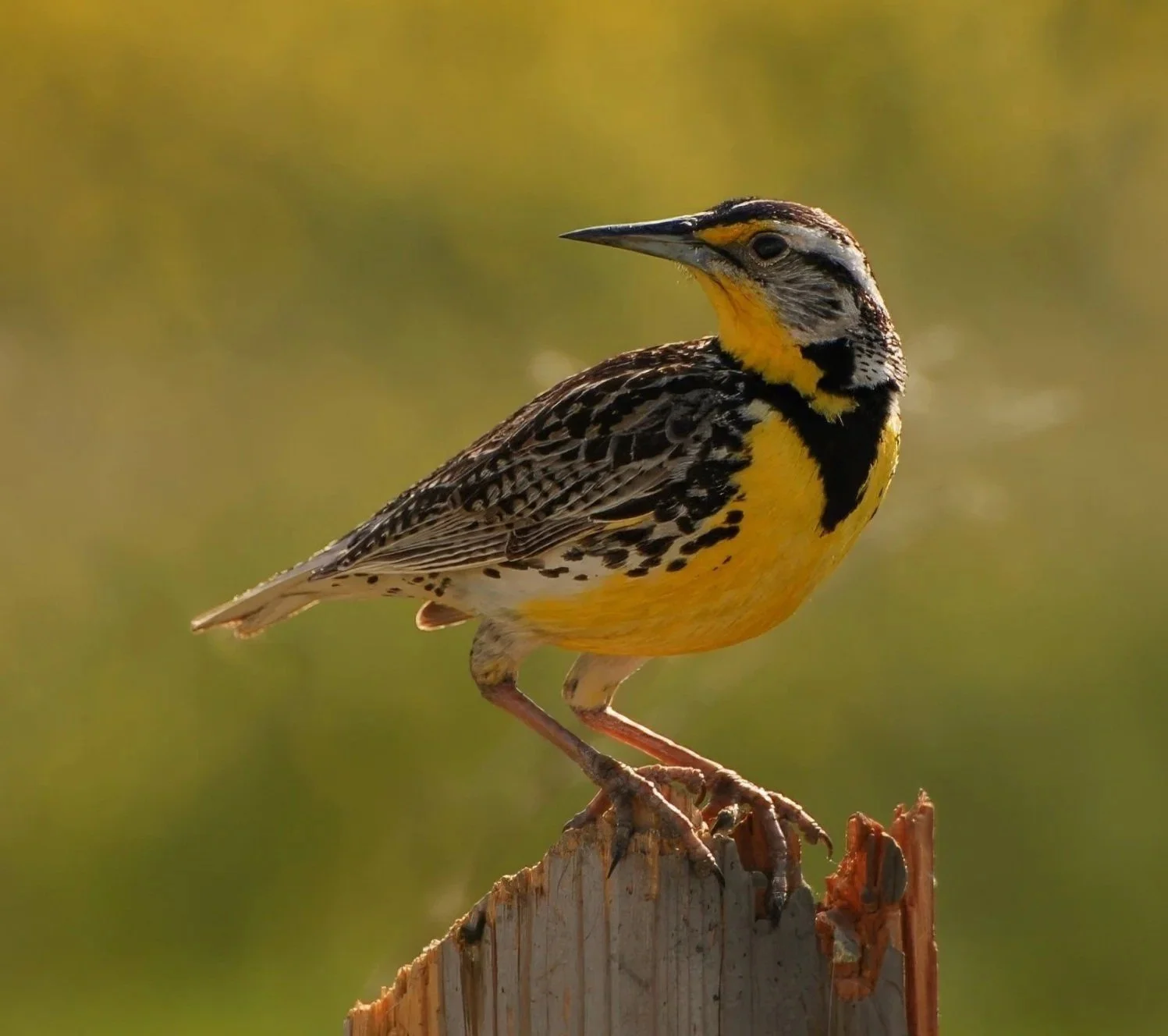
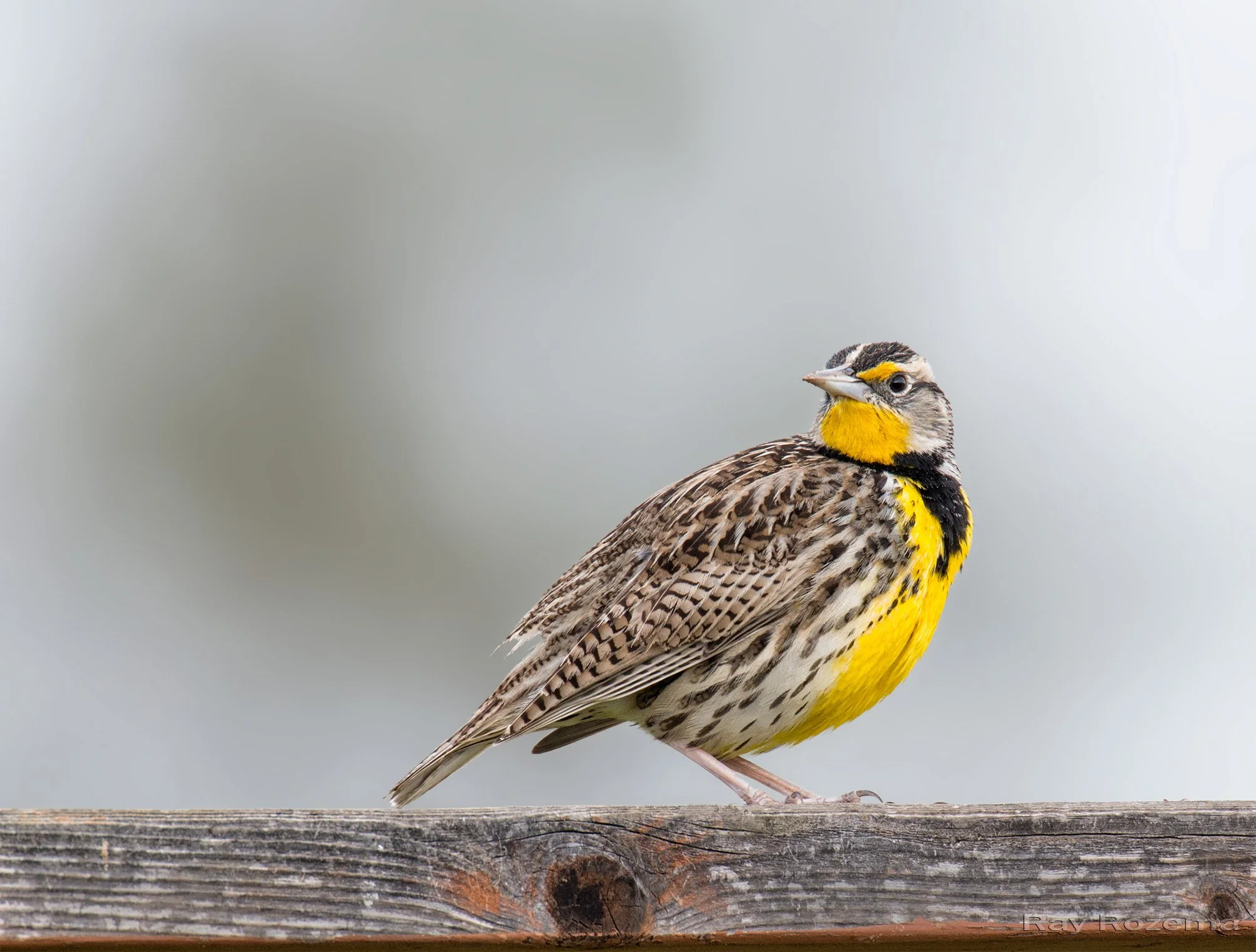
Western Meadowlark © Ray Rozema

This month, let’s learn about a song bird that lives year-round in California’s Central Valley, the Western Meadowlark (Sturnella neglecta). They are regularly found from the Pacific Ocean across to Michigan and up to Canada and south to northern Mexico. Western Meadowlarks are permanent residents in the western and south-central parts of their range. In contrast, the populations in the northern U.S. and Canada migrate south for the winter. Some winter as far away as northern Mexico.

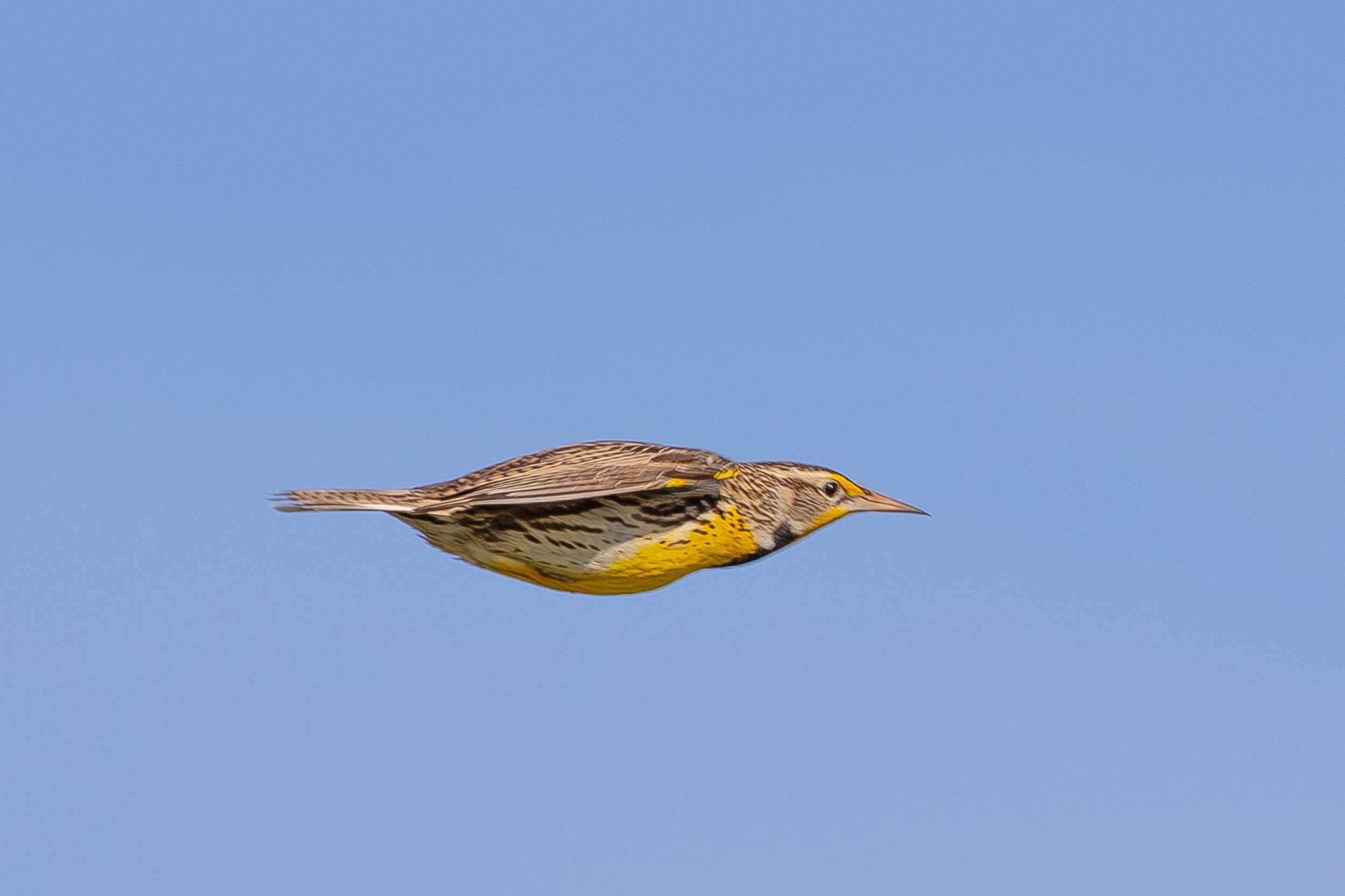
The Western Meadowlark is a vividly colored species and has a glorious song. No wonder six states in the U.S. have designated the Western Meadowlark to be their state bird! Meadowlarks are not related to birds in the lark family. Instead, they are closely related to blackbirds and orioles. In some Midwest states, Western Meadowlarks are referred to as thunderchunks. This is because their vocalizations can be quite loud and they are “plump or chunky-shaped” birds. One will often hear Western Meadowlarks sing or call prior to seeing them. If you are lucky, you may see one perched on a fence or on the ground foraging (or searching for food). Unfortunately, one may only get a brief glimpse of these birds before they quickly vanish into vegetation. When taking off in flight, they start with brief, quail-like bursts; then they alternate between quick flaps and short, stiff glides.

Western Meadowlark in flight © Larry Hickey

Take a minute to look at the second part of the Western Meadowlark’s scientific name “neglecta.” Western Meadowlarks were given this name because for a very long time they weren’t appreciated. They were thought to be individuals of another species called the Eastern Meadowlark. It wasn’t until the mid 1850’s that Western Meadowlarks were identified as a separate species. There is also a third and recently recognized (2022) meadowlark species, called the Chihuahuan Meadowlark. The ranges of these species overlap in specific areas but not in the Sacramento Valley. All three species are similar in shape, color, and pattern. However, they have different vocalizations and have some slight differences in their physical structure and/or plumage color.

What do Western Meadowlarks look like?

Western Meadowlark, adult © Susie Nishio

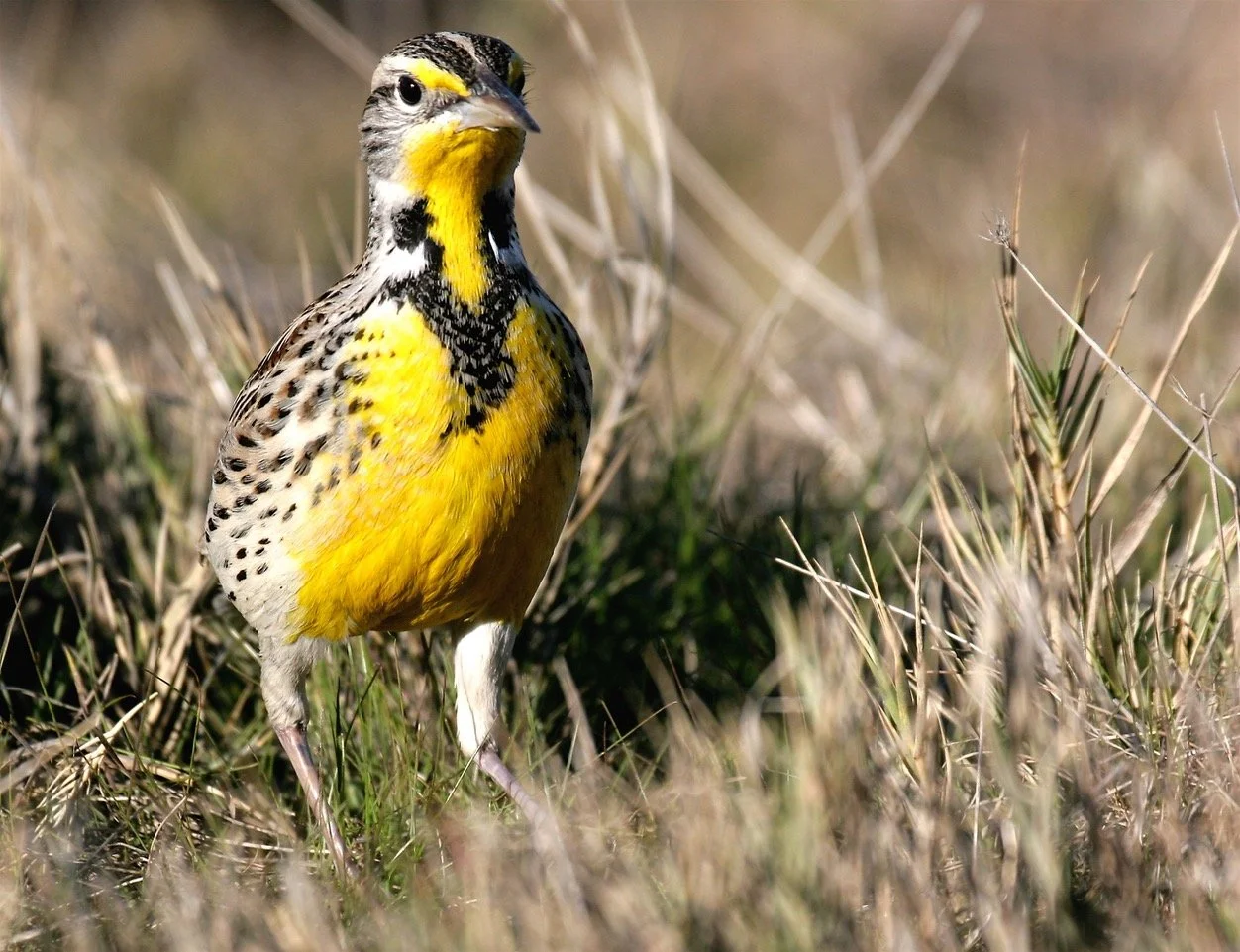
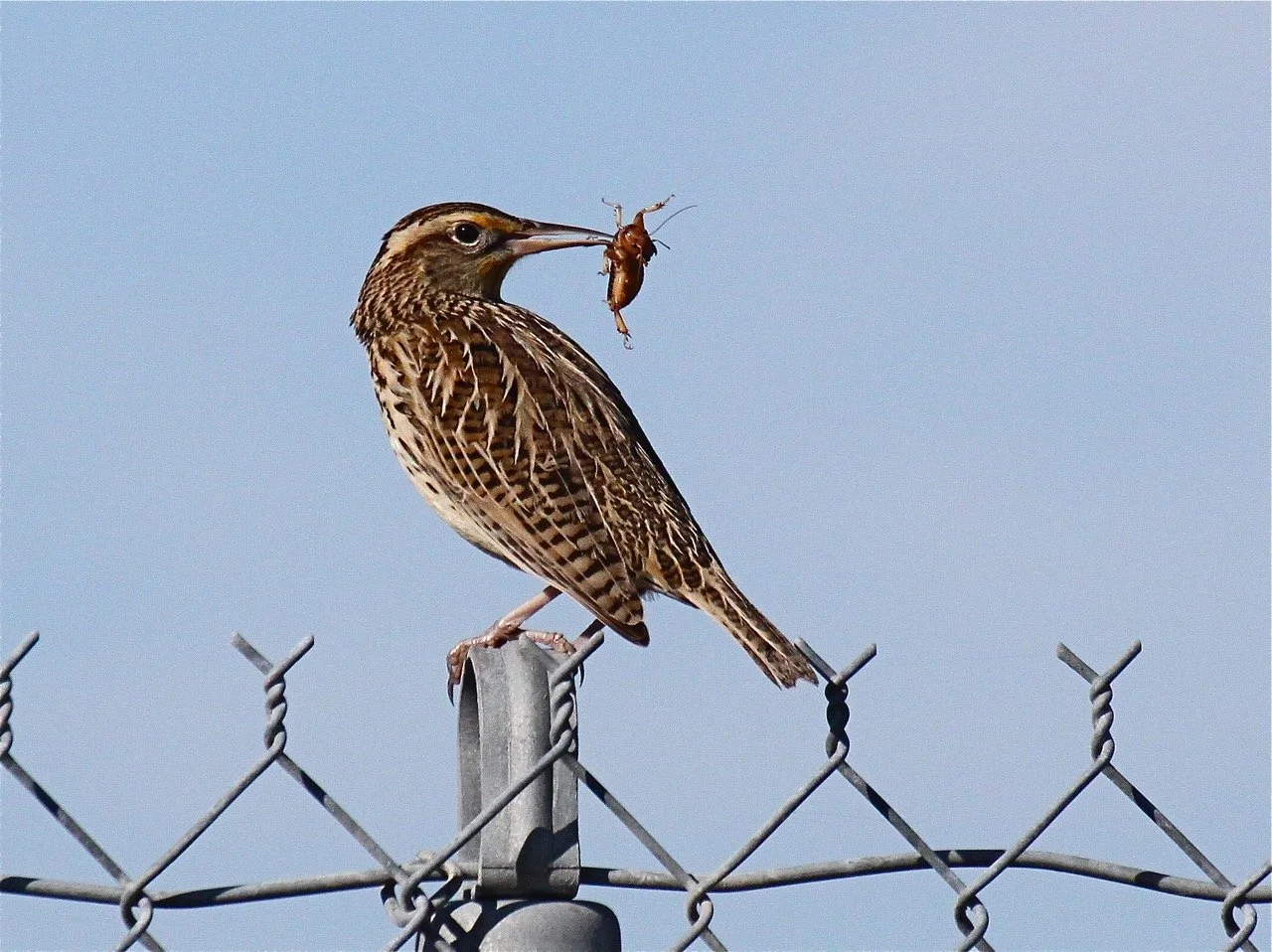
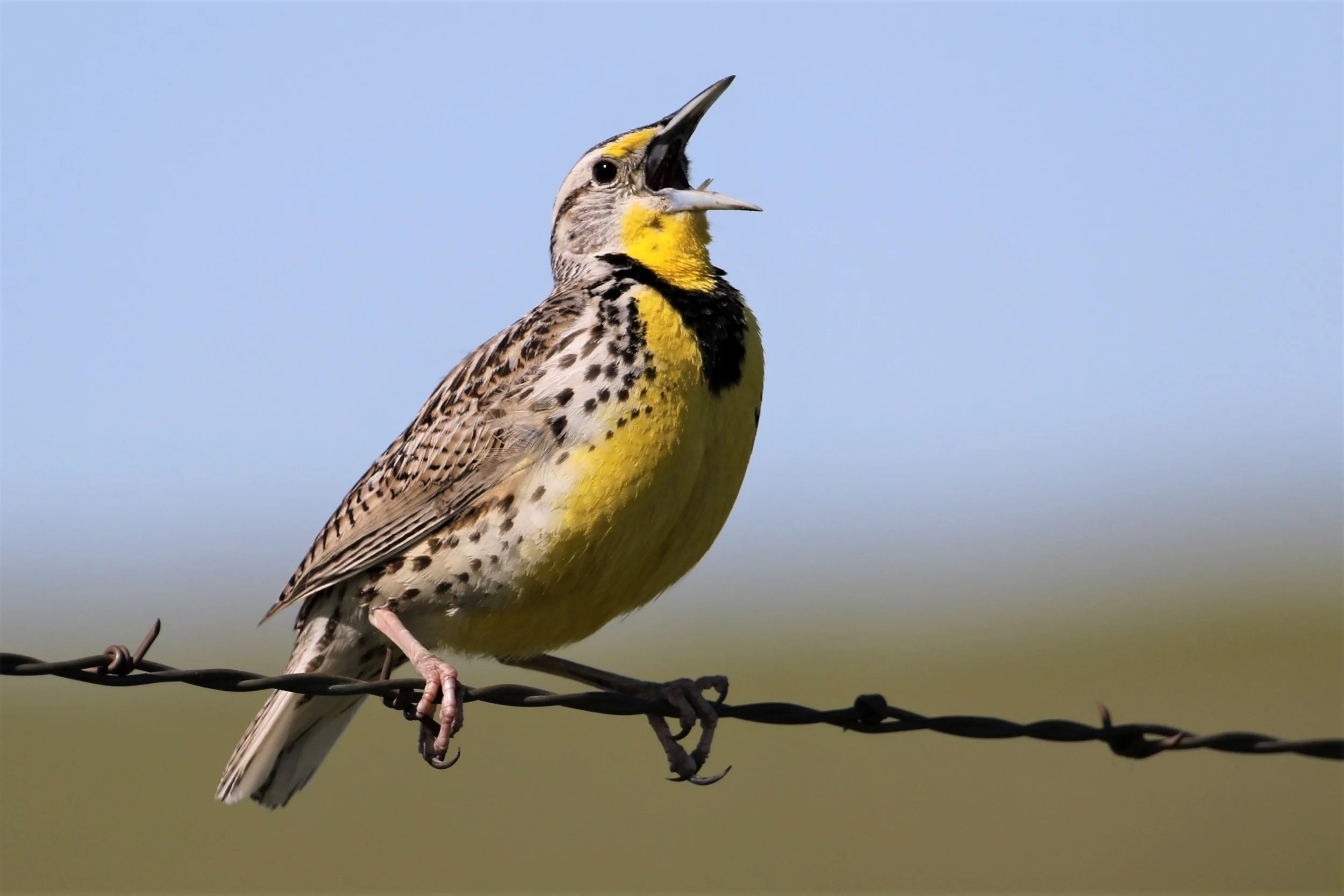
Western Meadowlarks are around 9 inches in length. Female birds look similar to males but are slightly duller. In the spring and summer, Western Meadowlarks have bold yellow throats and chests with contrasting black V-shaped necklaces, tannish-brown and black plumage on their backs, tails, and wings, tan sides (or flanks) with dark streaks and spots, fairly short tails with white outer tail feathers (seen more often in flight on takeoff and landing), long, slender, slate or clay-colored bills, dark eyes, and long pink legs. Their heads are striped with light brown and black bands. Their light colored middle band changes to a bright yellow from the eye to the bill. Juvenile birds have paler bellies, less streaking of their flanks, pinkish bills, and the black chest Vs are absent.

After Western Meadowlarks molt and grow new feathers in the fall, the new feathers have a veil (or covering) over them which is tan or buff in color. During this time, Western Meadowlarks are less colorful. By early spring, this covering wears off and their breast plumage becomes a bright yellow which remains throughout the summer.

Where do Western Meadowlarks live and nest?

Many people do not see any value in non-developed dry fields. However, these dry grass fields are very desirable and  critically necessary habitats for Western Meadowlarks. Western Meadowlarks actually avoid areas with dense trees and shrubs and require wide open spaces to nest and hunt for food. One can find them in open grasslands, meadows, prairies, agricultural fields, weedy fields, pasturelands, and along marshes. They are very sensitive to human disturbance and will abandon their nests if they feel at all threatened.

Western Meadowlark © Ed Harper

Western Meadowlark females select nest sites on the ground and in a concealed location. Their nests are usually located in a slightly depressed spot (or slightly lower than the surface). The females independently construct cup-shaped nests out of grasses which takes 6-8 days to build. Frequently, the females also construct domed-shaped coverings over the nests to protect them from the sun and/or rain, etc. They make these “domes” by weaving grasses and shrub stems together and will anchor them to surrounding shrubs. Female Western Meadowlarks will also make tunnels going from the nest to the grasslands to have safe passage for foraging: both for herself and her future fledgelings. The female also solely incubate the young. The incubation period lasts for about two weeks. Males protect the nesting territory and will aggressively chase intruders away. Males also bring insects to the nest that the female will feed to the young. The young leave the nest (or fledge) in about 10-14 days after hatching and begin to learn how to forage. The parents continue to care for them for two additional weeks until they are able to skillfully fly.

What do Western Meadowlarks eat?

Western Meadowlark © Ed Harper

The diet of Western Meadowlarks changes with the seasons. They eat mainly grains in the winter and early spring, switch to insects during the nesting season, and consume weed seeds in the fall. In the early 1900’s, grain growers thought that Western Meadowlarks greatly harmed their crops. After research was done, it was discovered that these birds actually eat a great number of crop-damaging insects!

Western Meadowlarks’ diet includes grain, weed seeds, beetles, caterpillars, sow bugs, snails, spiders, ants, cutworms, grasshoppers, and crickets. They will occassionally eat eggs from other grassland birds and roadkill in extreme winters. In the winter, they will often feed in flocks.

The long, slender bill of the Western Meadowlark is perfect for grabbing insects. Western Meadowlarks also have very powerful muscles used to open and close their bills. Because they have these extra strong muscles, they are able to use a special foraging technique called gaping. First they penetrate the soil with their long bills and then force open their bills wide underground. This creates a hole in which Western Meadowlarks find buried insects and larvae.

What do Western Meadowlarks sound like?

Western Meadowlark © Chris Conard

The beautiful and familiar song of a Western Meadowlark can perk up a listener’s ears and spirits. Western Meadowlarks’ vocalizations have been described as “whistles that speed up to a bubbling jumble”, “watery sounds”, “bell-like”, “warbles”, “a dull rattle in flight”, “a sharp chuck or chuk note”, and “flute-like gurgles going down the scale”. When you can listen to the Western Meadowlark and may wish to come up with your own descriptions.

You can listen to the sounds of the Western Meadowlarks at xeno-canto. https://xeno-canto.org/species/Sturnella-neglecta.


Meet the Killdeer

This month let’s learn about an interesting shorebird in the plover family called a Killdeer, (Charadrius vociferus). Killdeers somewhat tolerate human presence so it is fairly easy to observe them, at least from a distance. Their calls are frequently heard before they are seen. They tend to vocalize after the slightest disturbance or whenever a potential predator comes into view. Killdeers make a call that sounds similar to their name and this is why they were given their common name. The species name, vociferus, means “shouting” or “yelling” in Latin so that name is quite fitting too.

Killdeer, adult © Ed Harper

Killdeer populations can be found in many regions of the U.S. and in Newfoundland, Canada, Mexico, Central and South America, and the Caribbean. 

Killdeer populations are either “resident” species or “medium-distance migrants”. In the Sacramento region they live here year-round. This is also the case for other populations in the southern half of the U.S. and along the Pacific coast. In contrast, the populations that nest in the colder, northern states migrate south for the winter. Some populations migrate as far south as South America! It is interesting that migrating Killdeers often fly over populations that are non-migratory.

Killdeers are often solitary birds or are seen in pairs during the nesting season. They are not known to gather into large flocks but may form small groups when lingering in their summer habitats or during migration.

Killdeers travel by walking or running on the ground or by direct flight with rapid wing beats. They are good swimmers but aren’t seen in the water very often.

What do Killdeers look like?

Kildeer, adult © Paul Miller

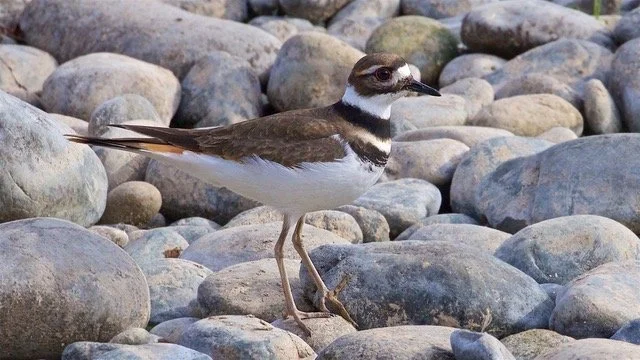
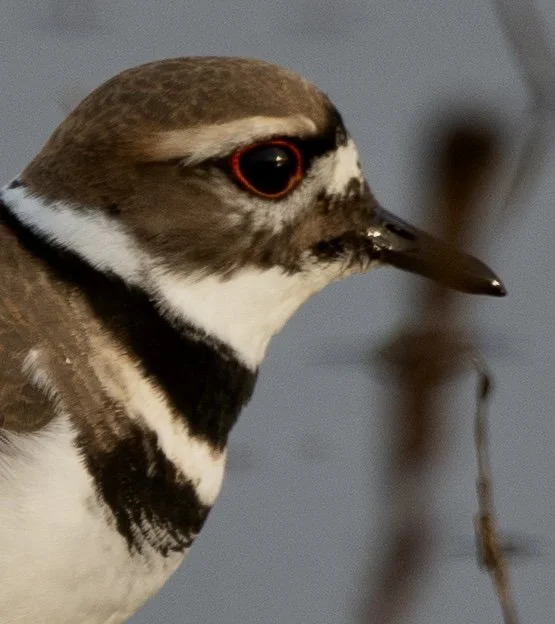
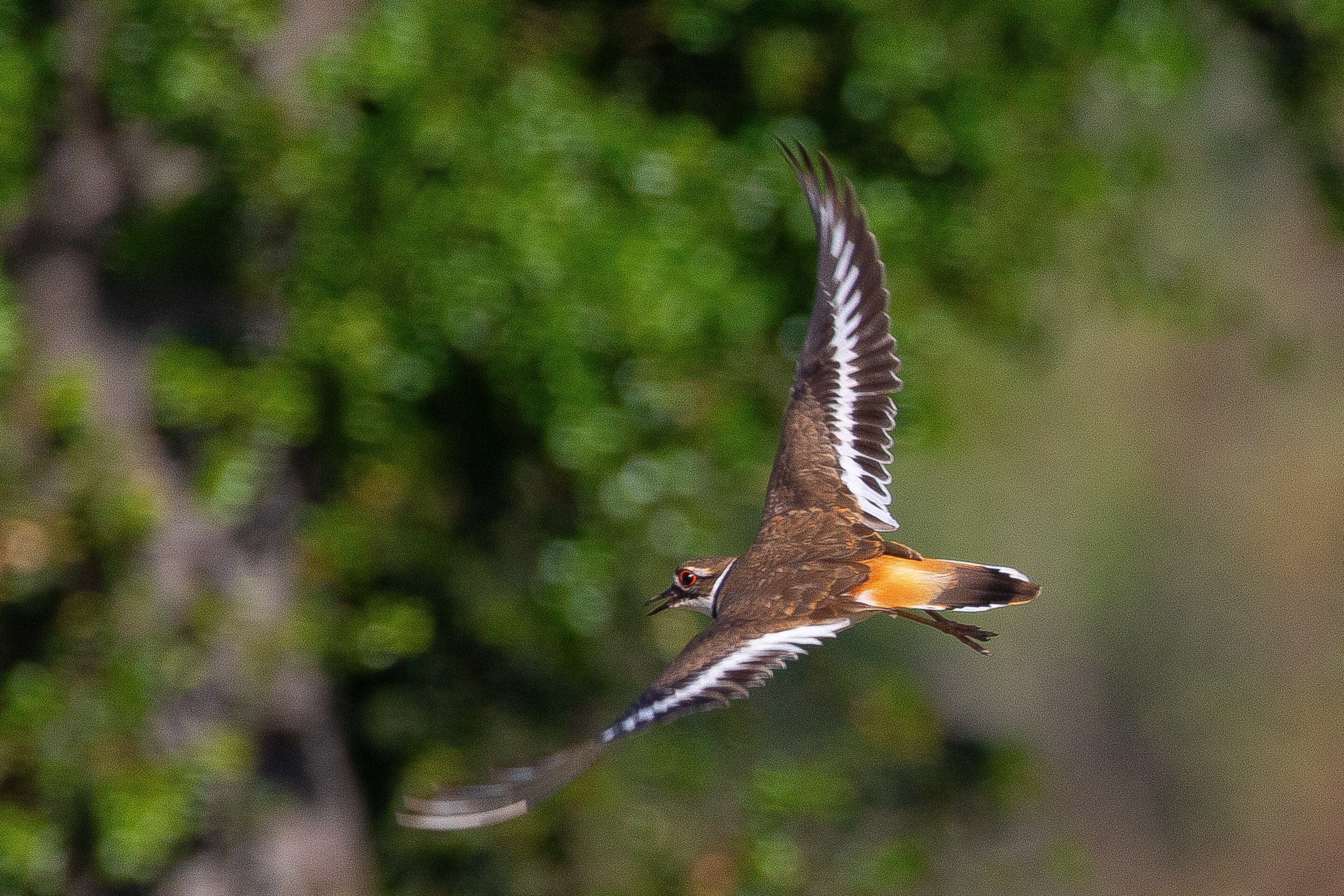
Killdeers are tall, slender birds about the size of American Robins. Adult males and females look similar. They have two distinctive, dark chest bands with the upper band continuing around the neck. It's the only plover in North America with two breast bands and is the largest of the ringed plovers. Their chest bands contrast greatly with their white chests. Some sources report that the chest bands and/or facial markings of females are duller. Killdeers have bright white collars, red eye rings, short dark bills, white foreheads, white stripes behind their eyes, long flesh-colored legs, long tails, grayish-brown backs with reddish feather edges, brown heads with areas of black and white, orange rumps, and brown upper tail feathers. Their wings are long and pointed which enable them to fly fast and maneuver quickly. Black feathers with a white central band are visible on outstretched wings. In flight, they have noticeable orange (or rusty) midline tail feathers.

Killdeer, adult © Larry Hickey

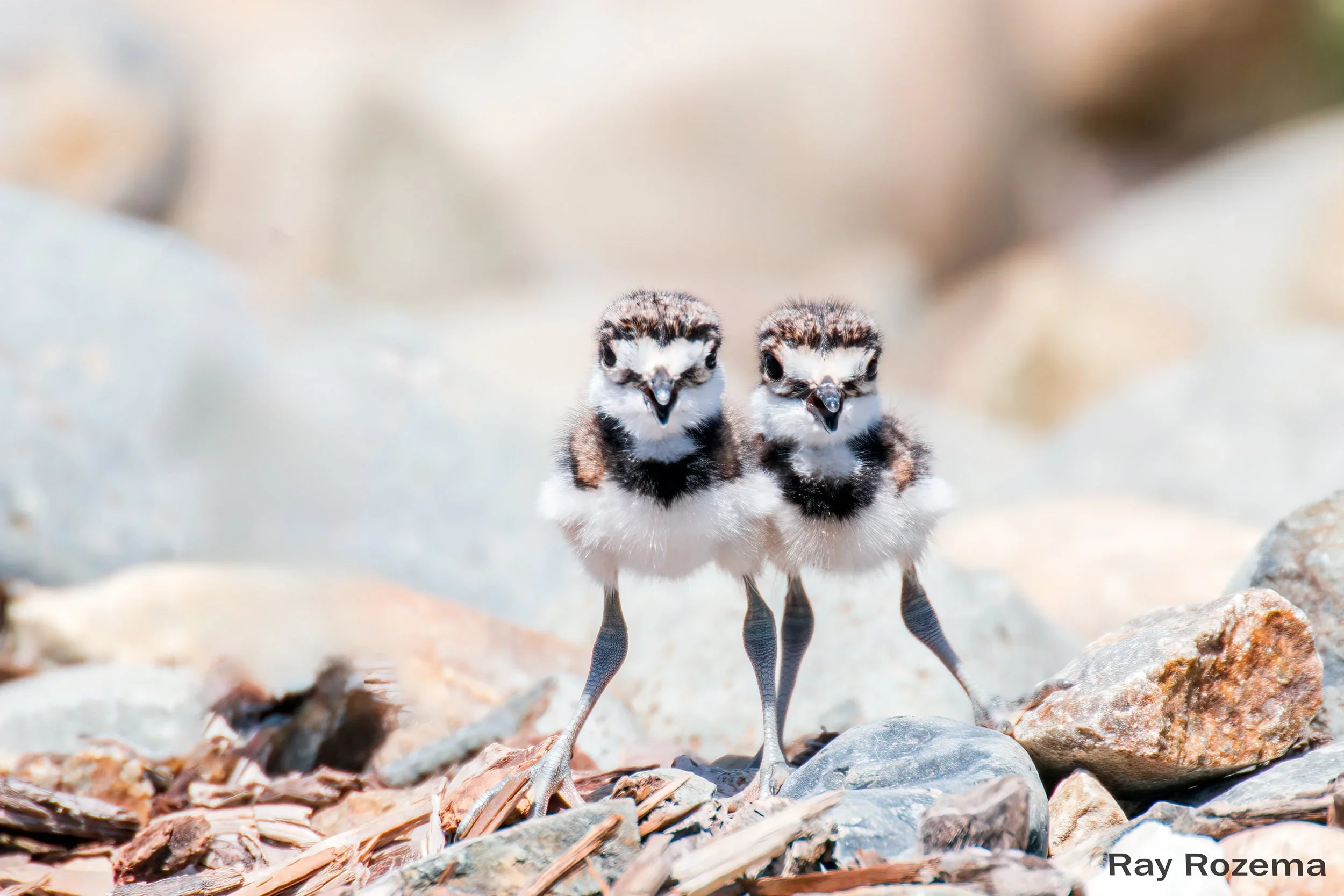
Killdeer, 1 day old chicks © Ray Rozema

Juvenile birds with their downy feathers are similar to adults but are smaller and only have one dark chest band. They have white abdomens, foreheads, necks, and chins. There is a light reddish or rufous color on their undersides near the rear. Their upper parts are tanish-brown with black. Because of their smaller size and single chest band, young Killdeers could be incorrectly identified as being other plover species. Pictures of other plovers (and many other birds) that can be found in the Sacramento Area are available in the Gallery of Birds, specifically the Shorebirds section.

Where do Killdeers live and nest?

Killdeers are usually found in short vegetation, up to one inch in height or in areas with sandy or gravelly surfaces. They are seen both in natural environments and human-modified habitats. Their close proximity to humans puts Killdeers at a huge risk for pesticide poisoning since they forage and nest on surfaces that are often sprayed with toxins. Killdeer prefer open or semi-open areas such as sandbars, shores of rivers, ponds, and lakes, mudflats or lagoons, fields, lawns, driveways, meadows, athletic fields, gravel parking lots, wetlands, airports, and golf courses. Killdeers are a type of shorebird but a dry prairie is just as welcoming to a Killdeer as a river shore. Most other shorebird species remain close to water. 

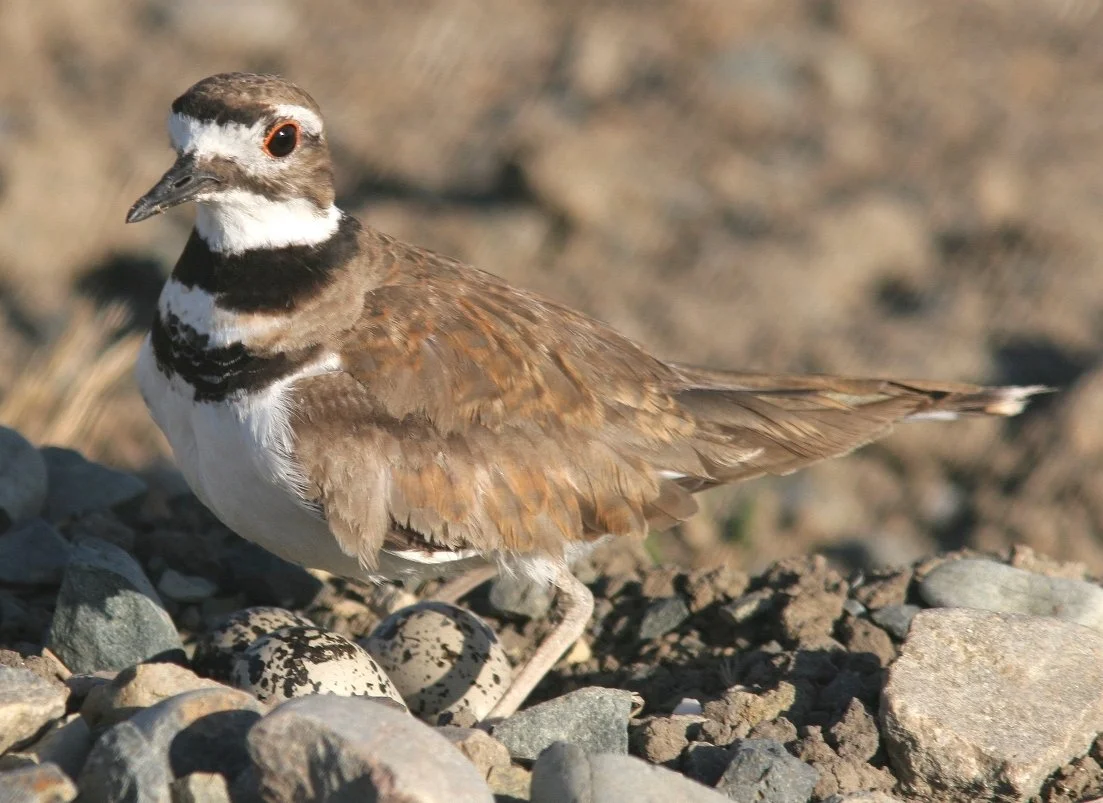
Killdeer with eggs © Chris Conard

The nest sites of Killdeers are well camouflaged. Because their egg shells have a speckled design that makes them resemble pebbles, their eggs blend well into the environment. Their nests are simple depressions in the ground about 3-3.5 inches across and are often made in gravel parking lots, on bare soil, lawns, parks, short grass fields, along river edges, and on farmland that has short vegetation due to cattle grazing. They may place their nests in open dry areas but will also require shallow water or mudflats where their young can forage. Killdeers occasionally nest on gravel rooftops making it difficult for the fledglings to descend to the ground to find food. One interesting fact is that after laying their eggs, Killdeers will  frequently add light-colored items to their nests, such as white stones or sea shells, along with grass, twigs, and/or trash.

Incubation (or sitting on the eggs to keep them warm) is done by both parents for 22-28 days. In very hot climates, adults will sometimes shade the eggs with their bodies. They will also attempt to keep the eggs cool by placing their water-soaked belly feathers next to the eggs.

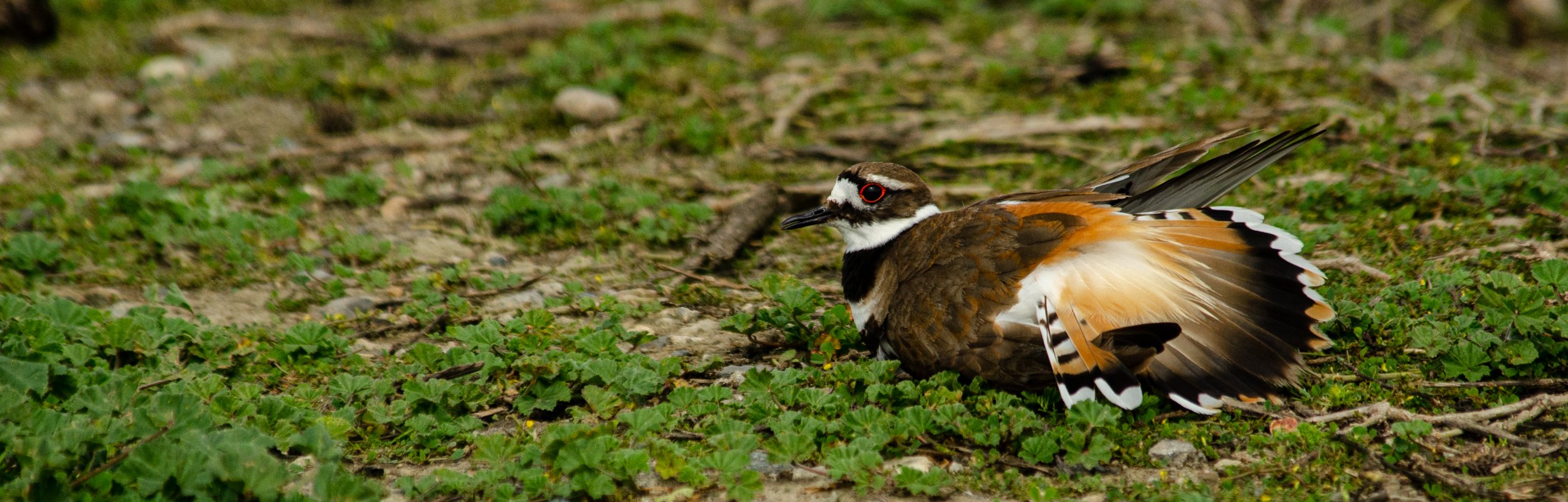
Because Killdeers nest on the ground, they use several tactics to try to keep their eggs safe. They often vocalize loudly at predators and turn to expose their orange rump feathers as a warning. Adult Killdeer also pretend to be injured in order to lure predators away from the nest. Called “the broken-wing distraction display,” they will drag their bodies and wings on the ground while hopping on one leg. This distraction display can be dangerous for Killdeers, but they are usually able to fly away before a predator gets too close. In addition, when it appears that a large animal could crush the eggs in its path, an adult Killdeer will fluff up their feathers, fan its tail over its head, and then run towards the threat while loudly vocalizing. Their goal is to startle the animal so that it changes its direction, avoiding the nest. One more method Killdeers use is to have several false nest sites. They will go to the false sites if predators come around. The predators eventually tire of examining empty nests and will leave the area!

Killdeer, adult, broken-wing display © Susie Nishio

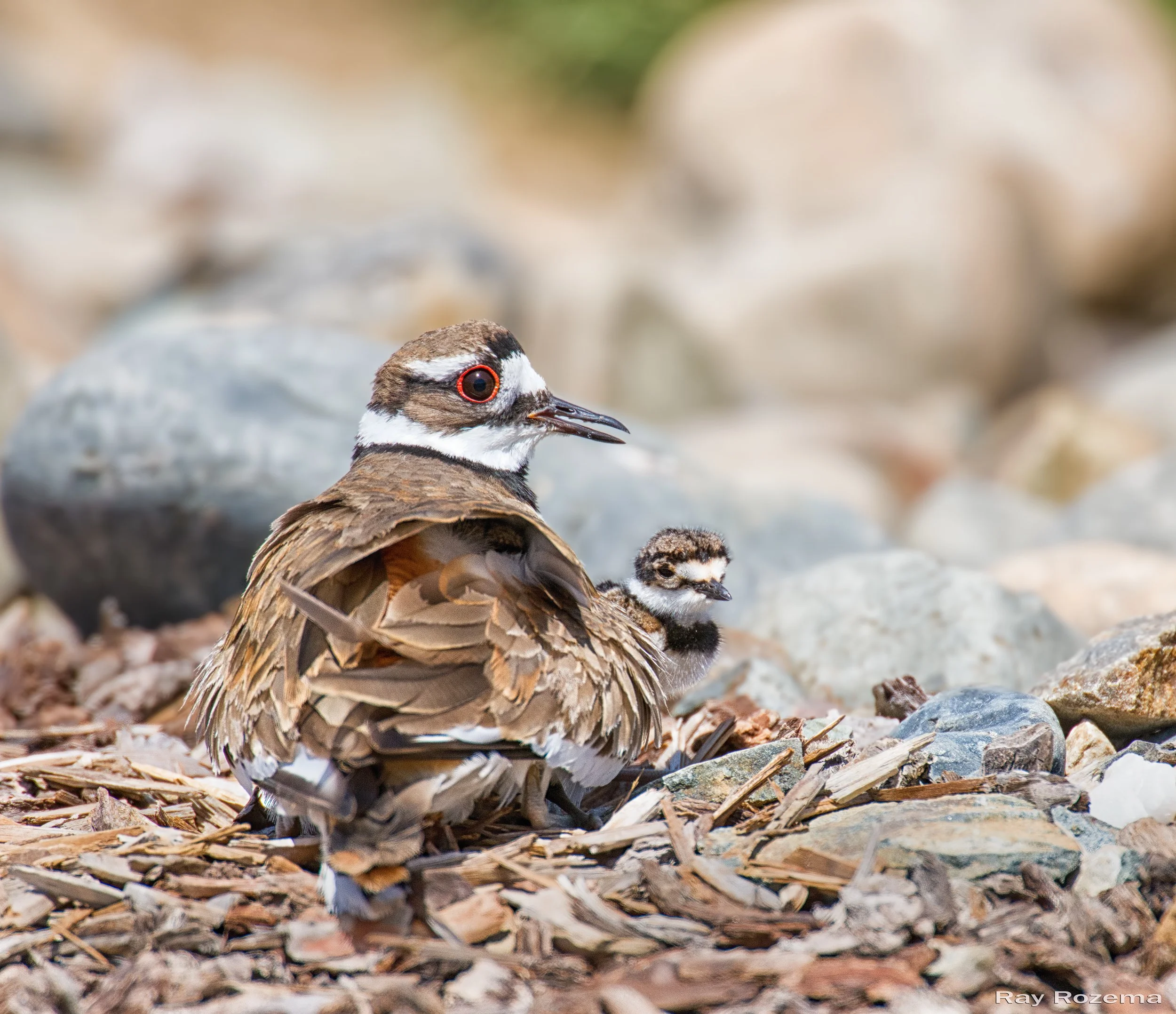
Killdeer hatchlings hatch with eyes open and a full cover of downy feathers. Soon after their feathers dry, their parents lead them to an area of dense vegetation with cover so they can look safely for food. The hatchlings hunt and feed for themselves. However, both parents watch over and protect them. If the parents sound an alarm call, the chicks instinctively flatten themselves on the ground and remain motionless. Parents and young remain in close association until the young can fly about a month after hatching. 

Killdeer, adult and chick © Ray Rozema

What do Killdeers eat? 

Killdeer are beneficial because they control insects that are considered garden and crop pests such as grasshoppers. They also feed on invertebrates such as earthworms, centipedes, flies, beetles, spiders, snails, crayfish, fly larvae, and aquatic insect larvae. Kildeers will occasionally eat berries, seeds left in agricultural lands, and small vertebrates such as frogs or minnows.

Killdeer often forage (or hunt for food) in the daytime, but may also hunt at night when it’s safer, especially in the non-breeding season. When on the ground and foraging, they will often start to run or walk, then will pause suddenly and bring their heads upwards flashing their striking throat bands, and then bring their heads back down and start moving again. This behavior is thought to help startle prey so they come to the surface. Killdeers also use a technique called foot stir or foot-trembling. This is when they stand on one foot while shaking or patting the other foot in mud or shallow water. The vibrations created by their foot movements make the hidden prey rise upwards so that they can be seen and caught. Additionally, Killdeer forage in fields and have been known to follow farmers’ plows which help to expose earthworms and grubs.

What do Killdeers sound like?

Many people are familiar with the Killdeers’ shrill, piercing, far-carrying, mournful, two-syllable kill-deer call that is often heard. All Killdeer sounds are high-pitched, from 1-4 syllables and their sounds can be drawn out. Calls have been described as kil-deee, kee-di-de-de, dee-dee-dee, fill-deee, deee, tyeeeeeee-deew-deew, deeekee-di-di-di. During flight, their calls are a repeating kil-deer or kee-deeyu. Their alarm call is a fast trill. You can listen to Killdeers calling now.

You can listen to the sounds of Killdeers at xeno-canto.org. https://xeno-canto.org/species/Charadrius-vociferus.


Meet the Northern Pintail

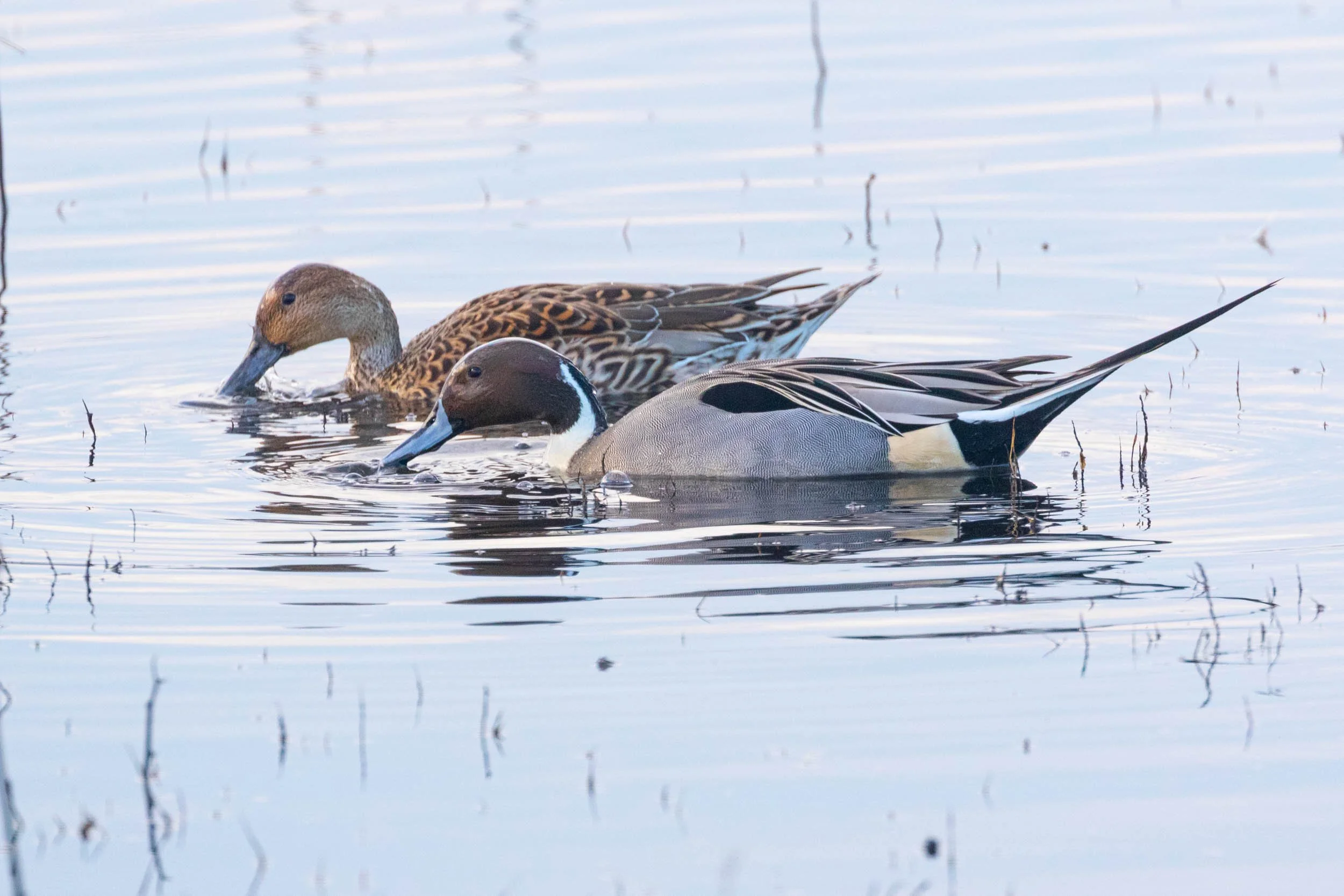
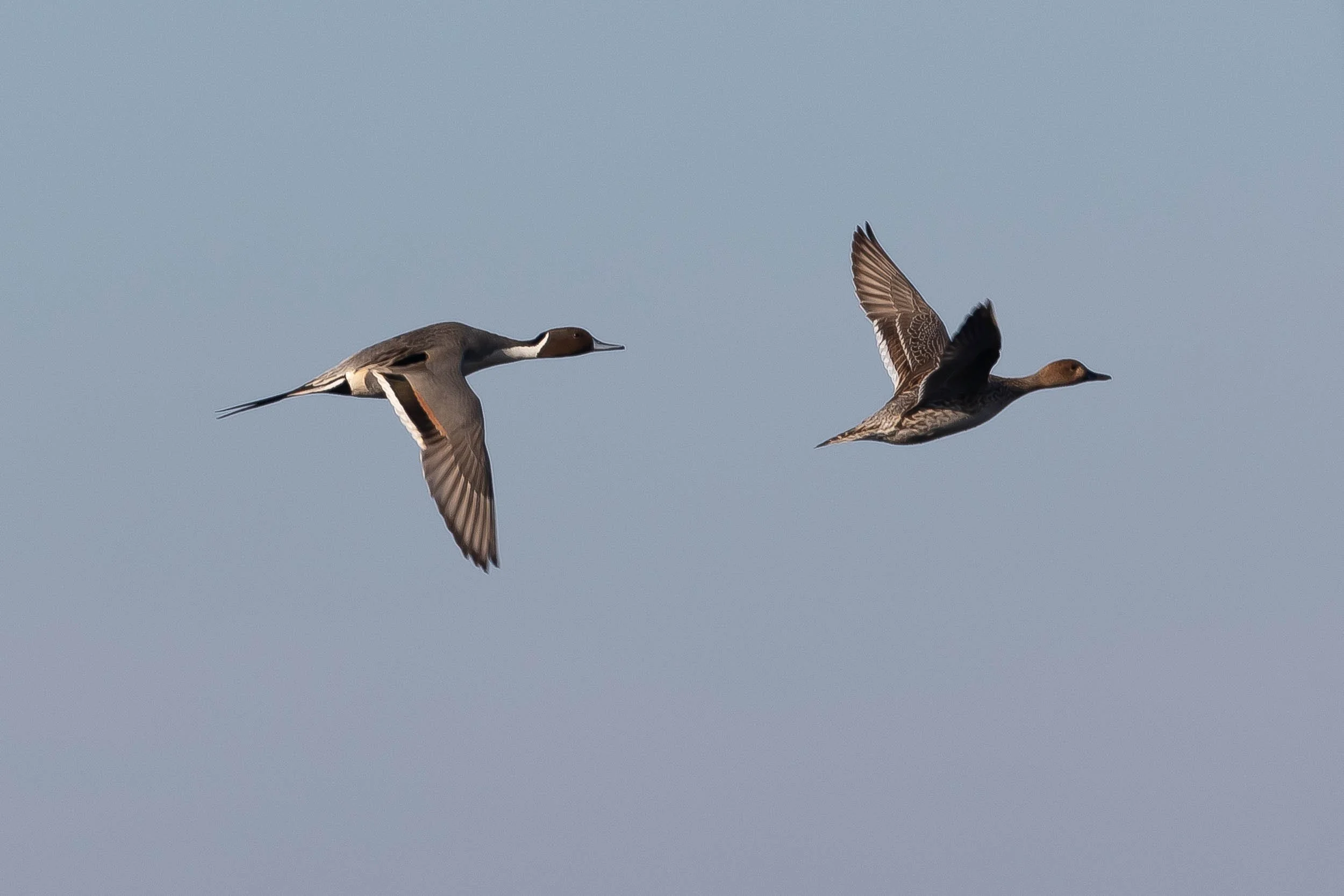
Northern Pintail, male and female © Larry Hickey

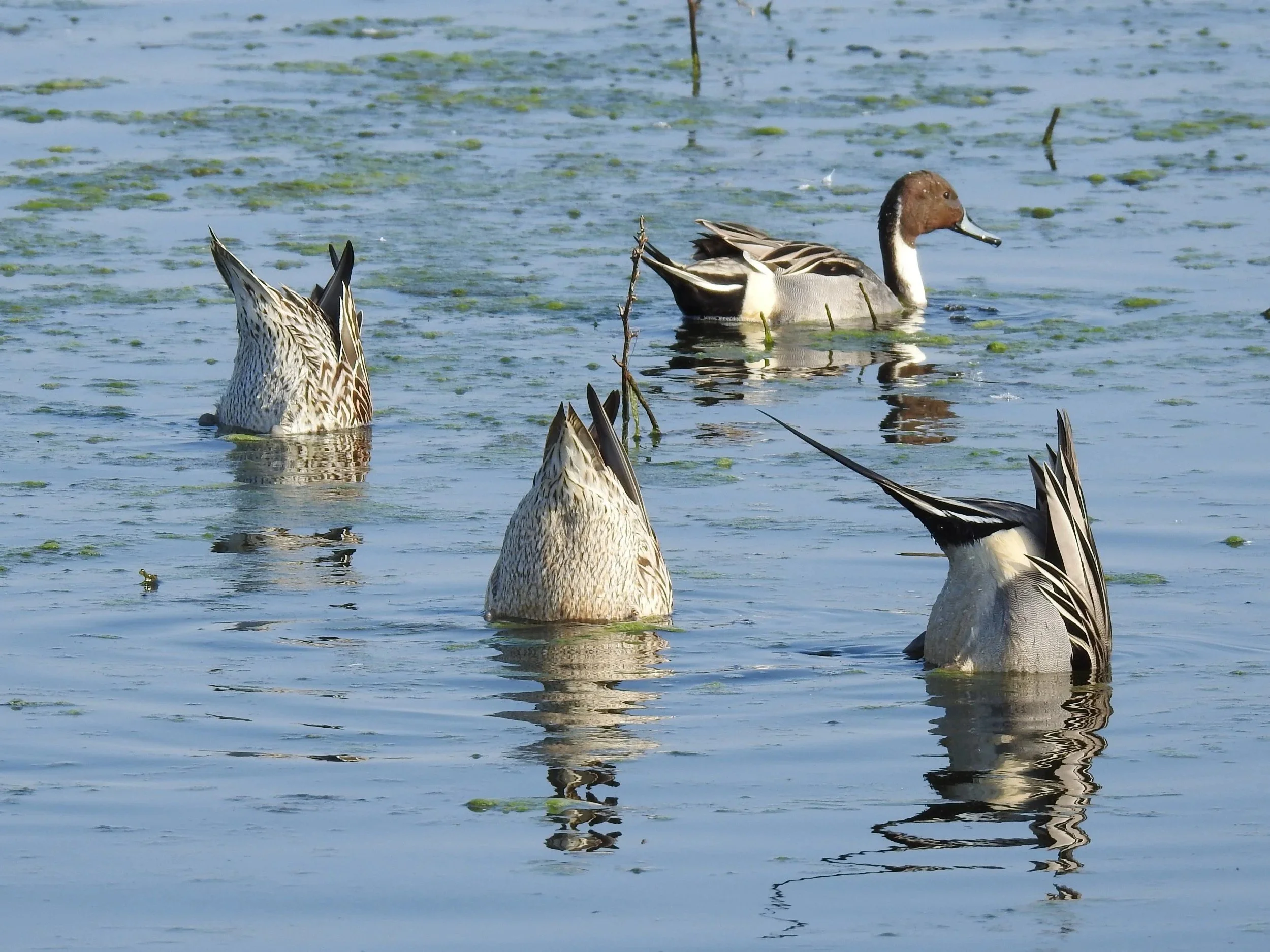
This month let’s learn about a duck species that is often found in the Sacramento area called the Northern Pintail (Anus acuta). Northern Pintails are widespread and found across North America, Europe, and Asia. They are in a group of ducks called dabbling ducks which prefer to be in shallow water where marsh plants grow. Dabbling ducks seldom dive; but rather will search for food near the water’s surface. Although Northern Pintails are abundant over many regions throughout the world, their numbers have steadily declined for decades due to habitat loss or change. Their wetland and prairie habitats are continually being converted and fragmented. In addition, some experts say that a series of drought years on the northern plains may drastically reduce nesting success there.

Most Northern Pintail populations are migratory birds (relocating depending on the season) and are one of the first duck species to migrate every spring and fall. They time their spring migration well and arrive in their northern nesting range as soon as the ice melts. Large flocks of Northern Pintails migrate at night and can fly great distances at speeds up to 65 miles per hour due to their slender bodies and their 3-foot wingspan. They nest in the northern-central parts of the United States, Canada, Greenland, in northern Europe, the Middle East, India, and Asia. 

Northern Pintails usually spend their winters south of their nesting range where it is warmer and food is more plentiful, usually in the southern United States or Mexico. They arrive in the Sacramento Valley after their nesting season is over and are quite common here from October through mid-March. Occasionally Northern Pintails are seen in our valley in other months as well. In the winter they gather in large flocks; but are accepting of other waterfowl and are often seen among several different bird species. They are comfortable either when waddling on land or swimming in water but can quickly take flight and maneuver through the air with great skill. When at great heights, they will use a zig-zag flight pattern when descending to look for food on land.
What do Northern Pintails look like?

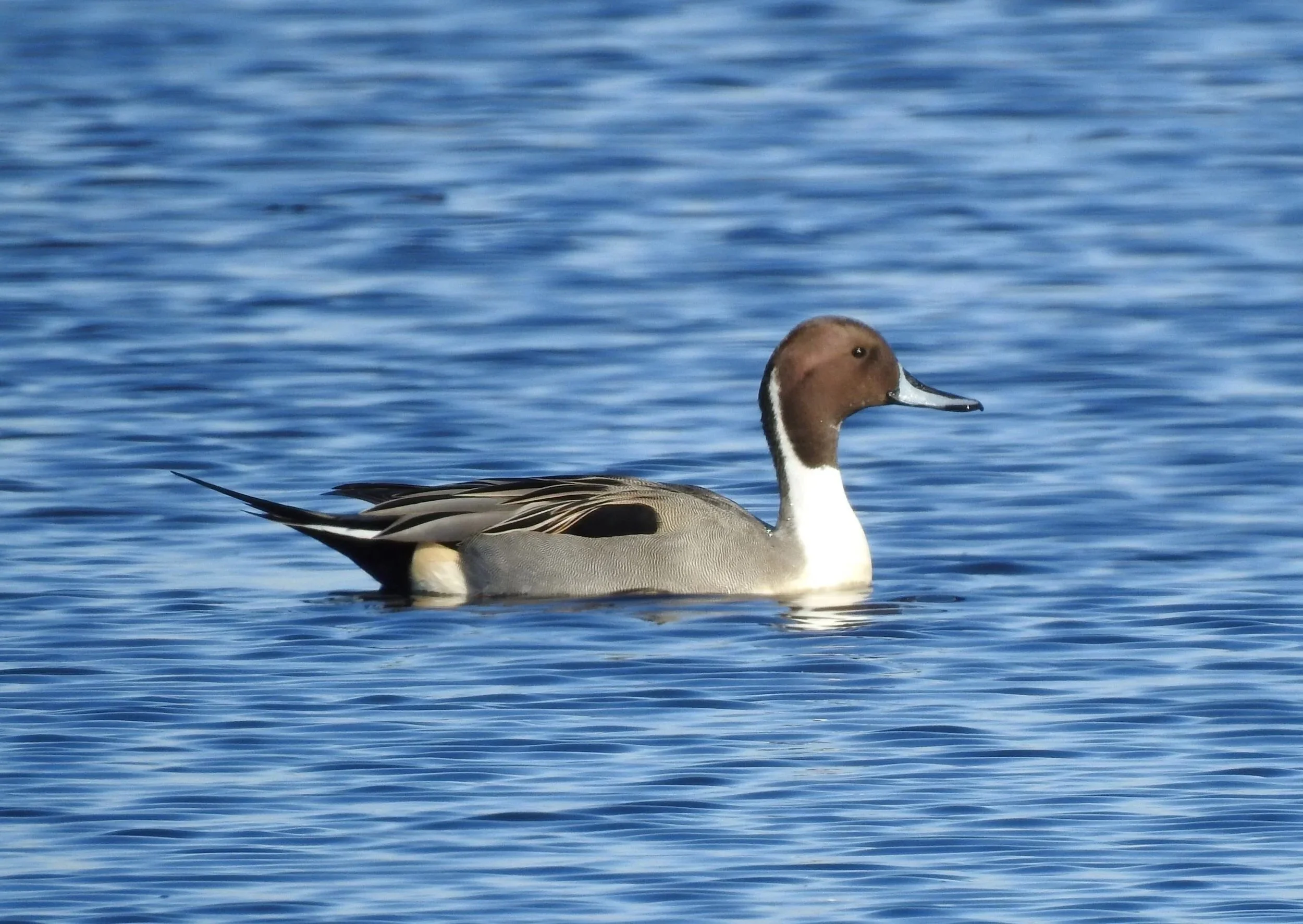
Northern Pintail, male © Daniel Lee Brown

When both on water and in flight, Northern Pintails are often described as elegant or handsome. Males have very long central pin-like tail feathers (which become even longer in the nesting season). This is why the species got its name. Northern Pintails are sometimes referred to as sprigs or sprig-tails because hunters said their tails resemble plant stems. 

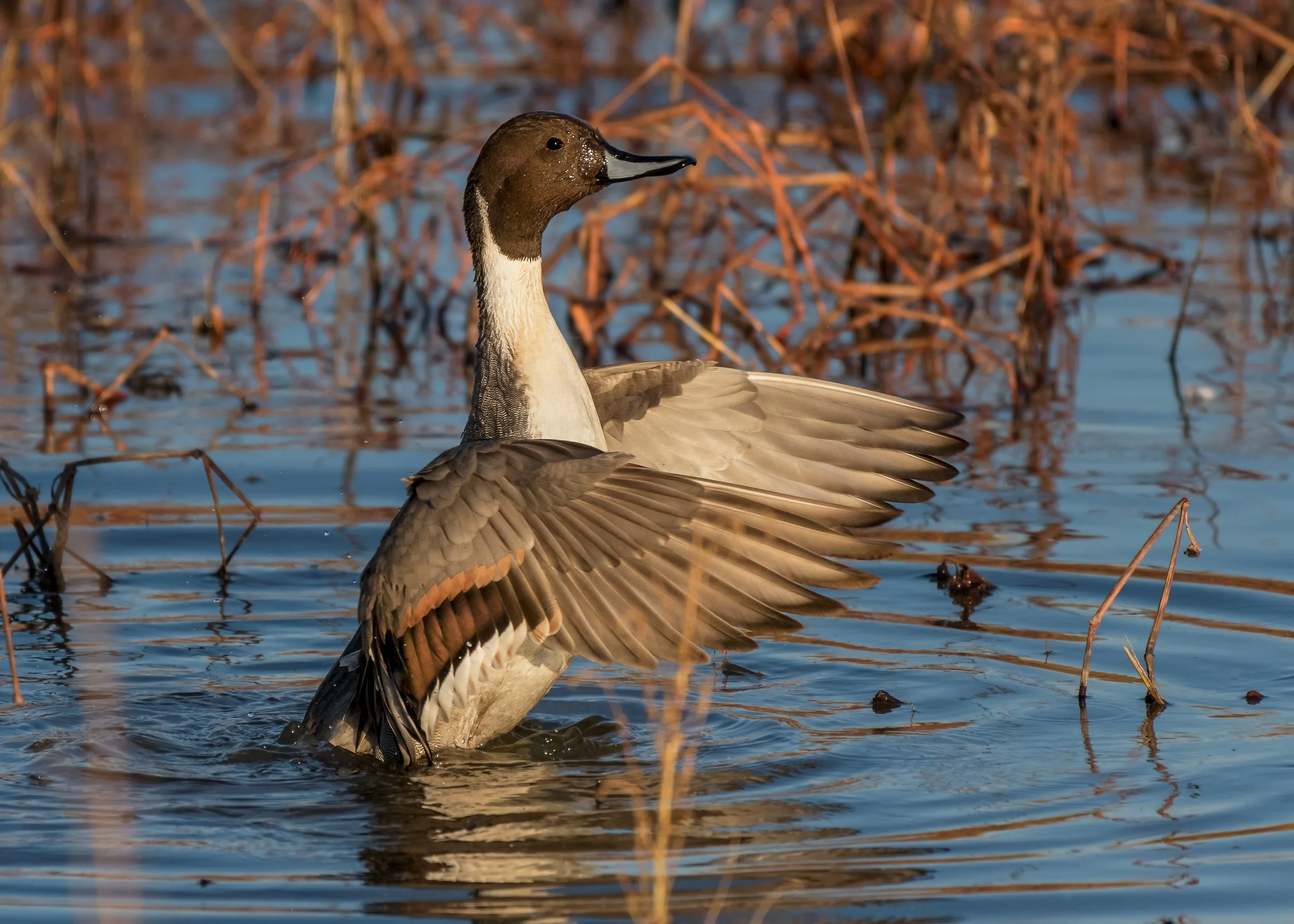
Northern Pintails have smallish heads, slim bodies, long and slender necks, and long narrow wings. Their slim bodies and long necks are a way to separate them from other duck species. During the nesting season, males look very different from females. Adult males have eye-catching white neck stripes, white chests, chocolate brown heads and throats, gray sides and backs that are finely speckled with black, white rump patches, blue-gray bills which have a central black stripe running to the tip, slate-gray legs and feet, and long black tails. During flight, one can see a brilliant metallic (or iridescent) green or bronze patch on the inner wings. These inner wing patches are called specula, (the singular is speculum). There is a bright white trailing edge on the specula as well. Female Northern Pintails are more uniform in color. They have grayish-brown heads, backs, and wings, brown sides, pointed tails, blue-gray bills with black blotching, bronze-brown specula with a white trailing edge, and slate-gray legs and feet. They have a scalloped pattern on both their backs and chests. The plainer plumage (overall feather coloration) of the females makes them camouflage well while sitting on nests. Immature birds look similar to adult females but have dark bills, dark brown to tan heads, and have speckled white and brown bellies.

Both adult males and females have a similar drab coloration in their molting season, a four-week period after nesting is complete. During this time, Northern Pintails are a mottled brown and white all over with dark bills and pale, unmarked faces. This plumage is called eclipse plumage. Northern Pintails are flightless as they molt and become secretive as they wait for new wintering feathers to grow.

Where do Northern Pintails live and nest?

Northern Pintail, male © Mary Forrestal

At various times of the year and in different regions, Northern Pintails are found along coasts and estuaries, in prairies, agricultural fields, flooded fields, shallow wetlands, meadows, grasslands, marshes, on or near streams, creeks, lakes, ponds, rivers, and even in treeless, in Arctic regions, also known as tundra, and in the far northern regions of the world also known as boreal habitat.

Female Northern Pintails often choose their nest sites further away from water than many other duck species. The nest site is a small clearing or shallow depression on the ground surrounded by low grasses or plants The female lines her nest with grasses, sometimes twigs and leaves, and her own down feathers. Only females incubate the eggs (sit on eggs to keep them warm) and the incubation period lasts for three to four weeks. Soon after the ducklings hatch, the mother leads them to the nearest body of water where they immediately swim and forage for themselves. Ducklings look for dead insects on the surface of the water. The mother stays close by the young birds for 4-6 weeks. The ducklings are able to fly in about 38-52 days after hatching. Female Northern Pintails will defend her chicks from predators by flying towards the threat to attempt to scare them or by leading predators away by pretending to be injured.

National Wildlife Refuges and agricultural fields are great places to look for Northern Pintails. There are several locations in the Sacramento Valley region to locate these ducks including: the Cosumnes River Preserve, Stone Lakes National Wildlife Preserve, the Yolo Bypass Wildlife Area, and the Woodbridge Ecological Reserve.

Northern Pintail, male and female © Larry Hickey

What do Northern Pintails eat?

In the fall and winter, Northern Pintails eat the seeds and nuts of weeds and grasses, and when available, will also take advantage of agricultural waste field grain. They are agile on both land and on water. Their bills are not only efficient at scooping up aquatic insects and plant seeds when in water but also at picking up seeds and grains when waddling on land. In both spring and summer, Northern Pintails will eat roots, algae, and new growth on aquatic plants. In the summer they eat protein-rich aquatic insects, mollusks, snails, crustaceans, and sometimes tadpoles and small fish. Northern Pintails forage (or search for food) either on or near the water’s surface. Their extra long necks allow them to reach further underwater than the other species of dabbling ducks. They find a good amount of food underwater in the mud. When foraging, Northern Pintails often tip their entire bodies so that their length is perpendicular to the water and pointing their tails toward the sky. They also will forage by dipping their heads and necks underwater as their bodies are swimming horizontal on the water.

Northern Pintail, foraging for food © Mary Forrestal

What do Northern Pintails sound like?

The male and female Northern Pintails have different calls. The male’s call is usually higher in pitch. Some of the males’ calls are described as a “choop”, “geeheee”, “whee", or a soft “wheezy whistle". Females’ calls have been described as a coarse nasal “quack” or “croak" and also a “ke” or “kuk” sound. Ducklings’ calls are often a repeated soft “peep" or a louder repeated “peep" when in distress.

You can listen to the sounds of the Northern Pintail at xeno-canto. https://xeno-canto.org/species/Anas-acuta


Meet the Lincoln's Sparrow

Lincoln’s Sparrow © Chris Conard

This month, let’s learn about a small-to-medium sized sparrow, called the Lincoln’s Sparrow (Melospiza lincolnii). Lincoln’s Sparrows are medium-distance migrants (or birds that change location depending on the season). They migrate into the Sacramento Valley starting in September and leave again in the spring around April to find nesting sites. Lincoln’s Sparrows have a reputation of being shy or elusive birds and often remain hidden under thick groundcover or bushes. There have been limited studies about Lincoln’s Sparrows because the majority nest in cold, northern (or boreal) regions. They tend to be solitary birds but sometimes they travel and forage with small groups of mixed sparrow species, especially during migration. There are three subspecies of Lincoln’s Sparrows, each having slight differences in coloration and size.

What do Lincoln’s Sparrows look like? 

At first glance, Lincoln’s Sparrows appear to be rather plain brownish-gray birds. However, when studying them more closely, the fine detail and harmonizing colors of their plumage (feathers) are very attractive. One author described the Lincoln’s Sparrow as “wearing a fine tailored suit.” Their pale breasts and sides are streaked with very thin dark lines and tinged with a buff color. In comparison, the closely related Song Sparrow has thicker streaking on the breast and a longer tail. Lincoln’s Sparrows also have thin, fairly small conical bills, dark eyes surrounded by pale eye rings, a thin brown eye line that runs from the back of their eyes down towards their neck region. A central dark spot on their breast may be present. They also have broad gray eyebrows (or supercilium), a gray face, a white chin region with tiny dark streaks, both buffy (or light brownish-yellow) and black cheek streaks, gray and brown backs with dark streaking, and reddish-brown or rusty edges on their wings and tails.

Lincoln’s Sparrow © Daniel Lee Brown

Lincoln’s Sparrow © Jane Van Kessel

Lincoln’s Sparrows have stripes on their crowns (or the tops of their heads). There is a central gray crown stripe bordered by two reddish-brown stripes streaked with black. Lincoln’s Sparrows can “raise up” their crown feathers forming a crest or peak. Juveniles look similar to adult birds but are more heavily streaked overall and do not have the buffy breast that's typical with adult plumage.

Where do Lincoln’s Sparrows live and nest? 

The Lincoln’s Sparrow nesting range is across Canada all the way east to Newfoundland, in eastern and far-northern California, and parts of Colorado, Idaho, Montana, Utah, Oregon, Washington, New Mexico, and Wyoming, usually from June-August.

Lincoln’s Sparrow © Mary Forrestal

In the summer, Lincoln’s Sparrows frequently nest in mountainous areas under willow and alder thickets or in wet meadows with sedges (grass-like plants) in wetlands. Their nests are also located near patches of cottonwoods or black spruce, areas with sphagnum moss present, and in shrubby areas near streams. Lincoln’s Sparrows are ground nesters and the females construct cup-shaped nests that are usually located under thick cover. Often females will first dig out a depression in the ground for their nests before gathering materials. They weave together willow bark and dried grasses and sedges to make the outer part of the nest. Then, they line the nests with soft plant material. Lincoln’s Sparrow females incubate their eggs (sit on eggs to keep them warm). Both parents help to feed the nestlings who are able to fly a distance of about 30 feet on the sixth day of life. Young birds fledge (or leave) the nests at around 9-12 days after hatching and their parents may continue to care for them for 2-3 additional weeks. 

Lincoln’s Sparrows spend their winters along the Pacific Coast south from British Columbia, in central and southern California, several southern states in the U.S., Mexico, Honduras, and El Salvador. Lincoln’s Sparrow habitats in wintertime include many types of forests, weedy pastures, and shrubby fields. They can also be found around the edges or ponds and marshes.

What do Lincoln’s Sparrows eat?

Lincoln’s Sparrow © Jane Van Kessel

Lincoln’s Sparrows primarily eat the seeds of weeds and grasses in the winter and switch to eating both seeds and  insects, such as beetles, flies, caterpillars, moths, leafhoppers, ants, and aphids in the summer. They spend a lot of time on the ground under dense thickets foraging (hunting) for food and frequently will scratch the ground’s surface to uncover seeds or insects. They will sometimes look for food when perching in low trees or bushes and can use aerial maneuvers to catch moths.

What do Lincoln’s Sparrows sound like?

Lincoln’s Sparrow © Ray Rozema

Lincoln’s Sparrows have a loud wren-like song that has been described as buzzy, warbling, trilling, or bubbly and is commonly heard near their nesting territories. During nesting season, males often perch and sing to claim their territories. Males use specific calls to “hopefully” scare intruders away from their nest sites. In the winter months especially, Lincoln’s Sparrows are often hidden and secretive. It’s their unique call(s) that can help birders identify and possibly see them. They have calls that sound like a buzzy “zeee” or “zeet”, a buzzing “zrrr-zrrr-zrrr”, and a flat “chup” or “chep”.

You can listen to the song and calls of Lincoln’s Sparrow at xeno-canto. https://xeno-canto.org/species/Melospiza-lincolnii


Meet the Black-chinned Hummingbird

Black-chinned Hummingbird, adult make © Ray Rozema

This month let’s learn about the Black-chinned Hummingbird (Archilochus alexandri) which is found in the Sacramento area from April through September. Only a few other species of hummingbird species are commonly seen here: the Anna's Hummingbird which lives here year-round and the Rufous Hummingbird that is seen briefly during migration in both spring and fall. 

Black-chinned Hummingbirds are migratory birds that nest in the western United States, southern British Columbia, and northern Mexico. Most Black-chinned Hummingbirds spend their winters in western Mexico. Some birds pass through the southeastern United States and winter along the Gulf Coast.

If you compare Black-chinned Hummingbirds to humans, they have an extremely fast heart rate (480 beats per minute at rest) and a fast respiration or breathing rate (245 breaths per minute at rest). In flight, their wingbeats are 15-80 times per second! Thankfully, in cold weather, hummingbirds enter a state called torpor where their metabolism is much slower. During torpor, their heart rate lowers to 45-180, their breathing is slow and sporadic, and they get their energy from stored fat which keeps them warm enough to survive.

What do Black-chinned Hummingbirds look like?

Black-chinned Hummingbird, adult male © Daniel Lee Brown

It is extremely difficult to follow a Black-chinned Hummingbird with your eyes because they dart and weave through an environment so quickly. They are small, slender birds that weigh only about three grams. Black-chinned Hummingbirds have long black bills that curve slightly downwards. This type of bill is called a decurved bill. Adult males have bronze-green iridescent backs. Iridescence is defined as luminous coloration that appears to change when movement alters the angle of light. Males also have black and purple throats, light green flanks (or sides), grayish-white chests, and dark heads, wings, and tails. Male Black-chinned Hummingbirds also have white collars that wrap around their necks. It is often much easier to see this white collar than the purple band above. Adult females and juvenile birds have green iridescent backs as well. In contrast to males, females and juveniles have white throats with faint dots or streaking, greenish-gray heads, and white tips on the outer tail feathers. Juvenile male Black-chinned Hummingbirds may have a few tiny iridescent and colorful spots visible on their throat area or throat patch.

The throat patch on a hummingbird is called a gorget. This area can be quite colorful and iridescent on male birds. The male Black-chinned Hummingbird’s gorget is black on top with a purple lower band. Their gorgets can appear solid black especially in low-light conditions.

Black-chinned Hummingbirds have been noted to flick or pump their tails more often than some other hummingbird species. They flip and spread their tails often while hovering. Some other helpful identification points for Black-chinned Hummingbirds is that they have slightly a longer bill and a somewhat thinner body shape and necks than do other species in our area.

Although female hummingbirds do not have brightly colored gorgets like males, the females of some species sometimes have a small area of colorful, iridescent gorget feathers. Since hummingbird females tend to look the same, it can be quite difficult to tell which species they are.

Where do Black-chinned Hummingbirds live and nest?

Black-chinned Hummingbird, adult male © Chris Conard

Black-chinned Hummingbirds are highly adaptable and live in a variety of habitats including arid canyons, high mountains, scrublands, forests and woodlands, and along rivers (riparian habitat). In addition, they will eagerly nest in urban and suburban habitat if they are offered tall trees and flowering shrubs and vines. As far as nesting, it’s the female that does all the work. The male is usually not involved.

Black-chinned Hummingbird females build their nests at various heights. Their nests are often fairly low (4-8 feet from the ground) but can be as high as 30 feet. Black-chinned Hummingbird nests are frequently constructed on horizontal, exposed, and bare tree branches.

Black-chinned Hummingbird, female with nestling on nest © Paul Miller

They also build nests on human structures. The nest is a small compact cup that can stretch lengthwise as the babies grow. Nest materials include spider webs, grasses, plant fibers, insect cocoon fibers, and plant down (plant material that is fluffy or fuzzy in nature) which is used for the lining. Some reports state that females use their whole body to powerfully mould the nest as if it were clay. The nest is often camouflaged with lichen or leaves. Females lay a clutch (or group) of eggs 1-3 times per nesting season. There are usually only two eggs per clutch, each being the size of a coffee bean. Only the females incubate the eggs (sit on eggs to keep them warm) and feed the young. They stick their long bills deep into the nestlings mouths to feed them partially digested food. The young first fly at about 20 days after hatching. Female Black-chinned Hummingbirds will often use the same perch out in the open to keep watch over the nest and easily chase away predators when necessary. Females have been known to nest near several other Black-chinned Hummingbird nests.

What do Black-chinned Hummingbirds eat?

Black-chinned Hummingbirds obtain nectar from flowers putting their long bills deep inside tubular flowers. They eat small insects, spiders, and sugar water in feeders. In cold weather, Black-chinned Hummingbirds may consume up to three times their body weight in nectar per day. They can survive without nectar when there is an ample supply of insects. Black-chinned Hummingbirds catch small insects in flight (such as in a swarm of gnats) or will hover and pluck insects from leaves, etc. Spiders sometimes suspend themselves on fine threads that flow in the air. Hummingbirds will readily catch and eat them. Black-chinned Hummingbirds will also take insects that have been trapped in spider webs.

It is good to have native plants in your yard that are known to be used by hummingbirds for obtaining nectar. When there are mature native plants around, there is less of a reason to put up sugar water feeders. If you do offer sugar water feeders, please clean your feeders often (every one to two days) and do not add food coloring. Molds can grow quickly on feeders in both cold and warm temperatures. Molds can cause hummingbirds’ tongues to swell making it impossible for them to drink. In hot weather, sugar water ferments and becomes toxic to hummingbirds. For more information on feeding hummingbirds check out these Frequently Asked Questions from National Audubon Society.
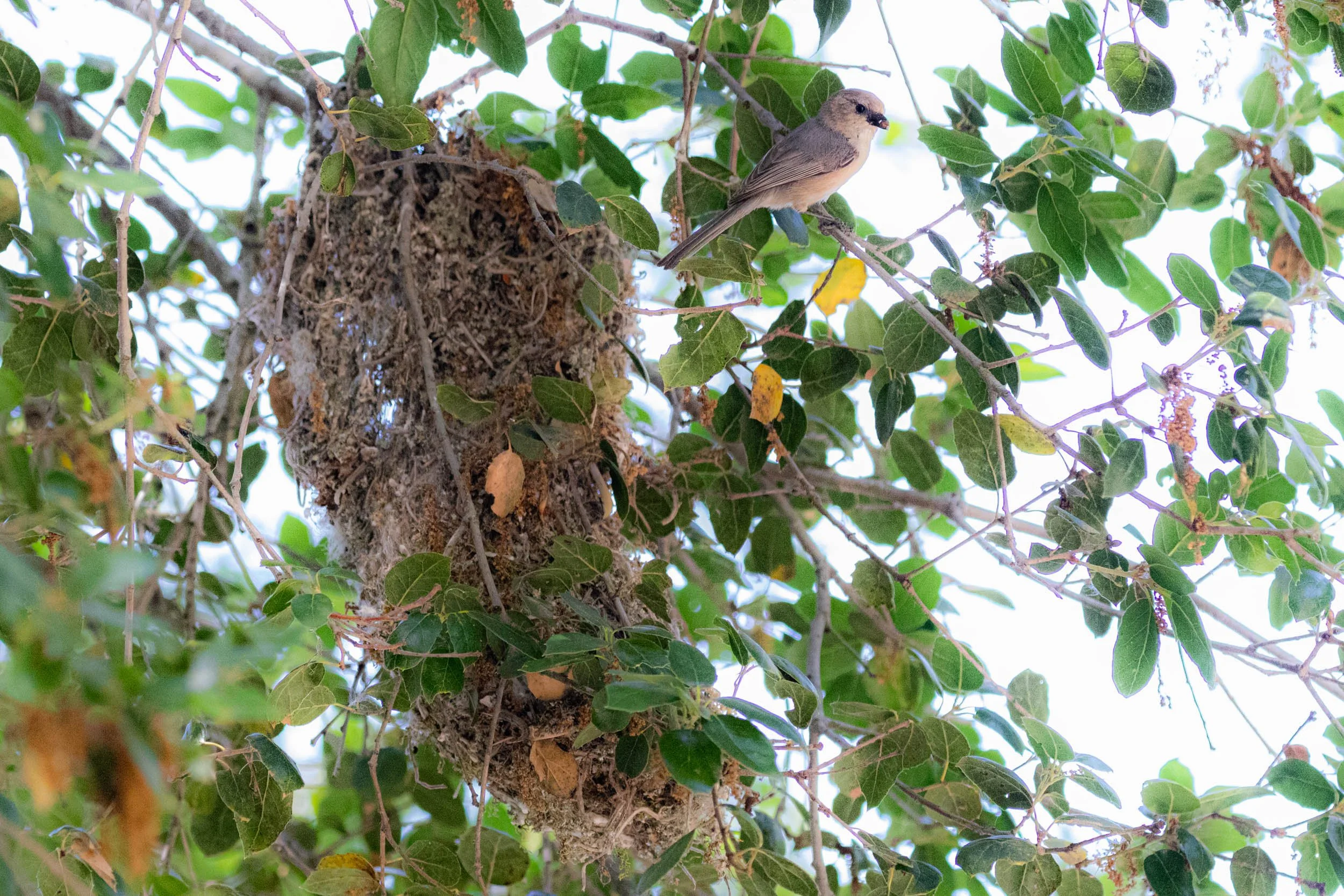
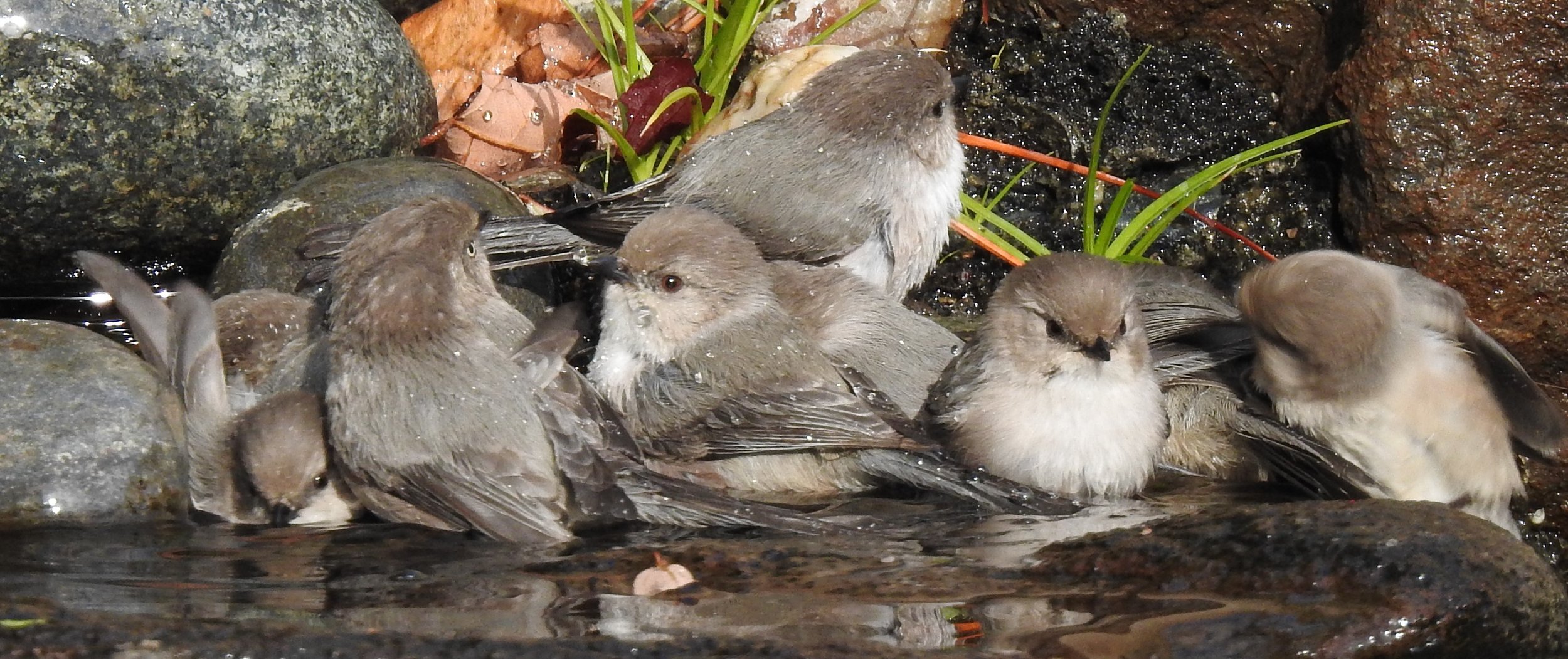
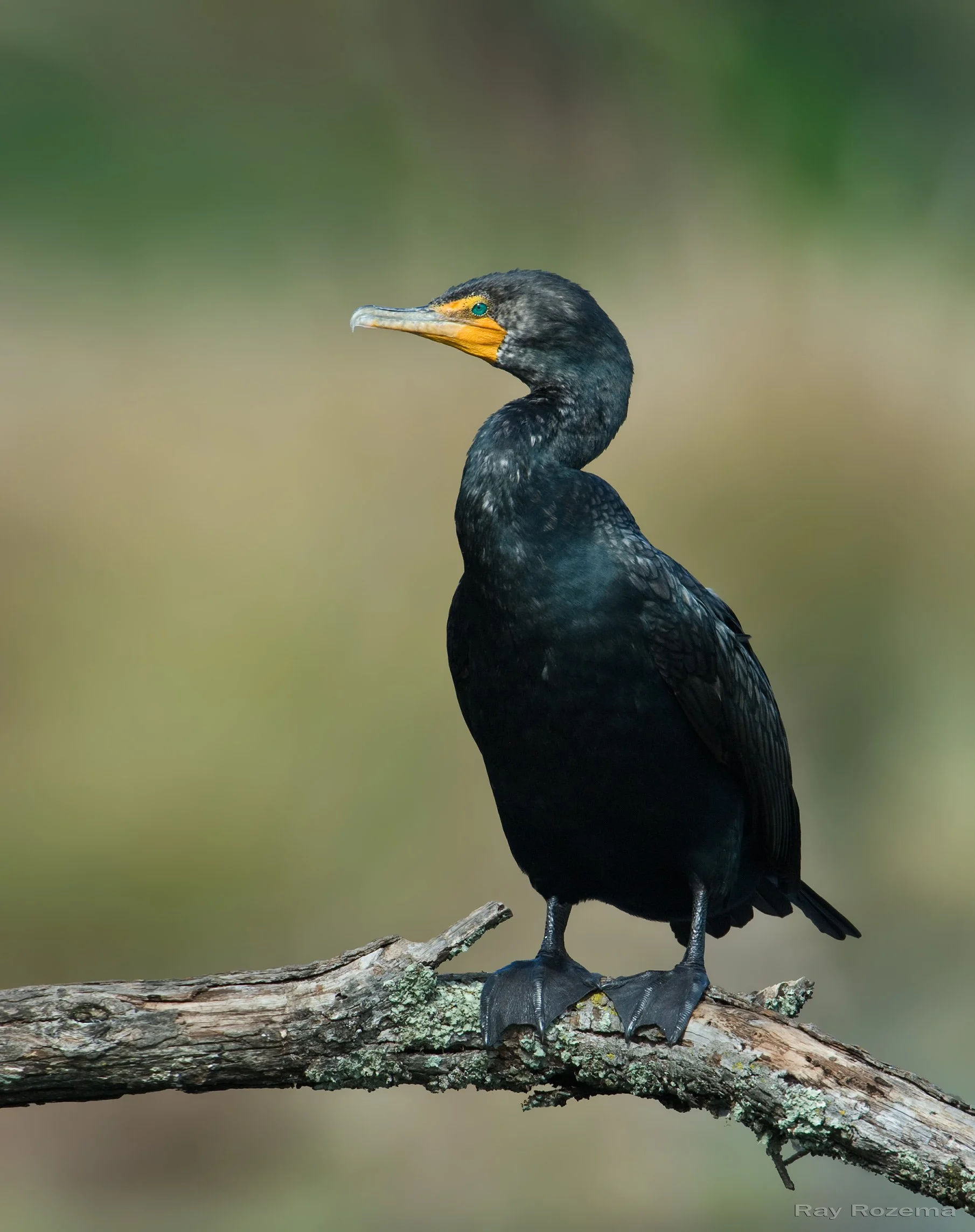
What do Black-chinned Hummingbirds sound like?

Perhaps one of the easiest ways to identify a Black-chinned Hummingbird is with their sounds. Their calls and distinctive sounds that their wingbeats and tails produce are heard often. There have only been two reports made of a male Black-chinned Hummingbird singing. The song was described as “warbling” and “high-pitched”.

You can listen to the sounds of the Black-chinned Hummingbird at xeno-canto. https://xeno-canto.org/species/Archilochus-alexandri


Meet the American Robin

American Robin, adult male © Ed Harper

This month, let’s learn about a familiar and very admired songbird called the American Robin (Turdus migratorius). American Robins are in the thrush family and are fairly widespread throughout the United States, Canada, Mexico, and Guatemala. Some populations are migratory while others remain in the same area year-round. Migration is necessary for some nesting populations where food sources are not as plentiful in the winter. The Sacramento area has a population of American Robins that stay here year-round. These birds remain because they are able to find ample food year-round. Transient (or short-term) populations of American Robins pass through the Sacramento area during migration. Therefore, because migrating flocks stop for a brief visit, you may occasionally notice a greater number of these beautiful birds in your yard than usual!

What do American Robins look like?

American Robin, adult female © Daniel Lee Brown

American Robins are eye-catching birds that are approximately 8-11 inches long. They have gray-brown backs and wings, dark heads and tails, yellow beaks, black and white streaked throats, long legs, and deep rust or reddish-orange chests. There is white on their lower abdomens, upper under-tail areas, and their eyes are outlined with a white, broken eye ring. Female and immature birds look similar to males; but their colors are usually less pronounced. During flight, an orange under-wing area is visible; but their very noticeable white undertail area is often a helpful identification tool. Juveniles have chests that are heavily spotted with brown, their backs are mottled gray, and orange or light rust color on their sides. Orange may be faintly present on their abdomens and chests as well. 

American Robin, adult male © Susan Goodrich

American Robin, immature © Daniel Lee Brown

Where do American Robins live?

American Robins are found in many habitats. They were at one time a species specific to forests; but have adapted to living in manicured landscapes near humans. American Robins can be found on lawns around homes in cities or towns, on golf courses, in parks, in farmlands, in open grassy areas with shrubs, in the Alaskan tundra, and also in dense woodlands. For some populations, spring migration is a necessity because they need a nesting habitat that has both trees and ample soil moisture. American Robins need moist soil where they can find earthworms to eat and have mud available for building their nests. One report noted that American Robins will probably be seen less around homes as more lawn-free, drought-tolerant landscapes are created.

American Robins © Paul Miller

Nesting pairs are very protective of their nesting area and become agitated when other birds come near. Their nests are usually constructed in trees or shrubs. American Robins are not cavity nesters but will sometimes build nests on (or inside) man-made structures such as gutters, eaves, ledges, barns, bridges, etc. In western prairies, American Robins may nest close to the ground. In Alaska, they may nest in cliff sides. 

American Robin, fledgling © Ed Harper

Female American Robins choose nest sites and also construct the nests. They use their wings to press the materials into a cup-shaped nest. Dead grass, paper, feathers, rootlets, moss, and twigs are some of the materials used to make nests. After the nest structure is formed, the female will smear on mud which acts to strengthen it. A fine dry grass is used to line the nest. Females lay three to five blue eggs in early spring and will usually lay eggs two times (or sometimes three times) per season. Both parents take part in feeding the young. Young birds are fed the parents’ regurgitated (partially digested) food, which is often earthworms and beetle larvae. Fledglings learn to be excellent flyers about two weeks after they fledge (leave the nest and begin to develop flight feathers). The time period that’s right after fledging, when young birds drop down from their nest and hide in low plants, can be dangerous until they learn to fly. Males will often care for the first fledglings while the female incubates (or sits on) her next clutch (group) of eggs. Males often lead their young to roost (to rest or sleep) in trees with other males doing the same. Females will join the flock after all the fledglings have learned to fly. In fall and winter, American Robins are often seen in roaming flocks that search for food and roost in trees. Therefore, in winter months they are more social birds, whereas in spring and summer, they pair off and become quite territorial.

What do American Robins eat?

American Robin, adult male © Daniel Lee Brown

American Robin © Ed Harper

American Robins are often seen searching for food on the ground, especially in the spring and summer. They primarily eat earthworms when available and can be seen running, walking, or hopping on lawns to find them. Many perching birds that remain in trees most of the time simply hop from branch to branch. But hopping consumes more energy than running or walking. American Robins can do all three! Their strong legs help them pull worms out of the ground. They also eat insects (such as beetle grubs and caterpillars), berries, and other fruits. In some areas, it has been reported that American Robins will eat worms and insects in the morning and fruit in the afternoon. When insects become less plentiful in the fall and winter, American Robins gather in flocks in search of berries in wooded areas. Because they spend more time in trees in the wintertime, they are not seen as often as they are in the warmer months.

Researchers have found that American Robins have an “expandable” esophagus (the tubular area between the mouth and the stomach). This capability allows these birds to store food. The extra stored food may give robins more energy so that they can make it through cold nights. 

What do American Robins sound like? 


The song of the American Robins has a beautiful melody having a series of slow whistling phrases. Their singing is heard before and after sunrise to attract mates or defend their territory. American Robins will also sing in the early evening. Their calls are used to communicate with each other. Their songs/calls have been described as a thrilled “whinny”, a “tup”, or a “cheerup cheerio cheerup” or a chuckling tuh-tuh-tuh-tuh sound. Listen to the American Robin now.

You can listen to the songs and calls of the American Robin at xeno-canto. xeno-canto.org/species/Turdus-migratorius.

Meet the Purple Martin

Purple Martin, adult male © Daniel Lee Brown

This month, let’s talk about a fascinating bird called the Purple Martin (Progne subis). Purple Martins are the largest swallow found in North America. They are long-distance migrants, skilled and acrobatic flyers, and can reach speeds of up to 40 miles per hour. Along with other swallow species, Purple Martins share a flight pattern that is a combination of short glides and rapid flapping. 

There are three subspecies of Purple Martin that can be found in the United States: an eastern subspecies (Progne subis subis), a western subspecies (Progne subis arboricola), and a subspecies found in certain desert regions of the southwest (Progne subis hesperia).

Sadly, the Purple Martin is a species of special concern across the United States. In California’s Central Valley, there has been a drastic decline. According to research by Dan Ariola, “the Sacramento population declined by 88% between 2004 and 2019.” What has caused their decline? Increased competition for nesting sites and the increased use of pesticides are two theories. The non-native European Starling and the House Sparrow have taken over the nest sites of many native species including those of Purple Martin. The invaders not only took over Purple Martin nest sites in dead trees, but also their nest sites in tile roofs of urban buildings. The increased use of pesticides is believed to have caused additional declines by decreasing the available food supply for Purple Martins. Researchers have found that specific pesticides developed in the 1990’s, called neonicotinoids, are extremely detrimental to Purple Martins. Neonicotinoids kill the flying insects that Purple Martin rely on for food.

What do Purple Martins look like?

Purple Martin, adult male and female/immature male © Chris Conard

Purple Martins have notched tails, broad chests, slightly hooked bills, and long pointed wings that almost reach to the end of their tails. Adult Female and male Purple Martins are different in coloration. Males have stunning dark blue feathers on their backs, abdomens, and heads. They have brownish-black wings and tails. Females have dark blue backs, areas of blue and whitish-gray on their heads, gray necks, grayish-white chests and abdomens, and dark brownish-gray undertail feathers. Purple Martins have an iridescent sheen (luminous colors that appear to change when viewed from different angles) which can appear as navy blue, green, or dark purple. First year males have blotchy purple blue heads, necks, and sometimes chests. First year females are similar to adult females; but the colors are less pronounced. Juvenile birds do not get their full adult plumage for two years. They are a dull brownish-gray, have stubby tails, and have yellow color inside their beaks. Hatchlings (or newborns that recently emerged from eggs) are featherless, have eyes shut, are pink-skinned, and totally dependent on their parents.

Where do Purple Martins live?

Purple Martin, male © Rich Howard

After spending winters in South America (in Brazil, Bolivia, Peru, or Ecuador), Purple Martins annually begin northerly journeys to their nesting sites in Mexico, the United States, or Canada. They usually return to their previous nesting locations year after year. Often, Purple Martins will nest in groups or colonies. However, sometimes nesting locations will only have a small number of birds. Occasionally, a single nesting pair will nest alone.

Historically, Purple Martin nested in old woodpecker holes inside dead trees or in holes in cliffs near wetlands, swamps, and waterfronts in natural riparian locations. However, use of man-made housing by Purple Martin’s began long-ago. Prior to European settlers coming to North America, a few Native Americans tribes routinely hollowed out and hung up gourds so that Purple Martins would nest in their villages.

While some Purple Martins still nest in dead tree snags in Oregon, populations in the eastern United States, Washington state, and British Columbia use human-made nest boxes (or multi-chambered structures for several pairs) almost exclusively. In the City of Sacramento, Purple Martins are unique. They nest in weep holes under freeway bridges.

Adult Purple Martins are feeding a nestling that hangs from the bottom of a weep hole underneath Highway 50 in Sacramento. Image by Rich Howard

Both parents typically share in both nest building and caring for their young. Pairs make nests out of twigs, mud, plant stems, and grass. They line their nests with fresh leaves for the eggs to lie on. Females incubate the eggs (sitting on eggs to keep them warm) for the majority of time. Males also help with incubation. The fledglings leave the nest 26 -32 days after hatching. Even after leaving the nest, the parents will continue to care for the young birds for around one month.

Frequently, in late summer after the young birds fledge (or leave the nests), both young and adult Purple Martins will gather in colonial roosts (places that groups of birds go to rest and sleep). They will continue to stay in flocks after returning to their wintering grounds. 

If you’d liked to try to find Purple Martins in our area Sacramento Audubon recommends two locations. Please be aware that both locations are occasionally occupied by homeless encampments and use your best judgement when visiting these locations.

Purple Martins can generally be found in the following locations in and near downtown Sacramento:

Directions and more information can be found at www.sacramentoaudubon.org/city-of-sacramento/#sac-specialty.

What do Purple Martins eat?

Adult Male and Female/Immature Male Purple Martin, Image by Chris Conard

Purple Martins for the most part eat winged or aerial insects. They hunt for food over open habitat, often doing so in flocks or pairs. Because Purple Martins catch and eat flying insects when in flight, it saves a great deal of time when they are migrating to and from South America. Purple Martins eat flies, dragonflies, damselflies, butterflies, wasps, and bees, moths, beetles, fire ants, leafhoppers, cicadas, grasshoppers, crickets, and mayflies. Unseasonably harsh weather (cold temperatures or rain) lasting 3-4 days or more make it impossible for Purple Martins to find adequate food.

It has been reported that Purple Martins also eat spiders, However, only rarely do they come down to the ground to eat insects. They will come down to the ground occasionally to ingest a small amount of gritty matter or gravel which helps them digest the hard shells or exoskeletons that cover insects. Purple Martins drink water in flight by skimming the surface of lakes, ponds, and streams with their lower bills.

What do Purple Martins sound like?

Purple Martins are quite vocal and are frequently heard at dawn when they are flying. Their sounds are described as musical, chirps, buzzes, trills, rattles, gurgling, and whistles. 

You can listen to the songs and calls of the Purple Martin on xeno-canto. xeno-canto.org/species/Progne-subis.


Works Referenced

Meet the Ash-throated Flycatcher

Ash-throated Flycatcher © Daniel Lee Brown

This month let’s learn about a bird in the flycatcher family called the Ash-throated Flycatcher (Myiarchus cinerascens). This species is common and widespread in the western regions of the United States. In the spring, Ash-throated Flycatchers migrate to find nesting sites in the western United States and in northern and central Mexico. In late summer or early fall, they migrate to western and eastern Mexico, Guatemala, and Honduras. There are populations of Ash-throated Flycatchers that remain in specific locations year-round in southern California, Baja California, and Mexico. In the Sacramento area we see Ash-throated Flycatchers primarily in the summer. They migrate to our area in late April, nest, raise their young, and leave the area beginning in early September.

Ash-throated Flycatchers typically have an erect posture when perched on twigs or low branches and remain fairly still when perched. When they take flight, there is often a burst of cinnamon color seen on their wings and tails. The same subtle colors of the Ash-throated Flycatcher’s plumage (or feathers) are often seen in nature. This enables Ash-throated Flycatchers to be well camouflaged.

What do Ash-throated Flycatchers look like?

Ash-throated Flycatcher © Mary Forrestal

Male and female Ash-throated Flycatchers look the same and are around 7.5 to 8.6 inches in length. Male Ash-throated Flycatchers are usually slightly larger than females. Ash-throated Flycatchers have olive-brown backs, dark brown heads, sometimes a light gray neck collar, brown wings with white wing bars, rust-colored wing edges, whitish-gray throats and chests, narrow bills, black feet, long tails, pale yellow bellies, and the area on the belly (near where the tail begins) is also a pale yellow. The tails of Ash-throated Flycatchers have streaks of rust and brown feathers. They have a slightly peaked crests (a group of projecting feathers) near the back of their crowns (or heads). Juveniles are similar to adults. They are somewhat paler except for their tails. The tails of juvenile birds have a greater amount of bold rust color compared to the tails of adults.

Where do Ash-throated Flycatchers live?

Ash-throated flycatcher © Larry Hickey

Ash-throated Flycatchers are found in a wide variety of habitats. They are most often found in dry, open habitats such as lightly wooded forests along rivers or streams, dry scrubby deserts, and chaparrals. Ash-throated Flycatchers will sometimes nest in grassland areas if nesting sites are available. However, they usually will avoid mountains and dense forests. Ash-throated Flycatchers do not need to drink water because they are able to get ample water in the foods they eat. This is the reason they can survive in very dry regions with high summer temperatures. In the Sacramento Valley, they are found in foothill locations and in oak woodlands.

Because they are cavity (or hole) nesters, Ash-throated Flycatchers seek habitats that have standing dead trees. Because they do not make new cavities, they need to find pre-existing ones. Ash-throated Flycatchers will nest in abandoned woodpecker holes and occasionally cactus holes. Because it can be difficult to find nest sites in dead trees (or other natural sources), they will also nest in artificial structures such as nest boxes, pipes, mailboxes, metal frames, fence posts, hanging articles of clothing, and ledges under eaves. Both the male and female help with nest construction. Ash-throated Flycatchers make the cup-shaped nests from strips of bark, grasses, twigs, weeds, and small roots. The nests are lined with mammal hair and soft feathers. The female Ash-throated Flycatcher usually lays eggs soon after the nest is completed, often in May. She incubates the eggs (keeps the eggs warm by sitting on them) for approximately 15 days. In the meantime, the male defends the nesting territory, brings food to the female, and provides extra materials for inside the nest. When the chicks hatch, their eyes are closed and they are bare-skinned. Both parents care for the nestlings. The young will leave the nest about 14-17 days after hatching. Usually, an Ash-throated Flycatcher pair will raise one brood (or group of young) in a nesting season. Pairs located in the more southern areas of the nesting range may raise two broods. An Ash-throated Flycatcher’s nest is usually found no more than 20 feet off the ground, however some nests have been found as high up as 70 feet. Pairs will sometimes reuse the same cavity for the following season. 

What do Ash-throated Flycatchers eat?

Ash-throated Flycatcher © Daniel Lee Brown

Ash-throated Flycatchers mainly eat insects and spiders. They help the environment by controlling insect populations and dispersing seeds. Ash-throated Flycatchers eat flies, larvae, bees, caterpillars, beetles, grasshoppers, moths, dragonflies, wasps, bugs, and sometimes cicadas. They will also eat fruit and berries, especially in winter. Rarely, they will eat small mammals and reptiles. 

When foraging (hunting for food), Ash-throated Flycatchers fly for short distances to grab insects or spiders on the ground or on leaves in the lower parts of trees and bushes. Unlike many other flycatcher species, they don’t usually return to the same perch after flying to catch food nor do they usually catch insects in mid-air. 

What do Ash-throated Flycatchers sound like?

The call of Ash-throated Flycatchers can be a useful identifier or clue to its presence. It is thought that one particular call sounds similar to an old-fashioned policeman’s whistle. Ash-throated Flycatcher calls have been described as sounding like: “ka-brick”, “burr”, “wheer”, “prrrt”, “pip”, and “zheep”. The song is a continuous but variable combination of their calls.

You can listen to the songs and calls of the Ash-throated Flycatcher on xeno-canto. xeno-canto.org/species/Myiarchus-cinerascens.

Meet the California Towhee

California Towhee, adult © Daniel Lee Brown

This month, let’s talk about a fairly common bird that is seen year-round in the Sacramento Valley, the California Towhee (Melozone crissalis). California Towhees are in the sparrow family. They are large, bulky, and non-migratory. In some regions, however, California Towhees will move from their low-land nesting areas to nearby foothill locations in late summer or fall. They are frequently spotted on the ground along roadsides or trails but are also seen in trees or on fences. California Towhees live in a variety of habitats and have adapted well to rural development and urbanization. Therefore, they are not only found in secluded natural habitats but also in urban and suburban yards. California Towhees are typically seen year-round in pairs due to their strong pair bond. The name towhee came about because its pronunciation is similar to that of a call made by another towhee species, the Eastern Towhee. Names created like this one are termed onomatopoeic (or imitative) names.

What do California Towhees look like?

California Towhee © Craig Swolgaard

California Towhees are slightly smaller than American Robins. Male and female birds look alike; however the males are somewhat larger. California Towhees are mainly brown (or grayish-brown) overall, have thick bills, long tails, short wings, tiny dark spots in a broken ring pattern circling around their necks. They also have the characteristic orange-brown patches around their bills, under-tail feathers, and sometimes the face. The chests and abdomens of California Towhees are lighter in color and are mostly free of streaking. Juvenile birds look similar; but have faint wing bars and blurry, faint streaking on their chests.

Where do California Towhees live? 

California Towhees are found in southern Oregon, western and central California, and western Mexico. Occasionally they are seen in eastern California. Their habitats vary and can be fairly dry or moist regions. California Towhees live in areas with streamside thickets (dense bushes), shady underbrush, in riparian areas (areas along rivers), parks, brushy patches in open woodlands, chaparral regions (habitat having mainly tangled shrubs and thorny bushes), coastal sage scrub, and canyon bottoms. 

California Towhees build cup-shaped nests fairly low in bushes, vines, or small trees, typically 4-12 feet above the ground. The female builds the nest while the male watches over their territory. Poison oak is often used for nest sites. For the outside of their nests, female California Towhees weave together twigs, strips of bark, weeds, grass, dried flowers, and sometimes trash, such as plastic ribbons. Then the nest is lined with fine grass, rootlets, and animal hair. Female California Towhees lay 1–3 clutches (or groups of eggs) per year. While only the female incubates the eggs (sits on the eggs to keep them warm), both parents feed the nestlings. The young usually fledge (or leave) the nest about 8 days after hatching. Since the new fledglings are unable to fly, young birds will stay near their parents for several weeks. They begin to forage for food by themselves at 3 to 4 weeks old.

Because California Towhees are extremely protective of their nesting and food location sites, conflicts can happen with other pairs living close by. In addition, a California Towhee may endlessly peck or attack a reflection of themselves in a mirror or window thinking it is an actual rival. Covering the area may be the only way to get them to stop this behavior. 

What do California Towhees eat?

California Towhee © Larry Hickey

Seventy percent of the food eaten by California Towhees is found on the ground. California Towhees eat a variety of both weed and grass seeds. Their thick beaks make it easy to crack seeds. They also sometimes eat waste grain. They eat the berries of native plants including those of coffeeberry, elderberry, and poison oak. California Towhees will also eat edibles from the home garden such as stone fruits, lettuce, and peas. During the nesting season, California Towhees will eat live foods such as beetles, crickets, grasshoppers, caterpillars, spiders, and snails. Parents feed their young mainly insects. When foraging for food (looking for food) under leaves on the ground, they often use a double-scratching technique where they jump forward and then quickly jump backward. Edible morsels that pop up after this disturbance are quickly caught and consumed. When eating grass seeds, California Towhees hold onto a stem and strip the seeds off all at once with their beaks. In some parts of California they depend on native berries and/or cattle troughs for sources of water during the hot summer months.

What do California Towhees sound like?

California Towhees make a variety of sounds. One of their more distinctive calls has been described as a bright chip, a sharp ringing note, a loud metallic chip, a seet or seek, a tsip, a tink, and a chink. They also have a call that has been described as a thin tseeee. 

The song of the California Towhee has been described as “a series of high-pitched notes” or “squeaky chips followed by an accelerating trill”. Pairs often call to each other (in duets) using a series of squealing sounds. Song patterns vary as to geographical area.

You can listen to the songs and calls of the California Towhee at xeno-canto. xeno-canto.org/species/Melozone-crissalis

Meet the Snow Goose

Snow Goose, adult © Daniel Lee Brown

This month let’s learn about another fascinating bird called the Snow Goose (Anser caerulescens). Snow Geese are one of the most abundant waterfowl in North America. They begin nesting in late spring or summer in the arctic tundra (the extreme northern regions of Alaska, Canada, Greenland, and Russia) where it can be icy cold in winter and trees never grow due to environmental conditions. In the fall, Snow Geese migrate south to the United States using one of the four major North American flyways (or bird migration routes). They travel as far south as Mexico. Snow Geese, like many other species of birds, migrate to where there is more food in the winter. Although the Snow Goose population is extremely large in the United States in the winter, Snow Geese only gather in specific habitats in each region. Some of the best places to see Snow Geese in our area are the National Wildlife Refuges: Gray Lodge, Colusa, and Sacramento.

Snow Geese usually walk on the ground (or wade in shallow water) for several hours a day to search for food. They sleep sitting on land, standing on one leg, or even while swimming.

Around March, Snow Geese head north again for spring migration. They usually fly in groups of at least two dozen birds; but often gather into flocks of several hundred thousand birds! Snow Geese flocks fly in a U pattern or a “messy” line formation. Traveling in flocks offers birds greater protection from predators and increases their success rate for finding food sources. During migration, Snow Geese travel for long distances and will fly over the same routes and stop in the same places they have used historically.

Snow Geese are divided into two subspecies: greater and lesser. In fall, the lesser subspecies (A. c. caerulescens) migrate to several regions in the United States. In contrast, Greater Snow Geese (A. c. atlantica) only migrate to areas close to the eastern U.S. coastline. In the Sacramento Valley, the Lesser Snow Goose is the subspecies that’s usually seen.

What do Snow Geese look like?

Snow Goose, adult © Daniel Lee Brown

Male and female Snow Geese look alike; but females are often smaller than males. Lesser Snow Geese have variations in plumage (or feather) color. The color pattern seen most often in the Sacramento Valley is the light- or white-morph. Light-morph Snow Geese are mostly white, have thick long necks, pink legs, pink feet, and pinkish-orange bills. The Snow Goose’s bill has a horizontal black streak running along the bottom half which is referred to as the grin patch. The ‘grin patch’ is a very helpful tool used to identify this species. Snow Geese also have black wingtips (a group of wing feathers called primaries). Their black primaries tend to be more noticeable in flight. Frequently Snow Geese will have orange-stained faces and heads caused by iron in the soil where they forage (or search) for food. Juvenile white-morph Snow Geese are partially white. They have black primaries, dark bills, and grayish-brown smudges on their heads, necks, and wings.

Snow Geese: blue-morph on left, white-morph on right © Daniel Lee Brown

The second color form of the Lesser Snow Goose is the dark- or blue-morph. These darker birds are seen less often in the Sacramento Valley. The blue-morph Lesser Snow Geese have dark-brown or dark slate-gray bodies, white heads, and a variable amount of gray and white on the underside. Birds with this darker coloration also have the characteristic ‘grin patch’. Juvenile “blue morphs” have an overall dark-brown plumage and have dark bills and legs.

The Greater Snow Geese subspecies, found along the eastern coast of the United States, rarely has any color variations like lesser Snow Geese do.

Where do Snow Geese live?

Usually around late May or June, Snow Geese build their nests in the arctic tundra along shallow rivers, on small islands with surrounding shallow lakes, in low grasses, or among Arctic willows. They often nest in colonies (groups of animals or plants living close together). Pairs generally will remain together for life and begin to nest when they reach 3 years old. Female Snow Geese lay eggs once per year and choose the nest sites. Female birds also build nests in a shallow depressions on the ground among grasses, rocks, shrubs. They use grasses, leaves, twigs, or seaweed to make the base of the nest. Then the nest is lined with the females’ own down feathers. Some sources say male feathers are also used. Female Snow Geese tend to choose sites which are slightly elevated so there is better visibility to spot potential predators. Males stand guard while the females spend most of their time incubating the eggs (keeping eggs warm by sitting on them). Females incubate their eggs for 22 to 25 days and don't consume much food during this period. A few hours after hatching, the goslings (or baby geese) will quickly leave the nest. They immediately start feeding themselves while their parents watch over them. Family groups can walk for hours searching for food. The young will start to fly in about 40-50 days; but often remain near the family until they are about 2-3 years old.

Snow Goose © Mary Forrestal

When they migrate south in the fall, Snow Geese are found in wetlands or agricultural fields, such as plowed cornfields. They can also be found in or near lakes, bays, ponds, and coastal salt marshes.

What do Snow Geese eat?

Snow Goose © Mary Forrestal

Snow Geese are mainly vegetarians and eat grass, water plants, shrubs, seeds, stems, horsetails, and willows. Because their diet consists mainly of plant life and they are fairly large birds, Snow Geese must spend a long time each day foraging for food in order to eat enough to survive. They dig up roots, shoots, and tubers in muddy fields and marshes and will consume nearly any part of a plant. Snow Geese have serrated (having a saw-like or jagged edge) bills and tongues that help them cut and tear the strong marsh plants. In the winter, Snow Geese will eat the waste grains found in plowed agricultural fields. Goslings may eat flowers, fruits, plant shoots, and insect larvae.

What do Snow Geese sound like?

Snow Geese are extremely vocal and can be heard about a mile away. Their call has been described as hoarse, nasal, or honking. Researchers think that the continuous calling of geese flocks in flight helps to maintain the organized pattern or formation of the flock.

You can listen to the sounds of the Snow Goose are from xeno-canto. xeno-canto.org/species/Anser-caerulescens.

Meet the Red-breasted Sapsucker

Red-breasted Sapsucker, adult © Kevin Thomas

This month let’s learn about a colorful woodpecker called the Red-breasted Sapsucker (Sphyrapicus ruber). Why are some woodpeckers named ‘sapsuckers’? It’s because sap is an important food source for sapsuckers; while other woodpeckers don't eat sap. Red-breasted Sapsuckers are closely related to both the Red-naped and the Yellow-bellied Sapsuckers. They were all considered to be the same species prior to 1983.

While some populations of Red-breasted Sapsuckers live in the same location year-round, others migrate (or change locations depending on the availability of food or the season). They will move to lower elevations or coastal regions to locate edible food when temperatures drop cold enough to freeze the sap.

In the Sacramento area, Red-breasted Sapsuckers are seen from late September through March. Look for these birds as they cling against tree trunks in their quest for food. Like other woodpeckers, Red-breasted Sapsuckers use a flight style that is referred to as undulating which is a combination of flapping and gliding. One source describes this type of flight as: “alternating a burst of wing flaps that make the birds rise, followed by a gentle descent with their wings tucked close to their bodies.” In the spring, the Red-breasted Sapsuckers wintering in the Sacramento Valley will migrate to their nesting region outside our local area.

What do Red-breasted Sapsuckers look like? 

Red-breasted Sapsucker, adult © Daniel Lee Brown

Red-breasted Sapsuckers are similar in size to an American Robin. Adult birds have completely red heads and chests. They have chisel-shaped bills, white rumps, black backs with lightly-colored spots, black tails with white barring, and black wings with a white patch running lengthwise. The area that is between the nostril and the eye, called the lore, is also bright white. Red-breasted Sapsuckers have white or light-yellow bellies with dark streaks on the sides. Female and male birds look similar; but some sources say that females have less red and more white. Juvenile Red-breasted Sapsuckers either have no red or very little red. Their head and chest are brown and have brownish-black backs and wings. Their wings have white patches similar to adult birds. 

Where do Red-breasted Sapsuckers live?

Red-breasted Sapsucker © Kevin Thomas

Red-breasted Sapsuckers are found in the western regions of Canada, Alaska, Washington, Oregon, California, and the western tip of Mexico. They nest in the far western portions of Canada, Alaska, Oregon, and Washington, and northeastern California.

Red-breasted Sapsuckers are cavity nesters which means they nest inside tree holes. They frequently nest in mixed forests with both coniferous and deciduous trees. Red-breasted Sapsuckers seek dead tree snags (sharp, jagged projections) to drill nest cavities in. The cavities are often 50-60 feet high. Red-breasted Sapsucker pairs will drill out several cavities each nesting season. Afterwards, they pick one of these cavities to be their nest site. Whereas their nest cavity may be in the same tree as the previous year, Red-breasted Sapsuckers will not reuse old cavities. They usually only nest once per year. The entrance holes of their cavities are just large enough for the parent birds. This prevents most predators from entering. Red-breasted Sapsuckers can be quite territorial (or protective) of the area around their nest and are extremely dedicated parents. Both parents are active in the incubation of eggs (keeping the eggs warm by sitting on the eggs) and help raise and feed their young. The nestlings are fed every seven minutes for six days after hatching! Other nearby Red-breasted Sapsucker adults without nestlings of their own may help to feed the young. The nestlings are fed spiders, caterpillars, flies, sap, and fruit. The young leave the nest 23-28 days after hatching and their parents continue to feed them for about 10 days. Young birds are shown by the adults how to obtain and consume sap.

What do Red-breasted Sapsuckers eat?

Horizontally-patterned tree wells made by a Red-breasted Sapsucker © Jane Van Kessel

As previously mentioned, the Red-breasted Sapsucker’s primary diet is tree sap. They consume a certain type of sap called phloem which has a high sugar and amino acid content. In search of sap, Red-breasted Sapsuckers drill shallow holes or wells in the trunks of a variety of tree species, such as aspen, cedar, pine, birch, or maple. They return to the same wells periodically to feed on the sap as it slowly oozes out. It is interesting to note that sapsuckers in general do not suck the sap out of tree wells, like their name implies. They simply lick or collect sap with their brush-like tongues. Red-breasted Sapsuckers will also conveniently eat insects that are attracted to the sap. Their entire bodies cling to tree trunks while they drill for sap or look to find insects in tree crevices (or narrow openings). Red-breasted Sapsuckers have stiff tail feathers that help brace their bodies close to tree trunks. They can also securely hold onto surfaces because their feet have strong claws, with two toes facing forward and two toes facing backwards. Besides sap, Red-breasted Sapsuckers eat spiders, caterpillars, berries, fruits, and tree cambium (the slender plant membrane located under the bark of a woody tree or plant). They sometimes will also catch insects in mid-air. Mammals, insects, and other birds benefit by feasting on the sap and trapped insects that are inside the tree wells made by sapsuckers. 

What do Red-breasted Sapsuckers sound like?

Red-breasted Sapsucker calls have been described as a ‘mew’, ‘cheer’, ‘weep weep', ‘waa', or a ‘nasal squealing’ sound. One additional call is a chatter-like sound. Their bill-drumming sound has an irregular cadence (or beat) and has slower beats toward the end.

Like most bird species, Red-breasted Sapsuckers use their calls to establish territory or to find a mate. All species of sapsuckers tend to be quieter in the winter.

You can listen to the calls of Red-breasted Sapsuckers at xeno-canto. xeno-canto.org/species/Sphyrapicus-ruber.

Meet the Bushtit

Bushtit, Male © Chris Conard

This month, let’s talk about a very active songbird that's often seen in the Sacramento area called the Bushtit. The name Bushtit is derived from the Old Icelandic “titr” which means something small. Bushtits are one of the smallest bird species in North America. They are related to chickadees and titmice, and are similar in size to kinglets. Their range includes the southernmost part of western Canada, the western U.S., Mexico, and Guatemala. Bushtits don’t usually migrate (or change their location according to season). They usually stay in the same area year-round. However, Bushtit populations that stay in higher elevations in the summer months may move down to a lower elevation for the winter. Occasionally, they may travel a bit further to locate a warmer winter area. 

Bushtits do not seem all that concerned when there are humans standing nearby. When searching for food, they seem to be preoccupied and in constant motion. Bushtits are social birds and form flocks of 10-40 birds or more after their nesting season is over. On cold nights, a Bushtit flock sometimes will huddle together to share body heat. Bushtits help keep their flock together by using sound. They continuously call out to each other as they travel. When a flock flies into an area, the group quickly begins to search for food. Soon they will take flight again, in single file, to investigate another tree or location. Bushtit flocks will repeat this foraging technique over-and-over throughout the day. Sometimes birds from other species, such as warblers, kinglets, or chickadees, join Bushtits in search of food and water. When birds form a large group, there is a greater success rate in finding ideal locations that offer ample food for all the participants. This is also a way to have safety in numbers.

What do Bushtits look like?

Bushtit, female © Chris Conard

Bushtits are plain and tiny birds about 3 inches in length. They are brown and gray on top and have slightly lighter, grayish-white, breasts. Bushtits have round bodies, short pointed bills, short necks, long tails that seem to drag in flight, and relatively large heads. Males and female birds look similar except that males have dark eyes and females have light-colored (or golden) eyes. 

There are geographical differences in coloration and markings in Bushtit populations. Here in the interior valley and foothills, Bushtits have gray heads and brown ear patches. Those living near the coast have brown heads. Some male Bushtits found in the south (in Texas, Arizona, and Mexico, for example) have a blackish cheek area that resembles a mask. 

Where do Bushtits live?

Bushtit near nest © Larry Hickey

Bushtits live in a variety of habitats. They are found in open woodlands, forests, scrub or sagebrush habitats, riparian areas (areas situated near banks of a river), suburban parks, and residential gardens. Bushtits are not commonly found in high mountainous areas or in the hot desert regions of the West.

Bushtits will produce 1-2 clutches (groups of eggs) per year. Both parents help to weave very unique, hanging nests, up to a foot in length, that are constructed out of spider webs, twigs, rootlets, grass, moss, and leaves. Bushtit nests may take up to a month or more to build and are at various heights; but the nests are often low enough to visualize. Spider web is used to hold the grassy structure together. An entrance hole is located on the side of the nest, near the top. The nest is lined with soft and insulating material such as fur, cushiony plant material, and feathers. Bushtits will often attempt to camouflage their nests by placing leaves or other plant materials around the outside. Both parents usually sleep inside the nest with their eggs or young birds at night. In addition, both parents will incubate the eggs (keep the eggs warm using close contact), care for, and feed their young. Bushtits aren’t territorial towards other Bushtits or even with other bird species. Sometimes, a few additional adult Bushtits (usually males) help the parents care for the nestlings and are welcome to sleep inside the nest too! Young birds (fledglings) will leave the nest about 14-18 days after hatching.

Bushtits © Mary Forrestal

What do Bushtits eat?

Bushtits are omnivores meaning they will eat both animal and plant based foods. They mainly eat spiders and insects, such as aphids, scale, leafhoppers, caterpillars, larvae, beetles, wasps, and ants. However, in cooler weather when live food is difficult to find, Bushtits will eat berries, fruits, and seeds. They will occasionally come to seed feeders or to seed that has been scattered on the ground. Because Bushtits are small and nimble birds that can easily hang upside-down on twigs, they find it easy to search for insects or spiders that are hiding on the underside of leaves or pine needles. Larger bird species usually search on the tops of foliage when they forage (search) for live food. In the cold winter months, Bushtits’ rate of body heat loss is high and they must consume about 80% of their body weight per day in order to not lose weight!

What do Bushtits sound like?

Bushtits have several calls. Some sources feel that Bushtits have songs and other think they only have calls. They frequently use various short and simple contact sounds (or calls) to communicate. Bushtits use different calls for different occasions such as: “It’s time to move to another spot; you should follow me”. They also may use a certain call for perhaps: “ Beware! There's a large raptor overhead”. The calls made by Bushtits have been described as high-pitched buzzing chips, loud chattering notes, soft chips and twitters, and as being scratchy or wispy.

You can listen to the songs and calls of the Bushtit at xeno-canto. xeno-canto.org/species/Psaltriparus-minimus.

Meet the Double-crested Cormorant

Double-crested Cormorant © Ray Rozema

This month, let’s talk about a bird that’s often seen around the Sacramento Valley near bodies of water, the Double-crested Cormorant. Double-crested Cormorant is the most widespread and common cormorant species in North America. Cormorants are active during the daytime (or diurnal). You may find Double-crested Cormorants along with herons, geese, and ducks; but they are not closely related to them. Bird experts have placed cormorants in a separate bird family or group. Double-crested Cormorants are found in Alaska, the continental United States, Mexico, Caribbean Islands, and Central America. Many nest along coastlines; but they also nest inland where there is a body of water nearby. While some Double-crested Cormorants live in California’s Central Valley year-round, many populations are migratory. Large flocks will migrate in a messy V formation and frequently winter along the Pacific, Atlantic, and Gulf coasts. 

Double-crested Cormorants may be seen swimming alone and often will swim in open water areas, such as the middle of a lake. They are also seen in small or large sized flocks when both nesting and feeding. It can be easier to observe Double-crested Cormorants out of water because sometimes only their necks and heads are visible when they swim. They often will perch with their wings outstretched. Double-crested Cormorants do this to dry their feathers. Unlike duck feathers, their feathers are not fully waterproof. However, it has been suggested that not having waterproof feathers is a benefit for Double-crested Cormorants. Their wet feathers make them very fast and agile when they chase prey underwater.

There have been times in U.S. history when the population of Double-crested Cormorants has decreased to very low numbers. In the 1920’s, Double-crested Cormorants were killed and generally disliked. It was thought that they consumed too many fish. The population of Double-crested Cormorants also declined when the pesticide DDT was used in the 1960’s. In addition, the species has been negatively affected by oil spills and the exposure to other types of water contamination. After the use of DDT ended and the U.S. government made laws to protect wild birds, Double-crested Cormorants began to thrive again. Their numbers are now continuing to increase markedly. However, some fishing industries currently blame Double-crested Cormorants for depleting fish populations. Huge flocks can suddenly fly in and congregate at fish hatcheries or near commercial fishing areas. Studies have shown that a single cormorant can eat 1.5 pounds of fish per day. In a few regions, it is also believed that Double-crested Cormorants may be crowding out other colonial birds, such as herons. However, many scientists believe Double-crested Cormorants do not cause the negative impact that some people think to be the case. These scientists feel that the species is being treated unfairly or cruelly once again. 

What do Double-crested Cormorants look like?

Double-crested Cormorants © Daniel Lee Brown

Double-crested Cormorants are in-between the size of a crow and a goose and have a wingspan of about four feet. Both males and females look alike; however, male birds are usually slightly larger. Adult Double-crested Cormorants have black (or brownish-black) feathers and in certain lighting they have a greenish or bronze sheen. They have a yellow-orange area of bare skin on their faces and throats (called the gular area) which extends to the lores (the facial area on birds that’s in front of their eyes and next to their bills). They have teal (or aquamarine) colored eyes and the lining inside their mouths is also a bright blue color. Double-crested Cormorants have long bodies, wedge-shaped tails, small heads, relatively short legs and wings, and slender bills. Their long necks frequently appear to be bent or s-shaped. When double-crested cormorants fly, they pull their necks inwards creating a bent neck appearance. The necks of other cormorant species in the western U.S. appear straight during flight. 

Double-crested Cormorant © Mary Forrestal

As the nesting season approaches, adult Double-crested Cormorants develop a curled, double crest of feathers on their heads. Their crests of white or black feathers (crest feather color is specific to each subspecies) stick out away from their heads and curve backwards, making them very unique-looking birds. Double-crested Cormorants also develop blue eyelids and their throat area turns deep orange during this time. Some people describe them as being ‘prehistoric’ looking. 

Juvenile (or immature) Double-crested Cormorants have pale necks and spotted white (or pale-gray) upper chests. Their backs, wings, and tails are brown. Juveniles also have a yellow bare skin area on their faces.

Where do Double-crested Cormorants live?

Double-crested Cormorants are very adaptable and live in many types of water habitats, either in fresh or saltwater. They are found near rivers, ponds, reservoirs, swamps, lakes, and in coastal areas. Double-crested Cormorants require water for feeding and sturdy perches to rest or dry off, such as rocks, dead tree tops, or docks.

Double-crested Cormorant © Mary Forrestal

Double-crested Cormorants form nesting colonies between May and July. They nest in trees or shrubs that are frequently near or in water, on sea cliffs, on platforms, among flooded logs, or on the ground where there are no sturdy trees. Pairs work together to repair an old nest or to build a new one. Usually it’s the male that brings in materials for nest building and the female does the nest construction. The simply-constructed nests are 1.5 to 3 feet in diameter and are made out of sticks and plant material. It is reported that Double-crested Cormorants will use pieces of trash when constructing their nests. Both parents will sit on the eggs to keep them warm (or incubate the eggs). After hatching, both parents feed the young and bring water to them using their bills.

Double-crested Cormorants parents frequently will use their bodies to shield the eggs or their young from the sun, since their nests are not normally under cover. The young leave the nest 3-4 weeks after birth, learn to fly at about 5-6 weeks of age, and are completely independent when they reach about 9-10 weeks of age. They will start nesting when they are around 2-3 years of age.

What do Double-crested Cormorants eat?

Double-crested Cormorant © Daniel Lee Brown

Double-crested Cormorants are carnivorous (or flesh-eating). They mainly eat fish and hunt by swimming and diving. Double-crested Cormorants are very skillful at catching their prey when they dive into water. They use their wings for steering and their powerful webbed feet to quickly propel their bodies underwater. Double-crested Cormorants will also eat insects, crayfish, crabs, shrimp, frogs, salamanders, and eels. Occasionally they will eat plant material and snakes. Because the tips of their upper bills are shaped like a hook, it is easy for them to catch and manipulate their prey for eating. Double-crested Cormorants generally eat smaller fish underwater; but they bring larger fish up out of the water prior to eating them. They actually flip fish into the air and then swallow them head first!

What do Double-crested Cormorants sound like?

Double-crested Cormorants are often silent. However, they do use calls to communicate with each other. Their calls are described as hoarse, bull-frog-like grunting sounds. 

You can listen to the calls of the Double-crested Cormorant at xeno-canto. xeno-canto.org/species/Nannopterum-auritum.

Meet the Black-headed Grosbeak

Black-headed Grosbeak, adult male © Daniel Lee Brown

This month, let’s learn about a brilliantly-colored songbird that the Sacramento area welcomes each Spring, the Black-headed Grosbeak. Black-headed Grosbeaks share a bird family (or group) with cardinals and buntings. They are found in the western U.S., southern Canada, and Mexico. Black-headed Grosbeaks are diurnal birds. (They are active in the daytime and rest at night.) They spend the wintertime in Mexico. Some populations remain in Mexico year round; but the majority migrate northward in the Spring. They are short to long distance migrants (birds that travel from one area to another according to the seasons). In the Spring, Male Black-headed Grosbeaks are known to start their migration before females do. After nesting season is over, they usually gather in small flocks, looking for berries and other foods, and then head south before winter comes. 

What do Black-headed Grosbeaks look like?

Overall, Black-headed Grosbeaks are chunky birds and are about 8½ inches in length. They are fairly large for songbirds (larger than sparrows) and have thick, large, gray bills that are triangular or conical (cone-like) in shape. The top of the bill is slightly darker than the bottom half.

When in their nesting plumage, the males are especially eye-catching. They have solid black heads, black wings with bright white wing bars and patches, deep-orange chests, yellow bellies, orange sides, neck, and rump areas, and black tails that have splashes of white and have white outer tail feathers. Female birds are not as colorful. They have brown backs with dark streaking, brown wings with white wing bars, light-brownish yellow or light-orange chests, necks and throats, streaked flanks (or sides), and white bellies. Females also have brown heads with white stripes. One white stripe runs above their eye and is called the supercilium. Both males and female birds have yellow underwing linings which can be seen during flight. 

Young male Black-headed Grosbeaks do not attain full adult plumage (feather color and design) until they are two years of age. During this time male Black-headed Grosbeaks can have a wide variation in color, as some males develop more adult-looking plumage sooner than others do. It can be difficult to distinguish juvenile males and adult females. First-year males can be brown, have streaking on their bodies, and have striped heads like females; but their chests tend to be more orange than females.

Where do Black-headed Grosbeaks live?

Black-headed Grosbeak, female or juvenile © Daniel Lee Brown

Black-headed Grosbeaks frequently choose to live among deciduous trees (trees that lose leaves annually in the fall) and mixed wooded areas. They also require a good water supply nearby. Black-headed Grosbeaks are found in foothill habitat, forest edges, lakeshores, suburban gardens, urban parks, riverside woods, and even mountainous slopes having a water source. They are seldom seen among conifers (trees having needle-like leaves and cones). Black-headed Grosbeaks will accept human presence and will sometimes nest in residential yards and gardens if there is ample cover.

Black-headed Grosbeak nests are built by the female of a pair. It takes around 3-4 days to build a nest. The nests are frequently located on the outer limbs of trees and bushes along streams, ponds, or swamps. Nests are usually 4- 25 feet high and are well hidden by leaves. They are saucer or cup-shaped and constructed with twigs, rootlets, weeds, flowers, animal hair, and grasses. Black-headed Grosbeak nests are very loosely constructed. This thin nest structure may act to keep the eggs cool by allowing good air circulation during warm weather. 

The male and female spend equal time both incubating the eggs (sitting on eggs and keeping them warm) and feeding the young after they hatch. The young birds start to climb out of the nest around 11-14 days after hatching; but aren’t able to fly for two more weeks. Usually the fledglings (young birds that have left the nest) are in nearby trees and wait for their parents to bring them insects. A Black-headed Grosbeak pair usually only has one brood (a group of young birds that hatch around the same time) per year. Males tend to migrate south earlier than females do. The female alone continues to feed the fledged young until they learn to find enough food on their own.

What do Black-headed Grosbeaks eat?

Black-headed Grosbeak, adult male © Mary Forrestal

While Black-headed Grosbeaks move around inside the branches and leaves of trees and shrubs, they search for insects and fruits to eat. Occasionally, they will look for food on the ground or catch insects in mid-air. While in Mexico during the Winter, Black-headed Grosbeaks eat mainly seeds. When they migrate to California, around 60% of their diet is animals (insects, spiders, snails, etc.) and 40% is plant matter. As previously mentioned, all species of grosbeaks have large conical-shaped bills. The extra-long sides of their large bills have strong muscles attached. These muscles allow them to open heavy-walled seeds that many other birds are not able to crack open. Their powerful beaks also let them catch hard-bodied insects such as beetles.

In summer, they will eat caterpillars, grasshoppers, scale insects, wasps, bees, flies, moths, beetles, butterflies, and spiders. Black-headed Grosbeaks are one of the few species of birds that are able to eat the poisonous Monarch butterfly! There is a toxin (or poison) inside Monarch butterflies that comes from the milkweed plants they eat. Black-headed Grosbeaks are able to eat Monarch butterflies because they instinctively know to wait a few days in between Monarch eating sessions. This way the toxin is cleared from their bodies. Monarch butterflies taste very bitter to most birds due to this toxin and they spit them out! Black-headed Grosbeaks, however, find Monarch butterflies quite tasty. 

Black-headed Grosbeaks also enjoy both wild and cultivated (grown for crops) fruits such as cherries, crabapples, elderberries, blackberries, raspberries, strawberries, mistletoe berries, and poison oak berries. Black-headed Grosbeaks occasionally eat snails; their strong beaks make it easy for them to crack open the shells. They also eat grain, buds, and seeds. Even though they frequently stay in the upper levels of trees, Black-headed Grosbeaks will readily come to backyard feeders. They seem to be particularly fond of sunflower seeds and will come to suet cakes when placed in yards.

What does the Black-headed Grosbeak sound like?

Black-headed Grosbeak, juvenile © Mary Forrestal

Some consider the song and calls of Black-headed Grosbeaks to be a sign that Spring has finally come. Unlike some other songbirds, both the male and female Black-headed Grosbeaks sing. The male’s song appears to function primarily to defend a territory or to attract a female. The female’s song is usually a shortened version of the male’s song and appears to aid in communication with both the male and the fledglings. Their song has been described to be like that of an American Robin’s but at a faster pace. It is a flute-like, warble (a constantly changing series of notes). Their call has been described as a crisp pik, sharp eek, or tick sound.

You can listen to the songs and calls of the Black-headed Grosbeak at xeno-canto. xeno-canto.org/species/Pheucticus-melanocephalus.